Last updated: September 16, 2026
Quick Answer: Poodle coats mat easily because they’re single-layered, curly, and keep growing non-stop. The biggest mistakes owners make include brushing only the surface, bathing before brushing, and skipping regular grooming sessions. Fix these habits with the right tools and a consistent schedule, and your poodle’s coat stays soft, healthy, and manageable year-round.
Key Takeaways
- Poodle coats grow continuously and mat fast – brushing every 2-3 days is the minimum for most owners.
- Always brush and comb fully before bathing. Water tightens tangles into solid mats.
- Blow-dry after every bath. Air-drying causes re-matting and uneven curls.
- Use a metal greyhound comb after brushing to catch hidden tangles at the skin.
- The puppy cut is the easiest style for home maintenance; the continental clip needs a professional groomer.
- Professional grooming every 6-8 weeks is the standard recommendation for most poodles.
- Use dog-specific shampoo and conditioner only. Human products disrupt the coat’s pH balance.
- Start grooming your poodle puppy at 8-10 weeks to build positive associations early.
- Dull clippers and the wrong brush type are silent saboteurs of coat health.
- If the coat is already damaged, start with a short clip and rebuild from a healthy base.
What Is the Poodle Coat Type and Why Does It Mat So Easily?
Poodles have a single-layer, curly, continuously growing coat – there’s no undercoat to shed. This means loose hairs don’t fall out naturally; instead, they wrap around the surrounding curls and form mats.
The tight curl pattern traps debris, moisture, and loose hair close to the skin. Unlike straight-coated breeds, even a few days without brushing can create tangles that are hard to remove. According to AKC grooming guidance for standard poodles, the poodle coat requires consistent, attentive care to stay healthy – it’s not a low-maintenance coat by any stretch.
The areas most prone to matting are:
- Behind the ears
- Under the collar
- In the armpits (where legs meet the body)
- Around the tail base
- Between the toes
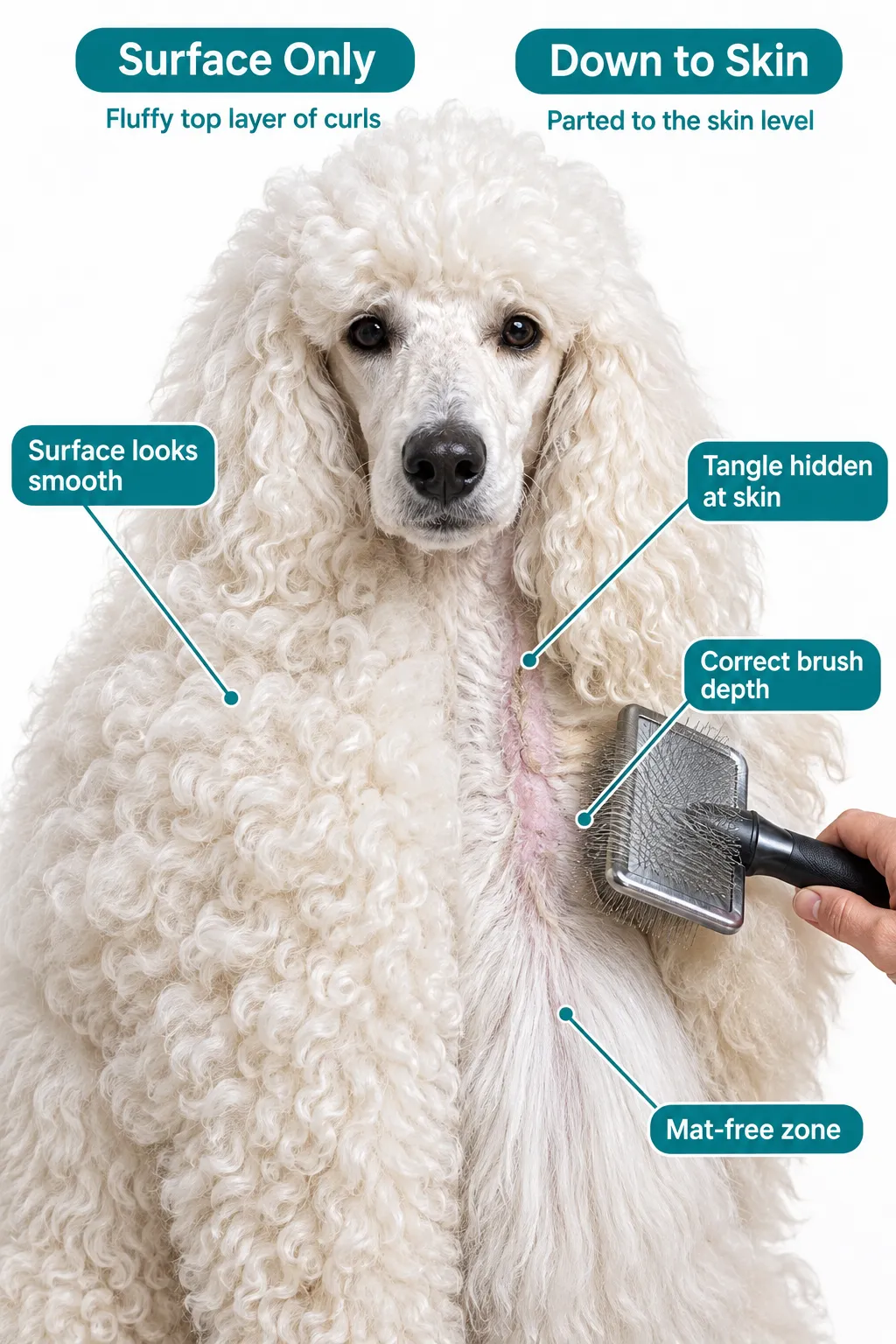
“A poodle coat that looks fine on the surface can be completely matted at the skin underneath. Always comb all the way down.”
How Often Should You Groom a Poodle to Keep Their Coat Healthy?
Most poodles need a full professional groom every 6-8 weeks, with home brushing every 2-3 days in between. Skipping sessions is the fastest route to a matted, hard-to-manage coat.
Here’s a simple schedule to follow:
| Task | Frequency |
|---|---|
| Full brush and comb | Every 2-3 days |
| Bath at home | Every 3-4 weeks |
| Professional clip | Every 6-8 weeks |
| Ear cleaning | Every 2-4 weeks |
| Nail trim | Every 3-4 weeks |
Poodle grooming schedule resources for 2026 consistently show that owners who stick to this routine spend far less time dealing with mats – and far less money on shave-downs at the groomer.
Common mistake: Waiting until the coat “looks messy” before brushing. By then, tangles are already forming at the skin where you can’t see them.
The 9 Mistakes That Make Your Poodle’s Coat Harder to Manage
This is the heart of any solid poodle grooming guide. Each mistake below is fixable once you know what to look for.
Mistake 1: Brushing only the surface
Running a brush over the top of the coat without reaching the skin is the single biggest matting mistake. The curls look fluffy, but tangles form at the base. Use a slicker brush in sections and part the coat as you go.
Mistake 2: Bathing before brushing
Water tightens existing tangles into rock-solid mats. Always brush and comb the coat fully before any bath. This one step alone prevents most serious matting.
Mistake 3: Air-drying after bathing
Letting a poodle air-dry causes the curls to clump and re-mat as the coat dries unevenly. Use a force dryer or a regular blow dryer on a low-heat setting, brushing as you dry.
Mistake 4: Skipping the comb check
A slicker brush can glide over a hidden tangle. After brushing, always run a fine-tooth metal comb through the entire coat. If the comb snags, there’s still a tangle to work out.
Mistake 5: Waiting too long between grooms
Letting more than 8 weeks pass between full grooms almost guarantees matting severe enough to require a shave-down. Consistent scheduling is non-negotiable.
Mistake 6: Using the wrong tools or dull blades
Dull clipper blades pull instead of cut, which is uncomfortable for your dog and damages the coat. Replace or sharpen blades regularly. Using a paddle brush instead of a slicker brush on a poodle coat is equally ineffective.
Mistake 7: Cutting mats out with scissors
Scissors near a mat that’s close to the skin is a recipe for accidental cuts. Use a dematting comb or detangler spray first, then work the mat apart with your fingers before reaching for any blade.
Mistake 8: Neglecting friction areas
The spots where collars, harnesses, or legs rub against the body mat fastest. Check these areas every single brushing session – don’t save them for last and rush through them.
Mistake 9: Using human shampoo
Human shampoos have a pH level designed for human skin (around 5.5), while dogs need a pH closer to 7. Using the wrong product strips natural oils, causes irritation, and leaves the coat dull and harder to manage. Always use a dog-specific grooming product.
For more general coat care tips across breeds, check out this Maltese dogs grooming at home routine – many of the same principles apply to other curly or long-coated dogs.
What’s the Difference Between a Puppy Cut and a Continental Clip?
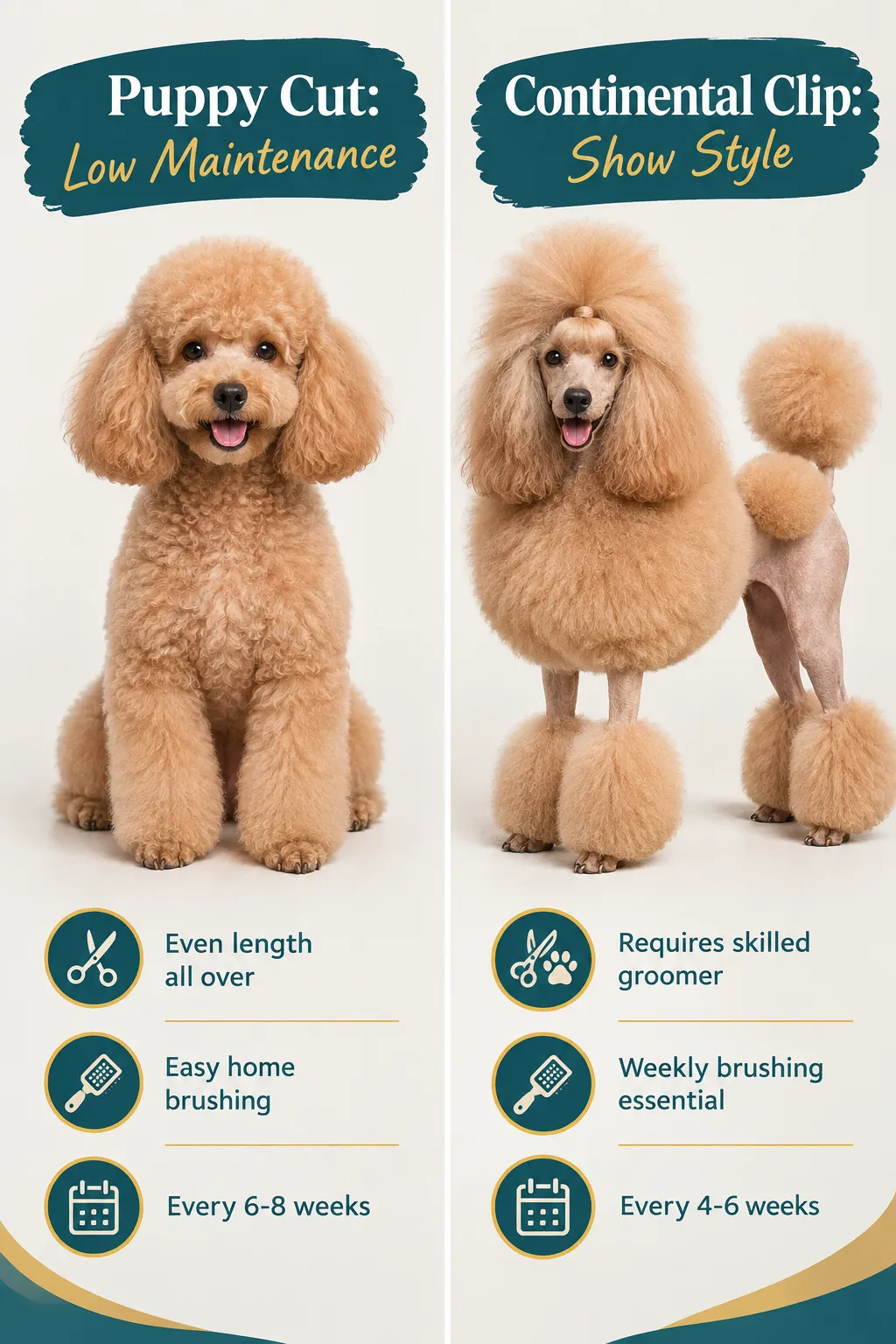
The puppy cut is a uniform trim all over the body – same length from head to tail, usually 1-2 inches long. It’s the most practical style for pet owners because it’s easy to brush at home and grows out evenly.
The continental clip is the classic show-ring style: shaved hindquarters, dramatic pompoms on the hips and tail base, and a full mane up front. It looks stunning but requires a skilled groomer and weekly brushing to maintain.
Choose the puppy cut if:
- You’re grooming at home between professional visits
- Your poodle is active and outdoors often
- You want a lower-maintenance routine
Choose the continental clip if:
- You show your poodle competitively
- You have access to a professional groomer every 4-6 weeks
- You enjoy the traditional poodle aesthetic and can commit to the upkeep
Other popular styles include the teddy bear cut (rounded face, fluffy body) and the lamb cut (shorter body, fuller legs). All of them work – the best style is the one you’ll actually maintain consistently.
Can You Groom a Poodle at Home or Should You Go to a Groomer?
You can absolutely do basic poodle grooming at home – brushing, bathing, drying, and even simple trims. But most owners benefit from a professional groomer for full clips, especially around the face, feet, and tail.
A hybrid approach works best: professional groom every 6-8 weeks, with thorough home brushing sessions in between. This keeps costs down while maintaining coat health.
For more tips on saving money while keeping your dog looking great, see this guide on dog grooming tips at home.
What Tools Do You Need to Groom a Poodle Yourself?
Five tools cover 90% of home poodle grooming needs.
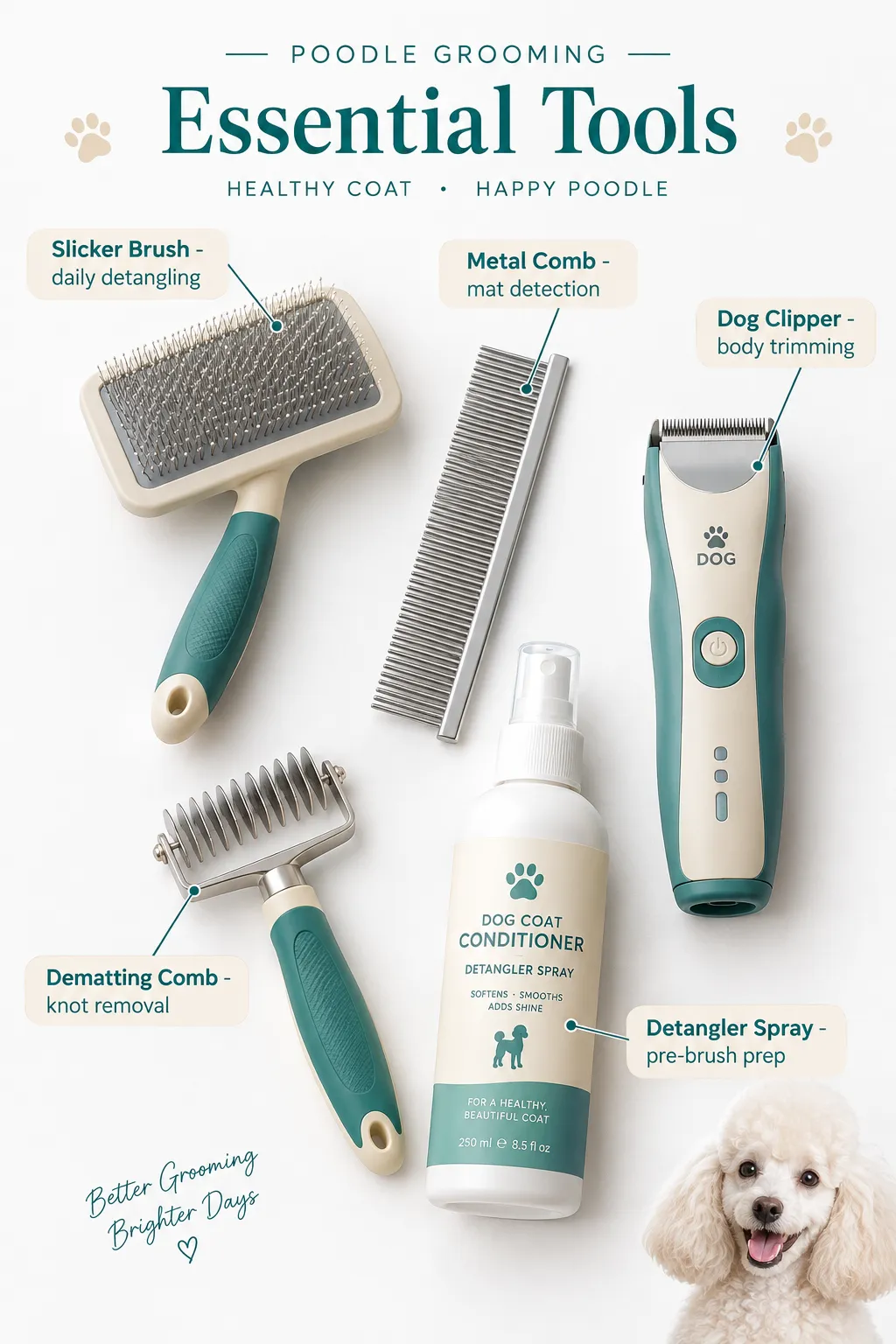
- Slicker brush – for daily detangling and fluffing the coat
- Metal greyhound comb – for checking that brushing reached all the way to the skin
- Dog clippers with a #10 or #15 blade – for trimming feet, face, and body
- Dematting comb – for working through minor tangles without scissors
- Detangler spray – applied before brushing to reduce breakage and friction
According to detailed poodle grooming guidance from grooming professionals, a quality metal comb is the most underused tool in home poodle care. Most owners own a brush but skip the comb – that’s where tangles survive undetected.
Why Does My Poodle’s Coat Get Matted Even After Grooming?
If your poodle’s coat mats quickly after a grooming session, the most likely causes are incomplete drying, surface-only brushing, or skipping the comb check.
Other reasons include:
- Collar or harness friction creating tangles between sessions
- High activity levels (swimming, running through grass) that tangle the coat faster
- A coat that’s grown too long for the current brushing routine
- Residue from shampoo or conditioner that wasn’t fully rinsed out
Research into poodle coat care confirms that incomplete drying is one of the most common hidden causes of re-matting. Even a slightly damp coat left overnight can form new tangles by morning.
Quick fix: After every bath, blow-dry until the coat is completely dry at the skin – not just dry on the surface.
What’s the Best Brush for Poodle Coats to Prevent Tangles?
A pin slicker brush is the best everyday brush for poodle coats. It reaches through the curls without breaking them and works well on all poodle sizes.
Follow up with a fine-tooth metal greyhound comb to confirm the coat is tangle-free all the way to the skin. This two-tool combination is the foundation of every professional groomer’s poodle routine.
Avoid:
- Paddle brushes (too gentle for dense poodle curls)
- Bristle brushes (designed for short, smooth coats)
- Rubber curry combs (great for shedding breeds, not poodles)
How Do You Bathe a Poodle Without Damaging Their Coat?
Bathing a poodle correctly takes about 30-45 minutes when done properly. The steps matter as much as the products.
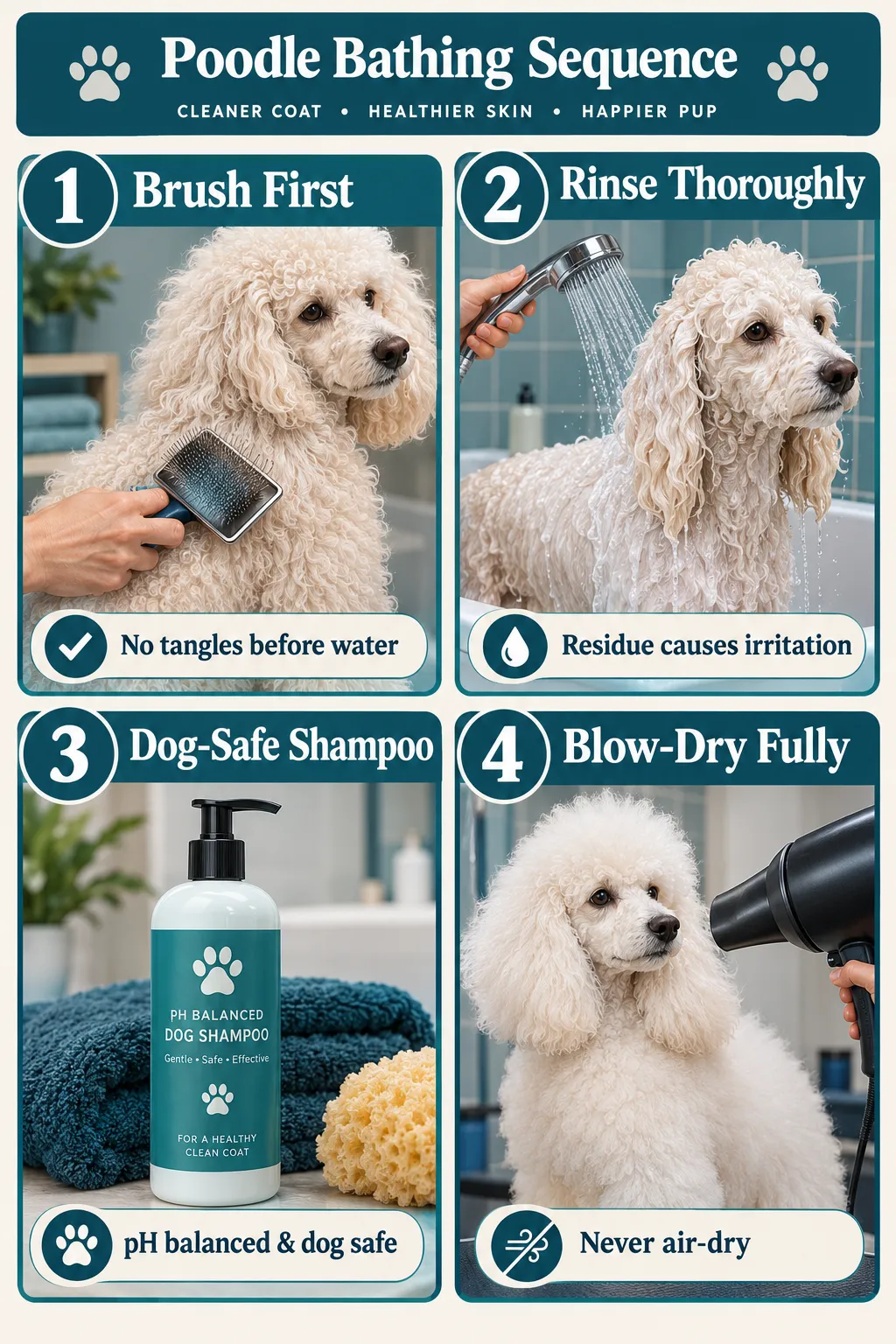
- Brush and comb fully before getting the coat wet. This is non-negotiable.
- Use lukewarm water and wet the coat thoroughly from skin to tip.
- Apply a pH-balanced dog shampoo, working from neck to tail.
- Rinse completely – leftover shampoo residue causes irritation and dullness.
- Apply a dog conditioner to help with detangling, then rinse again.
- Blow-dry immediately, brushing as you go until the coat is fully dry.
Poodle bathing and coat care guides emphasize that the rinse step is where most owners cut corners. Residue left in the coat is a direct cause of skin irritation and a dull, difficult coat.
What Happens If You Don’t Groom a Poodle Regularly?
Neglecting grooming leads to pelting – a condition where the entire coat mats so tightly it forms a solid sheet against the skin. At that point, the only option is a full shave-down, which can be stressful and uncomfortable for the dog.
Beyond appearance, poor grooming creates real health risks:
- Skin infections under mats (bacteria and moisture get trapped)
- Ear infections from hair growing into the ear canal
- Eye irritation from hair falling over the face
- Restricted movement if mats form in the leg joints
According to breed-specific grooming data, poodles are among the highest-maintenance breeds specifically because of their non-shedding coat. Regular grooming isn’t optional – it’s a health issue.
Are Some Poodle Coat Colors Harder to Maintain Than Others?
Darker poodle coats (black, blue, dark brown) show dust, dander, and product residue more visibly than lighter coats. White and cream poodles are prone to tear staining around the eyes and mouth, which requires regular cleaning.
In terms of texture and matting risk, color doesn’t directly affect how fast the coat mats. What matters more is coat density and curl tightness, which vary by individual dog rather than color.
Tip for white or cream poodles: Use a whitening dog shampoo occasionally to keep the coat bright, but don’t overuse it – once every few baths is enough.
How Do You Fix a Poodle Coat That’s Already Damaged or Over-Groomed?
Start with a short, even clip to remove the damaged coat and give healthy growth a clean base. This is the fastest reset for a coat that’s been over-clipped, matted, or chemically damaged.
Then focus on:
- Brushing every 2-3 days with a slicker brush and comb
- Bathing with a moisturizing dog shampoo and conditioner
- Using a leave-in coat conditioner spray between baths
- Feeding a diet with adequate omega-3 fatty acids for coat health
If you want to support coat recovery from the inside, homemade dog food recipes for a shiny coat can be a helpful addition to your routine.
Coat recovery takes time – expect 3-6 months of consistent care before you see significant improvement.
What’s the Difference Between a Poodle Mix Coat and a Purebred Poodle Coat?
A purebred poodle has a predictable single-layer, curly, non-shedding coat. Poodle mixes (labradoodles, goldendoodles, cockapoos, etc.) can inherit any combination of the parent breeds’ coat types.
Some poodle mixes have wavy coats that mat less severely than a tight poodle curl. Others inherit the full poodle curl with added density from the other breed, which can actually mat faster.
The key difference: you can predict and plan for a purebred poodle coat. With a mix, you need to assess the individual dog’s coat type and adjust your grooming routine accordingly. If you have a whoodle or similar poodle mix, the Whoodle dogs care guide covers coat-specific tips worth reading.
When Should You Start Grooming a Poodle Puppy?
Start gentle grooming handling at 8 weeks old, as soon as you bring your puppy home. The first professional groom can happen around 12-16 weeks, after vaccinations are complete.
Early exposure matters more than the actual grooming at this stage. Let the puppy sniff the brush, hear the clippers from a distance, and get used to being touched on their paws, ears, and face.
Standard poodle grooming guides consistently recommend starting grooming socialization as early as possible. A puppy that learns grooming is safe and normal becomes a calm adult that’s easy to groom for life.
Quick start plan for poodle puppies:
- Week 1-4 at home: Daily gentle brush sessions (2-3 minutes)
- Week 4-8: Introduce bath routine with warm water and puppy shampoo
- Week 8-12: First professional groom (keep it short and positive)
- Week 12+: Establish the full adult grooming schedule
If you’re still in the early days with your new dog, the new puppy checklist with must-have supplies is a great resource to bookmark.
FAQ
How often should I brush my poodle?
Every 2-3 days at minimum. High-activity dogs or those with longer coats may need daily brushing to stay mat-free.
Can I use baby shampoo on my poodle?
No. Baby shampoo is formulated for human skin pH and will strip your poodle’s natural coat oils over time. Use a pH-balanced dog shampoo instead.
How do I remove a mat without hurting my poodle?
Apply a detangler spray, let it sit for a minute, then gently work the mat apart with your fingers from the outside edge inward. Use a dematting comb for stubborn tangles. Never pull or yank.
What’s the average cost of professional poodle grooming?
Costs vary by location and dog size, but standard poodle grooming typically runs higher than smaller breeds due to the time involved. Toy and miniature poodles are generally less expensive per session than standards.
Do poodles need conditioner?
Yes. A dog conditioner after shampooing helps restore moisture, reduces static, and makes detangling much easier. It’s especially important for dogs with longer or denser coats.
How do I know if my poodle has a mat at the skin?
Run a fine-tooth metal comb through the coat after brushing. If the comb catches or stops, there’s a tangle you haven’t fully removed yet.
Is it okay to clip a poodle at home?
Yes, for basic maintenance trims around the face, feet, and sanitary areas. Full body clips are harder to do evenly at home and are best left to a professional groomer.
Why does my poodle hate being groomed?
Most grooming aversion comes from a bad early experience or from grooming sessions that were painful (from matted coats being pulled). Start with very short, positive sessions and use treats generously. For puppies with biting habits during grooming, see this guide on how to make a puppy stop biting.
What’s the difference between a toy, miniature, and standard poodle coat?
All three have the same coat type – single-layer, curly, and continuously growing. The main difference is volume. Standard poodles have more coat to manage, which means grooming sessions take longer.
Can I shave my poodle in summer to keep them cool?
A shorter clip in summer is fine and practical. However, shaving completely to the skin removes the coat’s natural insulation, which actually helps regulate body temperature. A short puppy cut is a better warm-weather option than a full shave.
Conclusion
A good poodle grooming guide isn’t just about keeping your dog looking polished – it’s about preventing real discomfort and health problems that come from a neglected coat.
The 9 mistakes covered here are all fixable. Start by brushing all the way to the skin, always brush before bathing, and dry the coat completely after every wash. Add a metal comb check to every session, stick to a 6-8 week professional grooming schedule, and use the right tools for the job.
Your next steps:
- Check your current brush – if it’s not a slicker brush with a metal comb, upgrade.
- Book a professional groom if it’s been more than 8 weeks.
- Set a recurring reminder for home brushing sessions every 2-3 days.
- Switch to a pH-balanced dog shampoo if you haven’t already.
Poodles are smart, joyful dogs that thrive when they’re comfortable in their own skin – literally. A consistent grooming routine is one of the best things you can do for their health and happiness.