Last updated: November 23, 2026
A long-haired dachshund’s coat can mat in a single week if nobody touches a brush. That’s not a scare tactic. It’s just what happens when silky, feathered fur meets a dog built low to the ground, dragging through grass, mud, and furniture daily.
Quick Answer
Weiner dogs long hair (long-haired dachshunds) need brushing 2 to 4 times a week, occasional baths every 3 to 4 weeks, and light trimming around the feet, ears, and tail to stay mat-free. Their coat is softer and silkier than a smooth or wire-haired dachshund, which makes grooming more involved but still manageable at home with the right tools.
Key Takeaways
- Long-haired dachshunds are one of three official coat types: smooth, long-haired, and wire-haired.
- Brushing 2 to 4 times weekly (some owners go daily) prevents the mats this coat is prone to.
- Mats form fastest behind the ears, in the armpits, on the “trousers,” and between the toes.
- A pin brush or slicker brush plus a metal comb covers most grooming needs.
- Bathing every 3 to 4 weeks with a dog shampoo keeps the coat soft without stripping oils.
- Long-haired dachshunds shed moderately, not heavily, but loose hair tangles into the coat if ignored.
- Professional grooming every 6 to 8 weeks is optional but helpful for trimming and ear maintenance.
- No dachshund is truly hypoallergenic, including the long-haired variety.
- The long coat itself isn’t tied to extra health problems beyond standard dachshund back issues.
What’s the difference between long haired and short haired dachshunds?
Long-haired and smooth (short-haired) dachshunds share the same body shape, but their coats and grooming needs are completely different. Smooth dachshunds have a short, close coat that sheds dirt easily and barely needs brushing. Long-haired dachshunds grow soft, wavy, feathered fur on the ears, chest, legs, belly, and tail that tangles easily.
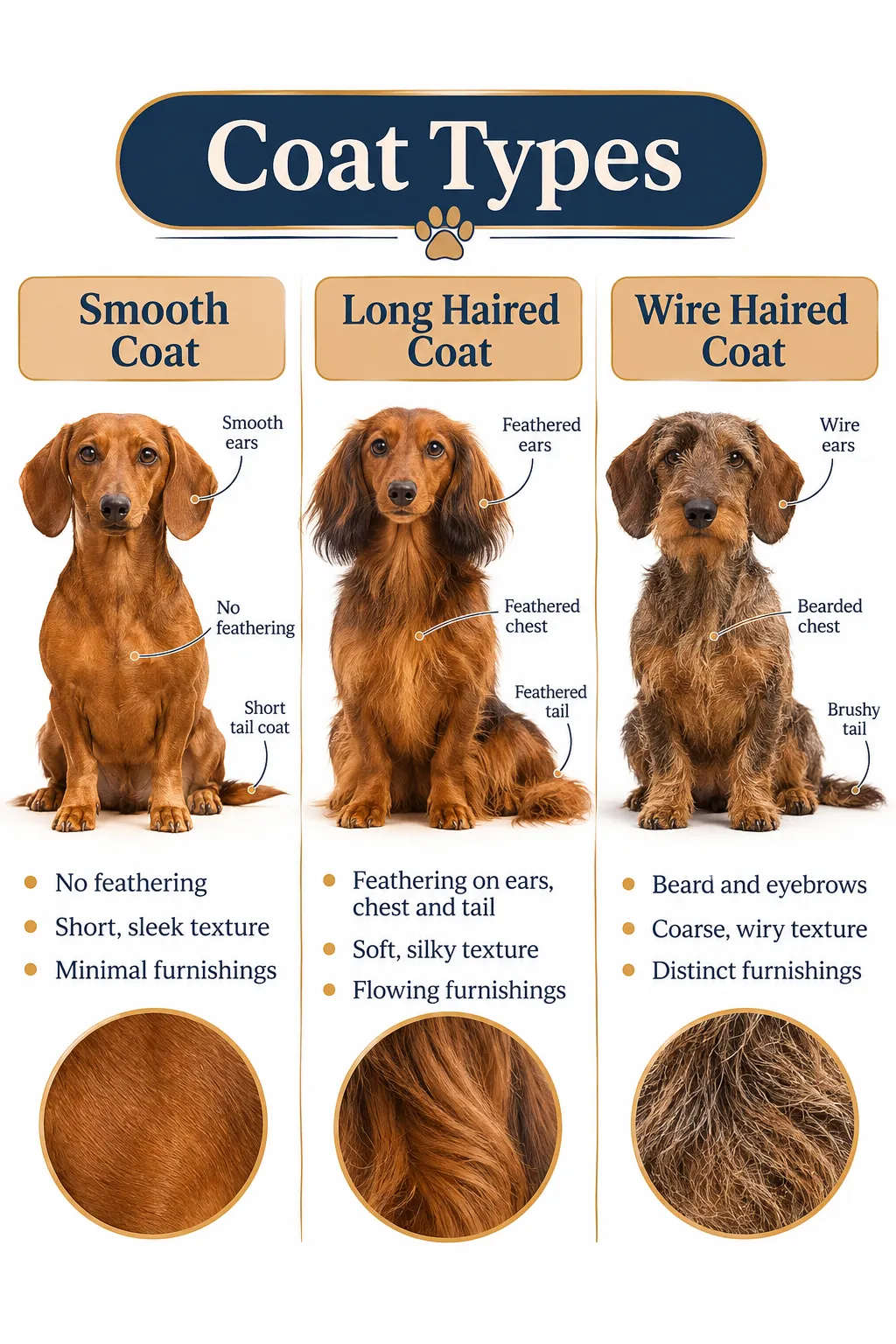
This difference comes down to genetics. Smooth coats carry at least one short-hair copy of the FGF5 gene, while long-haired dachshunds have two recessive long-hair copies of that same gene, according to genetic breed research.
Choose a long-haired dachshund if: you don’t mind a regular brushing routine and like the softer, flowing look.
Choose a smooth dachshund if: you want a low-maintenance coat and don’t want to deal with feathering or mats.
What are the different dachshund coat types?
Dachshunds come in three recognized coat types: smooth, long-haired, and wire-haired, and each one has a distinct grooming demand. The American breed standard treats these as official varieties, not just style differences.
Here’s a quick side-by-side:
| Coat type | Texture | Grooming need |
|---|---|---|
| Smooth | Short, shiny, close to body | Minimal, occasional wipe-down |
| Long-haired | Soft, silky, wavy feathering | Frequent brushing, light trimming |
| Wire-haired | Dense, wiry, with beard/eyebrows | Hand-stripping or clipping |
Wire coats come from a dominant RSPO2 gene variant that produces the beard and eyebrow “furnishings” you see on wire-haired dachshunds, per the same genetic analysis. Long-haired dogs don’t have this gene active, so their face stays smooth while their body grows feathering instead.
Common mistake: assuming all dachshunds groom the same way. The coat type changes everything about your routine, from brush choice to bath frequency.
How often should I groom my long haired dachshund?
Plan to brush a long-haired dachshund 2 to 4 times per week at minimum, and daily during shedding season or if the dog spends a lot of time outside. Multiple 2026 grooming guides agree on this range, with some recommending brushing every 2 days as a safer baseline for preventing mats, as noted by Artero’s breed grooming guide and Lemonade’s breed profile.
A full groom, including a bath, trim, and ear check, typically happens every 4 to 6 weeks.
Example: My neighbor’s long-haired dachshund, Pepper, gets a 5-minute brush every other evening while her owner watches TV. That small habit keeps her coat tangle-free without ever needing a big grooming session.
Edge case: puppies with soft, fine coats may mat faster than adults, so start the brushing habit early, even before the adult coat fully comes in.
What tools do I need to groom a long haired weiner dog?
You need a pin brush or slicker brush, a metal comb, blunt-tip scissors, and nail clippers to groom a long-haired dachshund properly at home. These four tools cover nearly every regular grooming task this coat type requires.
- Pin brush or slicker brush: removes loose hair and surface tangles
- Metal comb: gets through finer, closer-to-skin knots the brush misses
- Blunt-tip scissors: trims feathering around paws, ears, and tail
- Nail clippers or grinder: keeps nails short since this breed’s low build makes long nails uncomfortable
- Dog-safe detangling spray: helpful before brushing a tangled section
Work from the skin outward in small sections, brushing in the direction the hair grows, according to Artero’s grooming instructions and Doggy Styles Inc’s grooming post.
What’s the best brush for long haired dachshunds?
A slicker brush paired with a metal comb is generally considered the best combination for a long-haired dachshund’s coat. The slicker brush lifts loose hair and light tangles, while the metal comb catches anything hiding closer to the skin.
Some owners prefer a pin brush instead of a slicker brush because it’s gentler on sensitive skin, especially around the belly and legs. Either works fine as long as you follow it with a comb pass to check for missed knots.
Decision rule: choose a slicker brush if your dog’s coat mats often, choose a pin brush if your dog has sensitive skin or you’re brushing a puppy’s finer coat.
How do I prevent matting in my dachshund’s hair?
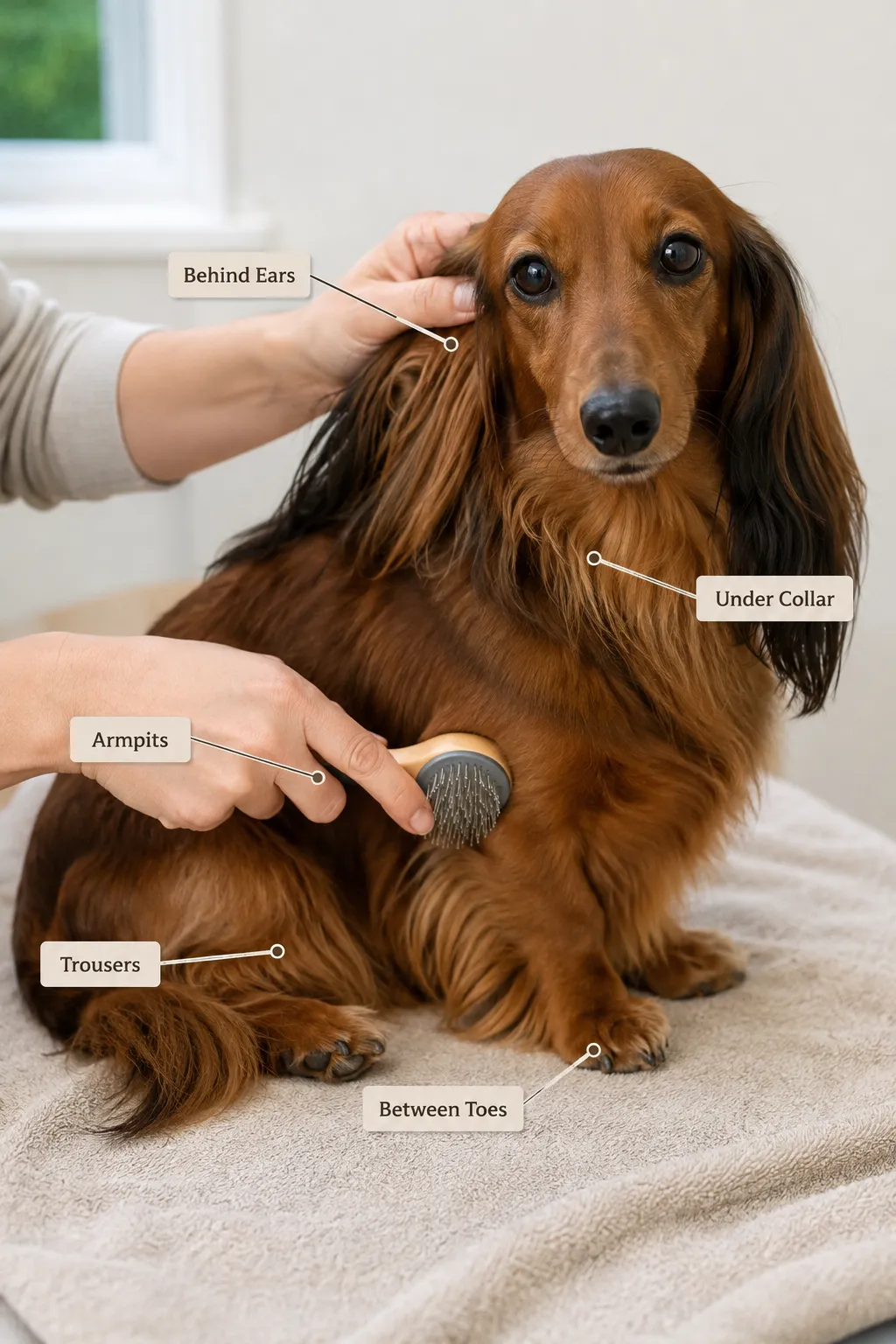
Prevent matting by brushing consistently, paying extra attention to high-friction areas, and drying the coat fully after baths or wet walks. Mats form where hair rubs against itself repeatedly, usually in warm, hidden spots.
The areas groomers flag most often for mats are:
- Behind and under the ears
- Armpits
- The back of the hind legs (“trousers”)
- Under the collar or harness line
- Around the tail base
- Between the toes
These hotspots are consistently named across professional grooming resources, including Doggy Styles Inc and Pets.org.nz’s breed care guide.
Common mistake: brushing only the top of the coat and skipping these hidden spots. Mats almost always start underneath, not on the surface.
Do long haired dachshunds shed a lot?
Long-haired dachshunds are moderate shedders, not heavy shedders, but their longer fur makes shed hair more noticeable on clothes and furniture. The coat length means loose hair doesn’t always fall away on its own, it can get caught and start tangling instead.
Regular brushing does double duty here. It removes the loose undercoat before it mats, and it reduces the amount of hair that ends up on your couch, as explained in Dogster’s breed overview and Dogster’s grooming guide.
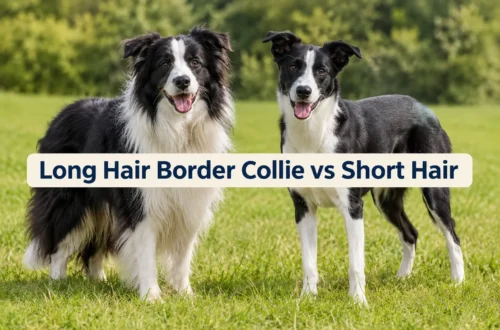
If you’re comparing shedding across breeds, it’s worth checking how other long-coated dogs stack up, like in this long hair border collie shedding guide.
How much does it cost to groom a long haired dachshund?
Professional grooming for a long-haired dachshund typically runs in line with small-breed grooming rates at local groomers, though exact pricing varies widely by region and groomer experience. I can’t give you a reliable national number here since pricing changes too much by area and salon, but a good way to budget is to call two or three local groomers and ask for their small-breed, long-coat rate.
What affects the price:
- Coat condition (heavy mats cost more to remove)
- Add-ons like nail trims, ear cleaning, or de-shedding treatments
- Your location and the groomer’s experience level
Decision rule: if your dog’s coat is well-maintained at home, a basic groom costs less because the groomer spends less time detangling.
What are the different dachshund coat types? (short answer recap)
This was covered above in detail, but as a quick reference: smooth coats are low-maintenance, long-haired coats need regular brushing and light trims, and wire coats need stripping or clipping to manage the wiry texture and facial furnishings.
Do long haired dachshunds need professional grooming?
Professional grooming isn’t strictly required for long-haired dachshunds, but it helps with trimming, mat removal, and ear maintenance that’s harder to do well at home. Many owners handle daily brushing themselves and schedule a professional groom every 6 to 8 weeks for the detail work.
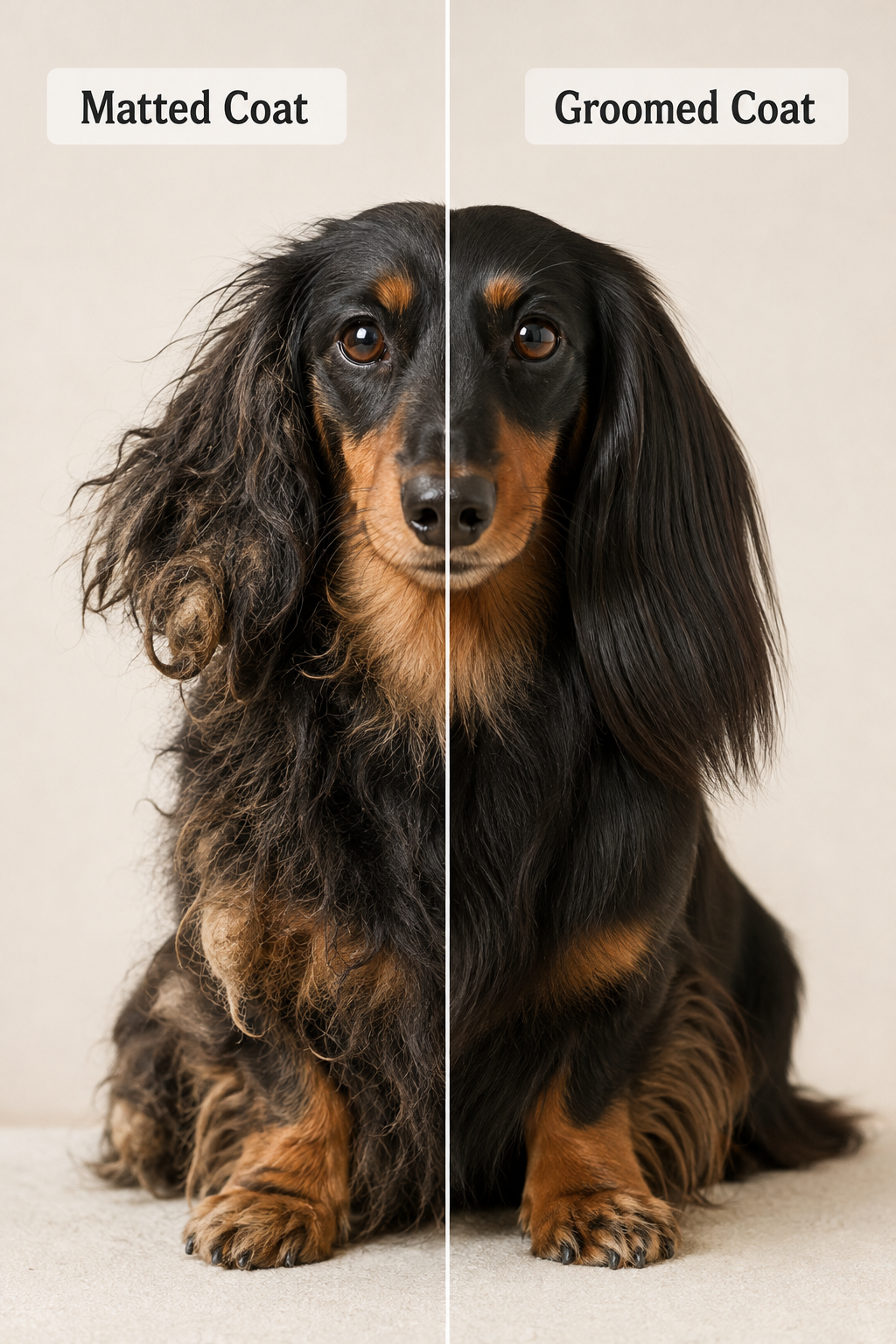
Choose professional grooming if: your dog has a lot of feathering, you’re not confident trimming around the ears and paws, or mats have already formed and need safe removal.
Choose at-home-only grooming if: you’re consistent with brushing and comfortable doing light trims yourself.
If you’re new to long-coat care in general, our long hair dachshund care tips guide walks through more beginner-friendly routines.
How do I bathe a long haired weiner dog?
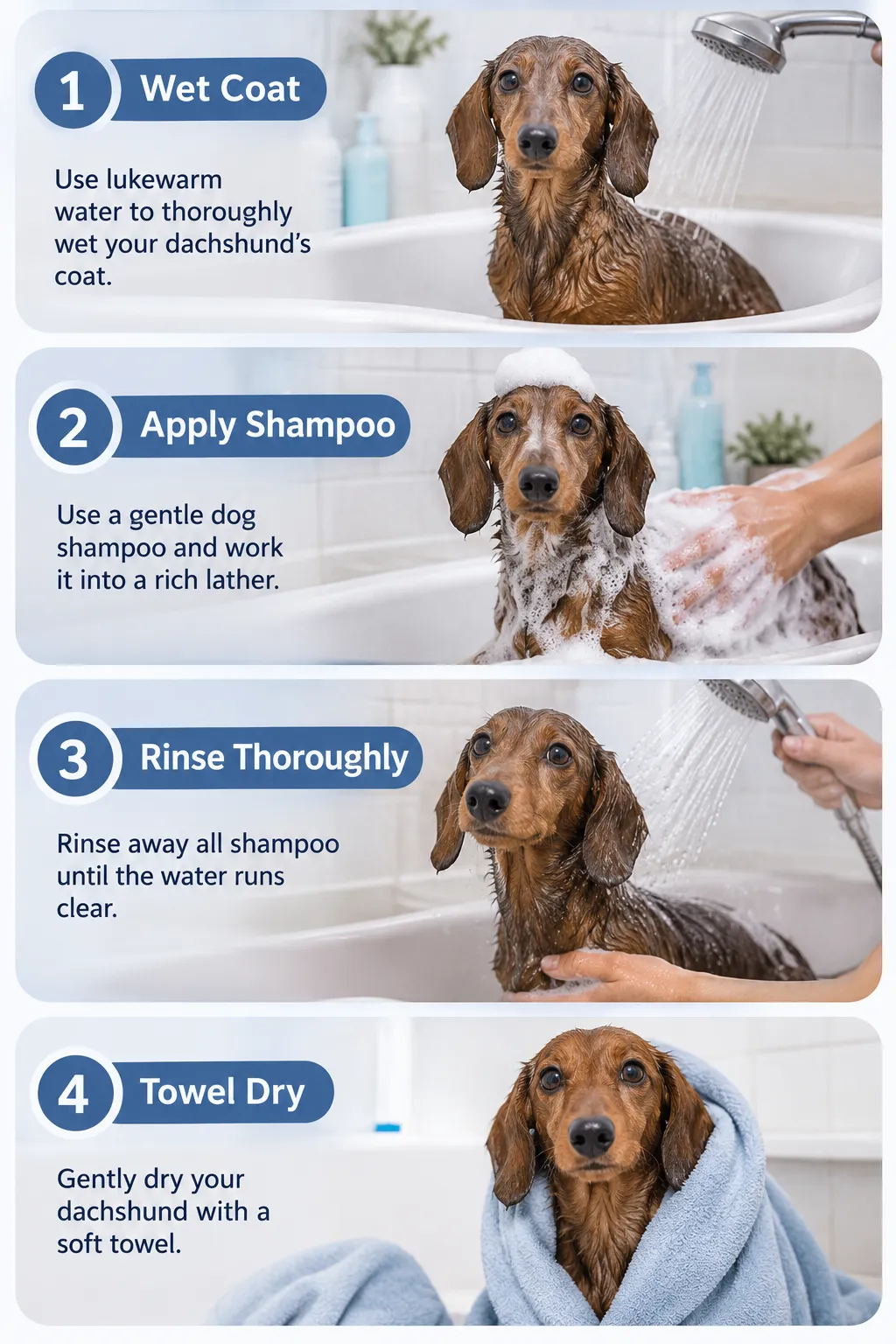
Bathe a long-haired dachshund every 3 to 4 weeks using a gentle, dog-specific shampoo, and always brush out tangles before getting the coat wet. Wetting a matted coat tightens the knots and makes them much harder to remove afterward.
Steps for a smooth bath:
- Brush thoroughly first to remove loose hair and tangles
- Wet the coat fully with lukewarm water
- Apply a hydrating dog shampoo, working it through the feathering
- Rinse completely, since leftover shampoo can cause skin irritation
- Towel dry, then finish with a blow dryer on low heat if the dog tolerates it
Some dogs that stay relatively clean can go up to three months between baths, per Artero’s care notes, but 3 to 4 weeks is a safer default for most households.
Are long haired dachshunds good for people with allergies?
No dachshund, including the long-haired variety, is truly hypoallergenic. There’s no scientific basis for a completely allergen-free dog breed, since allergens come from dander, saliva, and urine, not just fur length.
That said, some allergy sufferers find moderate shedders slightly more manageable than heavy-shedding breeds, simply because less loose hair and dander spreads around the house. If allergies are a serious concern, spend time with a long-haired dachshund before committing, and talk to an allergist about your specific sensitivities.
Is a long haired dachshund harder to care for?
Yes, in terms of grooming, a long-haired dachshund requires more time and effort than a smooth-coated dachshund, but it’s not dramatically harder once you build a routine. The extra work is mostly brushing frequency and occasional trims, not anything technically difficult.
Quick comparison:
- Smooth coat: wipe down occasionally, minimal brushing
- Long-haired coat: brush 2 to 4 times weekly, trim feathering periodically, bathe monthly
Once brushing becomes a habit, most owners find it takes just a few minutes per session, similar to the quick daily routines described in our Maltese grooming at home guide.
What health problems do long haired dachshunds have?
Long-haired dachshunds share the same major health risks as other dachshund coat types, primarily back problems related to their elongated spine, rather than issues caused by the coat itself. Intervertebral disc disease (IVDD) is the most commonly cited concern for the breed overall, as noted by WebMD’s dachshund breed overview.
The coat does add one specific risk area though: the long, pendulous ears. Hair around and inside the ear flap can trap moisture and debris, raising the chance of ear infections, according to Wahl’s breed grooming profile. Routine ear cleaning and trimming the hair near the ear opening helps manage this.
For general care beyond grooming, our 7 reasons dachshunds steal hearts guide covers more breed-specific context.
Can I cut my dachshund’s hair short?
Yes, you can trim a long-haired dachshund’s coat shorter, though most grooming guides recommend light trimming rather than a full short cut. Tidying the feathering around the feet, ears, tail, and underbelly keeps the coat neat and reduces tangling, without removing the breed’s signature flowing look.
If you do want a shorter overall cut, a professional groomer can manage it safely, especially around sensitive areas like the ears and paws. Cutting the coat yourself with scissors works for small touch-ups, but a full shave-down is best left to someone experienced, since dachshund skin can be sensitive and the coat grows back slowly in spots that are over-trimmed.
Edge case: if your dog’s coat is severely matted, a groomer may need to shave it down completely rather than comb it out, since combing through dense mats can hurt the dog’s skin.
Frequently Asked Questions
Do long-haired dachshunds need haircuts?
Not full haircuts, but light trims around the feet, ears, and tail every few weeks help prevent matting and keep the coat tidy.
How long does a long-haired dachshund’s coat get?
The feathering on the ears, chest, legs, and tail grows noticeably longer than the body coat, though it rarely reaches more than a few inches without trimming.
Can puppies have long hair from birth?
Yes, long-haired dachshund puppies are born with a visibly fluffier coat than smooth puppies, though the full silky feathering develops as they mature.
Is brushing painful for a matted dachshund?
Brushing through an established mat can hurt, since mats pull on the skin. Use a detangling spray and work gently from the edges inward, or have a groomer remove severe mats.
Do long-haired dachshunds need sweaters in winter?
Their coat offers some extra warmth compared to smooth dachshunds, but due to their small size and short legs, many owners still use a light coat or sweater in cold weather.
What shampoo is best for a long-haired dachshund?
A gentle, hydrating dog-specific shampoo is generally recommended to protect the coat’s texture without stripping natural oils.
How do I stop my dachshund’s ears from matting?
Brush behind and under the ears during every grooming session, since this is one of the most common mat-prone spots on the breed.
Does trimming hurt the dog?
No, trimming feathering with blunt-tip scissors is painless when done carefully away from the skin. Avoid sharp-point scissors near the paws and face.
Conclusion
Caring for weiner dogs long hair comes down to one simple habit: brush often, and check the hidden spots every time. Do that consistently, and most of the grooming headaches people worry about just don’t happen.
Start small. Pick up a slicker brush and metal comb, set a reminder for two or three sessions a week, and build a bath schedule around every 3 to 4 weeks. If mats ever get ahead of you, don’t force a comb through them, call a groomer instead.
Your long-haired dachshund’s coat is part of what makes the breed so charming. A little regular attention keeps it that way for years.