
Last updated: August 25, 2026
Quick Answer: 4 month old dog training works best in short bursts of 2-5 minutes, repeated several times a day, adding up to roughly 15-20 minutes of total focused practice. At this age, puppies can learn sit, down, come, leash manners, and bite inhibition – but only if sessions stay brief, positive, and consistent. You don’t need hours. You need a simple daily routine.
Key Takeaways
- 🐾 Four-month-old puppies learn best in 2-5 minute micro-sessions, not long drills
- 🐾 Aim for 15-20 minutes of total training per day, spread across multiple short sessions
- 🐾 Core commands to focus on: sit, down, come, leave it, drop it, and settle
- 🐾 Attach training to daily events – meals, potty trips, and transitions – so it fits naturally into your day
- 🐾 Positive reinforcement (treats + praise) is the most effective method at this age
- 🐾 Socialization is just as important as commands – expose your pup to new places, sounds, and people
- 🐾 Crate training and potty training should run alongside command work every single day
- 🐾 Biting is normal but manageable – redirect consistently rather than punishing
- 🐾 Most owners do not need a professional trainer at this stage if they follow a clear routine
- 🐾 Ending every session on a successful rep keeps your puppy eager to train again
Is My 4 Month Old Puppy Too Young to Train?
No – four months is actually one of the best times to start structured training. Puppies this age are in a prime developmental window where new habits form quickly and stick.
The idea that puppies need to be six months old before training is outdated. According to age-based puppy training timelines, dogs as young as 8 weeks can start learning basic cues. By 4 months, your puppy already has the focus and memory to build real skills.
The key is keeping expectations realistic. Your pup won’t sit perfectly in a busy park on day one. But with short, consistent sessions, they absolutely can learn the foundations that make everything else easier.
What Can You Teach a 4 Month Old Puppy?
At four months, puppies can learn a solid set of foundation behaviors that will shape how they behave for life.
Commands and skills well within reach:
- Sit and down – the building blocks of impulse control
- Come (recall) – the most important safety skill you’ll ever teach
- Stay – start with just 2-3 seconds, build slowly
- Leave it and drop it – essential for safety and manners
- Loose leash walking – early practice prevents pulling later
- Settle on a mat – great for calm behavior at home
- Polite greetings – four paws on the floor, no jumping
According to breed-specific and general puppy training guides, these are considered “foundation behaviors” – the skills that prevent future problems like pulling, jumping, and mouthing.
Pro tip: Pick 1-2 behaviors per session. Trying to teach five things at once overwhelms a 4-month-old puppy and slows progress.
Check out these 9 top commands for dogs smart daily training for a deeper look at which commands to prioritize.
How Long Should Training Sessions Be for a 4 Month Old Dog?
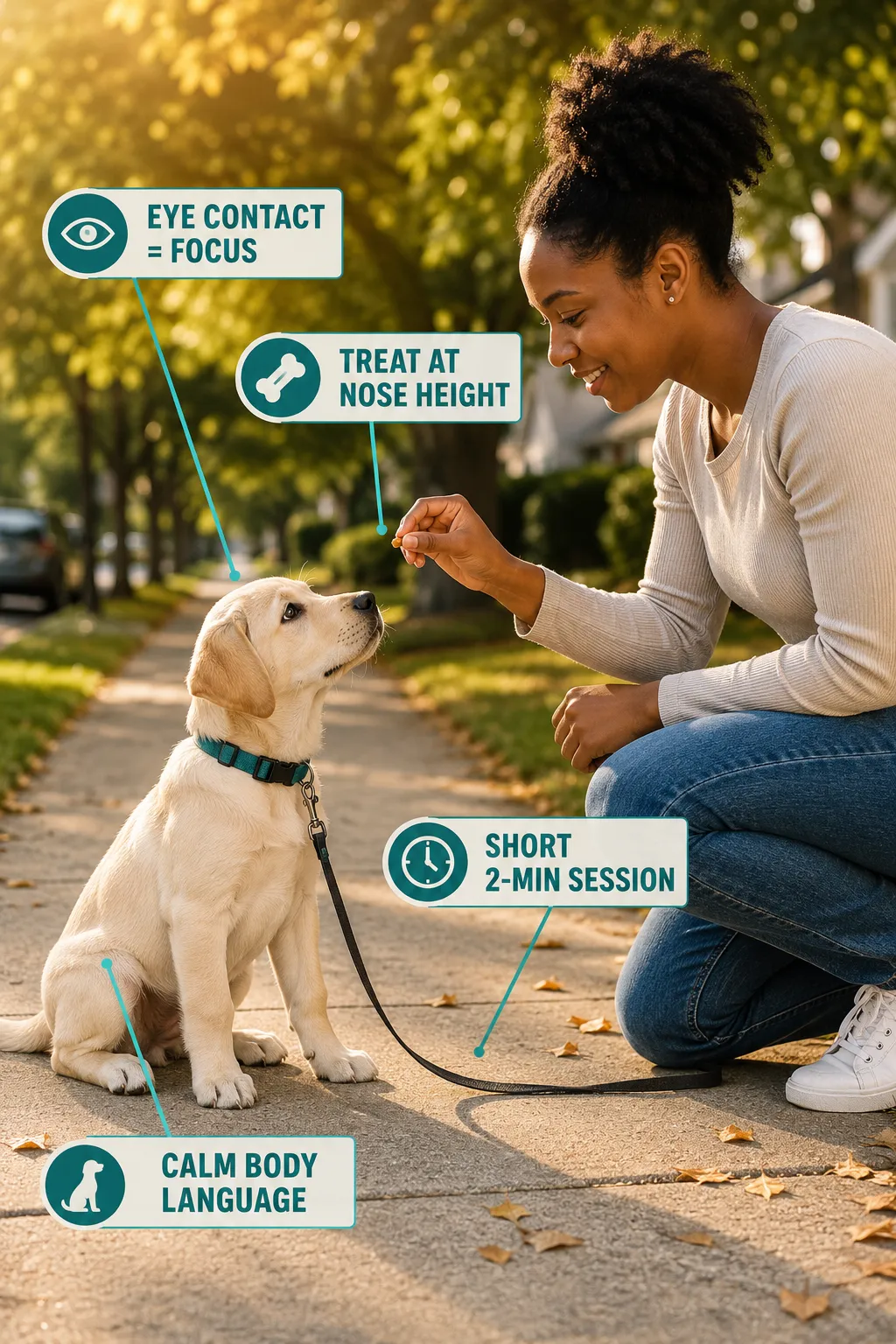
Keep each session to 2-5 minutes maximum. That’s not a typo – shorter really is better at this age.
A widely used rule of thumb says puppies can handle roughly five minutes of structured work per month of age. For a 4-month-old, that’s about 20 minutes of training spread across the whole day, never all at once. Puppy training schedule research backs this up, recommending multiple brief sessions rather than one long block.
Signs your session has gone too long:
- Puppy starts sniffing the ground and ignoring you
- Repeated failures on a command they knew moments ago
- Yawning, turning away, or lying down mid-session
Always end on a win – ask for something easy like “sit,” reward it, then stop. This keeps your puppy excited for the next session.
Best Training Methods for 4 Month Old Puppies
Positive reinforcement is the gold standard for 4 month old dog training, and the evidence behind it is strong.
This means rewarding the behavior you want – with a treat, praise, or a quick game – immediately after it happens. Punishment-based methods are not appropriate at this age and can damage trust during a critical developmental period.
Three methods that work well together:
- Lure and reward – use a treat to guide your puppy into position (like moving a treat over their nose to get a sit), then reward the moment they do it
- Clicker training – a click marks the exact moment of correct behavior, making it crystal clear what earned the reward. See how to use a clicker for dog training for a practical walkthrough
- Capturing – catch your puppy doing something good naturally (like sitting calmly) and reward it on the spot
Avoid repeating commands multiple times. Say “sit” once. If nothing happens, help them with a lure. Saying “sit sit sit sit” teaches your puppy that the first word doesn’t count.
How Often Should I Train My 4 Month Old Puppy?
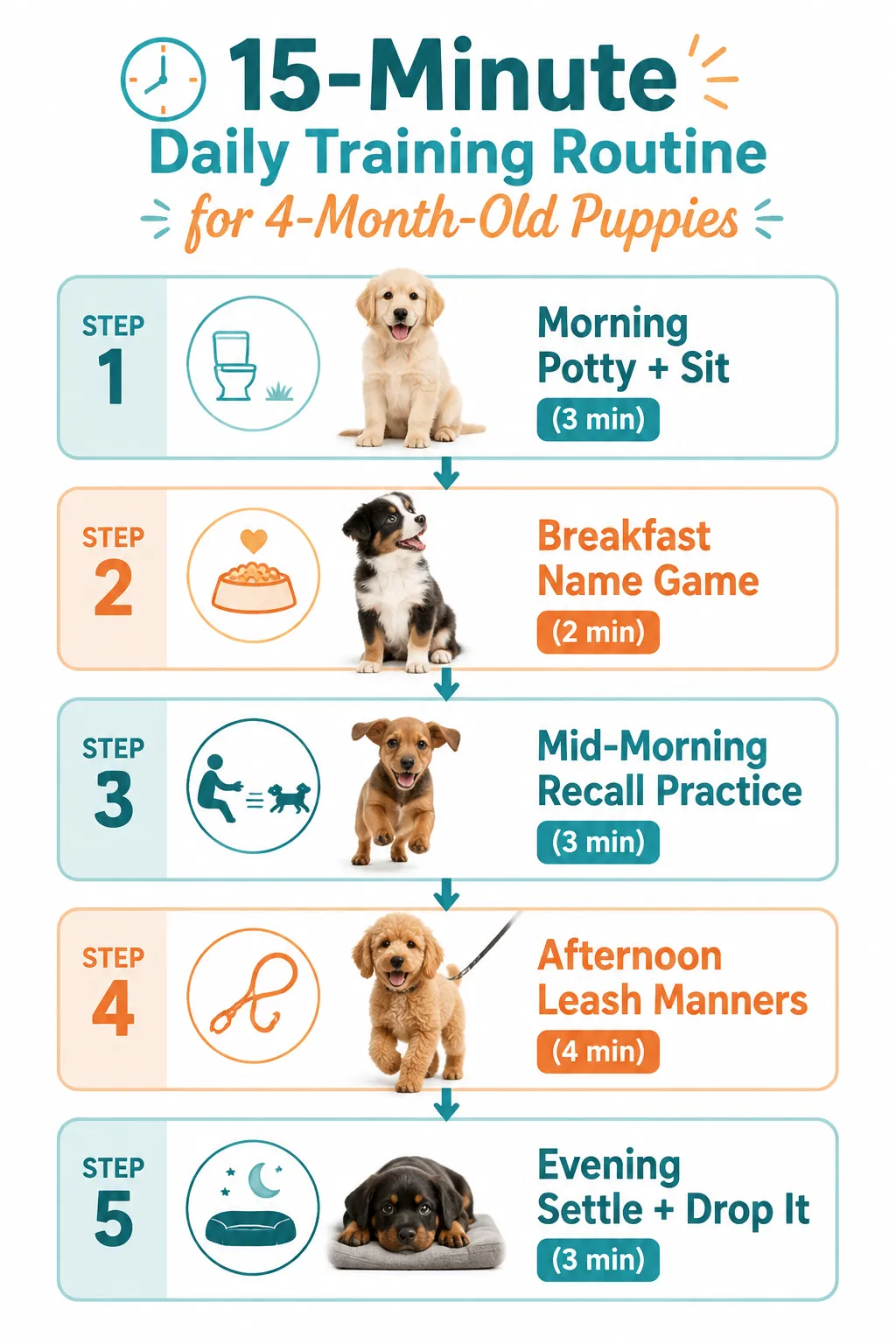
Train multiple times per day, but keep each session short. According to structured puppy training schedules, the most effective approach is attaching brief training moments to things that already happen – meals, potty breaks, and transitions.
A realistic daily frequency:
- After morning potty: 2-3 minutes of sit/down
- Before breakfast: name response and recall game
- Mid-morning potty break: one or two commands
- Before dinner: leave it or drop it practice
- Evening wind-down: settle on mat
This adds up to your 15-20 minute daily target without needing a dedicated “training block.” The whole day becomes a series of small, low-pressure learning opportunities.
What Commands Should a 4 Month Old Dog Know?
By the end of 4 months, a puppy on a consistent routine should reliably know sit, down, and come in a quiet environment. That’s a realistic benchmark.
By 5-6 months, with daily practice, most puppies can also perform stay (3-5 seconds), leave it, loose leash walking, and settle in familiar settings. Complete puppy training schedules by age describe this pre-6-month window as the time to complete “foundation training” before adding distractions.
What’s realistic vs. what’s not:
| Realistic at 4 months | Not yet realistic |
|---|---|
| Sit and down in quiet room | Perfect recall in a dog park |
| 2-3 second stay | 5-minute stay |
| Loose leash in low-distraction area | Ignoring squirrels on a walk |
| Basic name response | Off-leash reliability in public |
Don’t compare your puppy to someone else’s dog online. Breed, temperament, and consistency all affect the pace.
Puppy Training Schedule: 4 Months Old
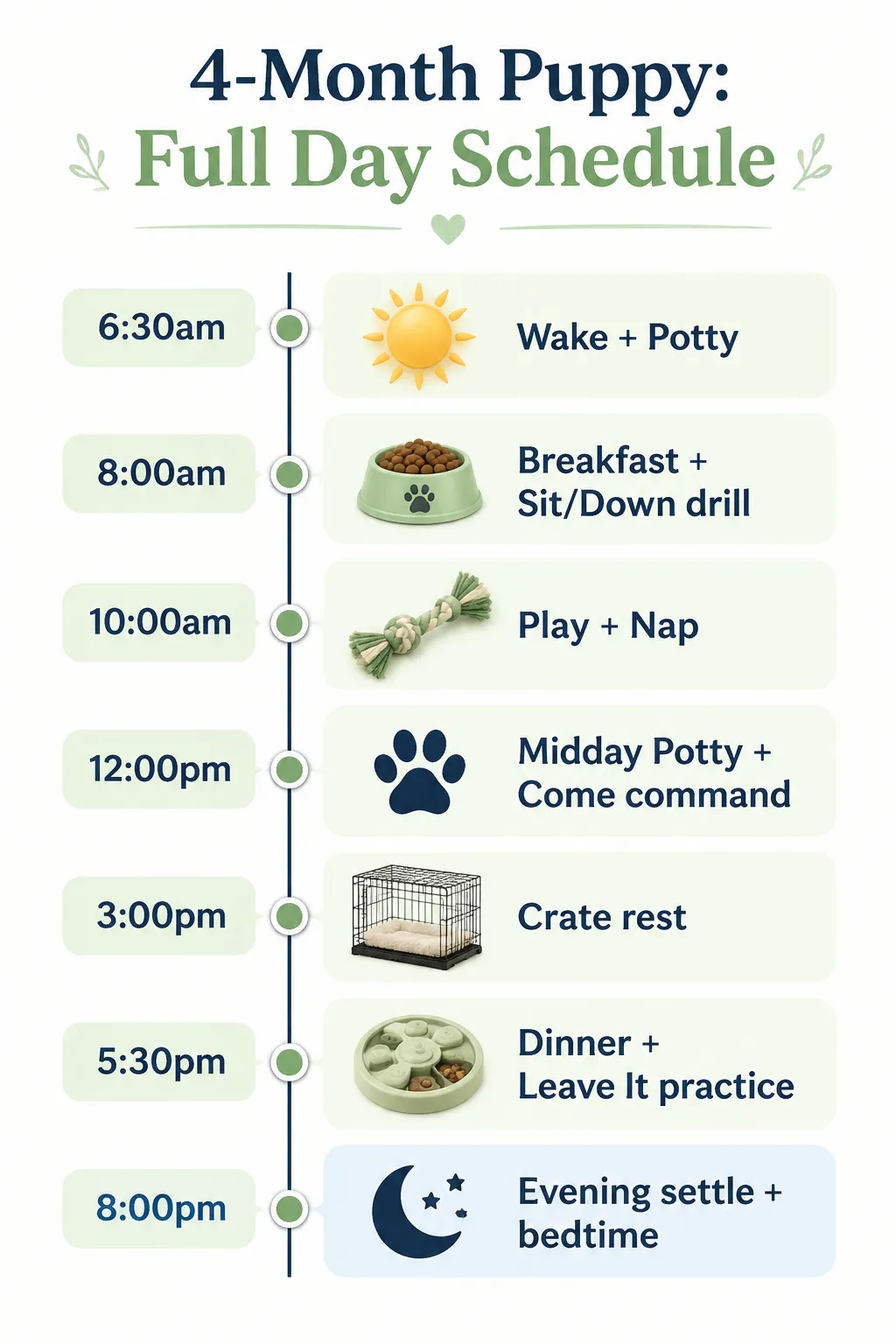
A good daily schedule for 4 month old dog training weaves short sessions into natural daily transitions. Here’s a sample routine based on age-specific puppy day structures:
Sample Day:
- 6:30 am – Wake up, straight outside for potty
- 7:00 am – Breakfast (ask for “sit” before placing bowl)
- 7:05 am – 2-min training: sit, down, name response
- 7:15 am – Play, then crate rest or quiet time
- 10:00 am – Potty break + 2-min recall game outside
- 12:00 pm – Lunch, short “leave it” practice
- 12:15 pm – Nap in crate
- 3:00 pm – Potty + short leash manners walk (15-20 min total)
- 5:30 pm – Dinner (sit before bowl)
- 5:35 pm – 3-min training: drop it, settle on mat
- 8:00 pm – Calm play, then bedtime routine
This structure – potty, short training, rest – repeated across the day prevents overtiredness and keeps behavior consistent. You can also explore a 14-day dog training plan that actually works to build on this foundation week by week.
How to Stop My 4 Month Old Puppy From Biting During Training
Puppy biting during training is extremely common and doesn’t mean your dog is aggressive. At 4 months, puppies are teething and use their mouths to explore everything – including your hands.
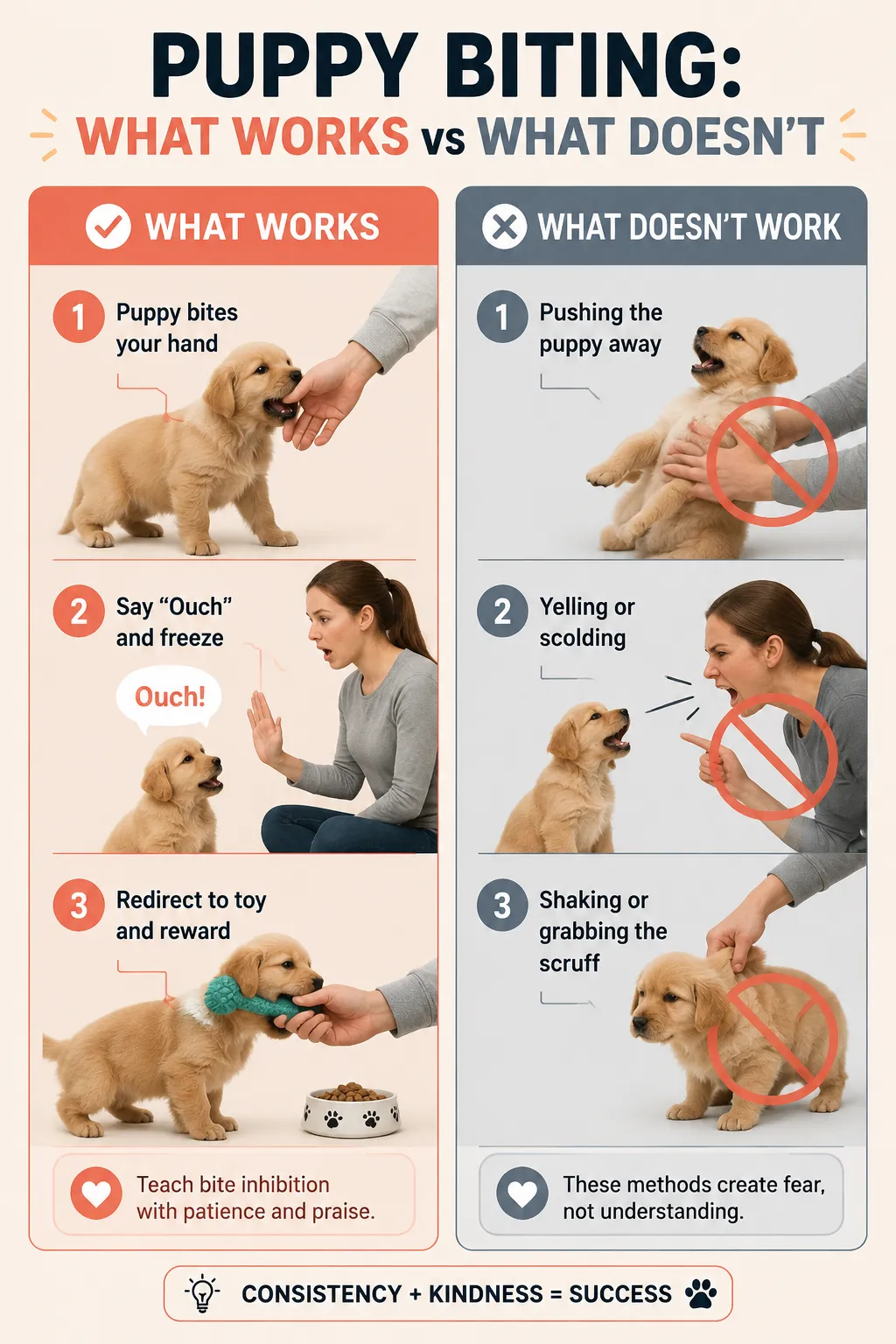
What actually works:
- The moment teeth touch skin, say “ouch” in a calm but firm voice and freeze completely – no movement, no reaction
- Redirect immediately to an appropriate chew toy
- Reward calm chewing on the toy with praise
- If biting continues, end the session calmly and give a short time-out
What makes it worse:
- Pulling your hand away quickly (triggers chase instinct)
- Yelling or physical correction (creates anxiety, not understanding)
- Continuing to play after biting happens
Consistency is everything here. Every person in the household needs to respond the same way. For more detail, read how to make a puppy stop biting – it covers the most common mistake owners make.
Crate Training a 4 Month Old Puppy
Crate training is one of the most valuable things you can do during 4 month old dog training. A crate gives your puppy a safe, calm space and makes potty training dramatically easier.
At 4 months, puppies can typically hold their bladder for about 4-5 hours during the day (though this varies). Puppy welfare schedules recommend several crate rest periods throughout the day to prevent overtiredness, which is a major cause of biting and ignoring commands.
Crate training basics:
- Make the crate positive – feed meals inside, toss treats in randomly
- Never use the crate as punishment
- Start with short periods (5-10 minutes) while you’re in the room
- Gradually increase duration as your puppy settles calmly
- Cover the crate with a blanket to create a den-like feel
A well-crate-trained puppy is also much easier to travel with, visit the vet, and manage in new environments.
Potty Training Tips for a 4 Month Old Dog
Potty training at 4 months is about consistency and timing, not punishment. Most puppies this age need to go outside every 2-3 hours, plus after every meal, nap, and play session.
The core routine:
- Take your puppy to the same spot outside every time
- Use a consistent cue word (“go potty” or similar)
- Wait quietly – don’t play or distract
- The moment they finish, reward immediately with a treat and praise
- If an accident happens inside, clean it thoroughly with an enzymatic cleaner and say nothing to the puppy
For a deep dive into this topic, the 15 puppy potty training tips that actually work guide covers even stubborn cases in detail.
Common mistake: Scolding a puppy for an accident you didn’t catch in the act. They cannot connect your frustration to something that happened 30 seconds ago. It only creates confusion and anxiety.
Why Won’t My 4 Month Old Puppy Listen to Commands?
This is one of the most common frustrations in 4 month old dog training, and it almost always comes down to one of a few fixable reasons.
Most likely causes:
- Session is too long – puppy has mentally checked out
- Too many distractions – you’re asking for “sit” near the dog park when they’ve only practiced it in the kitchen
- Reward isn’t motivating enough – dry kibble won’t compete with a squirrel
- Command has been repeated too many times – the word has lost meaning
- Puppy is tired, hungry, or overstimulated – training requires a certain baseline of calm
The fix is usually simple: shorten the session, remove distractions, upgrade the treat, and go back to the last thing your puppy did successfully.
According to week-by-week puppy training schedules, trainers explicitly warn that forcing long continuous drills reduces attention and creates resistance. Short, successful lessons repeated over many days always outperform marathon sessions.
Do I Need a Professional Trainer for My 4 Month Old Puppy?
Most owners do not need a professional trainer at 4 months if they follow a clear, consistent routine. The basics – sit, down, come, crate training, potty training – are very learnable at home.
Consider a professional if:
- Your puppy shows signs of fear aggression or extreme anxiety
- Biting is escalating despite consistent redirection
- You’re struggling to make any progress after 3-4 weeks of consistent effort
- You have young children and need faster results for safety
A group puppy class (not just private training) is genuinely worth it at this age – not just for training, but for socialization. Puppies learn a lot from being around other dogs and people in a controlled setting.
Common Training Mistakes With 4 Month Old Puppies
Even well-meaning owners fall into these traps. Knowing them in advance saves weeks of frustration.
- Training when the puppy is tired or overstimulated – the worst time to expect focus
- Repeating commands – say it once, then help if needed
- Inconsistent rules – if jumping is sometimes cute and sometimes not, your puppy can’t learn
- Skipping socialization – commands without exposure to the real world don’t generalize
- Ending on a failure – always close with an easy win
- Using punishment – it damages trust and slows learning at this age
For a broader look at what not to do, the 15 terrible dog training mistakes guide is worth bookmarking.
Training Treats Safe for 4 Month Old Dogs
The best training treats for a 4-month-old puppy are small, soft, and smelly. Small because you’ll use a lot of them. Soft because they’re easy to chew quickly. Smelly because scent drives motivation in dogs.
Good options:
- Small pieces of cooked chicken or turkey (plain, no seasoning)
- Commercial soft training treats (pea-sized pieces)
- Small bits of cheese
- Freeze-dried liver or salmon treats
Avoid anything hard, large, or high in salt and sugar. Keep treat size to roughly pea-sized – you want your puppy to eat it in one second and refocus on you.
If you like making your own, check out these 11 easy oatmeal dog treats that are simple and puppy-friendly.
FAQ
At what age should I start training my puppy?
You can start basic training as early as 8 weeks. By 4 months, puppies are ready for a structured daily routine with multiple short sessions.
How many times a day should I train my 4 month old puppy?
Aim for 4-6 micro-sessions per day, each lasting 2-5 minutes. Attach them to meals, potty breaks, and transitions rather than scheduling a single long block.
What is the 5-minute rule for puppy training?
The rule suggests puppies can handle roughly 5 minutes of structured training per month of age. A 4-month-old puppy can manage about 20 minutes total per day, broken into short sessions.
Can a 4 month old puppy learn “stay”?
Yes, but keep it very short – start with 2-3 seconds and build slowly. Expecting a 4-month-old to hold a 1-minute stay is unrealistic and sets both of you up for frustration.
Why does my puppy know a command inside but not outside?
Puppies don’t generalize well at first. A command learned in the kitchen needs to be re-taught in the backyard, then on the sidewalk, then at the park. This is normal – not stubbornness.
Is it okay to use my puppy’s kibble as training treats?
Yes, especially if your puppy is food-motivated. Using part of their daily meal as training rewards prevents overfeeding while keeping sessions rewarding.
My puppy bites my hands every time I try to train. What do I do?
Say “ouch,” freeze, redirect to a chew toy, and reward calm chewing. Be 100% consistent. If every person in the house does this the same way, biting during training usually reduces within 1-2 weeks.
How long does it take to potty train a 4 month old puppy?
Most puppies show significant improvement within 2-4 weeks of a consistent routine. Full reliability usually comes between 5-6 months, though some breeds take longer.
Should I train my puppy before or after meals?
Before meals is ideal – your puppy is slightly hungry and more motivated by food rewards. Avoid training immediately after eating, especially for larger breeds.
Do I need special equipment to train my 4 month old puppy?
No. A bag of small treats and a leash are all you need to start. A clicker is optional but helpful for marking precise behaviors.
How do I know if my training is working?
Your puppy should be able to perform a new behavior reliably in a quiet environment within 5-10 short sessions. If you’re not seeing progress after two weeks of daily practice, simplify the task or change the reward.
What if my puppy has zero interest in treats during training?
Try higher-value rewards like cooked chicken or cheese. Also check the environment – too many distractions can kill food motivation. Some puppies respond better to a short game with a toy as a reward.
Conclusion
Four month old dog training doesn’t have to be complicated or time-consuming. The 15-minute daily routine works because it fits into real life – short sessions attached to meals, potty breaks, and transitions throughout the day.
Your next steps:
- Pick 2-3 commands to focus on this week (sit, down, and come are the best starting point)
- Set up 4-5 daily training moments tied to things that already happen in your routine
- Keep every session under 5 minutes and always end on a success
- Run crate training and potty training in parallel – they support each other
- Gradually introduce new environments once your puppy is solid in quiet settings
The puppies that grow into well-behaved adult dogs aren’t the ones who trained the hardest at 4 months. They’re the ones whose owners stayed consistent, kept it positive, and made training a natural part of every day.
Start today. Even one 3-minute session before breakfast is a better foundation than waiting for the “right time.”