
Last updated: August 14, 2026
Quick Answer: French Bulldog potty training fails most often because of gaps in schedule, inconsistent cues, and poor cleanup – not because your puppy is dumb or defiant. Fix these hidden errors and most Frenchies become reliably house trained within 4 to 6 months.
Key Takeaways
- A French Bulldog puppy needs a potty break every 1-2 hours in the early weeks due to a tiny bladder
- Crate training is one of the most effective tools when the crate is sized correctly
- Always take your puppy outside to the same spot using the same potty command every single time
- Reward within 2 seconds of elimination – not after coming inside
- Use an enzymatic cleaner on every accident spot or the scent will keep calling him back
- Never punish accidents; it teaches your Frenchie to hide and eliminate out of sight
- Most training “failures” are actually schedule gaps or owner inconsistency, not a stubborn dog
Why Is My French Bulldog So Hard to Potty Train?
French Bulldogs are harder to house train than many other breeds because of a combination of small bladder capacity, a stubborn independent streak, and high emotional sensitivity. These three traits together mean that training behavioral habits takes longer and requires more consistency than owners typically expect.
A Frenchie is not being spiteful when he goes inside. He simply hasn’t made a strong enough connection between the outside world and where to eliminate – yet. According to The Frenchie Guide’s potty training breakdown, French Bulldogs respond best to calm, consistent, positive methods rather than any form of pressure.
The breed also carries a reputation for stubbornness that goes back generations. That strong will is part of what makes a Frenchie so charming – but it also means weak or inconsistent training simply won’t stick.
Are French Bulldogs Harder to Potty Train Than Other Breeds?
Yes – French Bulldogs are generally considered one of the more challenging breeds for house training. Their small bladders, brachycephalic (flat-faced) build, and independent temperament all work against fast progress.
Compare that to a Labrador, which tends to be eager to please and physically able to hold it longer from an earlier age. A Frenchie’s bladder control simply matures more slowly, and his personality means he’ll push back if training feels confusing or harsh.
That said, “harder” does not mean impossible. It means you need a tighter schedule and more patience. Check out this complete French Bulldog training guide for a broader look at managing the breed’s temperament across all types of training.
What Age Should I Start Potty Training a French Bulldog?
Start potty training your French Bulldog puppy the day he comes home – ideally between 8 and 12 weeks old. The earlier you establish a routine, the fewer bad habits he has time to build.
At 8 weeks old, a puppy’s bladder is tiny. He can only hold it for about 1-2 hours at a time during the day. Wagg’s potty training tips for French Bulldogs note that puppies under 12 weeks often need a break roughly every 2 hours, while older puppies may manage 3-4 hours.
By 4 to 6 months old, most Frenchies have the physical control needed to be reliably trained – but full consistency often takes until 6 to 8 months. Don’t rush the timeline. An old Frenchie who was never properly trained can still learn, but it takes longer to undo old habits.
How Long Does It Take to Potty Train a French Bulldog?
Most French Bulldog owners can expect the process to take 4 to 6 months of consistent daily work before their puppy is reliably house trained. Some dogs get there faster; a stubborn or anxious old Frenchie may take closer to a year.
The biggest factor is consistency. Owners who stick to a rigid schedule, use the same potty command every time, and reward immediately tend to see results much faster than those who train casually.
For a step-by-step framework that works across breeds, the ultimate puppy potty training guide is a great companion resource.
Before You Start: Build the Foundation Your Frenchie Needs
Before you take him outside for his first official potty trip, get three things in place: a correctly sized crate, a consistent schedule, and a chosen potty command. Missing any one of these is the most common reason house training stalls before it even gets going.
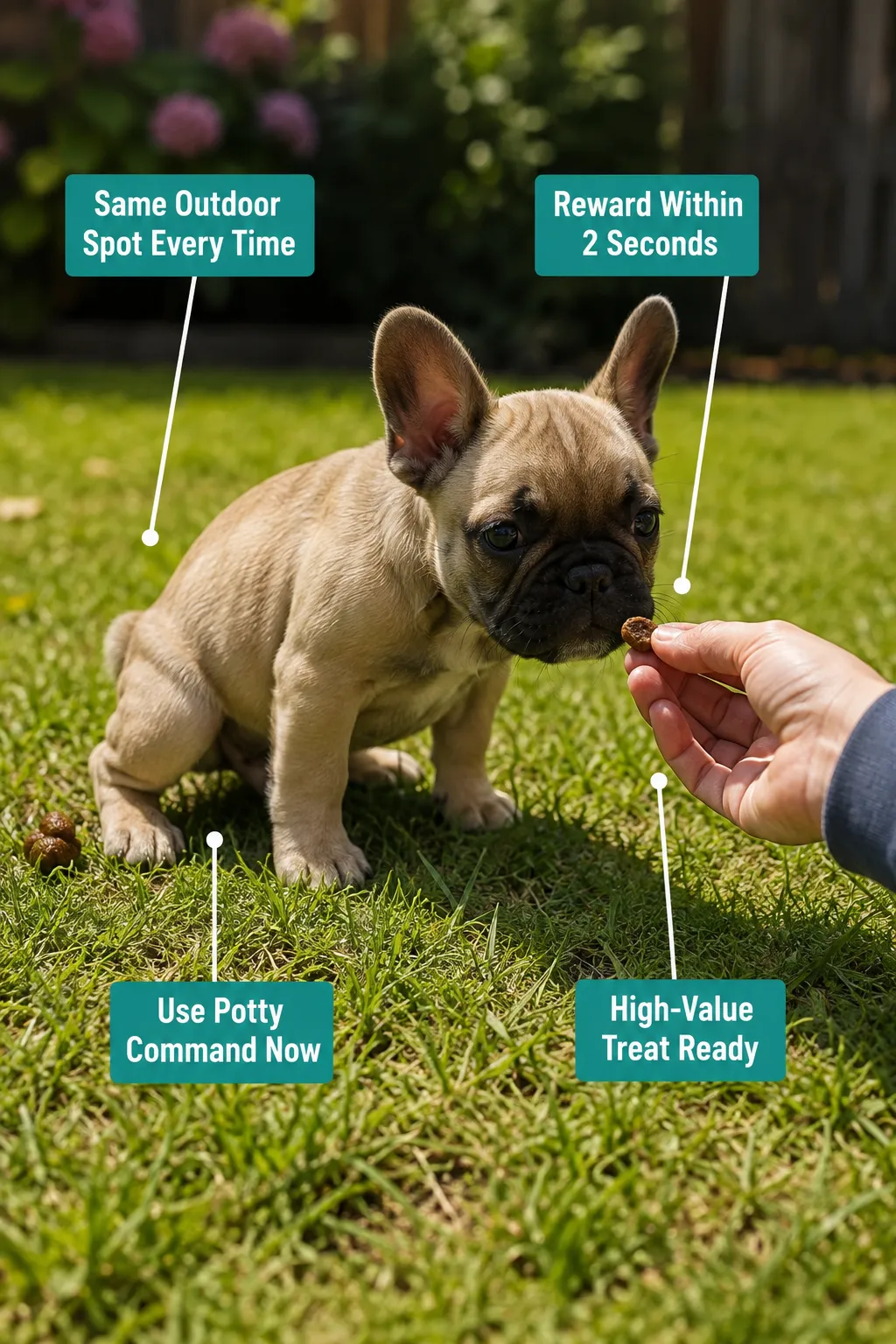
Choose a potty command. Pick one short phrase – “go potty,” “go wee,” or “outside” – and use it every single time. Say it calmly as he begins to eliminate, not before. Over time, this potty command becomes a powerful cue that speeds up the whole process.
Choose your outdoor area. Pick one specific spot outside and always take him there first. The scent of previous trips will trigger him to eliminate faster. If you’re working on setting up a dedicated dog outside potty area, consistency with location is the single biggest shortcut.
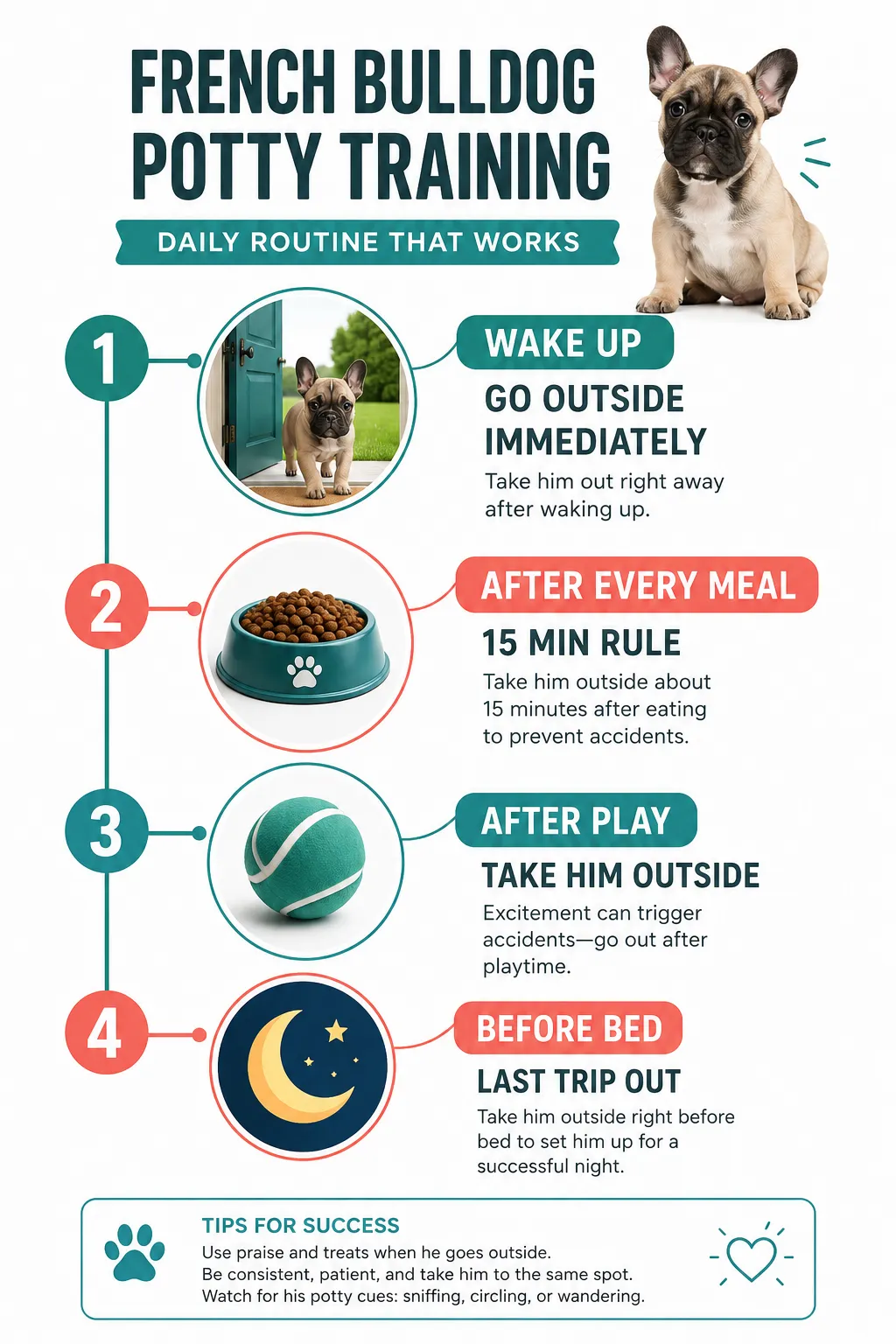
Set a schedule. Take him outside:
- First thing after waking up
- After every meal (within 15 minutes)
- After play sessions
- Before going inside for the night
- In the middle of the night for puppies under 12 weeks
How to Crate Train a French Bulldog for Potty Training
A correctly used crate is one of the most powerful potty training tools available. Dogs naturally avoid soiling where they sleep, so the crate teaches a puppy to hold it until you take him outside.
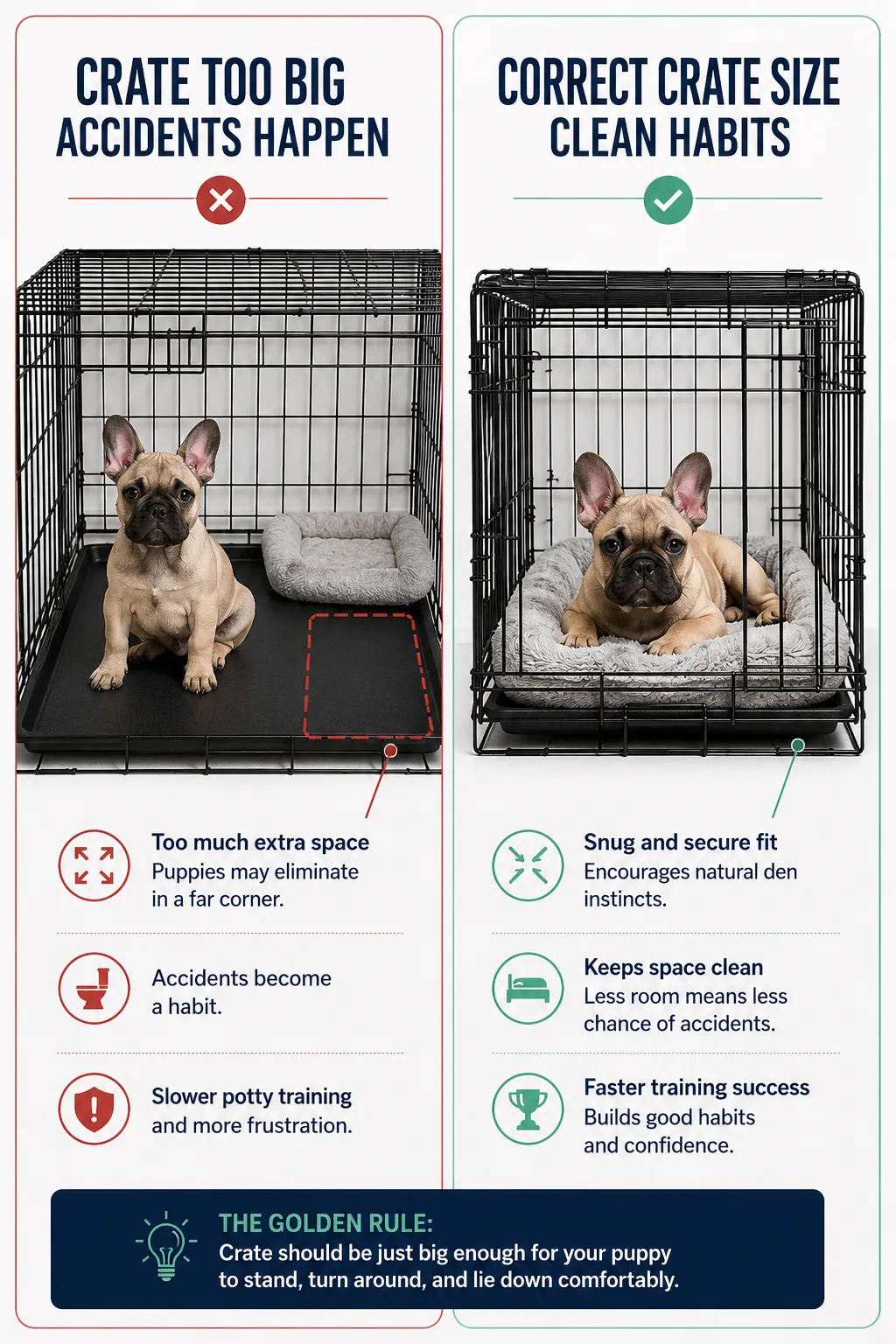
The key word is “correctly.” According to French Bulldog Lovers’ potty training guide, the crate should be just large enough for him to stand, turn around, and lie down – nothing bigger. A crate that’s too large gives him room to eliminate in one corner and sleep in another, which defeats the whole purpose.
Common crate mistakes to avoid:
- Using the crate as punishment (creates fear and resistance)
- Leaving him crated too long (puppies can’t hold it for more than a few hours)
- Allowing accidents inside the crate without thorough cleanup
- Skipping the crate entirely because it “feels mean”
Use the crate whenever you can’t actively supervise him inside the house. This prevents the silent rehearsal of bad habits that happens when a puppy roams freely and eliminates without anyone noticing.
French Bulldog Potty Training Methods That Actually Work
The methods that work for a Frenchie are positive reinforcement, a tight schedule, and active supervision – used together, every day, without shortcuts. Serene Valley Frenchies’ training protocol identifies these three pillars as non-negotiable for consistent results.
The praise and treat method is the gold standard. The moment your puppy finishes eliminating outside, praise him enthusiastically and give a high-value treat. Do this within 2 seconds of him finishing – not after you’ve walked back inside. Zoom Room’s Frenchie potty guide specifically warns that delayed rewards teach him that coming inside earns the treat, not going potty outside.
What about potty pads? Many experts recommend skipping indoor pads entirely for house training, because they teach the puppy that going inside the house is acceptable. If you live in an apartment and need a temporary solution, use pads only in one fixed location and transition outside as quickly as possible.
For apartment living specifically:
- Take him outside every 1-2 hours during active daytime hours
- Use the elevator or stairs on a leash so he doesn’t eliminate on the way out
- Pick a consistent outdoor spot near your building entrance
- Keep a log of when he goes so you can search for patterns and tighten the schedule
7 Sneaky Reasons French Bulldog Potty Training Keeps Failing
Most failures come down to one of these seven hidden errors. Go through each one and honestly ask yourself if it applies to your routine.
1. The schedule has gaps you haven’t noticed.
If he’s having accidents, the schedule is almost always too sparse. Add more trips outside before cutting back.
2. You’re rewarding too late.
If the treat comes after you come inside, you’re training him to love coming inside – not to eliminate outside.
3. The crate is too big.
A large crate lets him use one corner as a bathroom. Size it down.
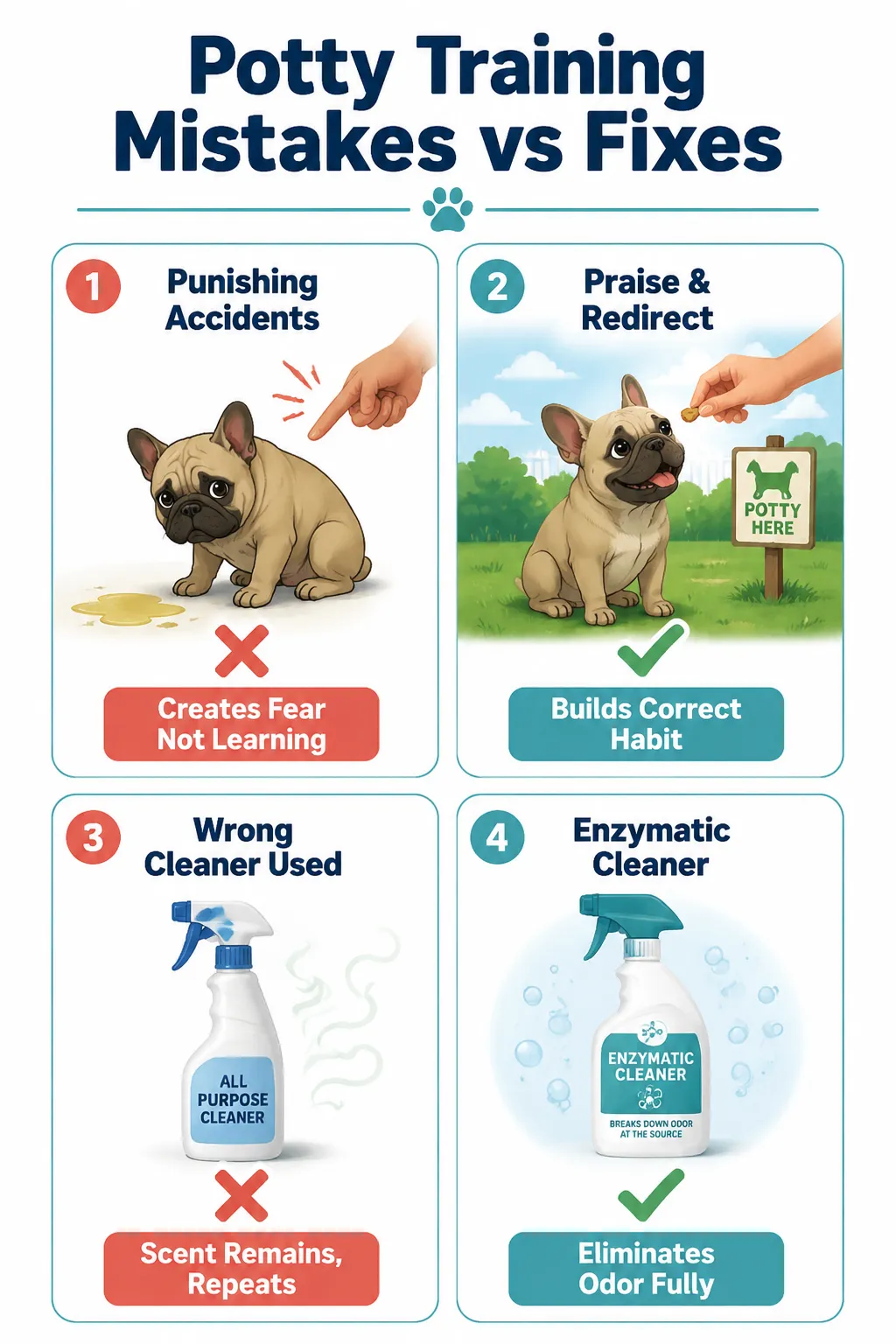
4. Accident spots aren’t cleaned with an enzymatic cleaner.
Standard household cleaners leave scent behind. That scent tells him that spot inside is an approved bathroom. Use an enzyme-based product every time.
5. You’re punishing accidents.
Scolding or rubbing his nose in it teaches him to hide and eliminate out of sight. It does not teach him to go outside.
6. He has too much unsupervised freedom inside.
Until he’s reliably trained, keep him in a small area or on a leash near you. Free roaming = silent accidents.
7. You relaxed the rules after a few good days.
A few clean days don’t mean training is complete. Keep the full routine going for weeks before loosening up.
French Bulldog Keeps Having Accidents in the House – What to Do
Repeated indoor accidents almost always trace back to one of the seven reasons above. Start by auditing your schedule and cleaning routine before assuming your dog has a behavior problem.
First, go back to basics. Increase the frequency of outside trips, re-introduce the crate for unsupervised time, and re-clean every accident spot with an enzymatic cleaner. Also check for French Bulldog health issues that could affect bladder control, such as urinary tract infections, which are more common in flat-faced breeds.
If he consistently won’t pee outside and only goes inside, try staying outside longer – up to 10-15 minutes – and walking him around to stimulate elimination. Some Frenchies need movement to trigger the urge. The moment he goes outside, praise him like he just won a championship.
French Bulldog Potty Training Regression – Why Does It Happen?
Potty training regression is normal and usually happens after a change in routine, environment, or household. Moving to a new house, adding a new pet, or even a change in your work schedule can set a previously trained Frenchie back weeks.
When regression happens, don’t punish – restart. Go back to the tight schedule, re-introduce the crate for supervision gaps, and reward every successful outside trip again. Most dogs recover quickly once the routine is restored.
Also check for physical causes. A sudden increase in accidents in an older, previously trained dog can signal a UTI or other health issue that needs a vet visit.
French Bulldog Health Issues That Affect Potty Training
Some French Bulldogs struggle with potty training because of underlying health issues, not just behavior. UTIs, bladder stones, and gastrointestinal sensitivities can all make it physically harder for a puppy to hold it or signal in time.
If your Frenchie is straining, going very frequently, or producing blood in urine, see a vet before continuing training. No amount of schedule work will fix a medical problem. For a broader look at health concerns in the breed, the French Bulldog allergies survival guide covers several conditions that can affect daily comfort and behavior.
Additional Tips: Socialization and the Training Connection
Socialization and potty training are more connected than most owners realize. A well-socialized puppy is less anxious outside, which means he’s more likely to relax and eliminate in new outdoor environments rather than holding it until he gets back inside.
Start socializing your Frenchie early – expose him to different outdoor surfaces, sounds, and environments from 8 weeks onward. A puppy who is comfortable going outside in various settings will generalize the “potty outside” rule far more easily than one who is nervous about leaving the house.
For more on building a calm, well-adjusted dog, the 15 puppy potty training tips that actually work includes socialization as a core component of the training process.
Conclusion
French Bulldog potty training is not a mystery – it’s a system. When it keeps failing, the answer is almost always hiding in one of these seven sneaky spots: a schedule with gaps, late rewards, an oversized crate, incomplete accident cleanup, punishment, too much indoor freedom, or premature relaxation of the rules.
Your action plan starting today:
- Set a potty break schedule and stick to it – every 1-2 hours for young puppies
- Pick one potty command and use it every single time you take him outside
- Reward within 2 seconds of elimination with a high-value treat and enthusiastic praise
- Size the crate correctly and use it whenever you can’t supervise
- Clean every accident with an enzymatic cleaner, not a standard household spray
- Never punish accidents – redirect and reset instead
- Keep the full routine going for at least 4-6 months before relaxing
Stick with it. A month old Frenchie who seems impossible to train today can become a reliably house trained companion with the right system in place. You’ve got this. 🐾
Frequently Asked Questions
Is it hard to potty train French Bulldogs?
Yes, French Bulldogs are considered one of the more challenging breeds to potty train. Their small bladders, independent personalities, and emotional sensitivity all slow the process. However, with a consistent schedule, crate training, and positive reinforcement, most Frenchies become reliably house trained within 4 to 6 months.
At what age are Frenchies fully potty trained?
Most Frenchies are reliably potty trained between 6 and 8 months of age, though some take up to a year. Physical bladder control develops around 4 months, but consistent behavior requires weeks of repetition beyond that. Starting training at 8 weeks and maintaining a tight schedule gives the best results.
What is the 10, 10, 10 rule for potty training?
The 10, 10, 10 rule is a timing guideline: take your puppy outside within 10 minutes of waking, 10 minutes after eating, and every 10 minutes during active play. It ensures you catch the highest-risk elimination windows before accidents happen inside the house, making it especially useful for young puppies under 12 weeks old.
How do I stop my French Bulldog from peeing in the house?
Increase the frequency of outside trips, re-introduce crate supervision for unsupervised time, and clean every accident spot with an enzymatic cleaner to remove scent. Never punish accidents. Reward every successful outside elimination immediately. If accidents persist despite a tight schedule, rule out a urinary tract infection with a vet visit before continuing behavioral training.