

Last updated: October 5, 2026
Quick Answer: Eggs are one of the safest, most affordable proteins you can add to homemade dog food. Cooked eggs – scrambled, hard-boiled, or mixed into a meal – give your dog high-quality protein, healthy fats, and key vitamins. Most healthy adult dogs can safely eat one egg per day as part of a balanced diet, but raw eggs carry a Salmonella risk and should be avoided.
Key Takeaways
- 🥚 Eggs are a complete protein source for dogs, packed with amino acids, vitamins A, D, B12, and healthy fats
- 🍳 Always cook eggs before feeding them to your dog – raw eggs carry a real Salmonella risk
- 📏 One egg per day is the general guideline for most adult dogs; keep eggs under 10% of daily calories
- 🥦 Pairing eggs with dog-safe vegetables like sweet potato, spinach, and carrots creates a balanced meal
- 🐶 Puppies should not rely on homemade egg-based diets without a vet-formulated plan
- 💰 Homemade egg-based dog food can cost significantly less per meal than premium commercial food
- 🧊 Store homemade egg dog food in an airtight container for up to 4 days in the fridge or 3 months in the freezer
- 🐾 Dogs with kidney disease or pancreatitis need vet guidance before eating egg-heavy meals
- 👩⚕️ Vets generally support eggs as a supplement, but recommend professional formulation for full-time homemade diets
- 🔗 Mixing eggs with proteins like chicken, salmon, or beef creates a more complete nutritional profile
What Nutrients Do Eggs Provide for Dogs?
Eggs are one of the most nutrient-dense single foods you can add to your dog’s bowl. A single large egg delivers complete protein, essential fatty acids, and a range of vitamins that support your dog’s overall health.
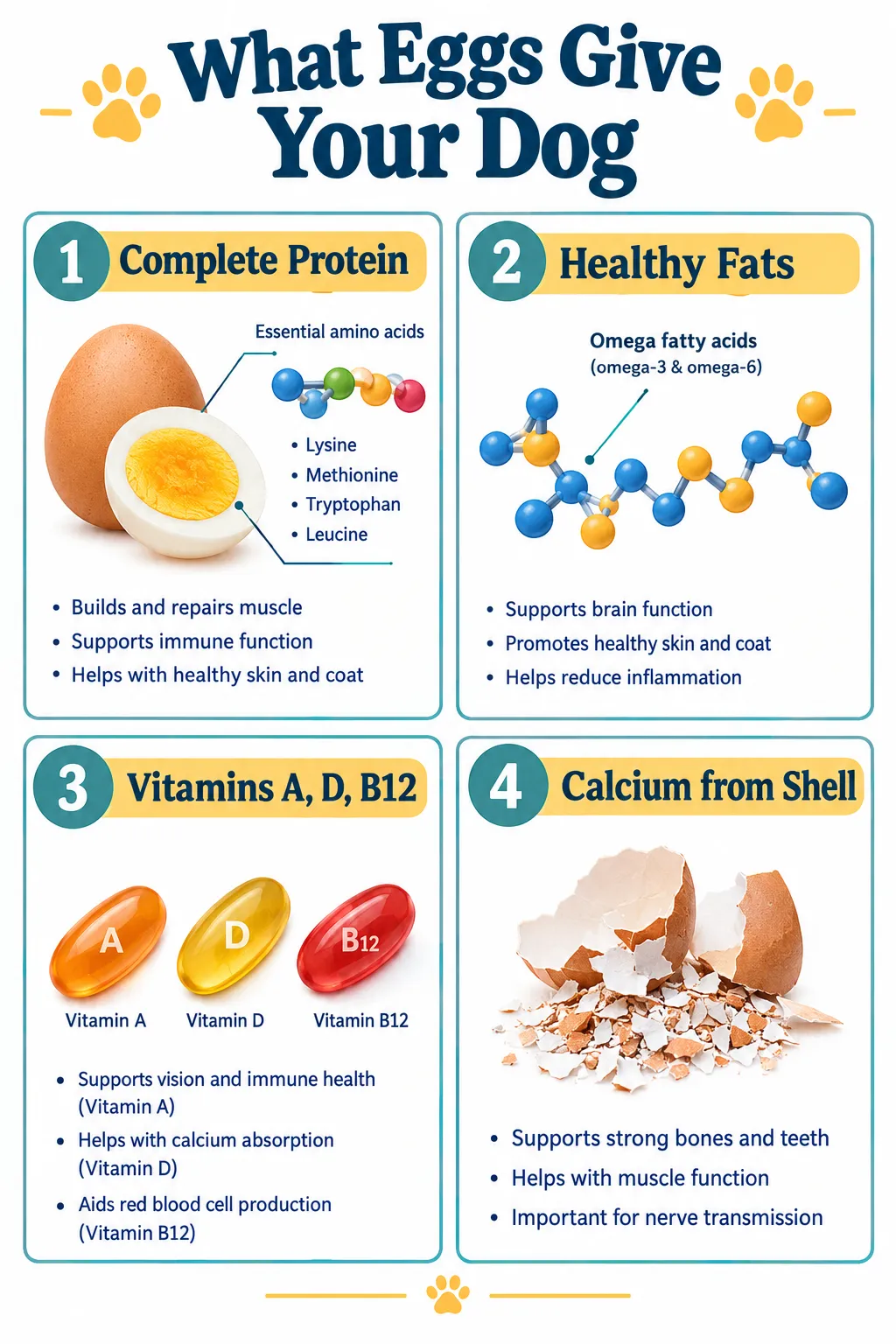
Here’s what one egg actually brings to your dog’s diet:
- Complete protein – all essential amino acids dogs need for muscle repair and growth
- Vitamin A – supports eye health and immune function
- Vitamin D – helps with calcium absorption and bone health
- Vitamin B12 – essential for nerve function and red blood cell production
- Riboflavin (B2) – supports energy metabolism
- Healthy fats – including omega-3 and omega-6 fatty acids
- Selenium – an antioxidant that protects cells
- Calcium – primarily in the shell, which can be ground and added to food
According to the AKC, eggs are considered a complete food source and are highly digestible for dogs. That’s a big deal when you’re building homemade dog food recipes with eggs as the protein base.
💡 Pull quote: “Eggs are considered one of the most digestible protein sources available for dogs – making them an excellent addition to any homemade meal.”
How Much Egg Can I Give My Dog Daily?
For most healthy adult dogs, one egg per day is a safe and reasonable amount. The key rule is that eggs should make up no more than 10% of your dog’s total daily calorie intake.
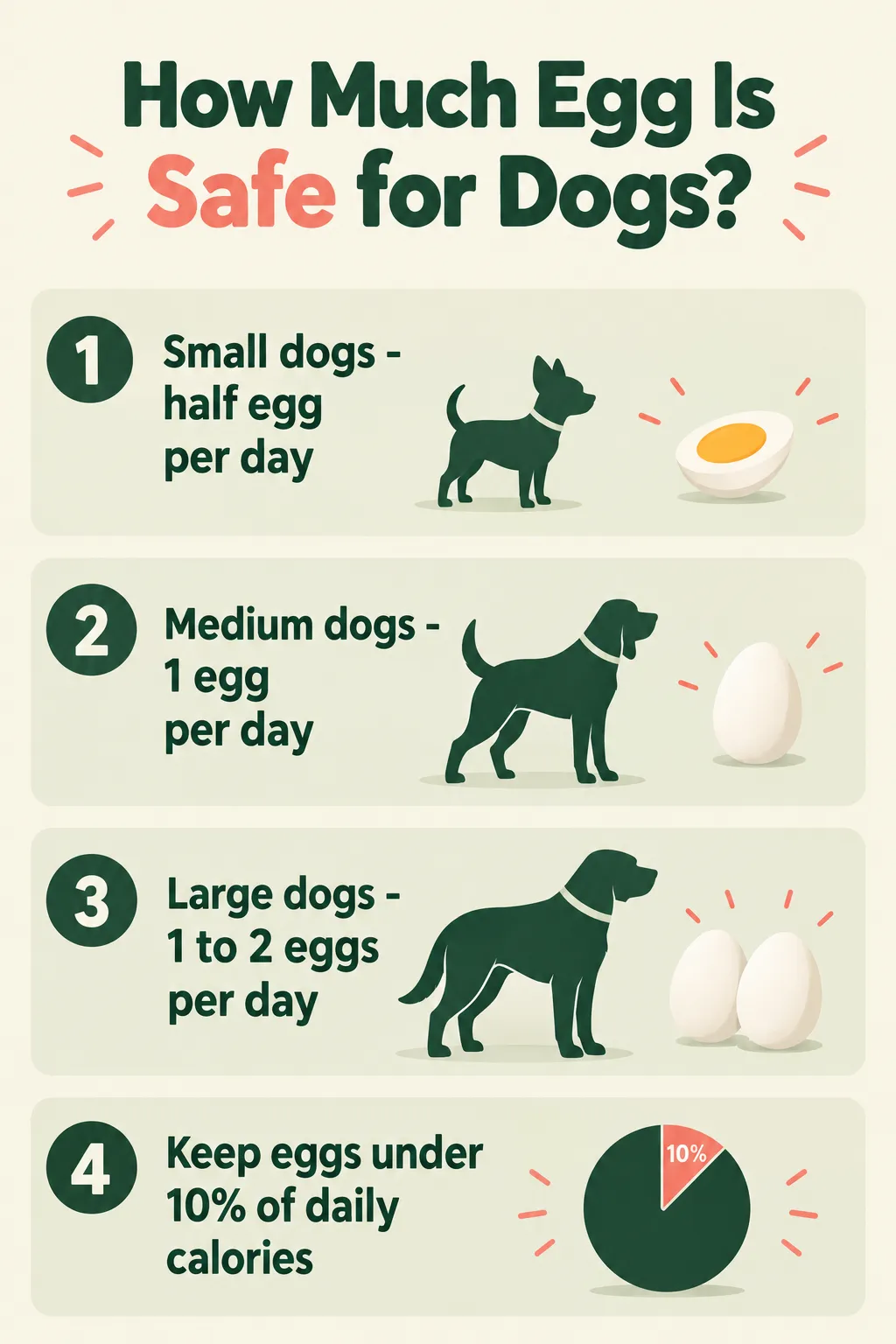
Here’s a simple size-based guide:
| Dog Size | Weight Range | Suggested Daily Egg Amount |
|---|---|---|
| Small | Under 20 lbs | Half an egg |
| Medium | 20-50 lbs | 1 egg |
| Large | 50-90 lbs | 1 to 2 eggs |
| Giant | Over 90 lbs | 2 eggs (with vet guidance) |
WebMD’s pet nutrition team notes that while eggs are healthy, feeding too many can add excess fat and calories, potentially leading to weight gain. Start with a smaller amount and watch how your dog responds before increasing.
For more guidance on daily food amounts, check out this helpful guide on how much food to feed your dog daily.
Can Dogs Eat Raw Eggs, or Should They Be Cooked?
Cook the eggs. This is the clear 2026 consensus among veterinary nutrition experts. Raw eggs carry a genuine risk of Salmonella contamination, which can make both your dog and your family sick.
There’s also a secondary concern with raw egg whites. They contain a protein called avidin, which blocks the absorption of biotin (vitamin B7). Cooking deactivates avidin entirely.
Chewy’s nutrition team explains that while some raw feeding advocates argue for raw eggs, mainstream veterinary advice has become increasingly conservative on this point.
You can read a deeper breakdown on this topic at can dogs eat raw eggs.
Bottom line: Scramble them, hard-boil them, or poach them – just don’t serve them raw.
What Are the Benefits of Eggs in Homemade Dog Food?
Eggs bring several practical benefits when used in homemade dog food recipes. They’re affordable, easy to prepare, and genuinely nutritious.
Key benefits include:
- High bioavailability – the protein in eggs is absorbed efficiently by a dog’s digestive system
- Budget-friendly – eggs are one of the cheapest high-quality protein sources available
- Versatile – they mix well with grains, vegetables, and other proteins
- Coat and skin support – the fatty acids in eggs contribute to a shinier coat and healthier skin
- Easy to digest – great for dogs with sensitive stomachs
Embrace Pet Insurance’s nutrition guide highlights that eggs can be especially helpful for dogs recovering from illness or those needing a gentle, digestible protein source.
If you’re focused on coat health, also check out these homemade dog food recipes for a shiny coat.
7 Best Homemade Dog Food Recipes With Eggs and Vegetables
These seven recipes use eggs as the protein anchor, paired with dog-safe vegetables and whole grains. Each recipe follows a loose 50/25/25 ratio – 50% protein, 25% vegetables, 25% grain or starch.
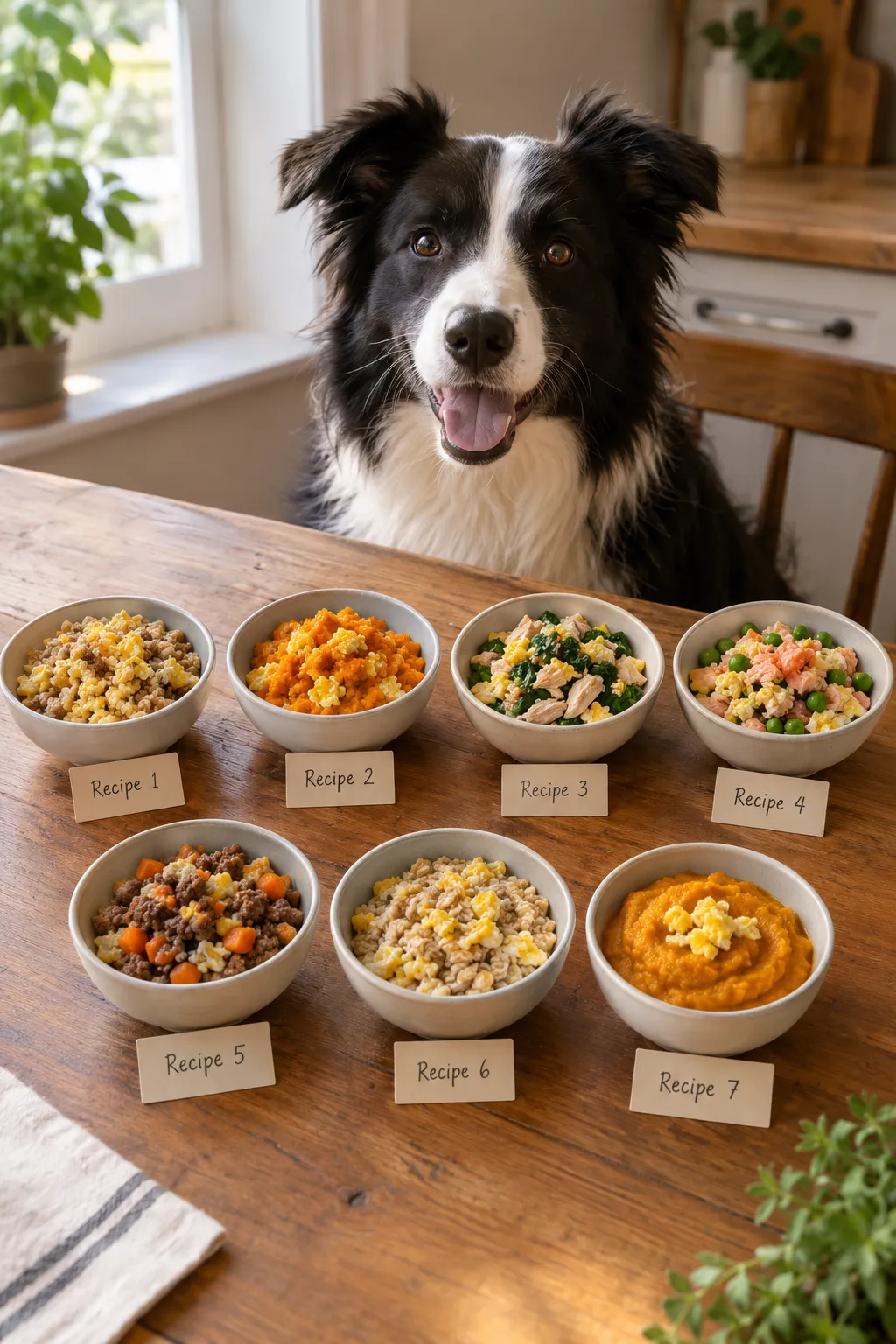
Always let food cool before serving. Use no salt, no onion, no garlic, and no seasoning.
Recipe 1 – Scrambled Egg and Brown Rice Bowl
- 2 eggs, scrambled plain
- 1/2 cup cooked brown rice
- 1/4 cup steamed carrots, diced
Cook eggs in a dry pan with no oil. Mix everything together and serve at room temperature.
Recipe 2 – Egg and Sweet Potato Mash
- 2 eggs, hard-boiled and chopped
- 1/2 cup mashed sweet potato (no butter or spices)
- 1/4 cup steamed green beans
Mash the sweet potato, fold in the chopped eggs and green beans. Great for dogs with sensitive stomachs.
Recipe 3 – Egg, Chicken, and Spinach Mix
- 2 eggs, scrambled
- 1/2 cup cooked chicken breast, shredded
- 1/4 cup fresh spinach, lightly steamed
This high-protein combo is excellent for active dogs. See more ideas in these homemade dog food recipes with chicken.
Recipe 4 – Egg and Salmon with Peas
- 1 egg, scrambled
- 1/2 cup cooked salmon (boneless)
- 1/4 cup cooked peas
Salmon adds omega-3s that support joint health and skin. Pair this with ideas from salmon and sweet potato dog food recipes.
Recipe 5 – Egg and Beef with Carrots
- 2 eggs, scrambled
- 1/2 cup lean ground beef, cooked and drained
- 1/4 cup diced cooked carrots
A heartier recipe for larger dogs or those needing extra calories.
Recipe 6 – Egg and Oatmeal Breakfast Bowl
- 1 egg, scrambled
- 1/2 cup cooked plain oatmeal
- 1/4 cup blueberries
A gentle, easy-to-digest option. Check out more homemade dog food breakfast recipes for morning meal ideas.
Recipe 7 – Egg and Pumpkin Puree
- 2 eggs, scrambled
- 1/2 cup plain canned pumpkin (not pie filling)
- 1/4 cup cooked white rice
Pumpkin supports digestive health. This is a great recipe for dogs with occasional tummy issues.
What Vegetables Pair Well With Eggs for Dog Food?
Several vegetables are safe and nutritious for dogs when paired with eggs. Stick to plain, cooked or raw dog-safe options with no added seasoning.
Best vegetables to mix with eggs:
- 🥕 Carrots – great for teeth and vision, low in calories
- 🍠 Sweet potato – rich in fiber and beta-carotene
- 🥦 Broccoli – in small amounts, high in vitamins C and K
- 🌿 Spinach – iron and antioxidants (use sparingly due to oxalates)
- 🫛 Peas – protein and fiber boost
- 🎃 Pumpkin – excellent for digestion
- 🫑 Green beans – low-calorie filler that dogs love
Avoid: onions, garlic, leeks, avocado, grapes, and mushrooms – all toxic to dogs.
For more on safe human foods, see what people food can dogs eat.
How to Store Homemade Dog Food With Eggs
Proper storage keeps egg-based dog food safe and fresh. Eggs are perishable, so storage matters more here than with dry food.
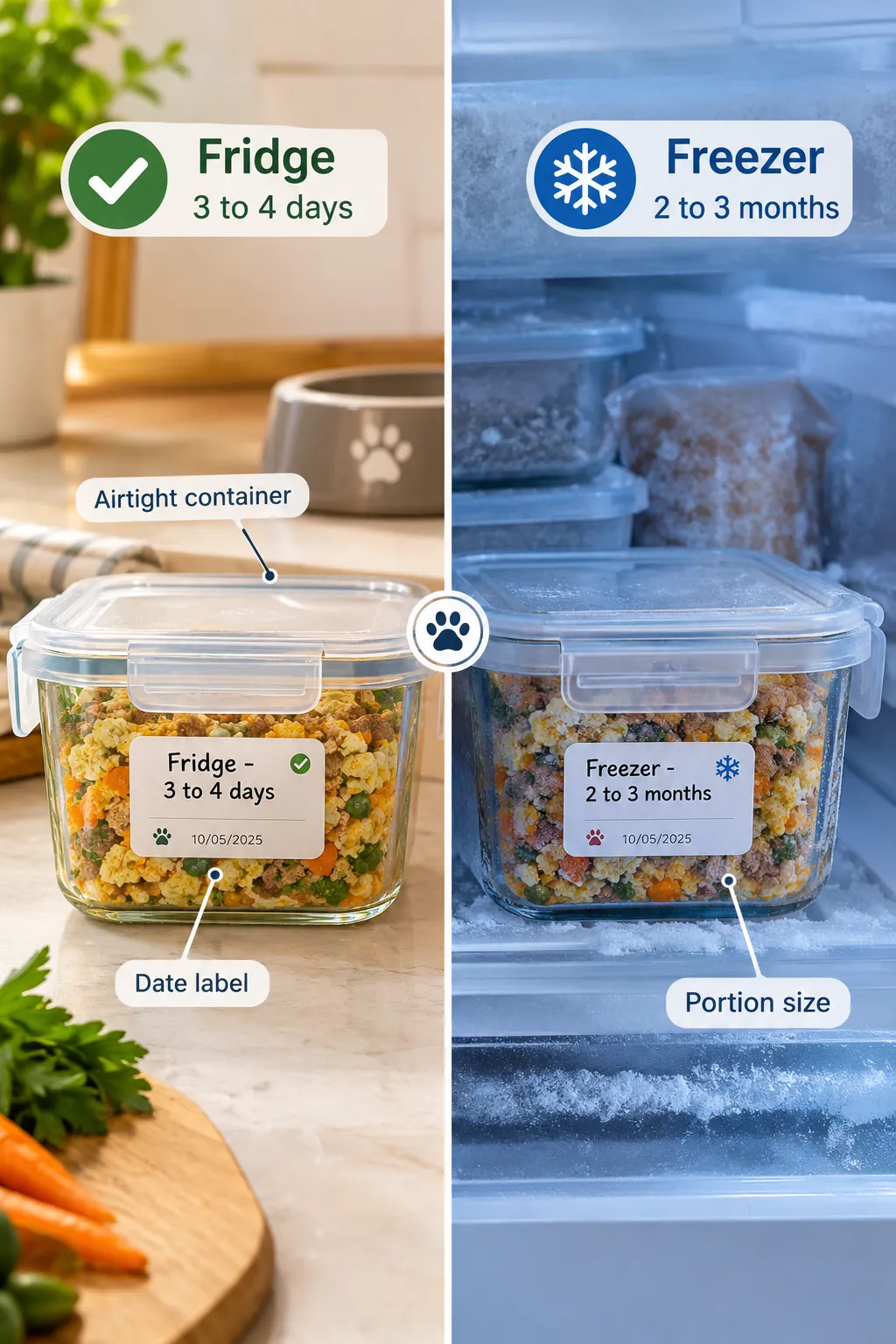
Fridge storage:
- Use an airtight glass or BPA-free plastic container
- Store for up to 3-4 days maximum
- Label with the date you made it
Freezer storage:
- Portion into individual meal-sized servings before freezing
- Use freezer-safe bags or containers
- Freeze for up to 2-3 months
- Thaw overnight in the fridge – never microwave to reheat
Quick tip: Make a batch on Sunday and portion it out for the week. It saves time and keeps feeding consistent.
Is Homemade Dog Food With Eggs Cheaper Than Commercial Dog Food?
For most dog owners, yes – homemade egg-based dog food costs less per meal than premium commercial dog food, especially raw or fresh-delivery brands.
A dozen eggs typically costs $3-5 (estimate based on average U.S. grocery prices in 2026). Add in rice, vegetables, and occasional meat, and a week’s worth of meals for a medium dog can cost $15-25 depending on your location and protein choices.
Premium commercial dog food or fresh-delivery services can run $50-100+ per week for the same size dog.
That said, the AKC’s homemade dog food guide points out that achieving complete nutritional balance at home requires careful planning – and potentially supplements – which adds cost. If you’re budget-focused, see homemade dog food recipes on a budget.
Can Dogs With Allergies Eat Egg-Based Dog Food?
Eggs are actually a low-allergen protein for most dogs. They’re often recommended as an alternative for dogs sensitive to chicken or beef. However, egg allergies do exist – they’re just less common.
Signs of an egg allergy in dogs include:
- Itchy skin or paws
- Ear infections
- Gastrointestinal upset (vomiting or diarrhea)
- Red or inflamed skin
If your dog shows any of these signs after eating eggs, stop feeding them and consult your vet. An elimination diet trial is the most reliable way to confirm a food allergy.
Dogs with kidney disease should also be cautious – eggs are high in phosphorus, which can be hard on compromised kidneys. Dogs with pancreatitis need to watch fat intake, and egg yolks are relatively high in fat.
Are There Any Risks or Side Effects of Feeding Dogs Eggs?
Eggs are safe for most dogs, but a few real risks are worth knowing.
Main risks:
- Salmonella – from raw eggs; eliminated by cooking
- Avidin – in raw egg whites; blocks biotin absorption; eliminated by cooking
- Excess calories – egg yolks are calorie-dense; too many can cause weight gain
- High phosphorus – a concern for dogs with kidney disease
- High fat – a concern for dogs prone to pancreatitis
Paws & Tales nutrition guide notes that for healthy dogs with no underlying conditions, these risks are minimal when eggs are fed in appropriate amounts.
What Other Proteins Can I Mix With Eggs in Dog Food?
Eggs work well as a base protein or a complement to other proteins. Mixing them with a second protein source creates a more complete amino acid profile and adds variety.
Best proteins to pair with eggs:
- Chicken – lean, digestible, widely available
- Salmon – adds omega-3 fatty acids
- Lean ground beef – higher in iron and zinc
- Turkey – low-fat option for weight-conscious dogs
- Beef liver – nutrient-dense; use in small amounts (see homemade dog food recipes with beef liver)
For high-protein meal ideas, check out these high-protein low-carb homemade dog food recipes.
Do Vets Recommend Homemade Dog Food With Eggs?
Vets generally support eggs as a supplement or occasional protein in a dog’s diet. The more nuanced answer is that most vets are cautious about fully homemade diets – not because of eggs specifically, but because achieving complete nutritional balance at home is genuinely difficult.
Purina’s veterinary nutrition team recommends consulting a board-certified veterinary nutritionist if you plan to feed homemade food as your dog’s primary diet. They can help you formulate a recipe that meets AAFCO nutritional standards.
Using eggs as a supplement to a commercial diet? That’s much simpler and widely supported.
Can Puppies Eat Homemade Dog Food With Eggs?
Puppies can eat cooked eggs in small amounts, but a fully homemade egg-based diet is not recommended for puppies without professional formulation. Puppies have very specific nutritional needs for growth – including precise calcium-to-phosphorus ratios – that are hard to meet with home cooking alone.
A scrambled egg mixed into puppy food a few times a week is fine. But relying on homemade egg recipes as a puppy’s primary food source without vet guidance risks nutritional deficiencies during a critical growth window.
For puppy-specific meal ideas, see these fresh puppy food recipes.
How Often Should I Feed My Dog Homemade Egg Recipes?
For most healthy adult dogs, egg-based homemade meals can be fed daily if the recipe is nutritionally balanced. If you’re using eggs as a supplement to commercial kibble, 3-5 times per week is a practical and safe frequency.
The key is consistency and balance over time – not perfection at every single meal. Rotate proteins, vary the vegetables, and check in with your vet annually to make sure your dog’s bloodwork looks good.
Conclusion
Homemade dog food recipes with eggs are one of the easiest, most affordable ways to boost your dog’s nutrition. Eggs are digestible, protein-rich, and genuinely good for most healthy dogs when cooked and served in appropriate amounts.
Here’s what to do next:
- Start simple – try Recipe 1 (scrambled egg and brown rice) this week
- Cook the eggs – always, no exceptions
- Stick to one egg per day for medium dogs; adjust by size
- Pair with dog-safe vegetables for a more complete meal
- Store properly – airtight container, 3-4 days in the fridge
- Talk to your vet before switching to a fully homemade diet, especially for puppies or dogs with health conditions
Also consider adding vitamins to your homemade dog food to fill any nutritional gaps. And if you want more variety, explore these 11 easy-to-digest homemade dog food recipes for more inspiration.
Your dog doesn’t need a fancy meal plan – just real food, made with care. 🐾
Frequently Asked Questions
Can I feed my dog eggs every day?
Yes, for most healthy adult dogs, one cooked egg per day is safe. Keep eggs under 10% of total daily calories and monitor your dog’s weight over time.
Are scrambled eggs or hard-boiled eggs better for dogs?
Both are equally safe and nutritious. The key is to cook them plain – no butter, oil, salt, or seasoning. Use whichever is easiest for you.
Can dogs eat eggshells?
Yes, ground eggshells are a source of calcium for dogs. Dry the shells, grind them into a fine powder, and add a small amount to food. Don’t feed large shell pieces that could be a choking hazard.
What happens if my dog eats a raw egg?
One raw egg is unlikely to cause serious harm, but it does carry a Salmonella risk and can block biotin absorption over time. Switch to cooked eggs going forward.
Can I add eggs to my dog’s kibble?
Yes, a scrambled or hard-boiled egg mixed into dry kibble is a simple and popular way to boost protein and palatability. It’s one of the easiest things you can add to your dog’s dry food.
Are egg yolks safe for dogs?
Yes, but yolks are higher in fat and calories than whites. For overweight dogs or those prone to pancreatitis, consider using mostly egg whites.
Can senior dogs eat egg-based homemade food?
Generally yes, but senior dogs often have changing protein and phosphorus needs. Check with your vet, especially if your dog has kidney or liver issues.
Do eggs help with a dog’s coat?
Yes. The fatty acids and biotin in eggs support skin health and coat shine when fed consistently as part of a balanced diet.
How do I know if my dog is allergic to eggs?
Watch for itchy skin, ear infections, vomiting, or diarrhea after feeding eggs. If symptoms appear, stop eggs and consult your vet for an elimination diet trial.
Can I use egg whites only in dog food recipes?
Yes, cooked egg whites are safe and lower in fat. Just make sure they’re fully cooked – raw egg whites contain avidin, which interferes with biotin absorption.
Is homemade egg dog food complete and balanced?
Not automatically. Most homemade recipes need supplements to meet AAFCO nutritional standards. Consult a veterinary nutritionist if eggs are a primary food source.
Can dogs eat eggs from any bird?
Chicken eggs are the most common and well-studied. Duck eggs are also safe in similar amounts. Exotic bird eggs haven’t been well-studied for dogs – stick to chicken or duck.