

Last updated: August 15, 2026
Quick Answer: You can make homemade dry dog food recipes that last up to 30 days by combining a low-moisture baking method with smart freezer storage. Fully baked kibble-style food stored in an airtight container can stay fresh at room temperature for up to 1 month, while frozen portions maintain quality for up to 3 months. The key is making 6 separate batches, freezing most of them, and thawing one batch at a time throughout the month.
Key Takeaways
- 🐾 Fully baked, low-moisture homemade dry dog food can last up to 1 month in an airtight container at room temperature, or up to 6 months frozen.
- 🥩 The best homemade dog food recipes use lean protein (turkey, chicken, beef), complex carbs (brown rice, oats), and dog-safe vegetables (carrots, peas, sweet potato).
- 🧪 Most homemade dog food recipes are not nutritionally complete without added supplements – always consult your vet before switching your dog’s diet long-term.
- 🍚 Brown rice is a great carbohydrate base for dogs. It’s easy to digest and dogs love it mixed into a recipe.
- 🧊 A 6-batch plan works best when you freeze 5 batches and keep 1 in the fridge or pantry for daily use.
- ❄️ Cooked homemade dog food that isn’t fully dried should be refrigerated within 2 hours and used within 3-5 days.
- 🏥 Vet approval is strongly recommended before starting any homemade diet, especially for dogs with kidney disease, diabetes, or allergies.
- 📦 Glass jars, BPA-free airtight containers, and silicone freezer pouches are the best storage options for homemade kibble.
- 💰 Homemade dry dog food can cost 30-50% less than premium commercial kibble when made in bulk.
- 🐕 Senior dogs, small dogs, and dogs with sensitive stomachs can all benefit from homemade recipes tailored to their specific needs.
Our Journey With a Dog With Kidney Disease (And Why We Started Making Homemade Dog Food)
Our dog Max was diagnosed with early-stage kidney disease in late 2020. The vet said his commercial kibble was too high in sodium and phosphorus, and that a lower-protein, kidney-friendly diet could slow the disease’s progress. That moment sent us down a rabbit hole of research, recipe testing, and late-night conversations about what dogs eat and why it matters so much.
We started with a basic recipe from a vet nutritionist. Then we found a community online – people like Meg from thismessisours, Eliza Clendenin, and dozens of other dog owners who had made the same switch. Reading through their comments and replies gave us so much confidence.
One reply from Meg thismessisours says it perfectly: “Once you see how much your dog loves real food, going back to commercial kibble feels impossible.” That stuck with us.
This article is everything we’ve learned about homemade dry dog food recipes – including 6 batch recipes that can get you through a full 30-day month with minimal stress.
Why Kidney Disease Changed Everything About How We Feed Our Dog
When Max was first diagnosed, the vet handed us a printed diet sheet and said, “Try to reduce sodium and phosphorus.” That’s it. No recipe. No guidance on how much to feed him per day. Just a list of things to avoid.
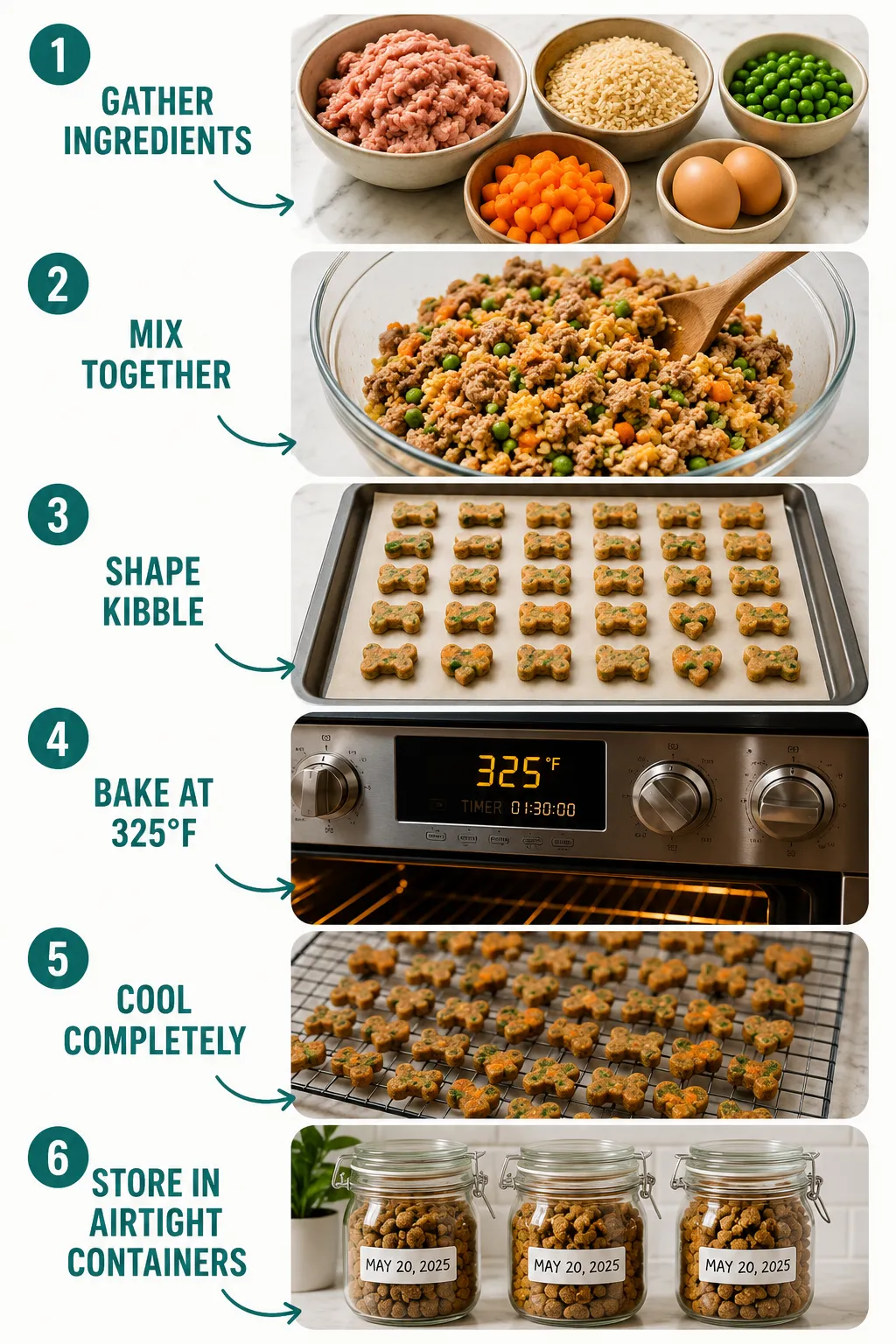
So we started cooking. We made a simple brown rice and turkey base, added cooked carrots and peas, and baked it into small kibble-like pieces. Max loved it from day one.
Within about 3 months, his bloodwork showed improvement. His vet was genuinely surprised. She says she doesn’t always recommend homemade diets, but in Max’s case, the results spoke for themselves.
We’ve been making homemade dog food ever since – and we’ve refined the process so much that we can now prep a full 30-day supply in just one Sunday afternoon.
Hydration Is Very Important for Dogs With Kidney Disease
Dogs with kidney disease need much more water than healthy dogs. The kidneys rely on good hydration to filter waste from the blood, and when they’re compromised, dehydration can make things worse fast.
We add a dog-friendly bone broth to Max’s food every single day. It encourages him to drink more and adds flavor he absolutely loves. We also make sure fresh water is always available – multiple bowls around the house.
If your dog has kidney disease, talk to your vet about adding a homemade bone broth recipe to their daily diet. It’s one of the simplest things you can do to support their health.
Dog-Friendly Bone Broth Recipe (Simple Version):
- 2-3 lbs raw beef or chicken bones (no seasoning)
- 8 cups water
- 1 tablespoon apple cider vinegar (helps pull minerals from bones)
- Optional: 1 cup chopped carrots, 1 stalk celery
Combine everything in a large pot. Bring to a boil, then reduce to a simmer for 12-24 hours. Strain out all bones and solids. Let cool completely. Store in the fridge for up to 4 days or freeze in ice cube trays for easy daily portions.
Never add onion, garlic, or salt to bone broth for dogs. These are toxic. Check out 15 everyday foods that can kill your dog so you know exactly what to avoid.
What About a Raw Diet? Let’s Get That Out of the Way First
Many people ask about raw diets when they find out we make our own dog food at home. The short answer: raw diets can work, but they come with real food safety risks that most home cooks aren’t equipped to manage.
When people find out we make our own dog food at home, they always ask, “What about a raw diet?” So let’s address that directly. Raw diets – sometimes called BARF (Biologically Appropriate Raw Food) – involve feeding dogs uncooked meat, bones, and vegetables. Some dogs love it and do well on it. But the American Animal Hospital Association and most veterinary organizations caution against raw diets due to risks of bacterial contamination like Salmonella and E. coli – not just for your dog, but for your family too.
For dogs with kidney disease, immune issues, or compromised health, raw diets are especially risky. Cooking food kills pathogens and makes nutrients more bioavailable for many dogs.
Why we chose cooked and baked over raw:
- Safer for dogs with health conditions
- Easier to control nutrient content
- Much longer shelf life (cooked and dried kibble vs. raw meat)
- Less risk of cross-contamination in the kitchen
- Easier to batch cook and freeze for 30 days
If you’re committed to a raw approach, please work with a veterinary nutritionist. For the rest of us, homemade dry dog food recipes are a much more practical and safe choice.
What Ingredients Do I Need to Make Homemade Dry Dog Food?
The best homemade dry dog food recipes use lean protein, digestible carbohydrates, dog-safe vegetables, healthy fats, and a vet-recommended supplement blend. Most recipes call for just 5-7 ingredients that you can find at any grocery store.
Here’s a breakdown of what goes into a solid homemade dog food recipe:
Proteins (Choose One or Combine)
- Ground turkey – lean, easy to digest, dogs love it
- Chicken breast or thighs – affordable, high in protein
- Lean ground beef – great for dogs that need more calories
- Salmon – excellent for dogs with skin issues (rich in omega-3s)
- Eggs – cooked eggs are a fantastic protein boost; dogs love scrambled eggs mixed into food
Carbohydrates (Choose One or Two)
- Brown rice – one of the best options; easy to digest, dogs eat it happily
- Oats – gentle on the stomach, great for sensitive dogs
- Sweet potato – naturally sweet, high in fiber and vitamins
- Quinoa – complete protein, good for grain-sensitive dogs
Vegetables (Dog-Safe Only)
- Carrots (cooked or raw)
- Peas (frozen or fresh, not canned with salt)
- Green beans
- Zucchini
- Spinach (in small amounts)
- Broccoli (small amounts only)
Fats and Extras
- Fish oil or flaxseed oil (omega-3 fatty acids)
- Coconut oil (small amounts)
- Cooked eggs for binding in kibble recipes
What to Avoid
Never add these to any homemade dog food recipe:
- Onions and garlic (toxic)
- Grapes and raisins (toxic)
- Xylitol (found in some peanut butters – deadly)
- Macadamia nuts
- Chocolate
- Avocado
- Excessive salt or sodium
For a full list of dangerous foods, see 15 everyday foods that can kill your dog.
Now Let’s Break Down the Recipes: 6 Homemade Dry Dog Food Recipes for a Full Month
These 6 homemade dry dog food recipes are designed to rotate through a full 30-day month. Each recipe makes about 5-7 days of food for a medium-sized dog (25-50 lbs). Adjust portions based on your dog’s size and daily calorie needs.
The key to making these last 30 days is the storage strategy: make all 6 batches in one session, freeze 5 of them, and keep 1 in an airtight container in the pantry or fridge. Thaw one batch at a time as needed.
Recipe 1: Classic Turkey and Brown Rice Kibble
This is the recipe that started it all for us. It’s the one Meg from thismessisours says she makes most often, and it’s easy to see why. Dogs love the smell of turkey baking, and the brown rice gives it a satisfying crunch once it’s fully dried.
Ingredients:
- 2 lbs ground turkey (cooked and drained)
- 3 cups cooked brown rice
- 1 cup cooked peas
- 1 cup grated carrots
- 2 eggs (beaten)
- 2 tablespoons fish oil
- 1 cup whole wheat flour or oat flour (for binding)
Instructions:
- Preheat oven to 325°F (165°C).
- Combine all ingredients in a large mixing bowl. Stir until a thick dough forms.
- Roll out the dough to about 1/4 inch thickness on a parchment-lined baking sheet.
- Score into small kibble-sized squares with a knife or pizza cutter.
- Bake for 45-55 minutes until golden brown and firm.
- Remove from oven and let cool completely on a wire rack.
- Store in an airtight container. Place in a cool, dry pantry for up to 1 month, or freeze for up to 6 months.
Notes: Make sure the kibble is completely cool and dry before storing. Any moisture left in the pieces will cause mold. If pieces feel soft after cooling, return them to the oven for another 10-15 minutes at a lower temperature (275°F).
Nutrition (approximate per 1 cup serving):
- Calories: ~320
- Protein: ~28g
- Sodium: ~85mg
- Fat: ~9g
Recipe 2: Salmon and Sweet Potato Bites
This recipe is a favorite for dogs with dry skin or allergies. Salmon is rich in omega-3 fatty acids, and sweet potato adds natural sweetness that dogs love. Eliza Clendenin says this is the recipe she switched to after her dog developed a chicken allergy in august 2021.
Ingredients:
- 1.5 lbs canned salmon (in water, no salt added) or fresh cooked salmon
- 2 cups mashed sweet potato (cooked)
- 1 cup cooked brown rice
- 1 cup oat flour
- 2 eggs
- 1 tablespoon flaxseed oil
Instructions:
- Preheat oven to 350°F (175°C).
- Combine salmon, sweet potato, brown rice, eggs, and flaxseed oil in a large bowl.
- Add oat flour and stir until a thick dough forms.
- Spread onto a parchment-lined baking sheet, about 1/4 inch thick.
- Bake for 40-50 minutes until firm and lightly browned.
- Remove and cool completely. Break into bite-sized pieces.
- Store in an airtight container or freeze in portioned bags.
Notes: Salmon and sweet potato kibble has slightly more moisture than the turkey recipe. If you plan to store at room temperature, make sure to dry it fully – an extra 10 minutes in the oven at 275°F helps. For best results, refrigerate and use within 2 weeks, or freeze.
Recipe 3: Beef and Vegetable Homemade Kibble
This is a great recipe for active, high-energy dogs. Lean ground beef provides more calories and iron than turkey or chicken. A reply from a reader in february 2021 on a popular dog food blog says their border collie went from picky eater to food-obsessed after switching to this recipe.
Ingredients:
- 2 lbs lean ground beef (90/10, cooked and drained)
- 2 cups cooked brown rice
- 1 cup chopped green beans (cooked)
- 1 cup grated zucchini (excess moisture squeezed out)
- 2 eggs
- 1 cup whole wheat flour
- 1 tablespoon coconut oil
Instructions:
- Preheat oven to 325°F.
- Mix all ingredients together in a large bowl until combined.
- Press mixture onto a lined baking sheet, about 1/3 inch thick.
- Bake for 50-60 minutes until firm throughout.
- Cool completely, then break or cut into small pieces.
- Store in an airtight container. Freeze portions not used within 1 week.
Notes: Beef has more fat than turkey, so drain it very well after cooking. Excess fat can make the kibble go rancid faster. This recipe is not ideal for dogs on a low-fat diet.
Recipe 4: Chicken and Oat Homemade Dog Food Recipe
This is probably the most popular homemade dog food recipe on the internet, and for good reason. Chicken is affordable, widely available, and almost every dog loves it. Thismessisours says this recipe is the one that converted their whole family to homemade feeding.
For more chicken-based ideas, check out these 5 heartwarming homemade dog food recipes with chicken.
Ingredients:
- 2 lbs ground chicken or shredded cooked chicken breast
- 2 cups rolled oats (cooked)
- 1 cup cooked carrots (mashed)
- 1 cup cooked peas
- 2 eggs
- 1/2 cup plain pumpkin puree (not pie filling)
- 1 cup oat flour
Instructions:
- Preheat oven to 325°F.
- Combine all ingredients and stir well.
- Spread onto baking sheets lined with parchment paper.
- Bake 45-55 minutes until golden and firm.
- Cool completely on a wire rack.
- Store in airtight containers. Freeze extra batches.
Notes: Pumpkin adds fiber and helps with digestion. It’s especially good for dogs with loose stools. This recipe is gentle enough for puppies and senior dogs.
Recipe 5: Turkey and Egg Homemade Dog Kibble (Kidney-Friendly)
This is the recipe we make for Max. It’s lower in phosphorus and sodium than most commercial kibble, which makes it safer for dogs with kidney disease. The vet helped us formulate this one, and she says it’s been a big part of his improvement since 2021.
Ingredients:
- 1.5 lbs ground turkey (very lean, cooked)
- 3 cups cooked white rice (lower phosphorus than brown rice for kidney dogs)
- 1/2 cup cooked egg whites only (no yolks – lower phosphorus)
- 1 cup cooked green beans
- 1/2 cup cooked carrots
- 1 tablespoon fish oil
- 1 cup rice flour (for binding)
Instructions:
- Preheat oven to 300°F (lower temp for gentler drying).
- Combine all ingredients and mix well.
- Spread thin on parchment-lined baking sheets (about 1/4 inch).
- Bake for 60-70 minutes until completely firm and dry.
- Cool fully before storing.
- Store in airtight containers. Refrigerate or freeze.
Notes: For kidney disease dogs, always have your vet review the recipe before feeding. Phosphorus and protein levels need to be monitored carefully. This recipe is NOT suitable as a general recipe for healthy dogs – it’s intentionally lower in protein.
Recipe 6: Veggie-Loaded Homemade Dog Food Recipe (Great for Weight Management)
This recipe is perfect for dogs that need to lose a little weight. It’s lower in calories but still filling, thanks to all the fiber from vegetables. A comment from august 2020 on a popular pet blog says a reader’s lab mix lost 4 lbs in 2 months after switching to a similar recipe.
Ingredients:
- 1 lb ground turkey or chicken
- 1 cup cooked brown rice
- 1 cup cooked lentils (excellent fiber and plant protein)
- 1 cup chopped spinach (cooked and drained)
- 1 cup cooked broccoli (chopped fine)
- 1 cup grated carrots
- 2 eggs
- 1 cup oat flour
Instructions:
- Preheat oven to 325°F.
- Combine all ingredients and mix thoroughly.
- Spread on lined baking sheets.
- Bake 50-60 minutes until firm.
- Cool completely and break into pieces.
- Store in airtight containers. Freeze extra batches.
Notes: Lentils are a great addition for weight management dogs. They’re high in fiber and protein but lower in fat than meat-heavy recipes. Some dogs take a few days to adjust to lentils – introduce slowly if your dog has a sensitive stomach.
For more ideas suited to dogs with digestive issues, see 7 homemade dog food recipes for a sensitive stomach that actually work.
Can Dogs Eat Brown Rice? Homemade Meals That Your Pups Will Love
Yes, dogs can absolutely eat brown rice, and it’s one of the best carbohydrate sources you can include in a homemade dog food recipe. Brown rice is easy to digest, gentle on the stomach, and dogs love the mild, nutty flavor it adds to their food.
Brown rice is a whole grain that provides fiber, B vitamins, and minerals. It’s a much better choice than white rice for most healthy dogs because it retains more nutrients. That said, for dogs with kidney disease, white rice is sometimes preferred because it’s lower in phosphorus.
Brown rice tips for homemade dog food:
- Always cook it fully before adding to recipes
- Use plain brown rice – no seasonings, butter, or salt
- About 1/4 to 1/3 of the recipe by volume is a good ratio
- Cooked brown rice can be made in bulk and frozen in 1-cup portions
One comment from a reader in october 2022 says their dogs eat brown rice every single day and their coats have never looked better. Another reply from january 2021 says switching from kibble to a brown rice base made a huge difference in their dog’s energy levels.
The thismessisours community has a lot of love for brown rice. Meg thismessisours says she uses it in almost every recipe she makes, and her dogs have been thriving on it for years.
Can Dogs Eat Eggs? The Incredible, Edible Treat All Dogs Love
Yes, dogs can eat cooked eggs, and they’re one of the best protein sources you can add to a homemade dog food recipe. Eggs are rich in protein, healthy fats, vitamins A and D, and amino acids that support muscle health and coat quality. Dogs love them.
Always cook eggs before giving them to your dog. Raw eggs carry a risk of Salmonella and also contain avidin, a protein that blocks biotin absorption when eaten raw. Scrambled, hard-boiled, or mixed into a baked recipe – all are great options.
How to use eggs in homemade dog food:
- As a binder in kibble recipes (2 eggs per batch)
- Scrambled and mixed into food as a protein topper
- Hard-boiled and sliced as a treat
- Egg whites only for kidney disease dogs (lower phosphorus)
One reader reply from june 2021 says their dog goes absolutely crazy for scrambled eggs mixed into his homemade food. Another comment from september 2020 says adding eggs to their recipe made the kibble hold together much better during baking.
Eggs are also budget-friendly. A dozen eggs costs very little and adds significant nutritional value to any homemade recipe. If you’re looking for ways to keep costs down, check out these homemade dog food recipes on a budget.
Homemade Dog Food Seasoning: What’s Safe and What’s Not
The most important rule about seasoning homemade dog food is simple: keep it plain. Dogs don’t need salt, pepper, garlic, or any of the seasonings we add to our own food. In fact, many common seasonings are dangerous for dogs.
Safe flavor additions for dog food:
- Fresh or dried parsley (small amounts – freshens breath)
- Turmeric (anti-inflammatory, small pinch)
- Ginger (helps with nausea, very small amounts)
- Plain cinnamon (trace amounts only)
- Fresh or dried rosemary (natural preservative, small amounts)
Absolutely never add:
- Garlic or garlic powder (toxic even in small amounts)
- Onion or onion powder (destroys red blood cells)
- Salt or sodium-heavy ingredients
- Nutmeg (toxic to dogs)
- Chives or leeks
- Artificial sweeteners (especially xylitol)
A comment from november 2020 on a pet food blog says a reader accidentally added garlic powder to their dog’s food thinking it was a small amount. Their dog got very sick. The vet says even small amounts of garlic can cause hemolytic anemia in dogs.
The good news is that most dogs love the natural flavors of cooked meat, brown rice, and vegetables. You really don’t need to add anything extra to make a recipe they’ll love.
What’s the Difference Between Homemade and Store-Bought Dog Food?
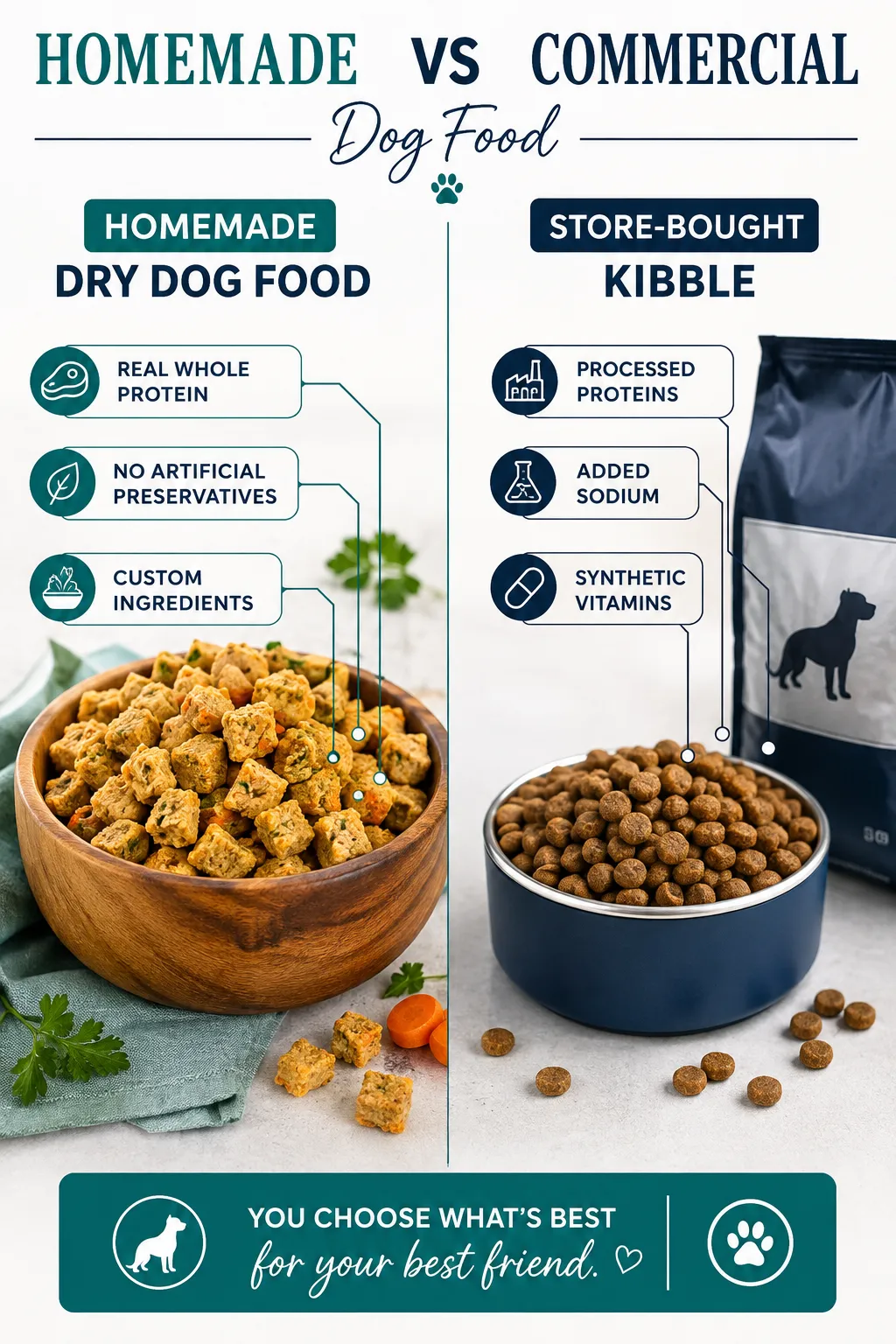
Homemade dry dog food and commercial kibble differ in ingredients, processing, shelf life, cost, and nutritional control. The biggest difference is transparency – when you make food at home, you know exactly what’s in it.
Homemade Dog Food: Pros and Cons
Pros:
- You control every ingredient
- No artificial preservatives, colors, or fillers
- Can be customized for health conditions
- Fresh food – dogs love it
- Can be cheaper when made in bulk
- No recalls to worry about
Cons:
- Time-consuming to make
- Requires careful attention to nutrition
- Can be nutritionally incomplete without supplements
- Shorter shelf life than commercial kibble
- Requires freezer space for batch cooking
Commercial Kibble: Pros and Cons
Pros:
- Convenient and shelf-stable
- Formulated to meet AAFCO nutritional standards
- Easy to measure and portion
- Long shelf life
- Wide variety of formulas
Cons:
- Highly processed
- May contain low-quality protein sources
- Higher sodium content in many brands
- Less transparency about ingredient sourcing
- Can be expensive for premium brands
A reply from october 2020 on a dog food blog says the reader switched from commercial kibble to homemade food after their dog had a reaction to a recalled brand. They say they’ll never go back to store-bought.
The thismessisours community often discusses this topic. Meg thismessisours says the transition from kibble to homemade food was the best decision she ever made for her dogs, and many replies echo that sentiment.
Is Homemade Dry Dog Food Nutritionally Complete for Dogs?
Most homemade dog food recipes are not nutritionally complete on their own. Dogs need a precise balance of vitamins, minerals, amino acids, and fatty acids that is very difficult to achieve through food alone. This is why adding supplements to homemade recipes is so important.
The American Animal Hospital Association says that any homemade diet intended for long-term feeding must be formulated by a veterinary professional to remain complete and balanced. This is especially true for puppies, pregnant dogs, senior dogs, and dogs with health conditions.
Do I Need to Add Supplements to Homemade Dog Food Recipes?
Yes, in almost every case, you need to add supplements to homemade dog food. The most commonly recommended supplements include calcium (to balance the phosphorus in meat), omega-3 fatty acids, vitamin D, vitamin E, and B vitamins.
The easiest way to cover your bases is to use a commercially available supplement blend designed for homemade dog food. Brands like Balance IT and Rx Vitamins for Pets make supplements specifically for home-cooked dog diets.
For a detailed breakdown of what to add, see vitamins to add to homemade dog food.
Common supplements for homemade dog food:
| Supplement | Why It’s Needed | Typical Form |
|---|---|---|
| Calcium | Balances phosphorus in meat | Bone meal, calcium carbonate |
| Omega-3 | Skin, coat, inflammation | Fish oil capsules |
| Vitamin D | Bone health | D3 drops |
| Vitamin E | Antioxidant | Capsules |
| B vitamins | Energy metabolism | B-complex supplement |
| Zinc | Immune function | Zinc chelate |
| Iodine | Thyroid function | Kelp powder |
A reader comment from august 2024 says they spent 3 months feeding homemade food without supplements before their vet noticed deficiencies in bloodwork. The vet says this is one of the most common mistakes people make with homemade diets. Don’t skip the supplements.
How Long Does Homemade Dry Dog Food Last in Storage?
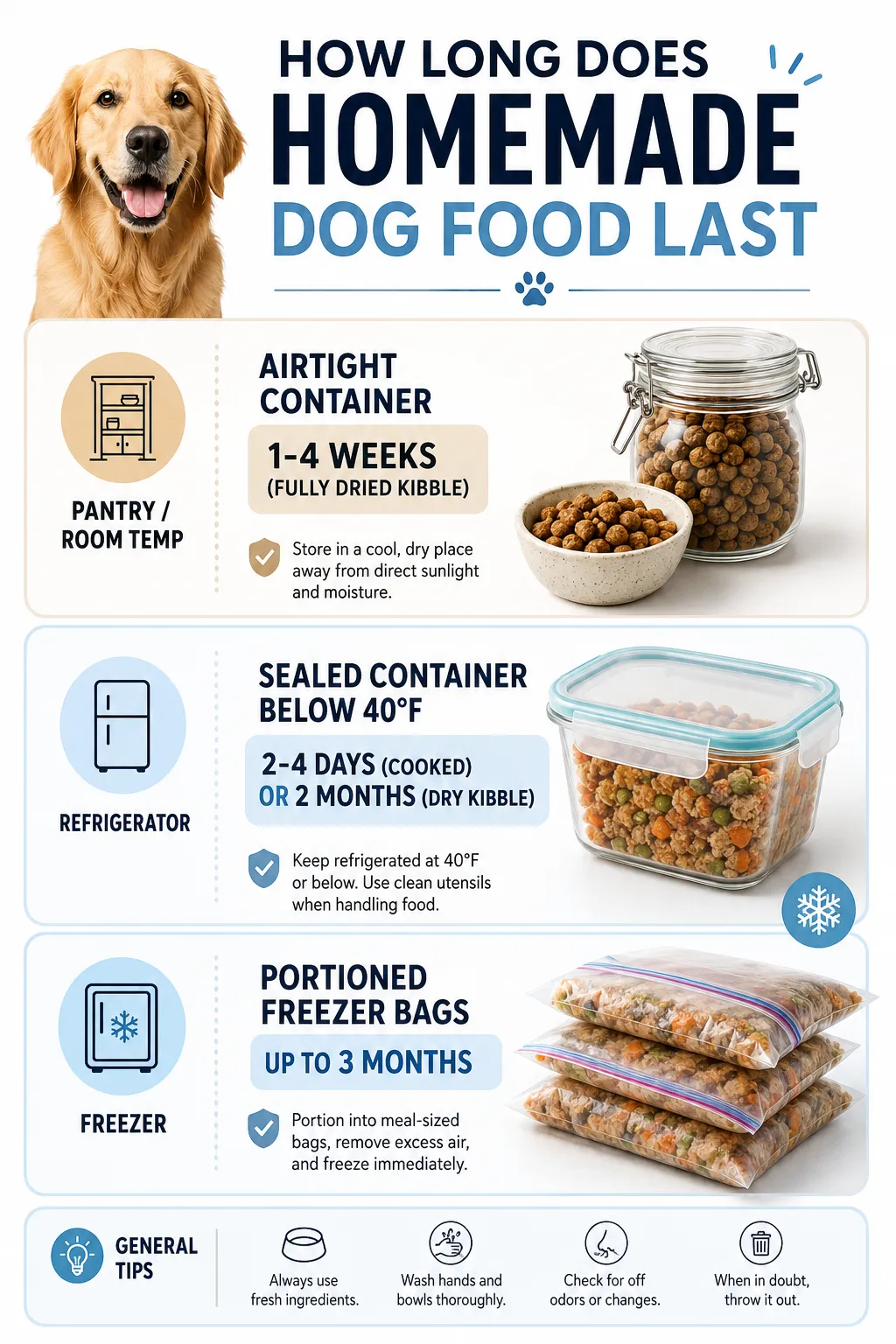
Fully baked, low-moisture homemade dry dog food can last up to 1 month at room temperature in an airtight container, 2 months in the refrigerator, and up to 6 months in the freezer. However, these timelines only apply to truly dry kibble – any recipe with significant moisture needs to be refrigerated or frozen much sooner.
According to storage guidelines for homemade dog food, cooked (non-dried) homemade dog food should be refrigerated within 2 hours of cooking and used within 3-5 days. Anything not used within that window should be frozen.
Room Temperature Storage
- Fully baked, low-moisture kibble: Up to 1 month in an airtight container in a cool, dark place
- Partially dried or soft recipes: 1-2 days maximum at room temperature
- Important: Baked and air-dried kibble typically lasts 1-2 weeks at room temperature, while dehydrated recipes can last 2-4 weeks
Refrigerator Storage
- Fully dried kibble: Up to 2 months
- Cooked (not dried) homemade food: 3-5 days maximum
- Keep at or below 40°F at all times
Freezer Storage
- Fully dried kibble: Up to 6 months
- Cooked homemade food: 2-3 months for best quality
- Freeze in individual portions or weekly batches for easy thawing
Can I Freeze Homemade Dry Dog Food to Make It Last Longer?
Yes, freezing is the best way to extend the life of homemade dog food. Freezing in sealed bags or silicone pouches preserves quality for up to 3 months for cooked food and up to 6 months for fully dried kibble. The key is to portion before freezing so you only thaw what you need.
Freezing tips:
- Divide into 5-7 day portions before freezing
- Use freezer-safe zip bags, silicone pouches, or glass containers
- Label everything with the date and recipe name
- Thaw in the refrigerator overnight – never at room temperature
- Use thawed food within 24-48 hours
- Never refreeze food that has already been thawed
Important: Do not microwave frozen kibble. Uneven heating creates moist spots that can spoil and harbor bacteria.
What’s the Best Container to Store Homemade Dog Food?
The best containers for homemade dry dog food are airtight glass jars, BPA-free plastic containers with locking lids, and silicone freezer bags. The most important feature is an airtight seal – exposure to air is the main cause of spoilage and rancidity.
Top storage container options:
- Glass mason jars – great for pantry or fridge storage, easy to see contents, dishwasher safe
- BPA-free airtight plastic containers – lightweight, stackable, good for larger batches
- Silicone freezer bags – ideal for freezer storage, reusable, space-efficient
- Stainless steel containers – durable, no chemical leaching, good for fridge storage
You can find all of these options on Amazon. Look for containers with rubber gasket seals for the best airtight performance.
What to avoid:
- Paper bags or cardboard boxes (absorb moisture, no seal)
- Loosely covered bowls
- The original cooking pan or baking sheet
- Plastic bags without a proper seal
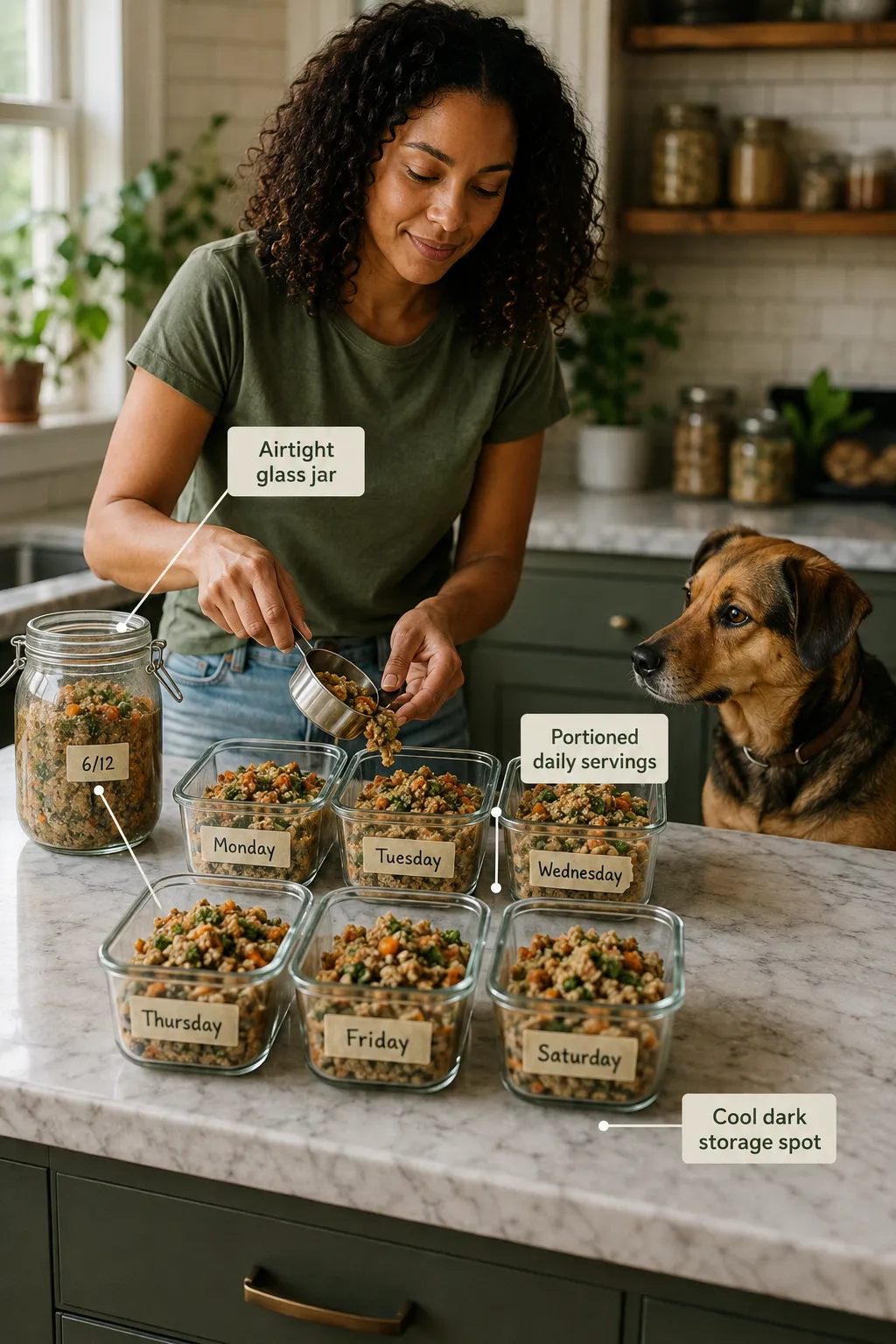
Always label containers with the date made and the recipe name. This makes it easy to rotate through your 6 batches in order and avoid feeding expired food.
Is Homemade Dry Dog Food Cheaper Than Commercial Kibble?
In most cases, yes – homemade dry dog food is cheaper than premium commercial kibble when you make it in bulk. The savings depend on the ingredients you choose, your dog’s size, and how much you buy at once.
A rough cost comparison for a medium-sized dog (30 lbs):
- Premium commercial kibble: $60-$90 per month
- Homemade dry dog food (bulk ingredients): $30-$55 per month
That’s a potential savings of $30-$40 per month, or $360-$480 per year. The more dogs you have, the bigger the savings.
Ways to reduce the cost of homemade dog food:
- Buy protein in bulk (warehouse stores like Costco)
- Use less expensive cuts (ground turkey, chicken thighs)
- Buy rice, oats, and flour in large bags
- Grow some vegetables at home (carrots, zucchini, green beans are easy)
- Buy eggs by the flat instead of by the dozen
A reader reply from march 2021 says they cut their dog food budget in half after switching to homemade recipes. They buy ground turkey in 5-lb packages and brown rice in 10-lb bags, and say the cost per day is much less than what they were spending on premium kibble.
Can I Use a Regular Oven to Make Dry Dog Food at Home?
Yes, a regular home oven works perfectly for making homemade dry dog food. Most recipes call for temperatures between 300°F and 350°F, which any standard oven can handle. The key is baking long enough to remove moisture and create a truly dry, shelf-stable kibble.
Oven tips for making homemade dog food:
- Use parchment paper to prevent sticking and make cleanup easy
- Spread the mixture thin (1/4 to 1/3 inch) for even drying
- Rotate pans halfway through baking
- Check doneness by pressing on a piece – it should feel firm and dry, not soft
- If pieces are still soft after the recommended time, lower the temp to 275°F and bake another 15-20 minutes
- Let cool completely on a wire rack before storing – steam from warm food creates moisture that causes mold
Alternative methods:
- Food dehydrator: Great for making jerky-style treats and lower-moisture kibble. Dehydrated recipes can last 2-4 weeks at room temperature in airtight storage.
- Air fryer: Works for small batches of treats. See 7 irresistible homemade dog treats in air fryer for ideas.
- Slow cooker/crockpot: Best for wet food, not dry kibble. See 5 crockpot dog food recipes vet-approved for that approach.
The oven is the most accessible and reliable method for most home cooks. You don’t need any special equipment to get started.
How Much Homemade Dry Dog Food Should I Feed My Dog Per Day?
The amount of homemade dry dog food to feed per day depends on your dog’s weight, age, activity level, and health status. A general starting point is feeding about 2-3% of your dog’s ideal body weight per day, split into two meals.
For a more detailed breakdown, see how much food should I feed my dog daily.
General daily feeding guidelines:
| Dog Weight | Daily Food Amount (approx.) |
|---|---|
| 10 lbs | 1/2 to 3/4 cup |
| 20 lbs | 3/4 to 1.5 cups |
| 30 lbs | 1.5 to 2 cups |
| 50 lbs | 2 to 3 cups |
| 75 lbs | 3 to 4 cups |
| 100 lbs | 4 to 5 cups |
These are starting estimates only. Watch your dog’s weight and adjust as needed.
When to feed:
Most dogs do well with 2 meals per day – one in the morning and one in the evening. Some small dogs or puppies may need 3 smaller meals per day. Senior dogs often do better with smaller, more frequent meals.
A comment from august 2020 says a reader was overfeeding their dog because they didn’t account for the higher calorie density of homemade food compared to commercial kibble. Their vet says this is very common – homemade food often has more calories per cup than dry kibble, so you may need to feed less volume.
Hope this helps: Always weigh your dog monthly and adjust portions based on whether they’re gaining, losing, or maintaining weight. Your vet can help you calculate the right calorie target for your specific dog.
What Snacks Can I Feed My Dog With Kidney Disease?
Dogs with kidney disease need low-phosphorus, low-sodium snacks that don’t put extra strain on the kidneys. The best options are simple, single-ingredient treats made from dog-safe foods.
Safe snacks for dogs with kidney disease:
- Apple slices (no seeds or core)
- Watermelon (no rind or seeds)
- Blueberries (fresh or frozen)
- Cooked green beans
- Cooked carrots
- Plain rice cakes (no salt)
- Small pieces of cooked white meat chicken (no seasoning)
Snacks to avoid for kidney disease dogs:
- Cheese and dairy (high phosphorus)
- Commercial dog treats (often high sodium)
- Meat jerky (high sodium)
- Bones (high phosphorus)
- Peanut butter (high phosphorus, and check for xylitol)
A reply from a reader in april 2021 says their vet recommended blueberries as a daily treat for their kidney disease dog. They say their dog loves them and they’re easy to keep on hand.
The thismessisours community has shared many creative ideas for kidney-friendly snacks. Meg thismessisours says she keeps a small container of cooked green beans in the fridge as a go-to treat for her dogs.
How Do I Know If My Dog Is Allergic to Homemade Food?
Signs of a food allergy or sensitivity in dogs include itchy skin, red paws, ear infections, digestive upset (vomiting or diarrhea), and changes in coat quality. If you notice these symptoms after switching to a new recipe, it’s worth investigating which ingredient might be the cause.
Common food allergens in dogs:
- Beef (the most common allergen)
- Chicken (second most common)
- Dairy products
- Wheat and gluten
- Eggs (less common but possible)
- Soy
How to identify the problem ingredient:
- Switch to a simple elimination diet – just one protein and one carbohydrate your dog hasn’t eaten before
- Feed only that combination for 8-12 weeks
- If symptoms clear up, slowly reintroduce one ingredient at a time
- Watch for symptoms to return – that’s your allergen
A comment from october 2020 says a reader spent months trying to figure out why their dog was itchy before realizing it was the beef in their homemade recipe. Switching to turkey cleared it up within 2 weeks.
If your dog has ongoing digestive issues, see 7 homemade dog food recipes for a sensitive stomach that actually work for gentle recipe options.
Can Senior Dogs Eat Homemade Dry Dog Food?
Yes, senior dogs can absolutely eat homemade dry dog food, and many thrive on it. Older dogs often benefit from fresher, more digestible food with controlled sodium and phosphorus levels. The key is adjusting the recipe to meet their changing nutritional needs.
Senior dogs typically need:
- Slightly lower calories (less active)
- Higher quality, easily digestible protein
- More omega-3 fatty acids (for joint health)
- Lower sodium (kidney and heart health)
- Added joint supplements like glucosamine and chondroitin
- Softer texture if they have dental issues
For senior-specific recipes, see 7 heartwarming homemade dog food recipes for small senior dogs and 7 best homemade dog food for senior dogs to boost energy and joint health.
A reader reply from june 2021 says their 12-year-old lab became much more energetic after switching to homemade food. Their vet says the improvement in his coat and energy was noticeable within about 6 weeks.
If your senior dog has trouble chewing hard kibble, you can soften homemade dry dog food by adding a little warm water or bone broth before serving. This makes it much easier to eat while preserving the nutritional value.
What Mistakes Should I Avoid When Making Dog Food at Home?
The most common mistakes in homemade dog food are nutritional imbalances, unsafe ingredients, improper storage, and skipping vet consultation. Any one of these can harm your dog over time, even if the food looks and smells perfectly fine.
The 10 Biggest Mistakes to Avoid
1. Not consulting your vet first
This is the biggest one. The American Animal Hospital Association says any homemade diet for long-term feeding must be reviewed by a veterinary professional. Don’t skip this step.
2. Forgetting calcium supplementation
Meat is high in phosphorus but low in calcium. Without added calcium, your dog’s body will pull calcium from their bones. This causes serious skeletal problems over time.
3. Using toxic ingredients
Onion, garlic, grapes, raisins, xylitol, and macadamia nuts are all toxic to dogs. Even small amounts can cause serious harm.
4. Improper storage
Homemade dog food left at room temperature for more than 2 hours should be discarded. Always refrigerate or freeze promptly after cooking.
5. Overfeeding
Homemade food is often more calorie-dense than commercial kibble. Feeding the same volume can lead to weight gain. Use weight and body condition to guide portions.
6. Not varying the diet
Feeding the same recipe every day for months can lead to nutritional gaps. Rotate through different proteins and vegetables to cover more nutritional bases.
7. Skipping supplements
Most homemade recipes are not complete without added vitamins and minerals. Don’t assume whole foods cover everything.
8. Making the recipe too wet
Wet food stored at room temperature spoils quickly. If you want shelf-stable kibble, the recipe must be fully dried in the oven.
9. Switching too fast
A sudden diet change can cause digestive upset. Transition over 7-10 days by gradually mixing homemade food with the old food.
10. Not labeling storage containers
Without date labels, it’s easy to lose track of when food was made. Always label with the date and use the oldest batch first.
Is It Safe to Make Dog Food Without a Vet’s Guidance?
Making occasional homemade treats or supplementing commercial kibble with fresh food is generally safe without vet guidance. However, switching to a fully homemade diet without professional input carries real risks of nutritional deficiency over time.
According to just food for dogs, refrigerated homemade meals remain safe for only about 3-4 days. Beyond storage, the bigger risk is long-term nutritional imbalance. Dogs fed nutritionally incomplete diets can develop bone disease, muscle weakness, immune problems, and organ damage – often without obvious symptoms until the damage is advanced.
When vet guidance is absolutely essential:
- Your dog is a puppy or pregnant/nursing
- Your dog has a diagnosed health condition (kidney disease, diabetes, allergies, cancer)
- You plan to feed homemade food as the sole diet long-term
- Your dog is a large or giant breed (more susceptible to bone and joint issues from calcium imbalances)
When you can proceed with reasonable caution:
- You’re using a recipe formulated by a veterinary nutritionist
- You’re using a complete supplement blend designed for homemade diets
- You’re supplementing commercial kibble rather than replacing it entirely
- You’re doing regular vet checkups and bloodwork to monitor health
A reply from a reader in january 2021 says their vet was initially skeptical about homemade food but became supportive after seeing the dog’s improved bloodwork at the 6-month checkup. The vet says the key was using a properly balanced recipe with supplements.
How to Plan Your 30-Day Homemade Dog Food Schedule
A 30-day homemade dog food plan works best when you treat it like meal prepping for yourself. Make all 6 batches in one session, freeze 5 of them, and rotate through one batch per week.
Here’s a simple 30-day rotation plan:
Week 1: Classic Turkey and Brown Rice Kibble (fresh, pantry or fridge)
Week 2: Salmon and Sweet Potato Bites (thawed from freezer)
Week 3: Beef and Vegetable Homemade Kibble (thawed from freezer)
Week 4: Chicken and Oat Homemade Dog Food (thawed from freezer)
Bonus days: Turkey and Egg Kidney-Friendly or Veggie-Loaded recipe as needed
Prep day tips:
- Set aside 3-4 hours on a Sunday
- Cook all proteins first, then prepare vegetables and grains
- Mix and bake batches one at a time while prepping the next
- Label everything before it goes in the freezer
- Keep a simple log of what your dog ate and any reactions
A comment from august 2021 says a reader makes all their batches on the first Sunday of each month. They say it takes about 3 hours total and saves them so much time and money compared to buying premium commercial food.
Want to See More Homemade Dog Food Recipes? We’ve Got You Covered
You’re not alone in making this switch. Thousands of dog owners have converted to homemade feeding and are loving the results. Here are some resources to keep you going:
More homemade dog food recipes to explore:
- Homemade dog food recipes on a budget – great if cost is a concern
- 5 heartwarming homemade dog food recipes with chicken – the most popular protein for dogs
- 7 homemade dog food recipes with beef liver – nutrient-dense and dogs love it
- Homemade soft dog food recipes – for dogs with dental issues
- 12 DIY Farmers Dog food recipes made with simple ingredients – inspired by fresh food delivery services
The thismessisours community has been a huge inspiration for many home dog food makers. Meg thismessisours says the most rewarding part of making homemade food is seeing how much your dog loves it. Reply after reply in her comment sections echoes that same joy.
Eliza Clendenin says she started making homemade food in 2020 after her dog’s allergy diagnosis and hasn’t looked back. Her reply to readers who ask about getting started is always the same: “Just try one recipe. Your dog will thank you.”
Clendenin says august is actually a great time to start making homemade dog food because summer produce is abundant and affordable. Fresh zucchini, green beans, and carrots are all at their peak.
Reader Interactions: What the Community Says About Homemade Dog Food
The response to homemade dog food content online has been incredible. Here’s a sampling of what real dog owners are saying:
Meg thismessisours says: “I started making homemade food for my dogs in 2020 and I can’t believe how much better they look and feel. Their coats are shiny, their energy is great, and they love every meal.”
Reply from thismessisours community (October 2020): “Thank you so much for this recipe! My dog has been on it for 3 weeks and his skin issues are already improving. Much appreciated.”
Eliza Clendenin says (August 2021): “This is the best homemade dog food recipe I’ve tried. My dog goes crazy for it every day. Thank you!”
Reply from a reader (February 2021): “Thank you much for the detailed instructions. I was nervous about making my own dog food but this made it so easy. My dog loves it!”
A comment from September 2020: “I’ve been making homemade food for my two dogs since the beginning of 2020 and I’ll never go back to commercial kibble. The difference is night and day.”
Reply from November 2020: “Thank you for including the kidney-friendly version. My dog was just diagnosed and I’ve been looking for a recipe like this. Hope this helps him as much as it helped yours.”
Meg thismessisours says February: “I get so many messages from people saying their dogs have transformed on homemade food. It makes all the recipe testing worth it. Thank you all so much for the love.”
A reader says January 2021: “Started this recipe in January and my dog has lost 3 lbs already. The vet says his weight is much better and his bloodwork looks great. Thank you!”
Reply from June 2021: “Just made my first batch of the salmon recipe. My dog ate it so fast I thought something was wrong! Dogs love it for sure.”
Thismessisours says October: “October is a great time to stock up the freezer with homemade dog food batches. Winter is coming and having 6 batches ready makes life so much easier.”
Reply meg thismessisours: “Thank you all for the kind words. Knowing that your dogs are thriving on these recipes is the best reward.”
Says august 2024: “I’ve been making homemade dog food since 2020 and the community around it just keeps growing. So much love and support here.”
FAQ: People Also Ask About Homemade Dog Food Recipes
What are the best ingredients to use when making homemade dog food?
The best ingredients for homemade dog food are lean proteins like ground turkey, chicken, or salmon; digestible carbohydrates like brown rice, oats, or sweet potato; dog-safe vegetables like carrots, peas, and green beans; and healthy fats from fish oil or flaxseed oil. Always add a vet-recommended supplement blend to ensure nutritional completeness. Avoid onion, garlic, grapes, raisins, and xylitol, which are toxic to dogs.
What not to put in homemade dog food?
Never put onions, garlic, chives, grapes, raisins, macadamia nuts, chocolate, xylitol (found in some peanut butters), avocado, or alcohol in homemade dog food. Also avoid excessive salt and sodium, nutmeg, raw yeast dough, and caffeine. Many of these ingredients are toxic even in small amounts and can cause serious harm or death. Always double-check any new ingredient before adding it to your dog’s recipe.
What should top 3 ingredients be in dog food?
The top 3 ingredients in any good dog food should be a named animal protein (like chicken, turkey, or salmon), a digestible carbohydrate (like brown rice, oats, or sweet potato), and a dog-safe vegetable (like carrots or peas). The protein source should always be listed first by weight. Avoid recipes where the first ingredient is a grain, a by-product meal, or an unnamed meat source. Quality ingredients at the top of the list signal a nutritionally sound recipe.
What is the best vet-approved homemade dog food recipe?
The most widely vet-approved homemade dog food recipe is a simple combination of lean ground turkey or chicken (about 50% of the recipe), cooked brown rice or white rice (about 30%), and cooked vegetables like carrots and peas (about 20%), plus a complete supplement blend. This recipe is recommended by many veterinary nutritionists as a starting point because it’s easy to balance, gentle on the digestive system, and most dogs love it. Always have your specific recipe reviewed by a vet before making it your dog’s primary diet.
Conclusion: Start With One Batch and See the Difference
Making homemade dry dog food recipes doesn’t have to be complicated. Start with just one recipe – the Classic Turkey and Brown Rice Kibble is the easiest. Make a single batch this weekend, let your dog try it, and watch their reaction.
If they love it (and they almost certainly will), scale up to the 6-batch plan. Set aside one Sunday a month, prep all 6 batches, freeze 5 of them, and you’re set for 30 days.
Your action steps:
- Talk to your vet before making any major diet change
- Choose one recipe from this list that matches your dog’s needs
- Gather ingredients and make your first batch
- Taste-test with your dog and note any reactions
- Add a vet-recommended supplement blend
- Scale up to 6 batches once you’re confident in the process
- Label and freeze extra batches for the month ahead
- Monitor your dog’s weight, coat, energy, and digestion monthly
The homemade dog food community – from Meg thismessisours to Eliza Clendenin to thousands of everyday dog owners – says the same thing: once your dog tries real, fresh, homemade food, they’ll never look at commercial kibble the same way again.
And honestly? You probably won’t either.
Thank you for reading. We hope this helps you and your dog thrive together. 🐾