Last updated: August 19, 2026
Quick Answer: Puppy dog energy is the naturally high activity level puppies show during their development phase – typically peaking between 8 weeks and 6 months of age. The fastest fixes combine enforced rest, short mental enrichment sessions, and consistent training for calm behavior. Most puppies begin to settle noticeably between 12 and 18 months, depending on breed.
Key Takeaways
- Puppies need 16-18 hours of sleep per day – overtiredness actually causes hyperactivity, not just excess energy
- Mental enrichment tires a dog’s brain faster than physical exercise alone
- High puppy dog energy is normal, but overstimulation makes it worse
- Crate training is one of the most reliable tools for teaching a puppy to settle
- Breed matters – Border Collies and Huskies need far more outlets than Basset Hounds
- Short, broken-up exercise sessions are safer and more effective than one long run
- Positive-reinforcement calm training builds lasting impulse control
- If nothing works, a vet check can rule out underlying health issues
What Is Puppy Dog Energy, Really?
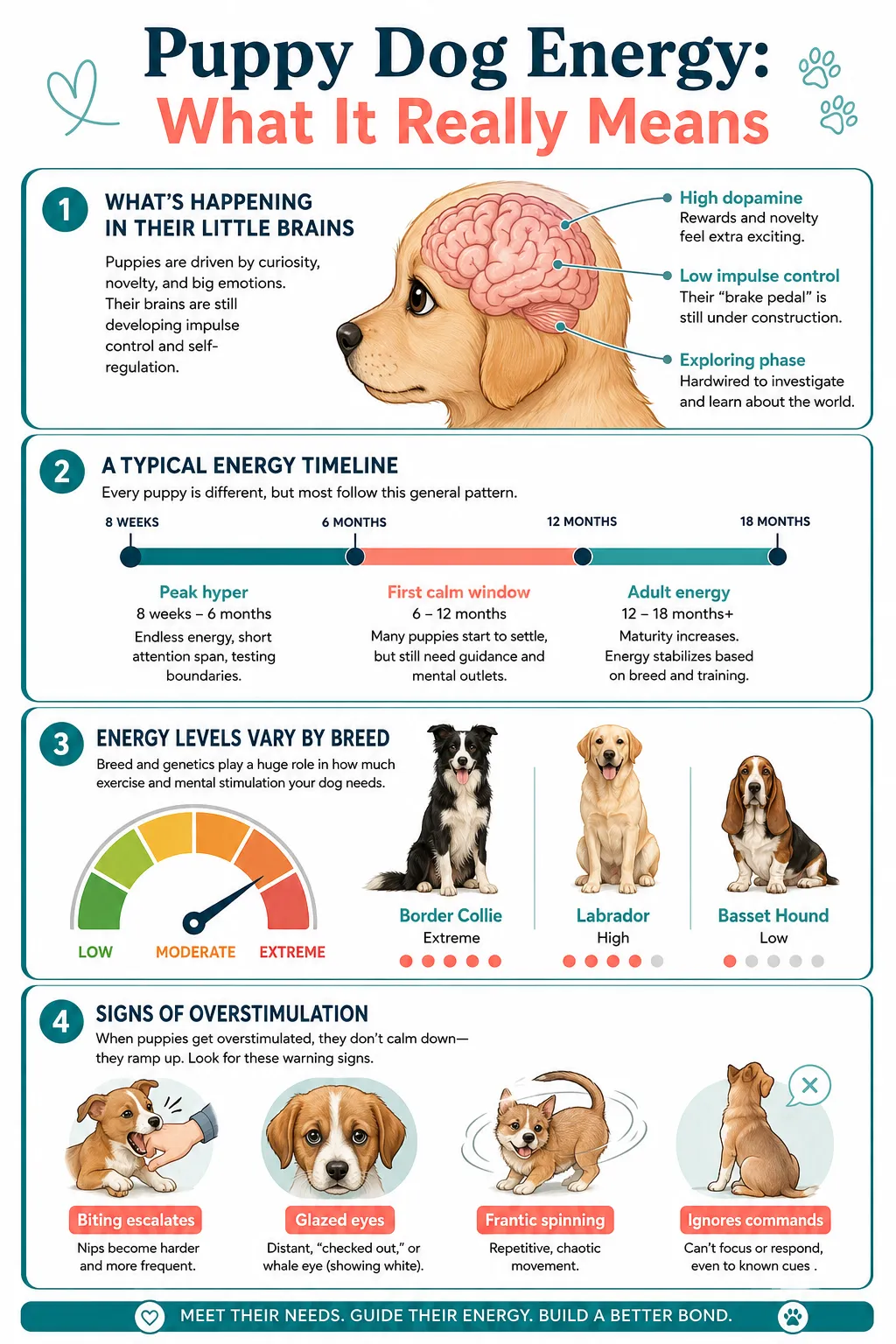
Puppy dog energy refers to the intense, seemingly non-stop activity, curiosity, and excitement that young dogs display during their early developmental months. It’s driven by a puppy’s rapidly developing brain, high dopamine response, and low impulse control – not bad behavior. According to VCA Hospitals, this is a completely normal developmental stage that every dog owner can learn to manage with the right approach.
Think of it like toddler energy, but with sharper teeth and no concept of personal space. 🐾
Puppy dog energy definition at a glance:
- Rapid bursts of running, jumping, and biting
- Difficulty focusing for more than a few seconds
- Excitement that escalates quickly into overstimulation
- A dog that seems to get more wound up the more you interact
This is also where the phrase “puppy energy person” comes from online – someone who is enthusiastic, warm, and relentlessly upbeat. But when it’s your actual dog at 11 pm, it’s less charming.
Is High Energy Normal for Puppies?
Yes – high energy is completely normal for a puppy, and it’s one of the most common concerns new dog owners contact trainers about. Chewy’s guide on calming high-energy puppies confirms that nearly all puppies go through a high-drive phase, and the goal isn’t to suppress it but to redirect and structure it.
The key distinction to learn: a puppy that won’t settle is often overtired, not just energetic. Research highlighted by The Pet Times shows that puppies who miss naps become more frantic, not less – similar to an overtired toddler who can’t wind down.
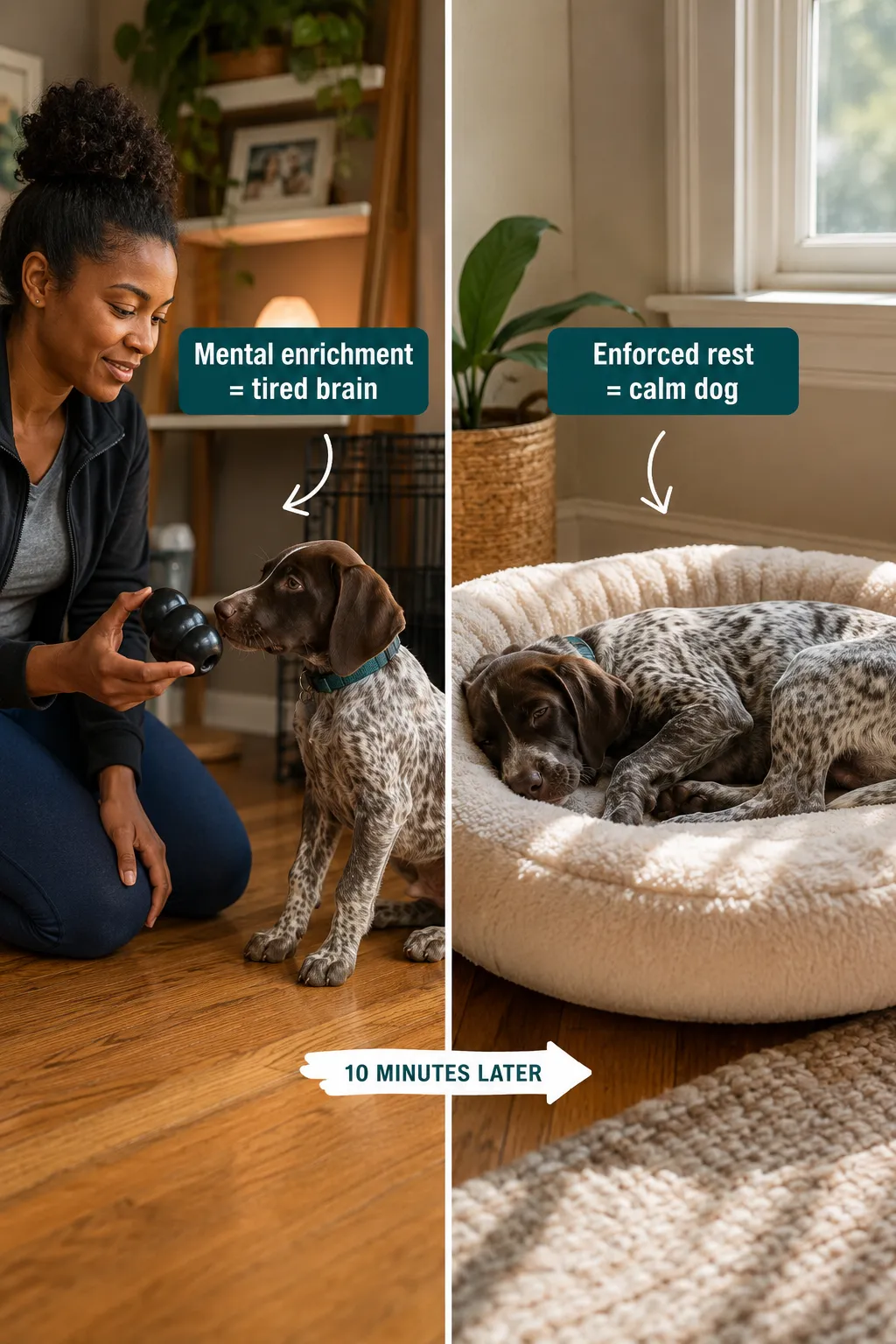
Puppies need roughly 16-18 hours of sleep per day. If your dog is getting less, enforced rest is your first fix, not more exercise.
When Do Puppies Start to Calm Down by Age?
Most puppies begin showing calmer behavior between 12 and 18 months, though breed plays a major role. High-energy breeds like Border Collies or Siberian Huskies may stay in a high-drive phase until age 2 or even 3.
Here’s a rough age guide:
| Age | What to Expect |
|---|---|
| 8-12 weeks | Maximum curiosity, short attention span |
| 3-6 months | Peak zoomies, biting, and testing limits |
| 6-12 months | Adolescent phase – energy stays high, impulse control slowly improves |
| 12-18 months | First real calm windows appear |
| 2+ years | Most dogs settle into adult energy levels |
For a deeper look at puppy exercise ideas across different ages, it helps to match activity type to developmental stage.
Why Won’t My Puppy Settle Down and Relax?
A puppy that won’t settle is usually dealing with one or more of these issues: overtiredness, under-stimulation, lack of a calm training foundation, or overstimulation from too much contact with people or other dogs. Dogs Trust notes that hyperactivity and restlessness in dogs often have environmental triggers that owners can change today.
Common reasons your dog won’t calm down:
- Skipped naps or irregular sleep schedule
- Too much rough play right before a rest period
- No designated “calm space” like a crate or mat
- Inconsistent responses from the pack – sometimes play is rewarded, sometimes not
- Underlying anxiety or a health issue
Check your routine first. A dog whose life lacks structure will always struggle to self-regulate.
How to Calm an Overactive Puppy: 11 Fixes That Work
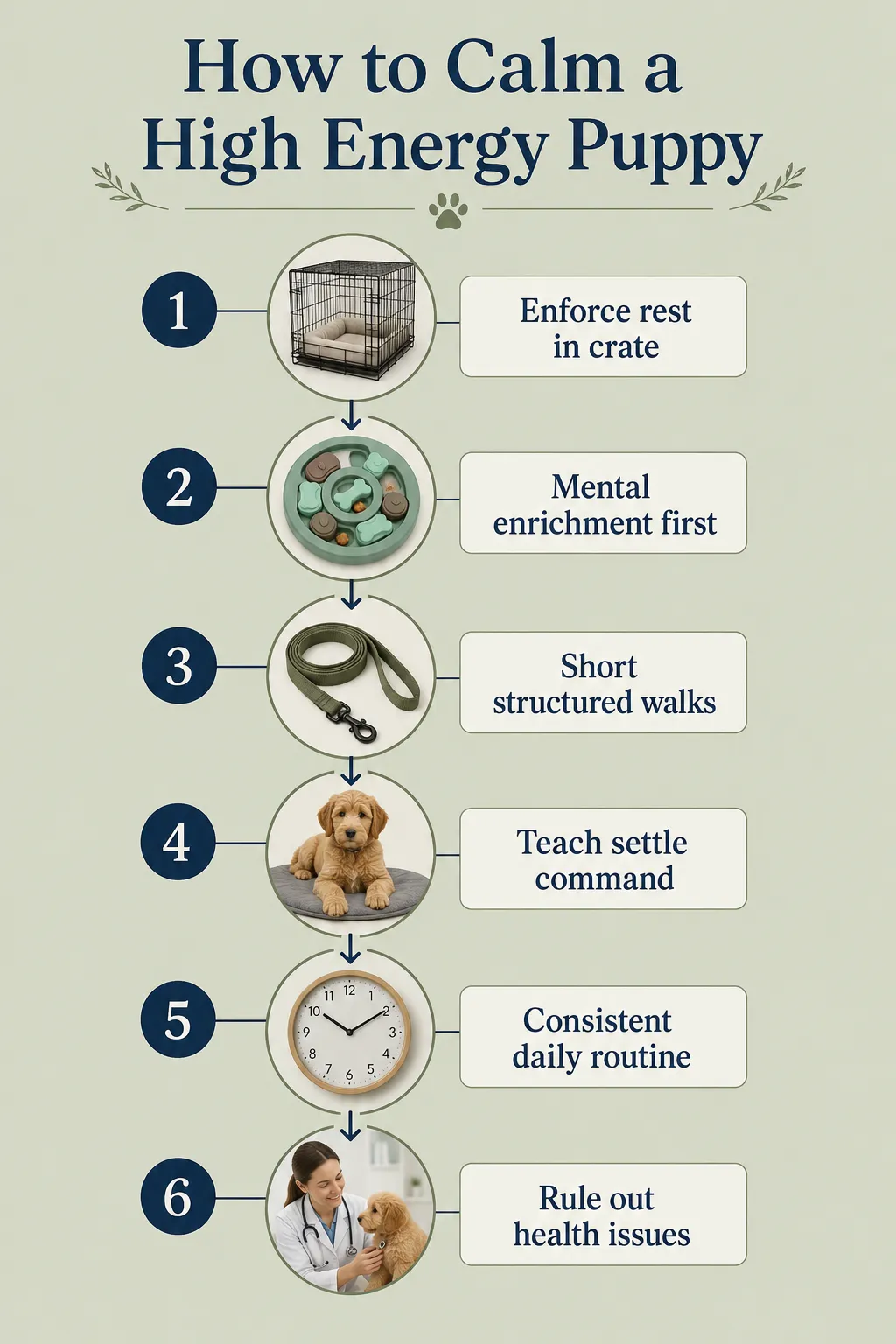
These 11 tips cover the full range of what actually works for managing puppy dog energy – from quick wins you can use today to long-term training habits. Hepper’s breakdown of why puppies get hyper confirms that a multi-pronged approach works far better than any single fix.
Fix 1 – Enforce rest immediately.
Put your puppy in a crate or quiet room when they hit the frantic stage. Don’t wait for them to crash on their own.
Fix 2 – Use mental enrichment before physical exercise.
A 10-minute sniff walk or puzzle toy tires a dog’s brain faster than a 30-minute run. Check out these playtime games that secretly train your dog for ideas.
Fix 3 – Build a daily routine.
Puppies thrive on predictability. Feed, walk, train, and rest at the same time each day. Consistency is the backbone of calm behavior.
Fix 4 – Teach a “settle” command.
Place your dog on a mat and reward calm behavior with low-key praise. Our full guide on the calm dog method walks you through this step by step.
Fix 5 – Use short, broken-up exercise sessions.
Two 10-minute walks beat one 45-minute run for a puppy. Over-exercise can actually increase energy room for chaos by spiking adrenaline.
Fix 6 – Manage the environment.
Remove high-stimulation triggers before rest time – turn off the TV, reduce contact with other dogs, and lower the noise level.
Fix 7 – Try crate training.
A crate gives your dog a safe, calm space that signals “rest time.” Read how to stop a puppy from crying in the crate at night if you’re just getting started.
Fix 8 – Avoid reinforcing hyper behavior.
Don’t greet an excited dog with excitement. Turn away, wait for four paws on the floor, then reward the calm.
Fix 9 – Add impulse control training.
“Wait,” “leave it,” and “stay” are the core commands that build self-regulation. These are about energy management as much as obedience.
Fix 10 – Check the diet.
Some dogs react to certain ingredients with increased restlessness. If your puppy’s energy seems out of proportion, talk to your vet about food sensitivities.
Fix 11 – Get a vet check if nothing changes.
Persistent hyperactivity despite routine, rest, and training can signal a health issue. Rule it out before assuming it’s purely a behavior problem.
Puppy Won’t Stop Playing and Biting – What to Do
Biting that won’t stop is usually a sign of overstimulation, not aggression. When a puppy’s energy escalates into frantic biting, the best response is a calm time-out – not a loud “no.” QYS Dog Training explains that continuing to engage an overstimulated dog actually makes the biting cycle worse.
Steps to break the biting loop:
- Go still and quiet – no eye contact
- If biting continues, calmly leave the room for 30-60 seconds
- Return only when the dog is calm
- Redirect to a chew toy, not your hand
For more detail, see our guide on how to make a puppy stop biting.
Puppy Overstimulation Signs to Watch For
Overstimulation is the point where puppy dog energy tips into distress. Catching it early lets you intervene before behavior spirals. A dog showing these signs needs rest, not more stimulation.
Signs your puppy is overstimulated:
- Biting escalates and becomes harder
- Glazed or “whale eye” expression
- Frantic spinning or running in tight circles
- Completely ignoring commands they normally know
- Yawning, lip-licking, or shaking off (stress signals)
If you want to learn more about reading your dog’s stress signals, these 12 stressed dog signs are worth bookmarking.
Best Toys for High Energy Puppies
The right toys redirect puppy dog energy into safe, productive outlets. Mental enrichment toys are more effective than simple fetch toys for burning energy.
Top picks by category:
- Puzzle feeders – slow the dog down and engage the brain
- Snuffle mats – tap into natural sniffing instincts
- Rope toys – safe for tug games with rules
- Kongs stuffed with frozen food – occupy a dog for 20+ minutes
- Flirt poles – high-energy outlet with built-in “off” switch
Always supervise play with new toys and rotate them to keep novelty high.
How Much Exercise Does a Puppy Need Per Day?
A common rule of thumb is 5 minutes of exercise per month of age, twice a day. So a 3-month-old puppy needs about 15 minutes of structured exercise, twice daily – not an hour-long run. K-9 Kraving’s guide on calming high-energy dogs emphasizes that over-exercising a young dog can damage developing joints and paradoxically increase restlessness.
Exercise by age:
- 8-12 weeks: 5-10 min gentle play, 2x daily
- 3-4 months: 15 min, 2x daily
- 5-6 months: 25-30 min, 2x daily
- 6-12 months: Gradually increase, avoid high-impact jumping
Mental enrichment – sniff walks, training sessions, puzzle toys – can supplement physical exercise without the joint risk.
Puppy Energy Levels by Breed – Which Dogs Are Highest?
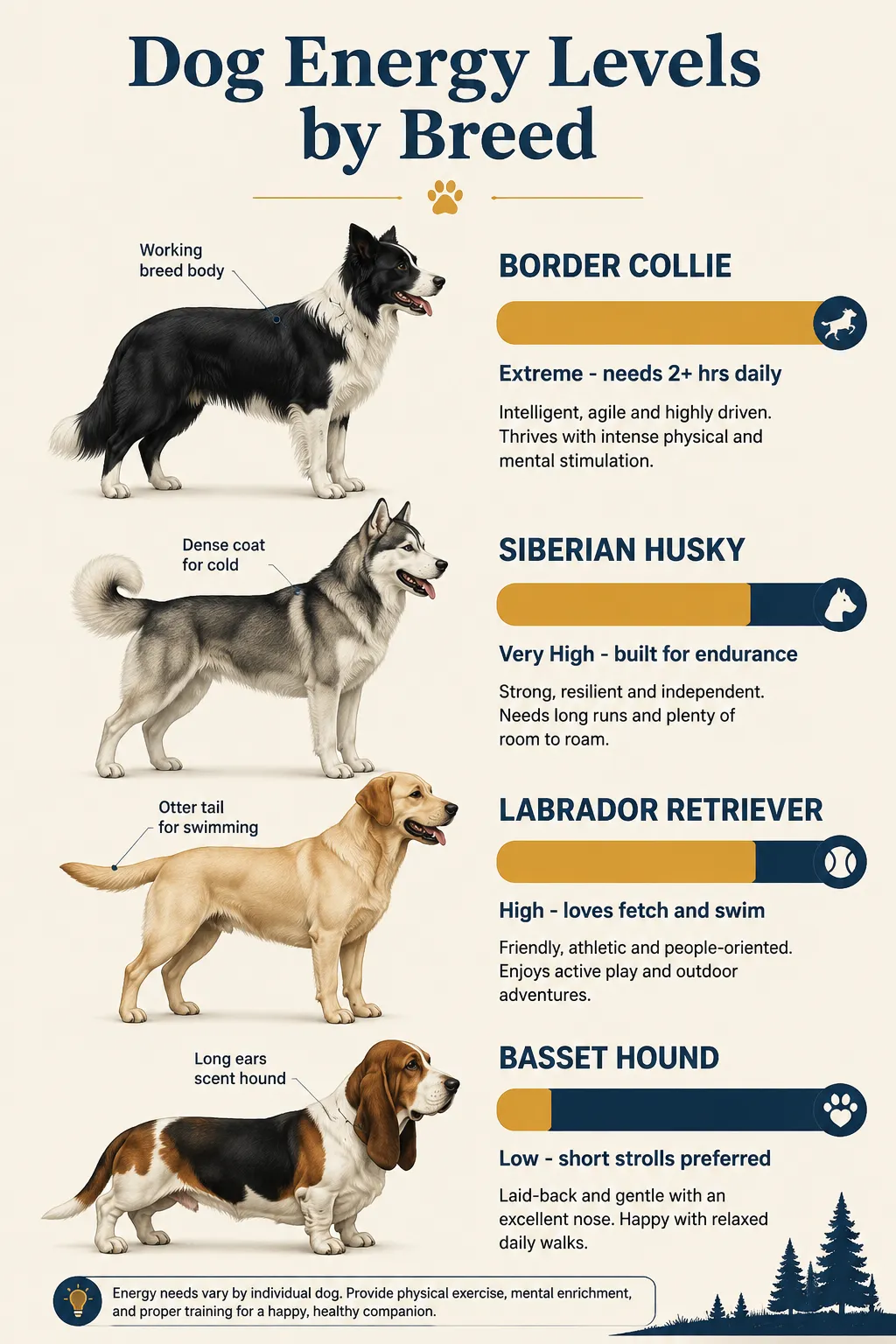
Breed is the single biggest predictor of a dog’s baseline energy level. High-energy dog breeds were developed for working roles that demanded endurance, speed, or problem-solving – and that drive doesn’t disappear just because they live in a house.
Highest energy breeds:
- Border Collie – bred for all-day herding, needs 2+ hours of activity daily
- Siberian Husky – built for long-distance running in harsh conditions
- Jack Russell Terrier – small body, enormous drive
- Australian Shepherd – highly intelligent, needs mental and physical outlets
- Labrador Retriever – high energy especially under 2 years
Lower energy breeds:
- Basset Hound
- Shih Tzu
- Bulldog
- Cavalier King Charles Spaniel
If you own a high-drive breed, know that training calm canines takes longer and requires more consistency. The off beaten trail to a calmer dog is always through structure, not suppression.
What Do Puppy Dog Eyes Mean?
“Puppy dog eyes” refers to the soft, wide, slightly upward-gazing expression dogs make when they want something – usually food, attention, or forgiveness. Research published in 2019 found that dogs have actually evolved a specific facial muscle (the levator anguli oculi medialis) that humans don’t have, which lets them make this expression deliberately. It’s a real communication tool, not just a coincidence.
It’s also used colloquially to describe someone with an open, eager, trusting energy – the “puppy energy person” archetype.
Puppy Training for Calm Behavior – The Awareness Approach
It’s all about awareness – both yours and your dog’s. Calm training works by rewarding the absence of chaos, not just the presence of commands. This is a behavior change approach, not a correction-based one.
Core calm training principles:
- Reward your dog for lying down voluntarily – even if you didn’t ask
- Keep training sessions short (3-5 minutes) and end on a win
- Use a calm, low tone of voice – your energy room sets the tone
- Practice “nothing in life is free” – ask for a sit before every meal, walk, or contact
Gillian Scarpino, a well-known dog behavior educator, has written extensively about this awareness-based approach. Gillian Scarpino’s bull November 2023 post on the off beaten trail canine facility blog covers exactly how to read about your dog’s energy patterns before trying to change them. Scarpino bull October entries also touch on how dogs lives are shaped more by routine than most owners realize.
If you want to read about the journey from reactive to calm, the beaten trail canine facility and calm canines academy membership boarding request reservation system offer structured programs. Daycare request reservation options through programs like calm canines academy can also provide socialization in a managed environment. Contact today to get more information about daycare request reservation Sunday availability and request reservation options.
The nbsp dog training philosophy at calm canines academy membership is built around the idea that nbsp dogs don’t need more stimulation – they need more structure. Nbsp nbsp dog owners who contact today often report the biggest change comes from simply enforcing rest.
It’s All About Awareness – Reading Your Dog’s Energy Signals
Awareness is the first skill every dog owner needs to develop. Before you can change your dog’s behavior, you need to learn to read the early signs that energy is building toward a tipping point.
Early warning signals to catch:
- Ears pinned back or hyper-alert
- Tail going stiff or flagging high
- Pupils dilating
- Breathing speeding up before any zoomies start
When you catch these signals early, you can redirect or enforce rest before the dog gets into a full frenzy. This is the core of what Gillian Scarpino and other trainers mean when they talk about “leading the pack” – it’s not about dominance, it’s about calm, confident guidance.
A good pack leader doesn’t react to chaos. They anticipate it.
What It Means to Lead the Pack – and Why It Calms Your Dog
Leading the pack means being the calm, consistent presence your dog can orient around. Dogs are social animals who look to their humans for cues about whether the environment is safe or exciting.
If you get excited when your dog gets excited, you amplify the energy. If you stay calm, move slowly, and speak quietly, you give your dog something to mirror.
Practical pack leadership tips:
- Enter and exit rooms calmly – don’t make arrivals a big event
- Wait for calm before giving food, toys, or attention
- Set and hold boundaries consistently – every time, not just when it’s convenient
- Learn to amp down your own energy when your dog amps up
This isn’t about being cold or distant. It’s about being the steady anchor your dog needs.
Stryker’s Story – Adopting a Middle-Aged Dog with Big Energy
Not all high-energy dogs are puppies. Stryker’s story is a good example – a middle-aged dog adopted from a shelter who came with what his owners described as “full puppy dog energy in a 5-year-old body.”
Stryker had never had structure. No crate, no routine, no calm training. His new family had to start from scratch – and they did, using the same fixes that work for puppies: enforced rest, short training sessions, and a consistent daily routine.
Within 8 weeks, Stryker was settling on a mat on cue. Within 3 months, he was calm enough to attend daycare without incident.
The lesson: it’s never too late to change a dog’s energy patterns. The timeline is just longer for an adult dog with ingrained habits.
The Board and Train Myth – What It Can and Can’t Do
Board and train programs can accelerate skill-building, but they don’t fix puppy dog energy on their own. The biggest myth is that you send your dog away and get back a calm dog. What you actually get back is a dog who has learned skills in one environment – and those skills need to be reinforced at home by you.
Labrador and You’s calming guide makes this point clearly: training transfers only when the owner learns alongside the dog.
What board and train is good for:
- Jump-starting basic obedience
- Giving a dog intensive socialization
- Breaking a specific problem behavior with professional guidance
What it won’t do:
- Replace daily practice at home
- Change a dog’s baseline energy level permanently
- Work without follow-through from the owner
The Importance of Vaccinations and Vet Checks for Hyper Puppies
A puppy that is unusually hyper despite good routines and training may have an underlying health issue. Thyroid problems, pain, parasites, and neurological conditions can all present as restlessness or hyperactivity.
Timely vaccinations also matter for socialization. A puppy that can’t safely interact with other dogs due to incomplete vaccination schedules misses critical calm socialization windows. Dachshund-specific hyper behavior research notes that some breeds are genetically predisposed to anxiety-driven hyperactivity that responds well to early intervention.
When to contact your vet:
- Hyperactivity that doesn’t improve with rest and routine after 2-3 weeks
- Sudden change in energy level (up or down)
- Hyperactivity paired with other symptoms like excessive thirst or weight change
FAQ
What is puppy dog energy?
Puppy dog energy is the naturally high activity level, curiosity, and excitability that young dogs display during their developmental phase. It’s driven by a rapidly growing brain, high dopamine response, and low impulse control. It’s completely normal and typically peaks between 3 and 6 months of age before gradually settling as the dog matures.
What age do dogs stop having puppy energy?
Most dogs begin to calm down noticeably between 12 and 18 months of age. However, high-energy breeds like Border Collies, Siberian Huskies, and Australian Shepherds may maintain elevated energy levels until age 2 or 3. Consistent training, routine, and adequate mental enrichment speed up the process regardless of breed.
At what age are puppies most hyper?
Puppies are typically most hyper between 3 and 6 months of age. This is the peak of the exploratory phase, when impulse control is lowest and curiosity is highest. The adolescent phase from 6 to 12 months can also bring a second wave of high energy as hormones develop, particularly in unneutered dogs.
What breed of dog has the highest energy?
The Border Collie is widely considered the highest-energy dog breed, originally bred for all-day herding work requiring intense focus and endurance. Other top high-energy breeds include the Siberian Husky, Australian Shepherd, Jack Russell Terrier, Belgian Malinois, and Vizsla. These dogs need significant daily exercise and mental stimulation to stay balanced.
Conclusion
Puppy dog energy is one of the most normal – and most exhausting – parts of early dog ownership. The good news is that every fix on this list is something you can start today, without special equipment or professional help.
Your action plan:
- Count how many hours your puppy is actually sleeping – enforce more rest if it’s under 16 hours
- Add one mental enrichment activity before the next walk
- Teach a “settle” on a mat using calm, positive-reinforcement training
- Build a consistent daily routine and stick to it for 2 weeks
- If nothing shifts, contact your vet to rule out health causes
The goal isn’t a dog with no energy. It’s a dog who knows how to turn it off when life calls for calm. That’s a skill – and like all skills, it takes time, consistency, and a pack leader who stays steady.