

Last updated: September 12, 2026
Quick Answer: A focused 10-minute dog training session beats a long, drawn-out hour of practice because dogs lose focus fast and learn better in short, high-energy bursts. Research from multiple 2026 training guides confirms that 5-10 minutes per session is the sweet spot for most dogs. Keep sessions short, positive, and consistent – and your dog will learn faster than you ever expected.
Key Takeaways
- Most dogs learn best in 5-10 minute training sessions, not hour-long drills
- Puppies under 6 months do best with sessions as short as 2-5 minutes
- Repeating 3-5 short sessions per day beats one long session every time
- Always end each session on a win – this keeps your dog eager to train again
- Use a small, high-value treat to reward your dog the moment he gets it right
- Core commands to teach: sit, down, come, stay, and leave it
- Positive reinforcement builds trust and makes training fun for your pet
- Consistency day to day matters far more than session length
- Short sessions reduce frustration for both you and your dog
- Even 2 minutes of training is better than skipping a day entirely
What Is a 10-Minute Dog Training Session (and Why It Works)
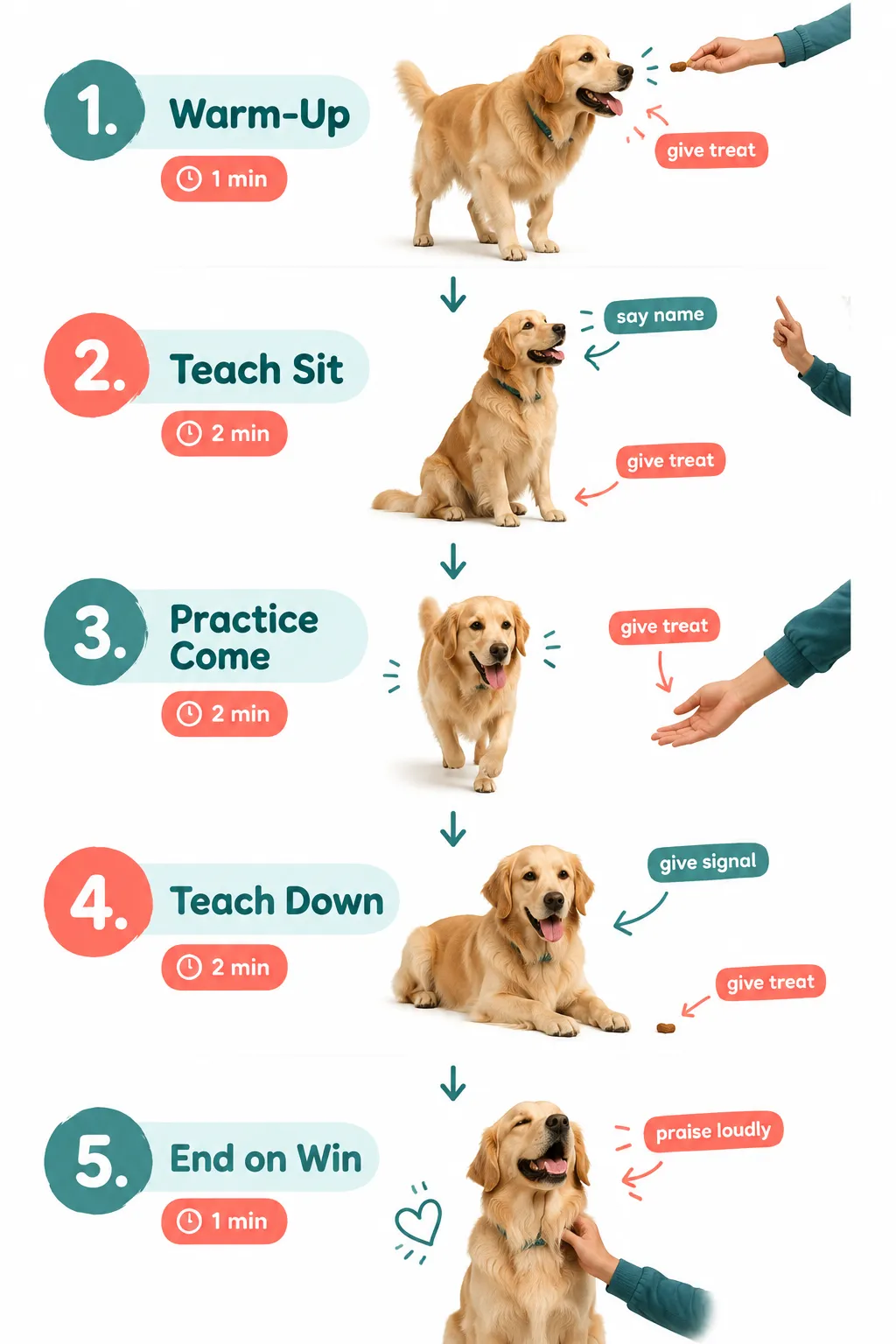
A 10-minute dog training session is a short, focused block of practice where you teach your dog one or two specific skills using positive reinforcement. It works because dogs have limited attention spans, and keeping sessions to 5-10 minutes prevents mental fatigue and keeps engagement high.
Think of it this way: your dog isn’t a student sitting in a classroom. He’s a pet who learns through repetition, reward, and fun. The moment a training session stops feeling good, learning stops too.
The concept is simple. You pick one command – say, “sit” or “come” – grab a small treat, and work with your dog for about 10 minutes. You give him clear cues, reward the right behavior, and stop before he gets bored or tired.
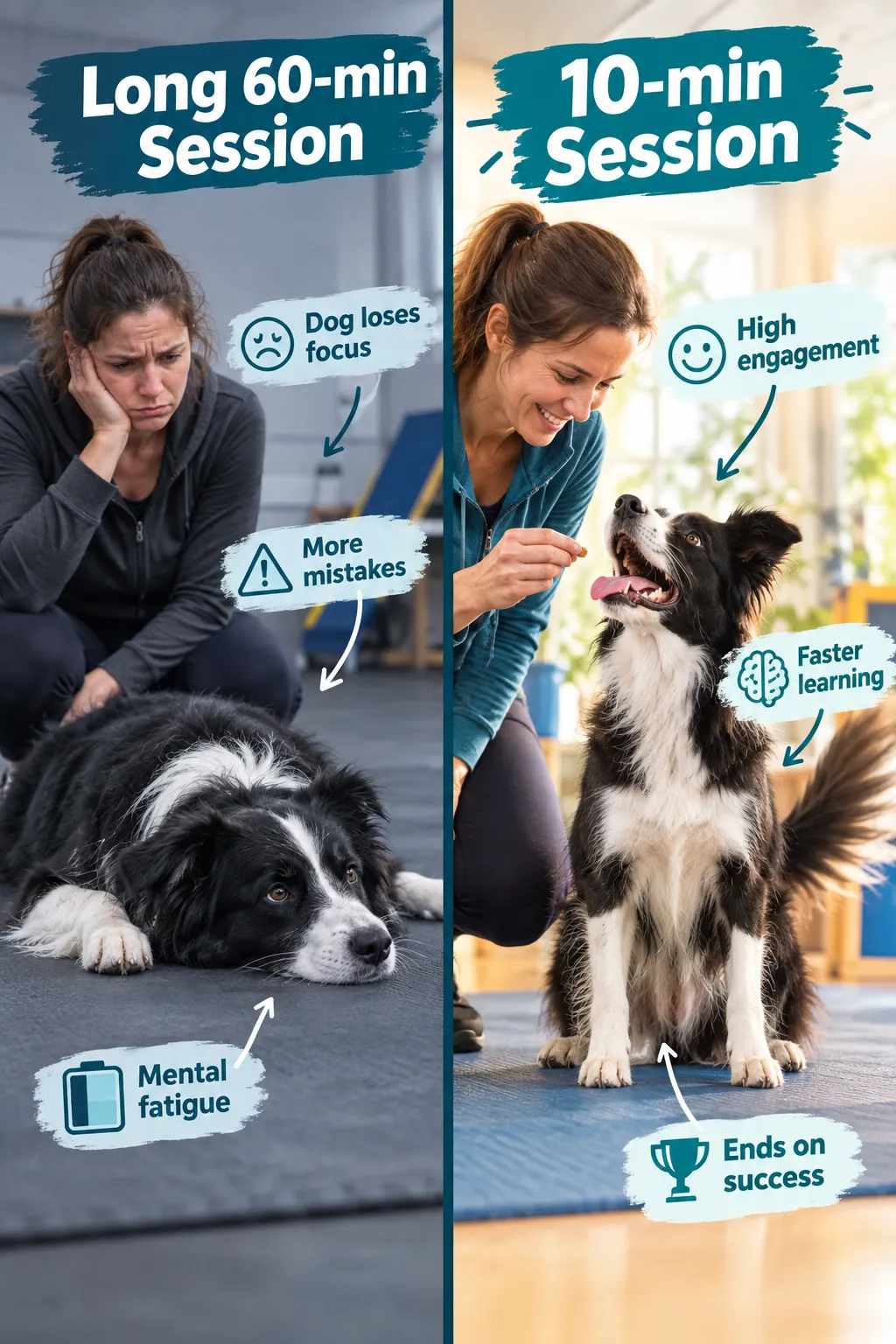
Why this beats an hour of practice:
- Dogs get mentally tired faster than most owners realize
- Mistakes increase after about 10-15 minutes of training
- Short sessions end on a positive note, making your dog excited to train again
- You can fit 3-4 short sessions into a normal day without any disruption
Free Dog Training Workshop: If you want to fast-track your results, check out this Free Dog Training Workshop – a first-of-its-kind online workshop that teaches you to housebreak your dog, stop bad behaviors, and train him to be as obedient as a service dog, using the same methods professional service dog trainers use.
Why Short Dog Training Sessions Beat Long Ones Every Time
Short sessions work better because a dog’s brain is wired for bursts of focused learning, not marathon drills. According to AnimalStart’s 2026 analysis of training frequency, sessions of 5-15 minutes repeated 3-5 times daily produce faster and more reliable behavior than longer, less frequent practice.
Here’s what happens during a long training session that most pet owners don’t notice:
- Your dog starts making more errors after 10-15 minutes
- He begins looking away, sniffing the ground, or lying down – all signs of mental overload
- You get frustrated, your tone changes, and your dog picks up on that stress
- The session ends on a failure instead of a win
A science-based review by Barrkera puts it plainly: five focused minutes every day will achieve more than a single hour-long weekly session. That’s not a motivational quote – it’s how dog cognition actually works.
Short sessions also make it easier to stay consistent. A 10-minute dog training session before breakfast, one at lunch, and one in the evening is realistic for almost any pet owner. A 60-minute block? Most people skip it.
Quick rule: Stop the session while your dog is still eager. Always end with a command he knows well, give him a treat, and praise him big. That last moment is what he’ll remember.
How Often Should You Do 10-Minute Dog Training Sessions
The ideal frequency is 3-5 short sessions per day, spread across the morning, afternoon, and evening. Happy Dog Training’s 2026 owner’s guide recommends exactly this structure – multiple 5-10 minute units throughout the day rather than one long block.
For most pet owners, this looks like:
| Time of Day | Session Goal | Length |
|---|---|---|
| Morning | Teach or review “sit” and “down” | 5-10 min |
| Midday | Practice “come” and “stay” | 5-10 min |
| Evening | Reinforce all skills + new trick | 5-10 min |
If you can only fit in one session per day, that’s still worthwhile. As Rescued by Training notes, even 2 minutes is better than zero minutes when time is short.
For a structured daily plan, see our 14-day dog training plan that actually works – it maps out exactly what to teach each day.
Best Exercises for a 10-Minute Dog Training Session
The best exercises for a short dog training session are the five core commands: sit, down, come, stay, and leave it. These skills build on each other, and each one can be taught and reinforced in just a few minutes per day.
Teach Your Dog to Sit
“Sit” is almost always the first command to teach, and for good reason. It’s easy, fast to learn, and gives your dog a clear default behavior.
How to teach dog sit in one session:
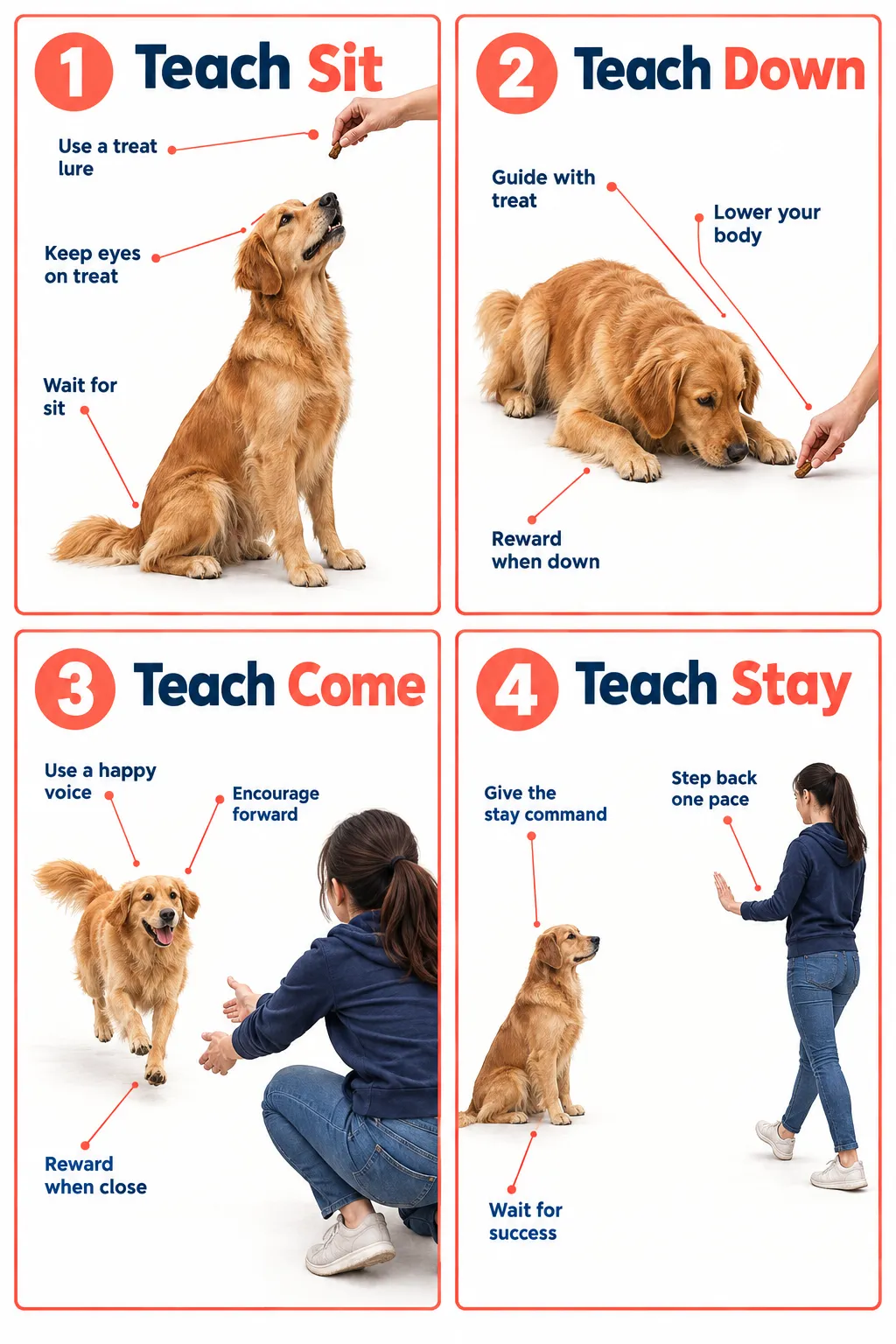
- Hold a treat just above your dog’s nose
- Slowly move it back over his head – his bottom will naturally go down
- The moment he sits, say “sit” clearly and give him the treat
- Praise him with “good dog!” and repeat 5-8 times
Once your dog consistently sits on cue, you can start adding a hand signal. See our guide on dog training hand signals you can use without saying a word for the next step.
Teach Your Puppy to Stay
After your dog learns to sit, “stay” is the logical next skill. Ask him to sit, then hold your palm out flat and say “stay.” Take one step back. If he holds it for 2-3 seconds, come back, give him a treat, and praise him. Gradually increase the distance each session.
Teach Your Puppy Down
“Down” is slightly harder than “sit” for most dogs because it’s a more vulnerable position. Lure your dog into a sit first, then slowly move the treat straight down to the floor between his paws. As he follows it down, say “down.” Give him the treat the moment his elbows touch the floor.
Teach Your Dog to Come
“Come” could be the most important command you ever teach. Say your dog’s name, then say “come” in a happy, excited voice. When he reaches you, give him a treat and praise him like he just did something amazing – because he did. Never use “come” to end something fun, or he’ll start ignoring it.
Teach Your Dog Leave It
Hold a treat in your closed fist. Let your dog sniff and paw at it. The moment he pulls back or looks away, say “leave it” and give him a different treat from your other hand. This teaches impulse control, which helps with everything from jumping to counter-surfing.
For more ideas on what to practice, check out these fun dog training tricks your dog will love learning.
Dog Training Session for Beginners at Home
A beginner dog training session at home works best when you keep it simple, distraction-free, and reward-heavy. TopDogChoice’s 2026 guide recommends starting with sessions of 3-10 minutes and warns that going over 10 minutes is “probably too long” for effective learning.
Here’s a simple beginner setup:
- Choose a quiet room with no other pets or distractions
- Use tiny, soft treats your dog goes crazy for
- Pick ONE command per session – don’t try to teach “sit,” “down,” and “come” all at once
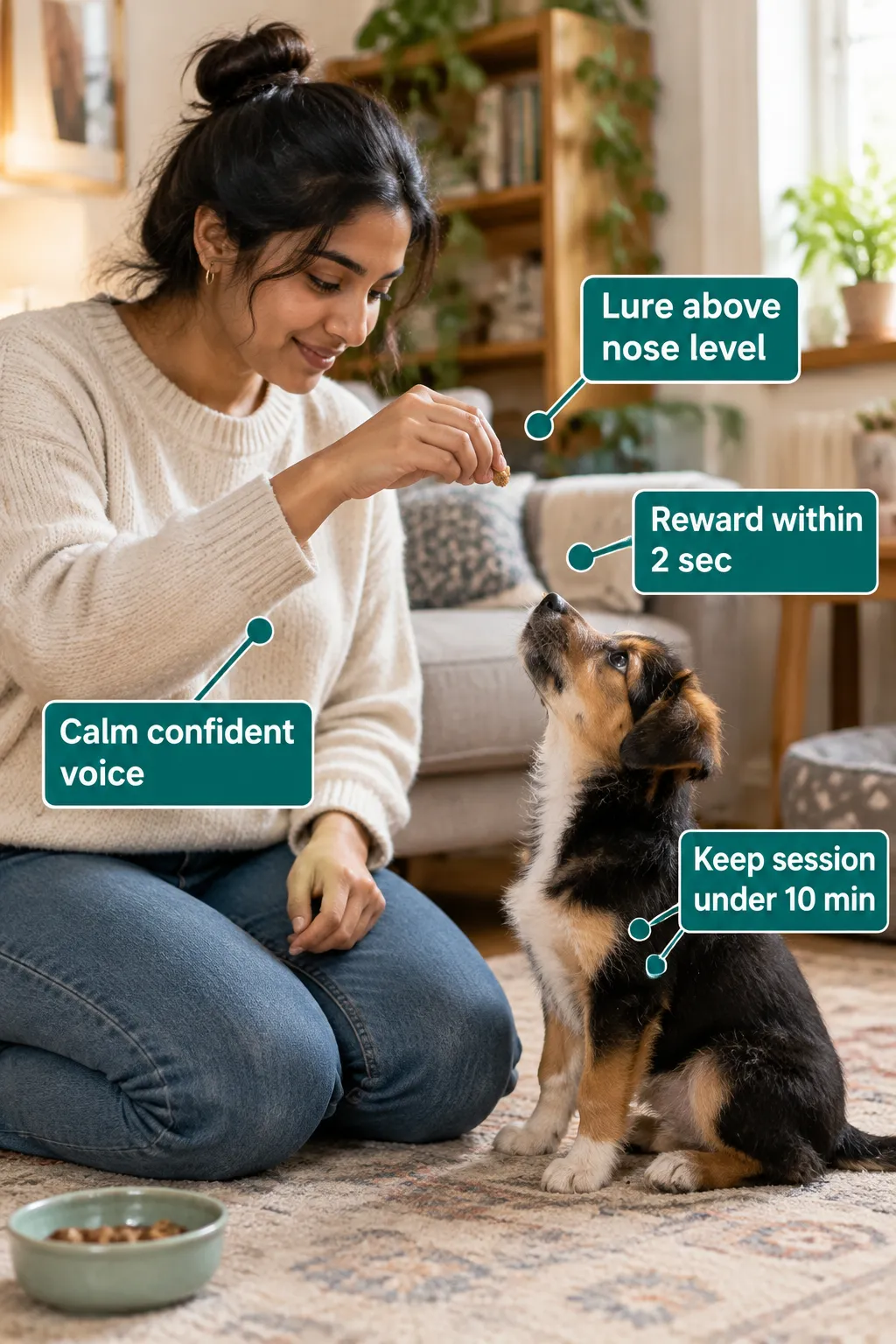
- Keep your tone upbeat and your energy calm
- End every session with something your dog already knows so he finishes on a win
Common mistake: Repeating a command over and over when your dog doesn’t respond. If he doesn’t sit after you say “sit,” don’t say it five more times. Lure him into position, reward him, and try again. Repeating the cue teaches him that the first time doesn’t count.
If you’re starting with a young dog, our 4-month-old dog training 15-minute daily routine is a great companion resource.
Free Dog Training Workshop: This is also a great moment to mention the Free Dog Training Workshop – it walks you through the exact methods service dog trainers use to get fast, reliable results, and it’s completely free to access.
Do’s and Don’ts: How to Get the Most From Each Training Session
Getting results from a short dog training session comes down to a few key habits. Dognition’s 2026 training hub confirms that three 5-minute sessions beat one 30-minute session – but only when those short sessions are run well.
Do’s
- Do use a high-value treat your dog doesn’t get at any other time
- Do give him the treat within 2 seconds of the correct behavior
- Do use your dog’s name before a command: say your dog’s name, then “come” or “sit”
- Do keep your body language relaxed and open
- Do praise him every single time – verbal praise amp; a treat together are more powerful than either alone
- Do train before meals when your dog is motivated by food
Don’ts
- Don’t train when your dog is overly excited, scared, or just woke up
- Don’t use punishment – it slows learning and damages trust
- Don’t push through a session when your dog is clearly checked out
- Don’t change the cue word mid-session (pick “sit” or “sit down” – not both)
- Don’t skip the praise – it’s just as important as the treat
For a deeper look at what not to do, read our list of 15 terrible dog training mistakes that most pet owners make without realizing it.
What Age Can Puppies Start 10-Minute Training Sessions
Puppies can start basic training as early as 7-8 weeks old, but their sessions should be even shorter than an adult dog’s. Happy Dog Training’s 2026 home routine guide advises keeping puppy sessions to just 2-5 minutes for dogs under 6 months.
A young puppy has a tiny attention span. Two minutes of focused “sit” practice is genuinely enough. More than that and you’ll start seeing the classic puppy shutdown: flopping over, biting the leash, or just wandering off.
Age-based session length guide:
- 7-12 weeks: 1-3 minutes per session, 3-4 times a day
- 3-6 months: 2-5 minutes per session, 3-5 times a day
- 6-12 months: 5-10 minutes per session, 3-5 times a day
- Adult dogs: 5-15 minutes per session, 2-5 times a day
If you have a new puppy, our 15 puppy potty training tips that actually work pairs perfectly with short obedience sessions to build great habits from day one.
Do Short Training Sessions Work for Stubborn Dogs and Aggressive Behavior
Yes – short sessions often work even better for stubborn or reactive dogs because they reduce pressure and frustration. AnimalStart’s 2026 piece on maximizing learning retention makes the point clearly: a well-timed 10-minute session with high-value rewards accomplishes more than an hour of dull repetition, especially for dogs who shut down under pressure.
For stubborn dogs, the key is making each session feel like a game rather than a drill. Keep the treat value high, the session short, and the criteria easy enough that your dog succeeds often.
For dogs with aggressive behavior, short sessions reduce the chance of hitting a trigger. Work below your dog’s threshold, reward calm behavior, and keep each session under 10 minutes. If aggression is serious, pair short home sessions with guidance from a certified trainer or a structured program.
Our guide on how to train a reactive dog gives a step-by-step method for dogs who struggle with reactivity.
How Much Does a Professional Dog Training Session Cost
Professional dog training sessions typically range from $30 to $150 per individual session, depending on your location, the trainer’s credentials, and the type of training. Group training classes tend to be more affordable, often running $100-$200 for a 6-week class.
Some trainers offer a lodge-n-learn training program where your dog stays with the trainer for several program days and nights – these tend to cost more but can be effective for intensive skills work. Programs like training 149 for a 6-week class are common at national pet retailers.
If cost is a concern, free dog training videos on YouTube and structured online programs are a solid starting point. The Free Dog Training Workshop is a great free option that covers housebreaking, obedience, and behavior – using the same secret methods professional service dog trainers use to get reliable, fast results.
You can also check with your local friends animal society, henderson pet resort, or page friends animal society chapter – many offer low-cost or free training classes as part of their community programs. Organizations like reach out rescue sometimes connect pet owners with affordable training resources too.
FAQ
What is the 3-3-3 rule for dog training?
The 3-3-3 rule describes the adjustment period for a newly adopted dog: 3 days to decompress from the shelter, 3 weeks to learn your household routine, and 3 months to feel truly at home. During this window, keep training sessions short and positive, focusing on building trust before adding complex commands. It’s a helpful framework for setting realistic expectations with a new pet.
Is it good to send your dog away for training?
Sending your dog away for training – such as a board-and-train or lodge-n-learn training program – can be effective for intensive skill-building, but results depend heavily on the trainer’s methods. The downside is that your dog learns with someone else, so you must still learn how to maintain those skills at home. Short daily sessions at home, combined with professional guidance, often produce the most lasting results.
How much do dog training sessions cost?
Individual professional dog training sessions typically cost between $30 and $150 per session. Group training classes usually run $100-$200 for a 6-week program. Board-and-train or lodge-n-learn programs cost more, often several hundred to over a thousand dollars. Free options like online workshops, YouTube dog training videos for beginners, and community programs through local animal societies can be a great low-cost starting point.
What is a good training schedule for dogs?
A good training schedule for dogs is 3-5 short sessions per day, each lasting 5-10 minutes. Spread them across the morning, midday, and evening. Focus on one or two skills per session, always end on a positive note, and rotate between new commands and review of skills your dog already knows. Consistency each day matters far more than the length of any single session.
Conclusion
The biggest shift most dog owners need to make is letting go of the idea that more time equals better results. A focused, fun 10-minute dog training session – done consistently each day – will get you further than a once-a-week hour-long marathon that leaves your dog exhausted and you frustrated.
Start simple. Pick one command. Grab a treat. Set a timer for 10 minutes, and stop before it goes off if your dog is still engaged. Praise him big, give him the treat, and call it a win.
Do that three times a day, and within a week you’ll see a real difference in how your dog responds to you.
Your next steps:
- Choose one command to start with today – “sit” is always a great first pick
- Get small, high-value treats ready before each session
- Train in a quiet space with no distractions to start
- Keep a simple log of what you practiced each day to track progress
- Explore the Free Dog Training Workshop for step-by-step guidance using proven service dog training methods – it’s free and genuinely useful for any pet owner who wants faster, more reliable results
Your dog wants to learn. He just needs short, clear, rewarding sessions to show you what he can do.