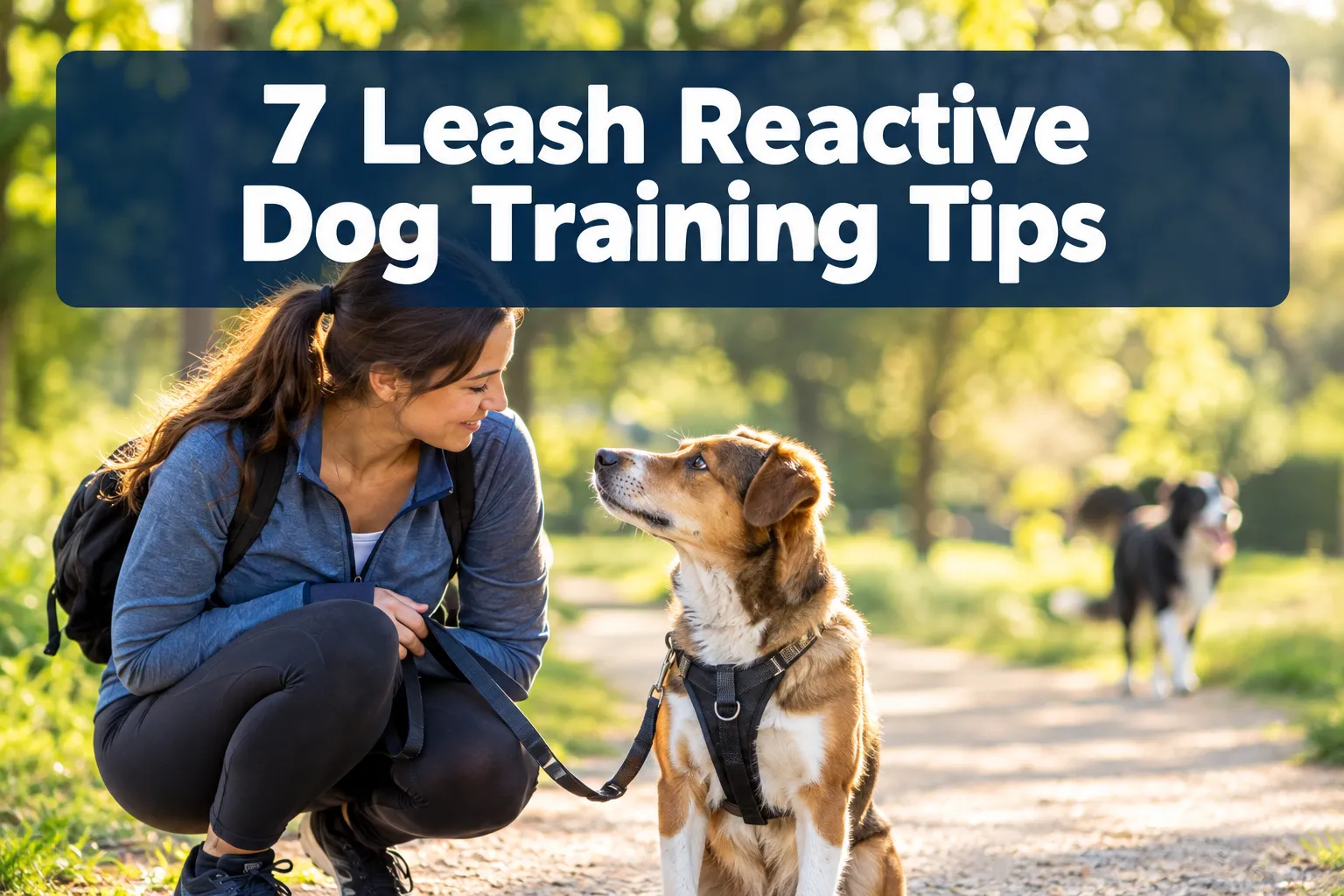
Last updated: September 24, 2026
Quick Answer: Leash reactivity is an emotional response – not a disobedience problem – which is why waving a treat in front of your dog’s face rarely works once they’ve spotted a trigger. The tips that actually work focus on changing how your dog feels about triggers, not just redirecting their attention. Start below the threshold where your dog reacts, use counter-conditioning instead of distraction, and build new emotional associations over consistent, short sessions.
Key Takeaways
- Leash reactivity is driven by fear, frustration, or over-arousal – not “bad behavior”
- Distraction fails because it doesn’t change the underlying emotional response
- Sub-threshold training (working at a safe distance from triggers) is the foundation of every effective protocol
- Counter-conditioning and the “Look at That” game are the most evidence-backed methods in 2026
- Equipment matters – front-clip harnesses and long lines reduce tension and frustration
- Punishment and aversive tools make reactivity worse, not better
- Most dogs show real improvement within 4-12 weeks of consistent, structured training
- Professional help is worth it for severe cases – group reactive dog classes are widely available
What Is Leash Reactivity in Dogs and Why Does It Happen?
Leash reactivity is when a dog overreacts to a trigger – usually other dogs, people, bikes, or skateboards – while on leash. It shows up as barking, lunging, growling, or spinning. The leash itself is part of the problem.
When a dog is off-leash, they have choices. They can move away, sniff, or approach at their own pace. On leash, those options disappear. That loss of control creates frustration or fear, and the reaction is the result.
According to ASPCA Pro’s guide on managing and training leash reactive dogs, reactivity is most often rooted in one of three things:
- Fear – the dog is scared of the trigger and wants distance
- Frustration – the dog wants to greet but can’t, so they explode
- Over-arousal – the dog’s excitement spills over into reactive behavior
Understanding which one drives your dog changes how you train. A fearful dog needs a very different approach than a frustrated greeter.
Is My Dog Leash Reactive or Just Excited?
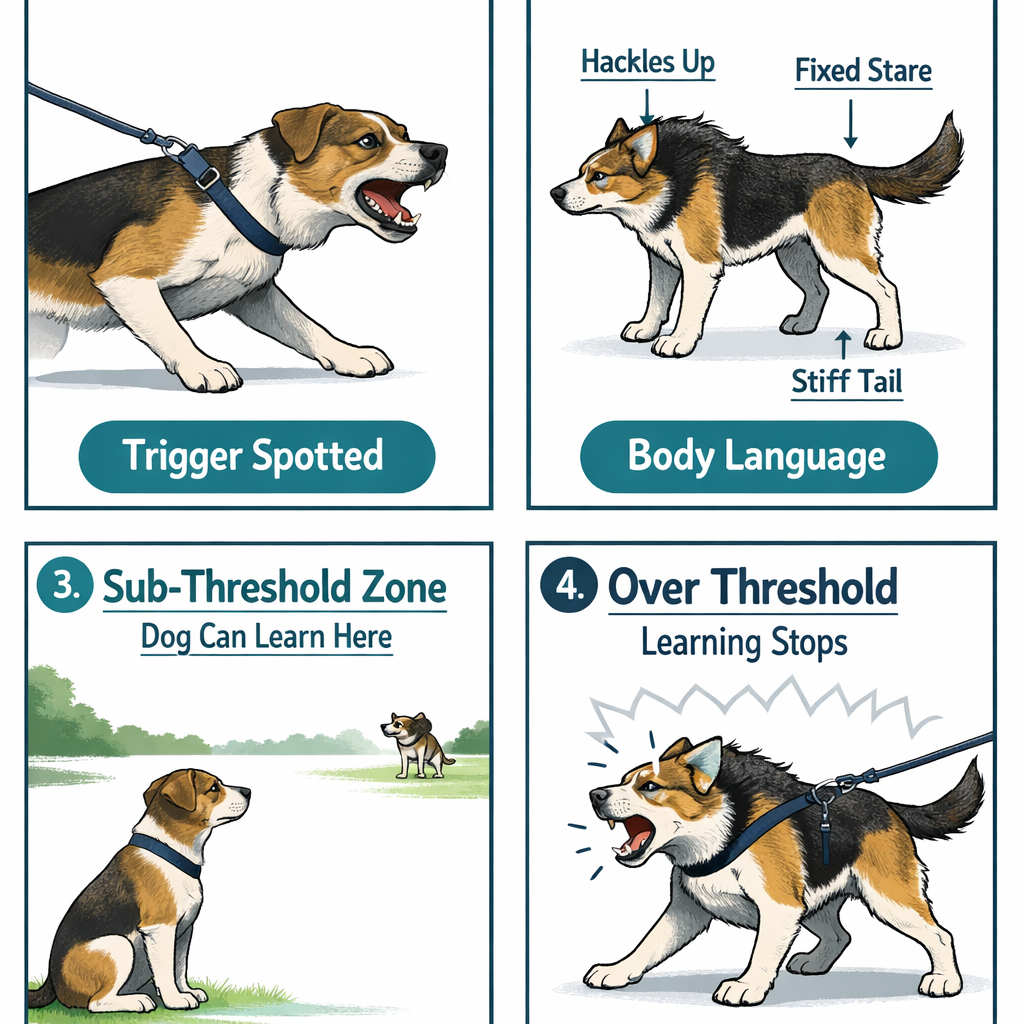
A dog that pulls toward another dog with a wagging tail and whining is excited. A dog that lunges, barks, and stiffens is reactive. The difference matters because excited dogs often just need better leash training for dogs that pull, while reactive dogs need a structured counter-conditioning plan.
Signs of leash reactivity (vs. excitement):
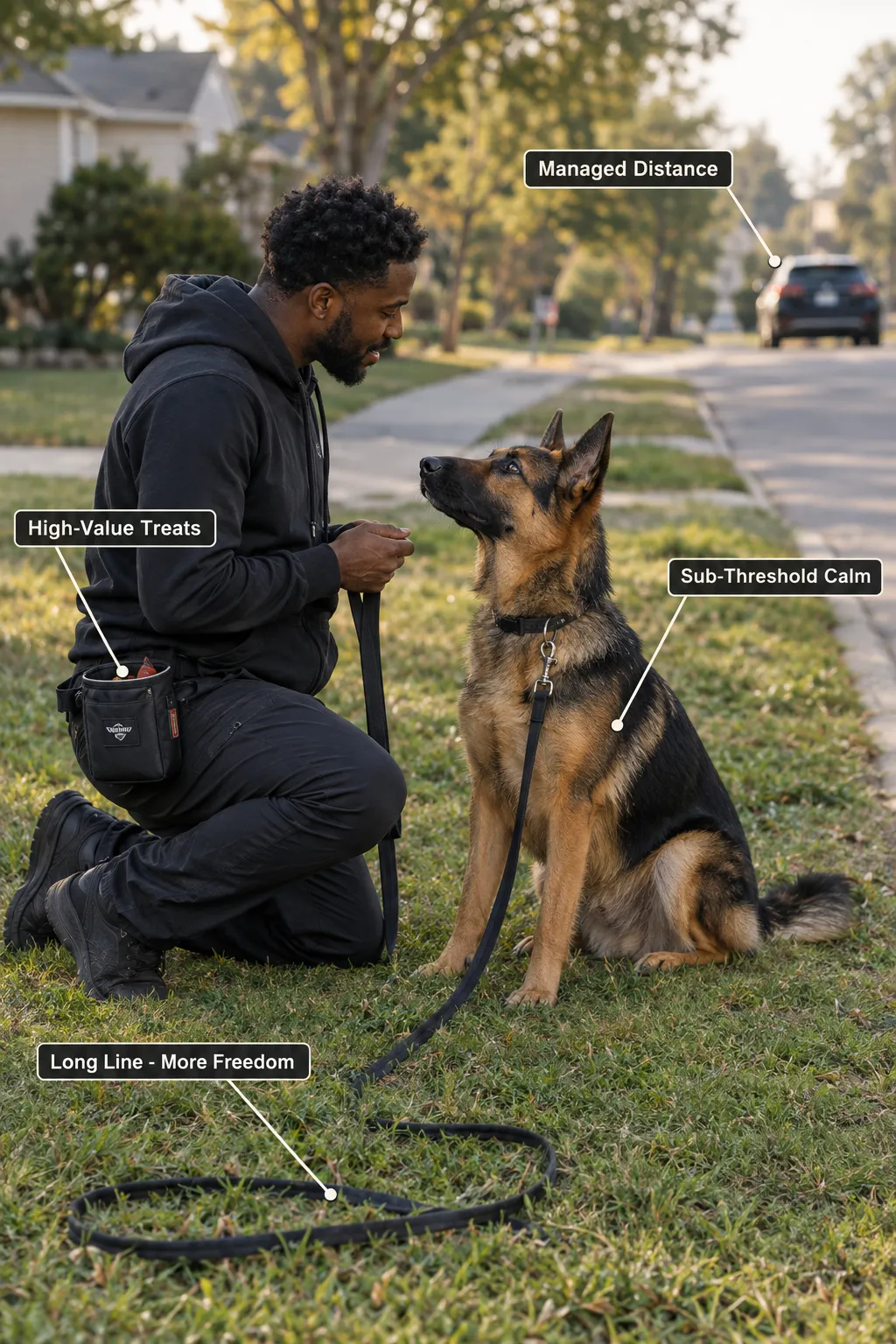
- Hard stare fixated on the trigger
- Raised hackles
- Stiff, rigid body
- Barking that sounds sharp or frantic
- Lunging that doesn’t stop when the trigger moves away
If your dog can take treats and look away from the trigger, they’re likely still in an excitable range. If they can’t take treats at all, they’ve crossed into reactive territory.
How Is Leash Reactivity Different From Aggression?
Leash reactivity is not the same as aggression, though it can look that way. Most leash reactive dogs are perfectly fine off-leash or in controlled settings. The reaction is context-specific – it happens because of the leash.
True aggression is more consistent across contexts and is often predatory or territorial in nature. Cornell University’s Riney Canine Health Center notes that reactive behavior is typically a stress response, not an intent to harm.
That said, if your dog has a history of biting or the reactivity is escalating, a veterinary behaviorist is the right call – not just a trainer.
If you’re also dealing with broader aggression issues, check out this guide on how to stop dog aggression at home using vet-approved tips.
Can Leash Reactive Dogs Be Trained or Is It Permanent?
Leash reactivity is not permanent. Most dogs improve significantly with consistent, structured training. Some dogs reach a point where they walk calmly past triggers without reacting at all. Others learn to manage their response but still need careful handling in high-distraction environments.
The honest answer is: it depends on how long the reactivity has been happening, what’s driving it, and how consistent the training is.
Early intervention works best. But even dogs who’ve been reactive for years can make real progress.
If you want a structured plan to follow, the 14-day dog training plan that actually works is a solid starting framework.
Speaking of structured plans – if you want to go deeper, the Free Dog Training Workshop is a first-of-its-kind online workshop that teaches you to stop bad behaviors and train your dog to be as obedient as a service dog, using the same methods professional service dog trainers use.
Why Doesn’t Distraction Work for Leash Reactive Dogs?
Distraction fails because it doesn’t change how the dog feels about the trigger. You’re asking your dog to ignore something their nervous system has flagged as a threat or frustration source. That’s not a training problem – it’s a biology problem.
Once a dog crosses their emotional threshold, the thinking brain essentially goes offline. At that point, no treat is interesting enough, no cue is clear enough, and no amount of “watch me” is going to cut through the stress response.
Sniffspot’s breakdown of leash reactive dogs puts it well: the goal isn’t to override the reaction, it’s to prevent the dog from reaching the point where a reaction happens at all.
That’s why the real leash reactive dog training tips focus on working below the threshold, not fighting the reaction once it starts.
7 Leash Reactive Dog Training Tips That Actually Work
These are the methods that consistently produce results – not quick fixes, but real behavioral change.
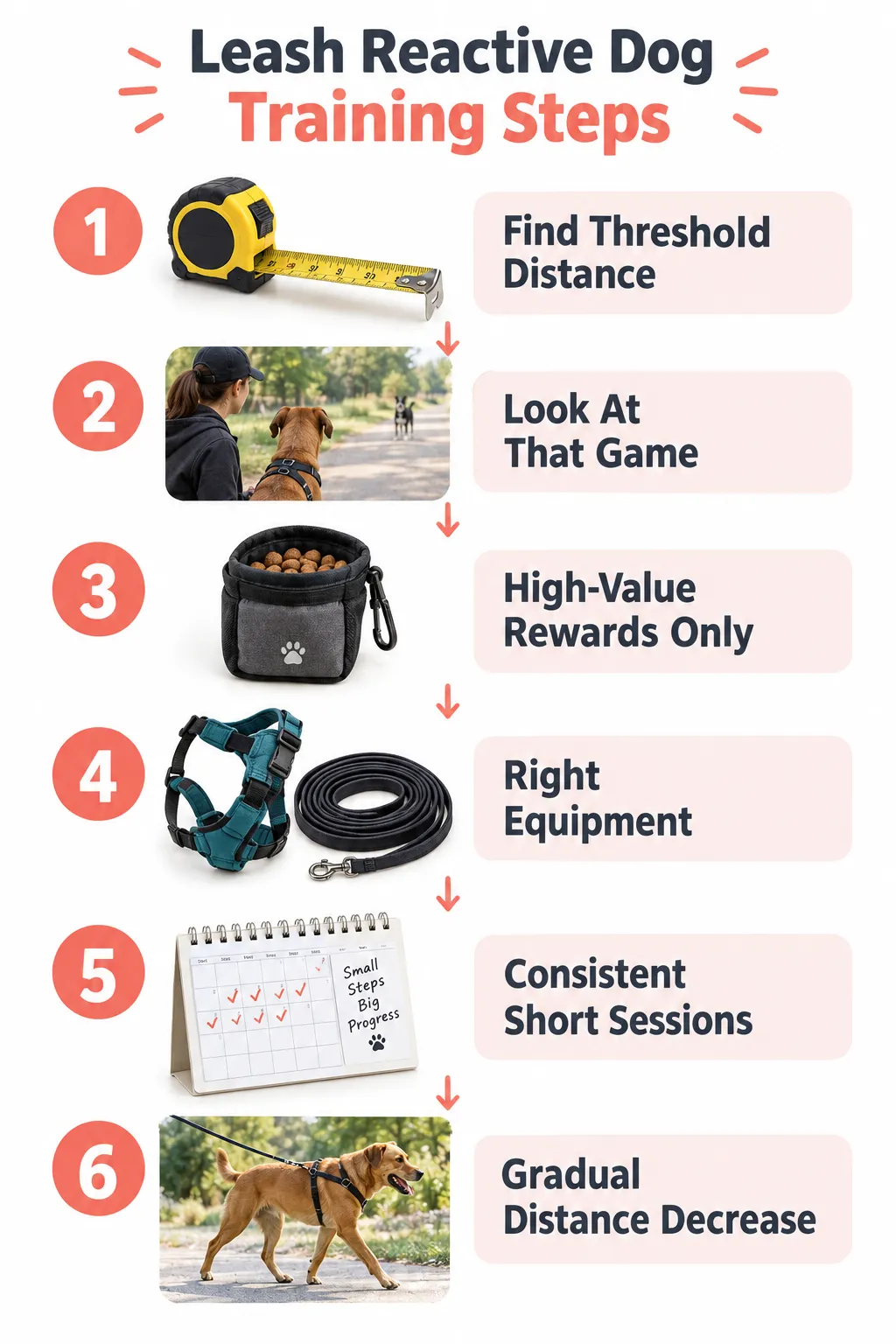
Tip 1: Find and Work Below the Threshold Distance
The threshold is the distance at which your dog first notices a trigger but hasn’t reacted yet. This is your training zone.
At sub-threshold distance, your dog can still take treats, look away, and think. Counter-conditioning a leash reactive dog step by step starts here – you pair the trigger appearing with something great (a high-value treat), over and over, until the trigger predicts good things instead of stress.
Start far away. Further than you think you need to be.
Tip 2: Use the “Look at That” Game
This is a structured counter-conditioning exercise where you mark and reward your dog every time they look at the trigger and then look back at you.
The sequence is simple:
- Dog spots trigger at a safe distance
- You say “yes” or click the moment they look
- You deliver a high-value treat
- Dog looks back at trigger, you repeat
Over time, the dog learns that seeing the trigger means good things happen. The trigger becomes a cue to check in with you, not to explode. The engage-disengage game using a long line builds on this same principle.
Tip 3: Use High-Value Treats – Not Kibble
If your dog won’t eat during a training session, the treats aren’t good enough. Near triggers, you need something that competes with the emotional arousal – think real chicken, cheese, or hot dog pieces.
Low-value treats are fine for calm environments. Near triggers, they don’t cut it.
Tip 4: Use a Long Line Instead of a Short Leash
A tight leash communicates tension directly to your dog. It also removes their ability to make small adjustments in distance, which increases frustration.
A long biothane line (15-30 feet) gives your dog more freedom of movement while keeping them safe. It breaks the tight-leash cycle that often makes reactions worse.
Tip 5: Manage the Environment – Don’t Just Train Through It
Route planning is not optional. Avoiding known trigger hotspots during early training isn’t giving up – it’s protecting the progress you’re making.
Every time your dog has a full-blown reaction, it reinforces the behavior. Fewer reactions mean faster progress.
Tip 6: Keep Sessions Short and End on a Win
Ten minutes of focused sub-threshold work beats a 45-minute walk where your dog reacts six times. Short, successful sessions build confidence faster.
Always end before your dog gets tired or overwhelmed.
Tip 7: Stay Calm on the Leash
Your tension travels down the leash. If you tighten up when you see a trigger coming, your dog feels it and ramps up in response.
Practice loose-leash awareness. Take a breath, loosen your grip, and cue your dog calmly before they spot the trigger.
What Equipment Helps With Leash Reactive Dogs?
The right equipment reduces physical tension and gives you more control without causing pain or fear.
| Equipment | Best For | Avoid If |
|---|---|---|
| Front-clip harness | Reduces pulling, redirects lunges | Dog slips out easily |
| Head halter | Strong pullers, large dogs | Dog is head-shy or panics |
| Long biothane line | Sub-threshold training, open spaces | Crowded sidewalks |
| Standard 6-ft leash | Everyday walks once improving | Dog is still lunging hard |
Avoid: Prong collars, choke chains, and shock collars. Research consistently shows that aversive tools increase fear and anxiety in reactive dogs, which makes the underlying problem worse.
Can You Use a Shock Collar for Leash Reactivity?
No – shock collars are not appropriate for leash reactivity. The timing required to use them correctly is nearly impossible for most owners, and the risk of making the dog associate pain with the trigger (or with you) is high.
If a dog is already reacting out of fear, adding pain to the equation intensifies the fear response. Veterinary behaviorists strongly advise against punishment-based tools for reactive dogs.
Leash Reactive Dog Training Mistakes to Avoid
Even well-meaning owners make these common errors:
- Flooding – forcing the dog to stay near the trigger until they “get used to it.” This causes trauma, not desensitization.
- Punishing the reaction – yanking the leash or scolding teaches the dog that triggers predict punishment, which increases anxiety.
- Training over threshold – working too close to triggers before the dog is ready. If they can’t take treats, you’re too close.
- Inconsistent sessions – skipping training for weeks then expecting progress.
- Expecting overnight results – this takes weeks to months, not days.
For a broader look at what not to do, this guide on 15 terrible dog training mistakes covers many of the same pitfalls.
How Long Does It Take to Train a Leash Reactive Dog?
Most dog owners start seeing noticeable improvement within 4-8 weeks of consistent, structured training. Full resolution – where the dog walks calmly past triggers – can take 3-6 months or longer, depending on the severity and how long the behavior has been established.
Factors that speed up progress:
- Starting early (younger dogs often respond faster)
- Short, frequent sessions (daily beats weekly)
- Staying below threshold consistently
- Using genuinely high-value rewards
Factors that slow progress:
- Frequent over-threshold exposures
- Inconsistent training
- Underlying anxiety or health issues
How Much Does Professional Leash Reactivity Training Cost?
Private sessions with a certified trainer typically run $75-$200 per session, depending on location and the trainer’s credentials. Group reactive dog classes are often more affordable – usually $150-$300 for a 6-8 week course.
Utah Humane Society’s “Help, I Have a Reactive Dog” class is an example of a structured group program specifically designed for reactive dogs. Many humane societies and shelters offer similar programs at reduced cost.
If professional training isn’t in the budget right now, starting with a solid online resource is a reasonable alternative.
Leash Reactive Dog Training for Fearful vs. Frustrated Dogs
The training framework is similar for both types, but the pacing and approach differ.
Fearful dogs need more distance, slower progression, and extra attention to body language. Pushing too fast causes setbacks. The goal is building confidence, not just reducing reactions.
Frustrated greeters often do better with structured greetings as a reward for calm behavior. The engage-disengage protocol works especially well here because it gives the dog a job to do when they see another dog.
Both types benefit from the same core leash reactive dog training tips – threshold work, counter-conditioning, and consistent management.
For more on socializing a reactive dog without adding stress, read how to socialize a reactive dog without stress.
What to Do If Your Leash Reactive Dog Lunges at Another Dog
In the moment, your job is to interrupt and create distance – not correct or punish.
Step-by-step for a lunge situation:
- Turn and walk the other direction immediately – don’t wait for the reaction to peak
- Keep your voice calm and neutral – no yelling
- Get enough distance that your dog can take a breath
- Once calm, reward the calm behavior
- Note the distance at which the reaction started – that’s your new training baseline
The counter-conditioning distance protocol recommends always moving away from the trigger rather than standing still and waiting for the dog to calm down. Movement helps break the fixation.
Finding Leash Reactive Dog Training Near You
Search for trainers with credentials from:
- IAABC (International Association of Animal Behavior Consultants)
- CPDT-KA (Certified Professional Dog Trainer)
- DACVB (Diplomate of the American College of Veterinary Behaviorists) – for severe cases
Ask specifically if they use force-free or positive reinforcement methods. If a trainer mentions prong collars or “corrections” as their go-to for reactivity, look elsewhere.
Many local humane societies now run reactive dog-specific group classes, which are often more affordable than private sessions and give your dog a controlled environment to practice in.
FAQ
What triggers leash reactivity in dogs?
The most common triggers are other dogs, strangers, cyclists, skateboards, and joggers. The leash itself contributes by removing the dog’s ability to control their own distance from the trigger.
Can any breed be leash reactive?
Yes. Any breed can develop leash reactivity, though herding breeds, terriers, and dogs with high prey drive may be more prone to it.
Should I let my reactive dog meet other dogs on leash?
Not during early training. Forced on-leash greetings often go badly and set back progress. Work on calm responses at a distance first.
Is leash reactivity the same as dog aggression?
No. Leash reactivity is usually context-specific and driven by frustration or fear. True aggression is more consistent across contexts. A veterinary behaviorist can help distinguish between the two.
My dog is fine off-leash with other dogs. Why is he reactive on leash?
This is classic “leash frustration.” The leash prevents the normal approach and sniff behavior dogs use to communicate, which builds frustration that spills over into barking and lunging.
What’s the fastest way to reduce leash reactivity?
Consistent sub-threshold counter-conditioning sessions, daily if possible, with high-value treats. There’s no shortcut, but this approach produces the fastest real results.
Does neutering or spaying help with leash reactivity?
It may reduce reactivity driven by hormonal arousal in some dogs, but it’s not a reliable fix on its own. Training is still required.
Can puppies be leash reactive?
Yes, and early intervention is much easier than addressing established reactivity in adult dogs. If your puppy shows early signs, start counter-conditioning now.
What if my dog is reactive toward people, not just dogs?
The same counter-conditioning principles apply. Work at a distance where your dog notices people but doesn’t react, and build positive associations gradually.
My dog only reacts to specific dogs – big ones, or dogs on leash. Is that still reactivity?
Yes. Selective reactivity is still reactivity. The training approach is the same – identify the specific trigger and work below threshold with that trigger specifically.
Conclusion
Leash reactivity is one of the most frustrating challenges dog owners face – but it’s also one of the most treatable when you use the right approach.
The biggest shift is moving away from distraction and toward genuine emotional change. Your dog doesn’t need to be told to ignore the trigger. They need to learn, through hundreds of repetitions, that the trigger predicts good things instead of stress or frustration.
Here’s where to start today:
- Find your dog’s threshold distance on your next walk
- Stock up on high-value treats (real meat, not kibble)
- Plan a route with predictable, manageable trigger exposure
- Practice the “Look at That” game at sub-threshold distance for 10 minutes
- Keep a simple log of what worked and what didn’t
Progress is slow at first, then it compounds. Most owners who stick with these leash reactive dog training tips for 6-8 weeks report a noticeably calmer dog on walks.
For more structured guidance, check out how to train a reactive dog with these 8 game-changing tips – it pairs well with everything covered here.
And if you want to go even further – the Free Dog Training Workshop teaches you the exact methods service dog trainers use to build calm, obedient dogs from scratch. It’s free, online, and genuinely one of the most practical resources available for owners dealing with reactive or difficult behaviors.