

Last updated: September 24, 2026
Quick Answer: Dogs tilt their heads for several overlapping reasons – better hearing, improved vision past their muzzle, processing meaningful words, and social bonding with humans. Most head tilts are completely normal. But a persistent tilt that won’t go away, especially paired with loss of balance, can signal a medical problem that needs a vet visit.
Key Takeaways
- 🐾 Dogs tilt their heads to triangulate sound and locate where a noise is coming from
- 👁️ The tilt helps dogs see past their own muzzle to read human facial expressions
- 🧠 Research links head tilting to word recognition – dogs tilt more when they hear familiar, meaningful words
- 🎵 High-pitched sounds trigger more head tilts because dogs are working harder to process them
- 🐕 Breeds with longer snouts or floppy ears may tilt more or less depending on their anatomy
- 🐶 Puppies and adult dogs both tilt, but frequency can vary with age and experience
- ⚠️ A sudden, persistent tilt that doesn’t stop is a red flag for vestibular disease or ear problems
- 💡 Head tilting is partly a learned social behavior – dogs do it more when they get a positive reaction from you
- 🔬 New 2026 research points to brain lateralization playing a role in which direction a dog tilts
- ✅ Most tilts are harmless and adorable – but knowing the difference between normal and abnormal can protect your dog’s health
Why Do Dogs Tilt Their Heads When You Talk to Them
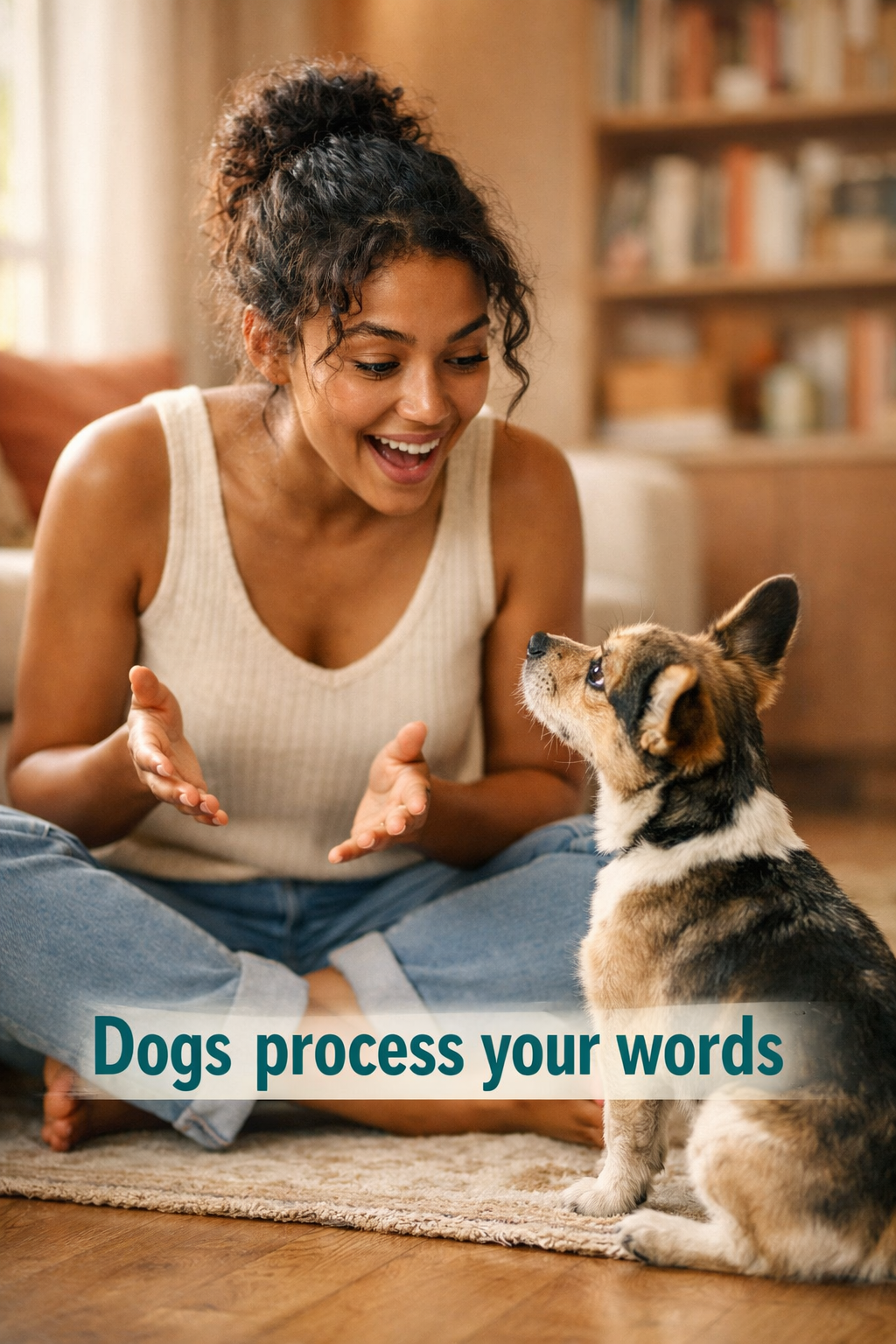
Dogs tilt their heads when you talk to them because they are actively trying to process your words, your tone, and your facial expressions all at once. It’s a sign of focused attention, not confusion.
According to the AKC, dogs are highly attuned to human communication. When you speak, your dog isn’t just hearing noise – it’s sorting through tone, pitch, and specific words it has learned to recognize.
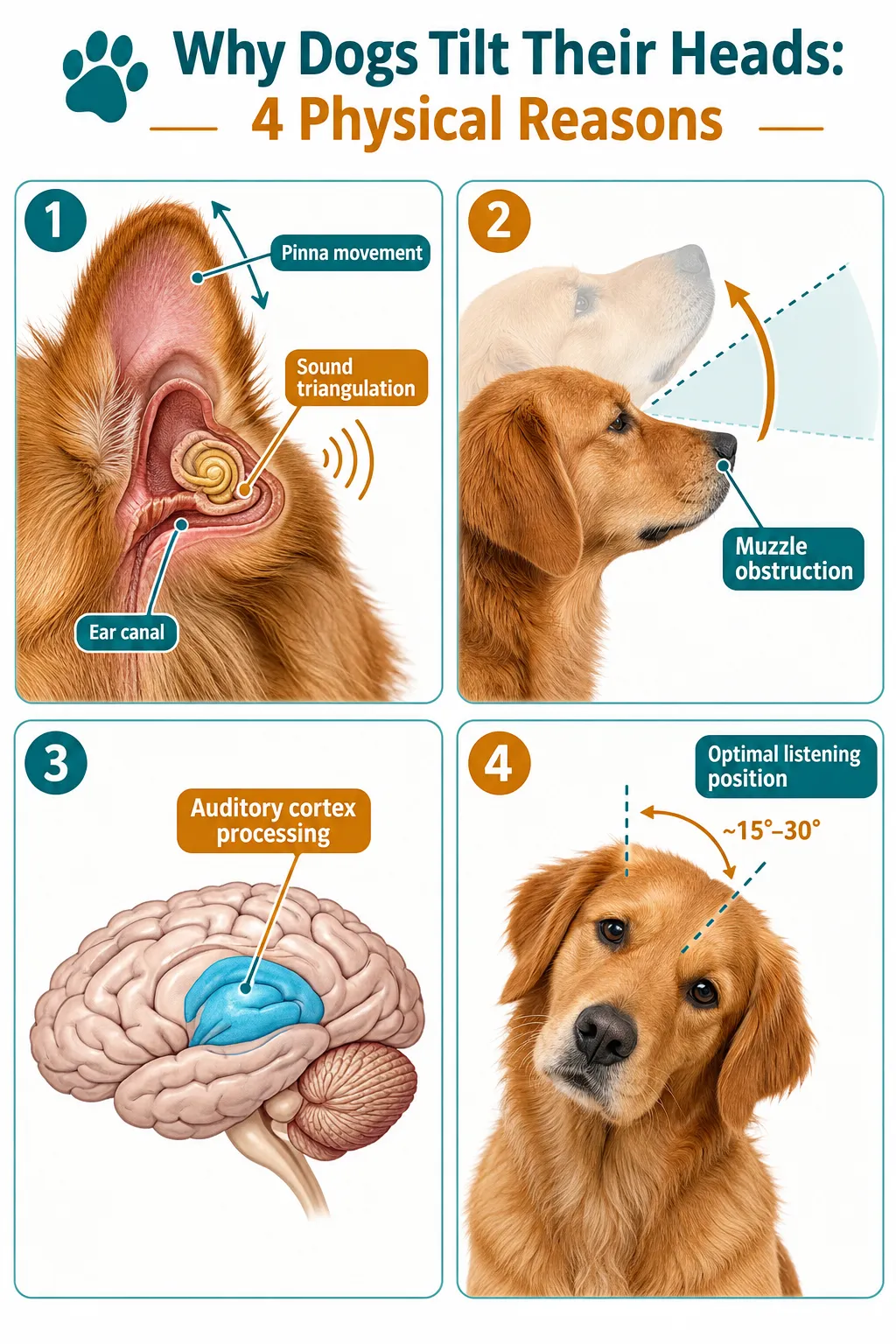
A 2021 study published in Animal Cognition found that dogs who had learned the names of specific objects tilted their heads significantly more when they heard those words. This suggests the tilt is connected to genuine cognitive processing, not just a random response to sound.
So when your dog tilts its head mid-sentence, it’s likely picking out a word it knows – like “walk,” “treat,” or “outside.”
Do Dogs Tilt Their Heads to Hear Better
Yes – and this is probably the most physically grounded reason. Dogs tilt their heads to adjust the position of their outer ears (called pinnae) to better capture and locate sound.
VCA Hospitals explains that dogs can move each ear independently, and tilting the head shifts the ear canals to different positions. This helps the brain calculate the exact direction and distance of a sound – a process sometimes called auditory triangulation.
Think of it like adjusting a satellite dish. A slight angle change can make a big difference in signal clarity.
This is especially useful for:
- Locating sounds that are directly in front or behind them (the hardest direction to pinpoint)
- Processing sounds that are faint or muffled
- Distinguishing between two similar sounds happening at the same time
Why Do Dogs Tilt Their Heads at High-Pitched Sounds
High-pitched sounds trigger more head tilts because they are harder for dogs to localize. Dogs hear a much wider frequency range than humans, but pinpointing the exact source of a high-pitched noise requires more effort.
When a dog hears a squeak, a whistle, or a high-pitched voice, the brain kicks into a more active listening mode. The head tilt is the physical result of that extra processing effort.
This is also why many dogs tilt their heads when they hear dogs howling on TV or certain music notes – the frequency is unusual and demands more attention.
What Does It Mean When a Dog Tilts Its Head
A head tilt from your dog is most often a positive signal. It means your dog is engaged, curious, and paying close attention to you or to a sound in the environment.
PetMD describes it as a combination of sensory processing and social communication. The tilt says: “I’m listening. I’m interested. I’m trying to understand you.”
There’s also a visual component. Dogs with longer muzzles – like Labradors or German Shepherds – tilt their heads to shift their snout out of their line of sight. This lets them better focus on your face and read your expressions.
What a normal head tilt looks like:
- Brief, lasting a few seconds
- Triggered by a specific sound or word
- The dog returns to a neutral head position afterward
- Accompanied by alert, relaxed body language
Is Head Tilting in Dogs a Sign of Intelligence
Head tilting is associated with higher cognitive engagement, but calling it a direct measure of intelligence is an oversimplification. It’s more accurate to say that dogs who tilt their heads more during human speech tend to be more tuned in to language.
Popular Science notes that the research connecting head tilts to word recognition was most pronounced in dogs that had been specifically trained to learn object names. So the tilt may reflect learned vocabulary more than raw intelligence.
That said, dogs that tilt more during conversations do appear to be more socially attuned. It’s a sign of a dog that has learned to pay close attention to human communication – which is a form of social intelligence.
Is My Dog Tilting Their Head Because They Don’t Understand Me – or Because They’re Curious
Both can be true at the same time. A head tilt often signals that a dog has caught something familiar in what you said but is still working to make full sense of it.
Think of it as your dog saying: “I heard something important in there – let me focus harder.”
Rover’s behavioral guide points out that dogs also tilt their heads when they encounter a new or unexpected sound – a sign of curiosity rather than confusion. The two states often overlap.
If your dog tilts its head and then immediately runs to the door, it understood “walk.” If it tilts and just stares, it’s still processing. Either way, it’s engaged and paying attention – which is a good thing.
Do All Dog Breeds Tilt Their Heads the Same Way – and Which Breeds Do It Most
No, not all breeds tilt their heads equally. Anatomy plays a big role – and this is one of the more surprising reasons why do dogs tilt their heads differently across breeds.
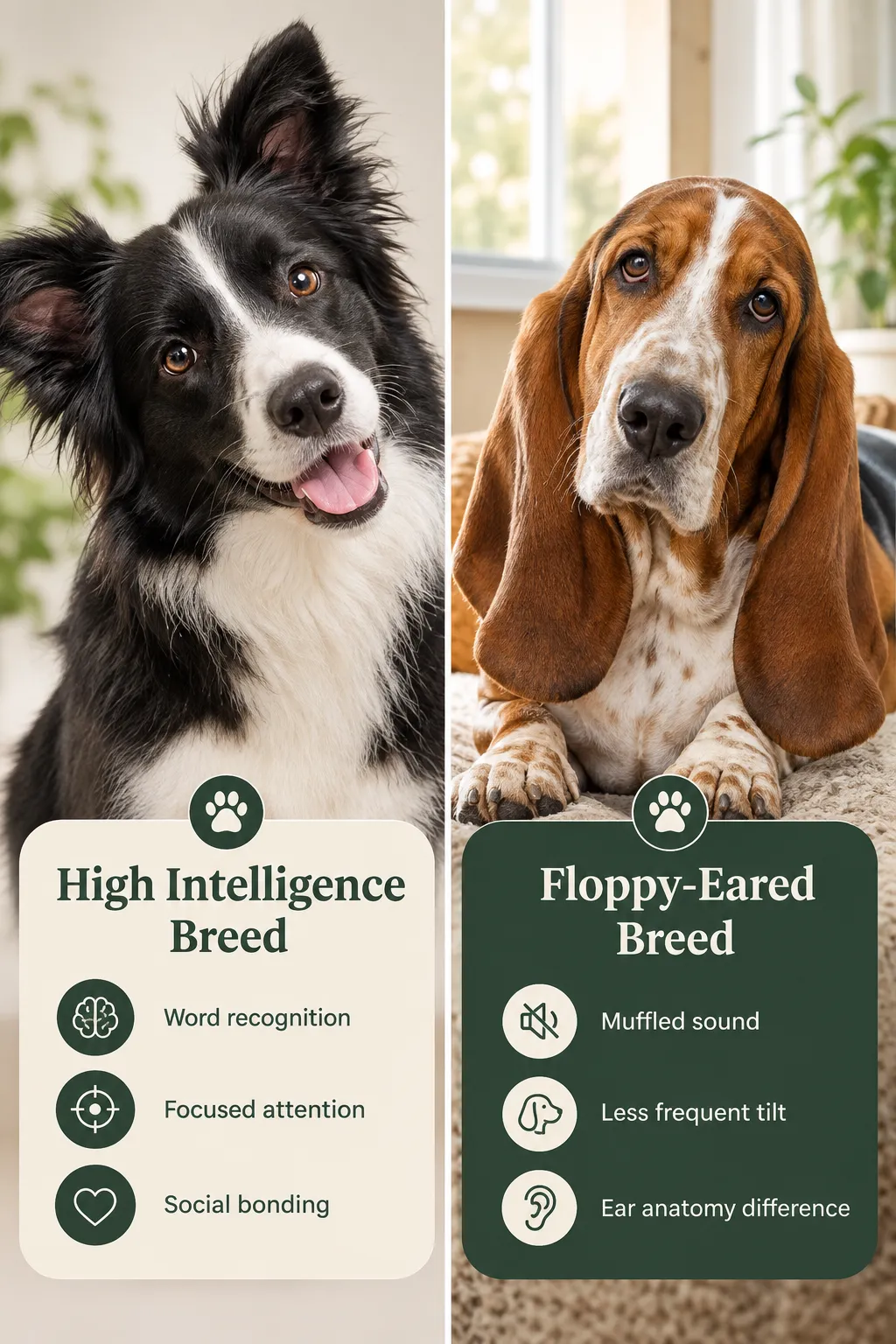
The Farmer’s Dog explains that dogs with longer muzzles (like Collies, German Shepherds, and Labrador Retrievers) tend to tilt more because their snout physically blocks more of their visual field. Tilting helps them see your face better.
Dogs with flatter faces (like Pugs or Bulldogs) have less muzzle obstruction, so they may tilt less for visual reasons – though they still tilt for auditory ones.
Breeds with floppy, heavy ears (like Basset Hounds or Bloodhounds) may tilt differently because their ears muffle sound more, requiring extra effort to localize it.
Breeds commonly observed tilting frequently:
- Border Collies
- Golden Retrievers
- German Shepherds
- Labrador Retrievers
- Cocker Spaniels
If you’re curious about breed-specific quirks, check out these surprising Jack Russell Terrier facts – they’re known for their expressive head tilts too.
Why Do Some Dogs Tilt Their Heads More Than Others
Beyond breed anatomy, individual personality, training history, and reinforcement all affect how often a dog tilts its head.
Dogs that have received positive reactions – laughter, treats, extra attention – when they tilt their heads learn to do it more often. It becomes a social tool, not just a sensory reflex.
Age also matters. Younger dogs in active learning phases may tilt more as they build their vocabulary and social skills. Senior dogs may tilt less if their hearing has declined.
Good Housekeeping’s pet experts also note that some dogs are simply more expressive communicators by temperament – and those dogs tend to be more frequent tilters.
New 2026 research also points to brain lateralization – meaning which brain hemisphere is more dominant – as a factor in which direction a dog tends to tilt. This is still an emerging area, but it suggests the behavior is more complex than it looks.
Do Puppies Tilt Their Heads as Much as Adult Dogs
Puppies do tilt their heads, but the behavior often becomes more pronounced as they grow and learn more words and social cues. Young puppies are still developing their auditory processing, so early tilts are more about raw sound localization.
As a puppy matures and builds a vocabulary of familiar words and sounds, head tilts become more tied to language processing. Adult dogs that have lived with people for years often tilt in response to very specific trigger words.
What’s the Difference Between Head Tilting and Head Shaking in Dogs
Head tilting and head shaking are two very different behaviors. Tilting is a deliberate, held posture – the dog cocks its head to one side and holds it there briefly while focusing on something.
Head shaking is a rapid, repetitive motion and is almost always a sign of physical discomfort. It usually means the dog is trying to clear something from its ear canal – water, debris, or irritation from an infection.
If your dog is shaking its head frequently rather than tilting it, that’s worth checking out. Ear infections are one of the most common health issues in dogs, and understanding why dogs put their ears back can also help you read other ear-related signals.
Can Head Tilting in Dogs Indicate a Health Problem
Yes – and this is the most important thing to know. While most head tilts are harmless, a sudden, persistent tilt that doesn’t resolve is a medical red flag.
PetMD’s clinical guide on head tilt in dogs identifies the following as the main medical causes:
- Vestibular disease – affects the balance system, either in the inner ear or brain
- Ear infections – middle or inner ear infections can disrupt balance signals
- Ear mites or foreign objects – irritation that disrupts normal ear function
- Brain tumors or lesions – rare but serious
- Hypothyroidism – can affect neurological function in some cases
- Idiopathic vestibular syndrome – sudden onset with no identifiable cause, common in older dogs
A 2026 case report also highlighted “positioning head tilt” as a specific sign of intracranial pathology – where the tilt changes depending on the dog’s body position. This is a more subtle but serious presentation.
When Should I Be Worried About Excessive Head Tilting in Dogs
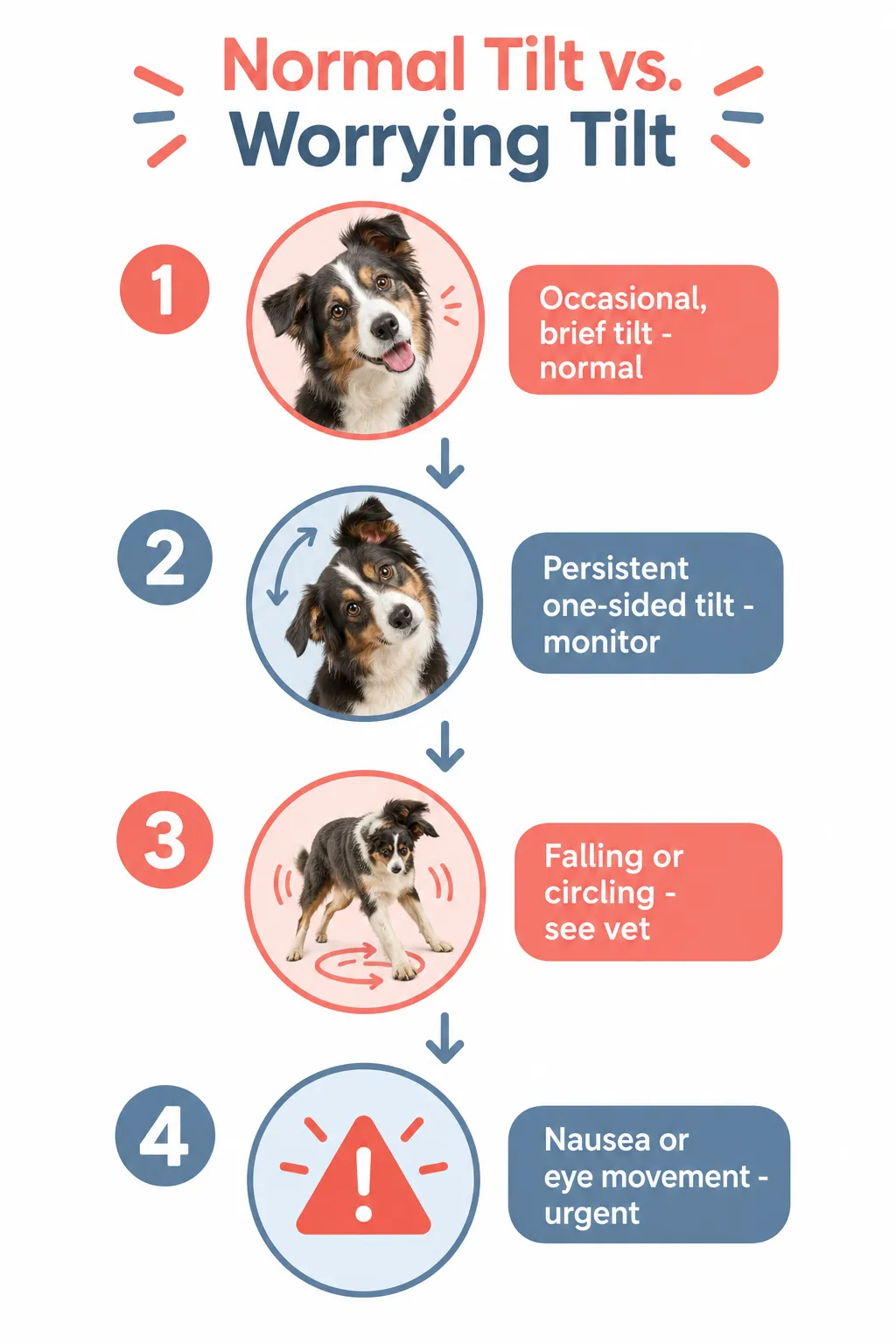
See a vet promptly if the head tilt is accompanied by any of the following:
- 🚨 The tilt is constant and doesn’t go away after a few minutes
- 🚨 Your dog is losing balance, falling, or circling in one direction
- 🚨 You notice rapid, involuntary eye movements (called nystagmus)
- 🚨 Your dog seems nauseous or is vomiting
- 🚨 The tilt appeared suddenly with no obvious trigger
- 🚨 Your dog’s tilt changes depending on body position
Chewy’s behavioral health resource notes that idiopathic vestibular disease – while scary-looking – often resolves on its own within a few weeks. But you should still get a diagnosis to rule out more serious causes.
A good rule: if the tilt lasts more than a few minutes without an obvious trigger, or if it comes with any balance or eye symptoms, call your vet that day.
The Social Bonding Side – Why Dogs Tilt Their Heads to Connect With You
This is the reason most people overlook. Head tilting isn’t just sensory – it’s also a communication signal that dogs have learned to use with humans.
When a dog tilts its head while you’re talking, it’s signaling attentiveness and engagement. Research suggests dogs have evolved to be highly sensitive to human emotional cues, and the head tilt may be part of that social toolkit.
Dogs that tilt their heads during conversations tend to get more positive responses from humans – more eye contact, softer voices, treats, and affection. Over time, this reinforces the behavior.
It’s a feedback loop: you react positively, so the dog tilts more. The tilt becomes a bonding gesture as much as a sensory one.
If you want to deepen your bond with your dog through communication, exploring hand commands for dogs and brain games for dogs can make a real difference.
FAQ
Q: Is a dog head tilt always a sign they like you?
A: Not always – it’s primarily a sensory and cognitive response. But dogs do tilt more toward people they’re bonded with because they pay more attention to them.
Q: Can I train my dog to tilt its head on command?
A: Yes. Because dogs tilt more when they hear specific sounds, you can pair a unique word or whistle with a reward to reinforce the behavior on cue.
Q: Why does my dog tilt its head to one specific side every time?
A: Consistent tilting to one side can be normal (related to dominant brain hemisphere) or a sign of an underlying ear or neurological issue. If it’s new and persistent, see a vet.
Q: Do dogs tilt their heads when they hear other dogs?
A: Yes, especially at unusual dog vocalizations like whines, barks, or howls. It’s the same auditory processing response.
Q: My older dog just started tilting its head suddenly – should I worry?
A: A sudden onset of head tilting in a senior dog warrants a vet visit. Idiopathic vestibular syndrome is common in older dogs and treatable, but other causes need to be ruled out.
Q: Does a dog tilting its head mean it’s happy?
A: It usually means engaged and curious, which are positive states. But happiness is better read from the whole body – tail, posture, and relaxed muscles together.
Q: Why do dogs tilt their heads at the TV?
A: They’re responding to sounds – especially animal noises or high-pitched tones – and trying to locate the source. Some dogs also respond to visual movement on screen.
Q: Is head tilting more common in certain ages?
A: Young adult dogs in active social and learning phases tend to tilt most frequently. Very young puppies and very old dogs may tilt less.
Conclusion
So why do dogs tilt their heads? The short answer is: it’s complicated – in the best possible way.
Your dog’s adorable head tilt is a window into a surprisingly sophisticated set of behaviors. It’s part hearing aid, part visual adjustment, part language processing, and part social bonding signal. All happening in one quick, charming movement.
Here’s what to do with this information:
- Enjoy it – a head tilt is a sign your dog is engaged and connected with you
- Talk to your dog more – using consistent words for familiar things reinforces the language connection
- Know the red flags – persistent tilts, balance issues, or eye movement changes mean a vet visit, not a photo opportunity
- Pay attention to patterns – if your dog always tilts to the same side and it’s new behavior, note it and mention it at your next vet appointment
Understanding your dog’s body language – from head tilts to why dogs stare at you to why dogs pant – makes you a better, more connected dog owner. And your dog will thank you for it (probably with another head tilt).