
Last updated: August 29, 2026
Quick Answer: Bloat (GDV – gastric dilatation-volvulus) is a life-threatening emergency where a dog’s stomach fills with gas and twists. Unlike a regular upset stomach, the key signs of bloat in dogs include unproductive retching (heaving with nothing coming up), a visibly distended abdomen, restlessness, and signs of shock like pale gums. If you see these signs, skip home remedies and go straight to an emergency vet.
Key Takeaways
- Unproductive retching is the single most critical warning sign – the dog heaves but nothing comes up
- A drum-tight, swollen belly that enlarges rapidly is a major red flag
- Bloat can kill a dog within hours without surgery – time is everything
- Regular upset stomachs produce actual vomit; GDV typically does not
- Large, deep-chested breeds like Great Danes, German Shepherds, and Weimaraners face the highest risk
- Pale gums, weakness, and rapid breathing signal shock – this is a true emergency
- There are no effective home remedies for GDV – vet care is the only option
- Feeding habits, meal size, and post-meal exercise are key prevention factors
What Does Bloat Look Like in Dogs?
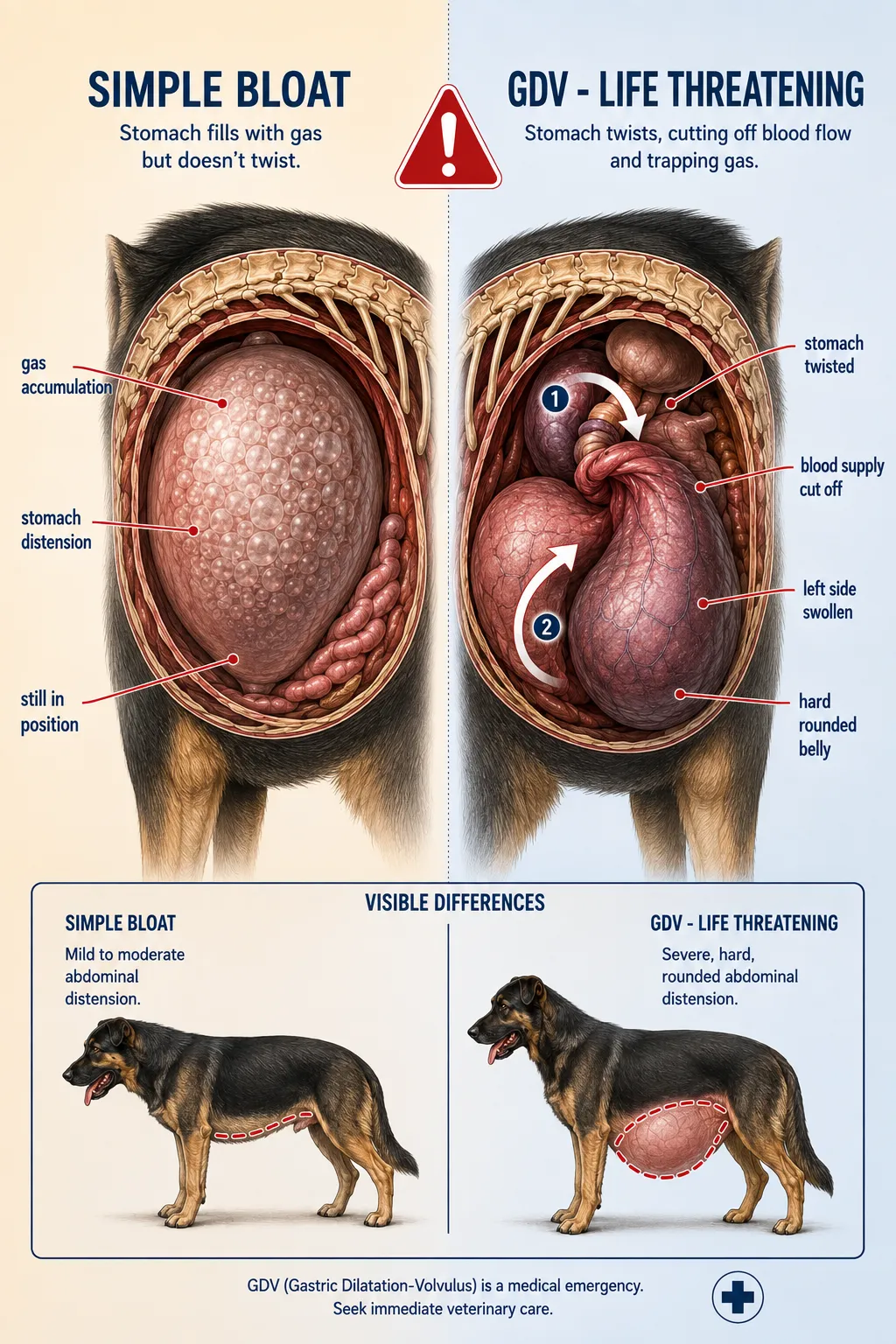
Bloat in dogs has two stages. Simple bloat means the stomach fills with gas. GDV means the stomach has also twisted, cutting off blood supply. The second stage is always life-threatening.
The most visible sign is a belly that looks swollen, hard, and rounded – especially on the left side behind the rib cage. Tap it gently and it may sound hollow, like a drum. This happens fast, sometimes within an hour of eating.
Other visible signs include:
- The dog standing in a hunched or uncomfortable posture
- Staring down at their own abdomen
- Pacing and unable to settle in one spot
- Drooling heavily without eating anything
- Gums that look pale, white, or grayish instead of pink
According to VCA Animal Hospitals on GDV in dogs, the combination of abdominal distension and unproductive retching together is a classic presentation that warrants immediate emergency care.
How to Tell if My Dog Has Bloat or Just Gas
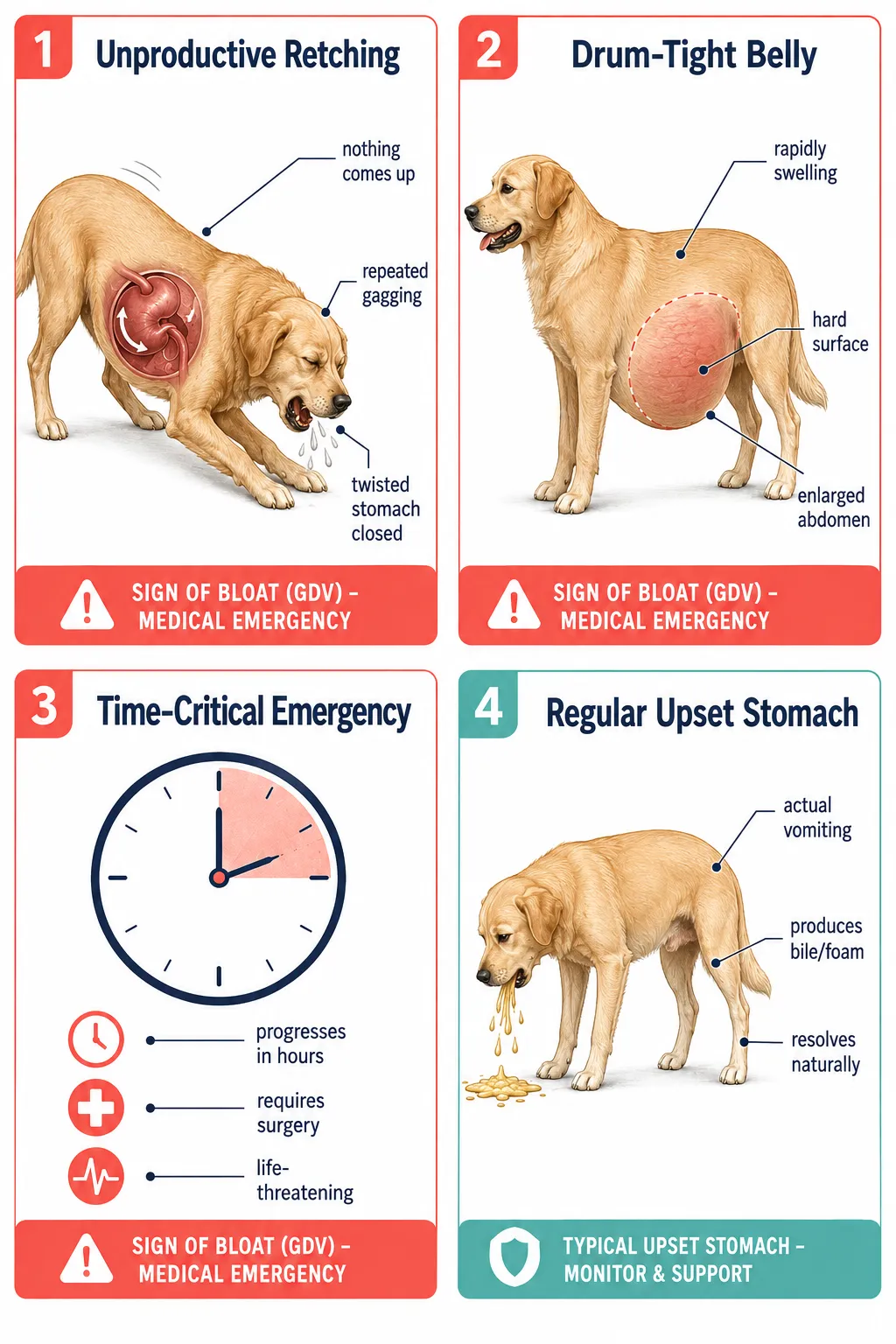
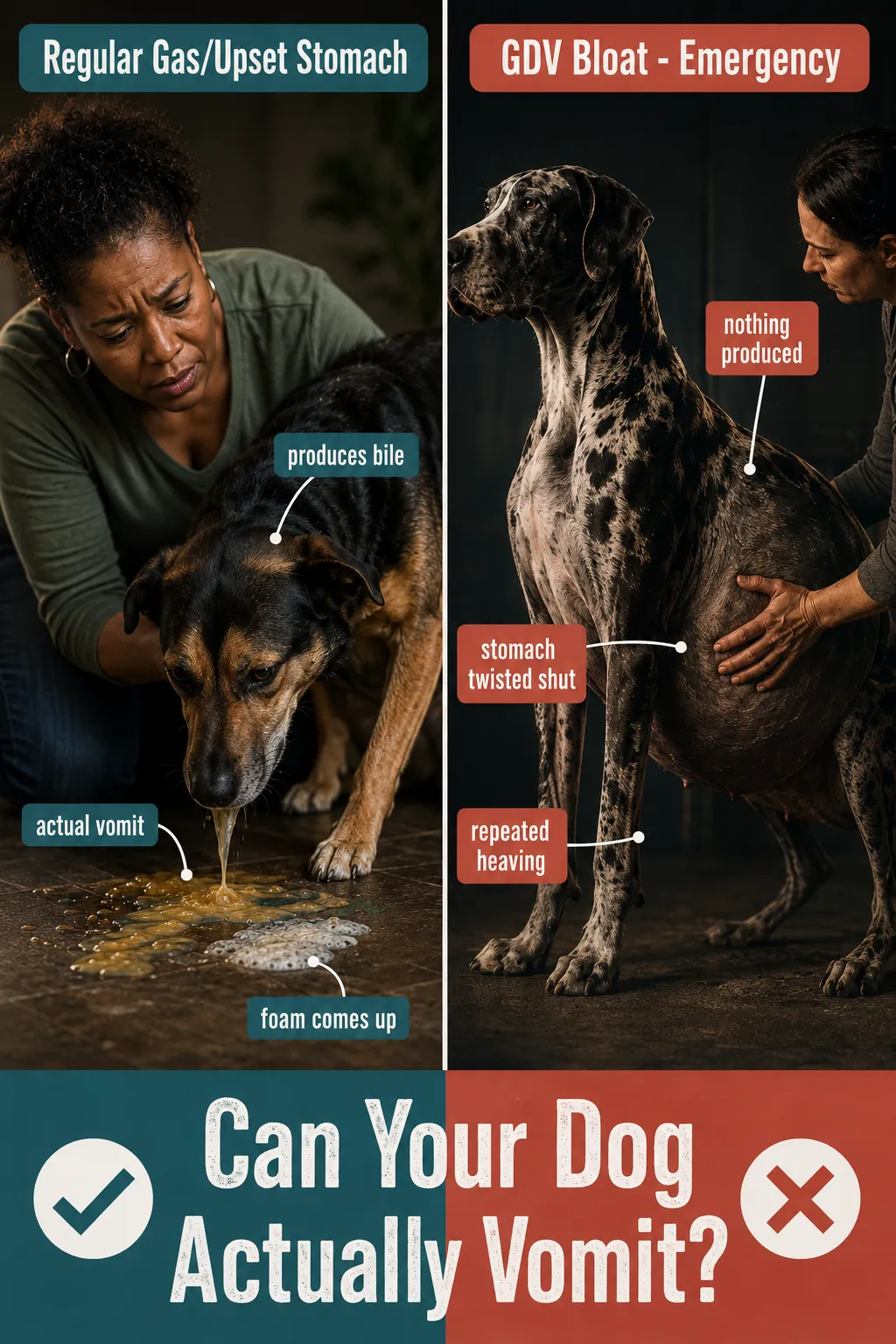
The biggest difference is whether your dog can actually vomit. With a regular upset stomach or gas, dogs usually produce something – bile, food, foam. With GDV, the stomach is twisted shut, so nothing comes up no matter how hard the dog tries.
Here is a quick comparison:
| Sign | Upset Stomach / Gas | Bloat / GDV |
|---|---|---|
| Retching | Produces vomit | Unproductive, nothing comes up |
| Belly appearance | Normal or slightly gassy | Visibly distended, tight, drum-like |
| Behavior | May rest and recover | Restless, cannot get comfortable |
| Gum color | Pink and moist | Pale, white, or grayish |
| Timeline | Improves within hours | Worsens rapidly |
| Response to rest | Dog settles down | Dog cannot settle at all |
A dog with a simple gassy stomach might pass gas, burp, or vomit once and then feel better. A dog with GDV gets progressively worse – and fast.
Rule of thumb: If your dog is retching repeatedly with nothing coming up AND their belly looks swollen, treat it as an emergency. Do not wait to see if they “sleep it off.”
7 Signs of Bloat in Dogs You Should Never Ignore
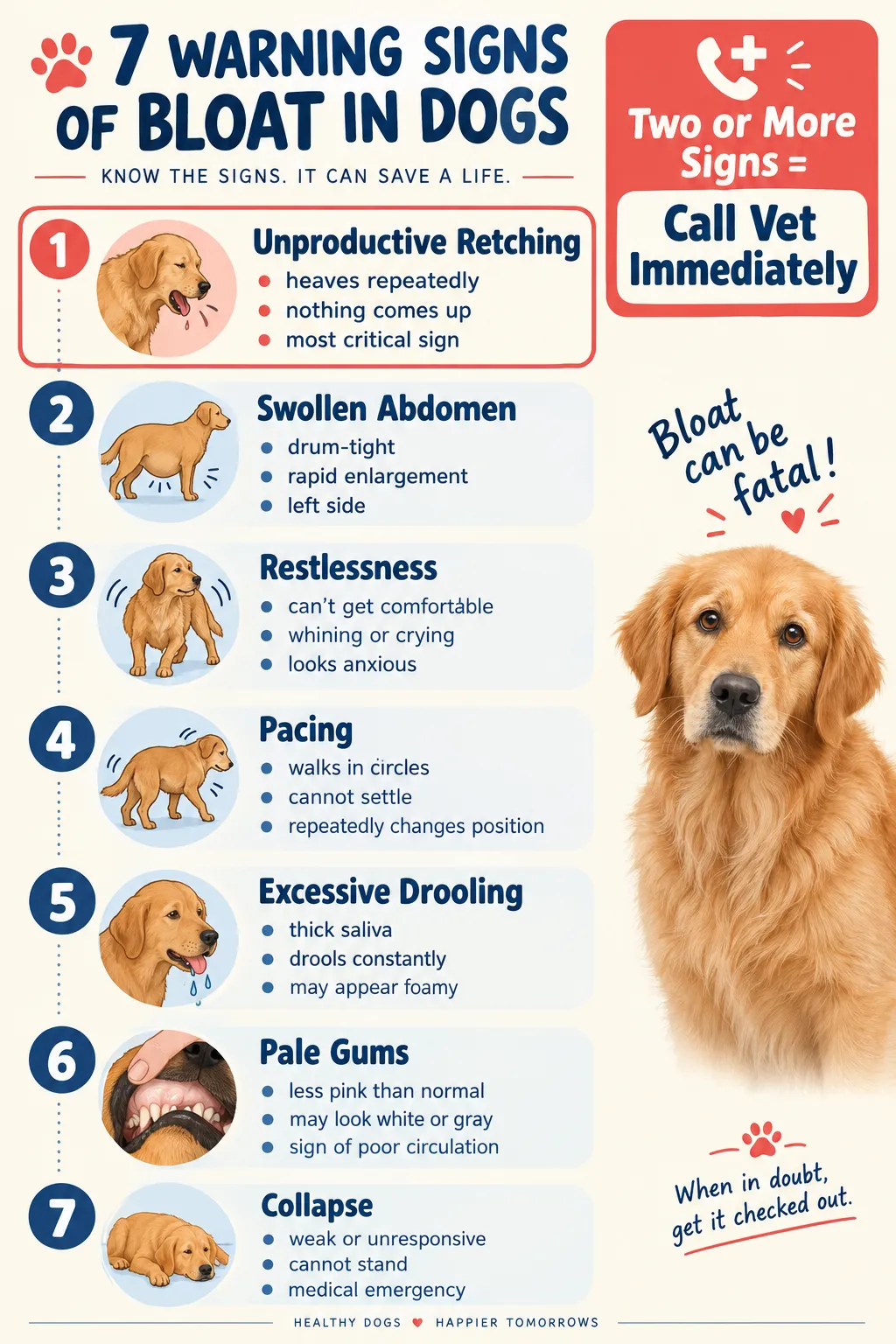
These are the seven warning signs every dog owner needs to memorize. Seeing two or more together means call a vet immediately.
1. Unproductive retching
The dog heaves and gags repeatedly but produces nothing. This is the single most critical sign of GDV, according to Pooler Vet’s guide on GDV signs every owner should know.
2. Visibly distended abdomen
The belly swells noticeably, especially on the left side. It may feel tight and hard like an inflated balloon.
3. Restlessness and inability to settle
The dog paces, lies down, gets up again, and cannot find a comfortable position. This reflects serious internal pain.
4. Excessive drooling
Heavy drooling alongside retching and restlessness is a strong combined warning.
5. Pale or white gums
Check the inside of your dog’s lips. Pink is normal. Pale, white, or grayish gums signal shock – a critical emergency.
6. Rapid breathing or weakness
Fast, shallow breathing and sudden weakness or collapse indicate the condition has progressed to shock.
7. Anxious expression and posture changes
Early bloat may show as a dog staring at their belly, standing stiffly, or looking worried without obvious cause. These subtle signs often appear before the dramatic ones.
If you notice any of these alongside signs described in our guide to 10 early signs of pain in dogs every owner should recognize, take it seriously.
How Quickly Does Bloat Happen in Dogs?
GDV can progress from early discomfort to life-threatening shock in as little as one to two hours. This is what makes it so dangerous compared to a regular upset stomach, which typically develops slowly and improves on its own.
The stomach fills with gas rapidly – often after a large meal. If the stomach then twists (volvulus), blood supply is cut off to the stomach wall and spleen. Tissue starts dying within minutes. According to the American College of Veterinary Surgeons, GDV is one of the most time-sensitive emergencies in veterinary medicine.
Key time facts:
- Symptoms can appear within 30-60 minutes of eating
- A dog in GDV without treatment can go into shock within 1-2 hours
- Survival rates drop significantly the longer surgery is delayed
How Long Can a Dog Survive With Bloat Without Treatment?
Without treatment, a dog with GDV may survive only a few hours. Some dogs deteriorate faster depending on how severely the stomach has twisted and how quickly shock sets in.
This is not a “wait and see” situation. Every minute matters. PetMD’s overview of GDV syndrome notes that without emergency intervention, GDV is almost always fatal.
Can Bloat in Dogs Be Treated at Home?
No. GDV cannot be treated at home. There are no home remedies, supplements, or positioning tricks that can untwist a stomach or release the trapped gas safely.
Some owners wonder about simethicone (Gas-X) or walking the dog to pass gas. While simethicone may help mild gas discomfort, it does nothing for a twisted stomach. Walking a dog in GDV can actually worsen their condition.
If you are researching natural options for minor stomach upsets, our article on what to give a sick dog naturally covers safe home remedies – but those apply only to mild digestive issues, not GDV.
Bottom line: If you suspect bloat, the only right move is an emergency vet visit.
What Should I Do if I Think My Dog Has Bloat Right Now?
Act immediately. Do not wait for symptoms to worsen or for your regular vet to open.
Follow these steps:
- Note the time symptoms started – your vet will need this
- Check gum color – press a finger on the gum, release, and see if color returns within 2 seconds (normal) or stays pale (emergency)
- Call an emergency animal hospital while someone else prepares the car
- Drive directly to the vet – do not stop, do not try home remedies
- Keep the dog calm and still during transport – avoid letting them pace or jump
Do not offer food or water. Do not try to make the dog vomit. Peak Pet Urgent Care’s guide to recognizing GDV symptoms confirms that immediate professional intervention is the only effective response.
Bloat vs Gastroenteritis in Dogs – What’s the Difference?
Gastroenteritis is inflammation of the stomach and intestines, usually caused by infection, dietary indiscretion (eating something bad), or stress. It produces actual vomiting and diarrhea, and most dogs recover with supportive care.
GDV is a mechanical emergency – the stomach physically twists. It does not cause diarrhea. The dog cannot vomit. The belly swells visibly.
Key differences:
- Gastroenteritis: vomiting produces material, dog may have diarrhea, belly is soft, dog can rest between episodes
- GDV: retching produces nothing, no diarrhea, belly is hard and swollen, dog cannot rest or settle
If your dog vomited once, had loose stool, and is now resting comfortably, that points more toward gastroenteritis. If your dog is retching repeatedly, belly is swelling, and they cannot lie still – that is a GDV emergency.
Also check our resource on 7 critical parvovirus signs in dogs since parvo can sometimes be confused with severe gastroenteritis in puppies.
Which Dog Breeds Are Most Prone to Bloat?
Deep-chested, large and giant breeds face the highest risk of GDV. The deep chest creates more physical space for the stomach to rotate.
High-risk breeds include:
- Great Dane (highest risk of any breed)
- German Shepherd
- Standard Poodle
- Weimaraner
- Irish Setter
- Doberman Pinscher
- Rottweiler
- Basset Hound (deep chest despite small size)
- Mastiff and Bullmastiff – see our Bullmastiff owner guide for breed-specific health tips
Risk also increases with age (dogs over 7 are more vulnerable), a family history of GDV, and having a nervous or anxious temperament. Male dogs are at slightly higher risk than females.
Smaller breeds can get simple bloat (gas distension) but are far less likely to develop the full GDV twist.
What Causes Bloat in Dogs and How to Prevent It?
The exact cause of GDV is not fully understood, but several risk factors are well established. Gas accumulates in the stomach faster than it can escape, and in some dogs the stomach then rotates.
Known contributing factors:
- Eating one large meal per day
- Eating too fast
- Exercising vigorously right before or after eating
- Drinking large amounts of water rapidly after exercise
- Elevated food bowls (research on this is mixed, but many vets now recommend floor-level feeding for giant breeds)
- High-stress environments
Prevention strategies:
- Feed two or three smaller meals per day instead of one large one
- Use a slow-feeder bowl to reduce eating speed
- Wait at least 60 minutes after eating before exercise – see our guide on how long you should walk your dog for safe activity timing
- Avoid letting your dog gulp large amounts of water after running
- Ask your vet about a prophylactic gastropexy (a surgical procedure that tacks the stomach to the abdominal wall, preventing it from twisting) – this is often recommended for high-risk breeds
For guidance on proper meal sizing, our article on how much food to feed your dog daily is a helpful starting point.
How Much Does Emergency Bloat Surgery Cost for Dogs?
Emergency GDV surgery is expensive. Based on general veterinary cost estimates (costs vary widely by region and hospital), treatment typically involves emergency stabilization, surgery to untwist the stomach, and hospitalization.
Costs can range from roughly $3,000 to $7,500 or more depending on location, severity, and whether complications arise. Some cases cost more if the stomach wall or spleen is damaged and requires removal.
Pet insurance that covers emergency surgery can significantly reduce out-of-pocket costs. If cost is a concern, ask the emergency vet about payment plans before declining treatment – most hospitals have options.
The preventive gastropexy surgery, done electively in a healthy dog, is far less expensive – typically $400 to $1,500 depending on the clinic and whether it is done at the same time as a spay or neuter.
What Is the Recovery Time After Bloat Surgery in Dogs?
Most dogs who survive GDV surgery and are discharged from the hospital recover over two to four weeks. The first 48-72 hours post-surgery are the most critical.
PDSA’s guide to GDV in dogs notes that dogs typically stay hospitalized for two to four days after surgery for monitoring and IV fluids. At home, activity is restricted for several weeks, and diet is gradually reintroduced.
Recovery milestones:
- Days 1-3: Hospital monitoring, IV fluids, pain management
- Days 4-7: Home rest, small bland meals, no exercise
- Weeks 2-4: Gradual return to normal activity under vet guidance
- Long term: Most dogs return to full normal life if surgery was successful
Can a Dog Get Bloat More Than Once?
Yes – if only simple bloat (gas distension without twisting) occurred, it can recur. However, if a dog had GDV and the surgeon performed a gastropexy (stomach tacking) during the operation, the stomach cannot twist again.
Without a gastropexy, recurrence risk is high – some studies suggest over 70% of dogs who had GDV without gastropexy will have another episode. This is why most surgeons perform gastropexy as a standard part of GDV surgery.
If your dog had simple bloat without surgery, talk to your vet about an elective gastropexy to prevent future GDV.
What Food and Water Habits Prevent Bloat in Dogs?
Feeding habits are one of the most controllable risk factors for bloat. The goal is to slow down eating, reduce the volume of gas swallowed, and avoid putting a full stomach under physical stress.
Best habits to adopt:
- Split meals: Two or three smaller meals per day instead of one large meal
- Slow feeders: Puzzle bowls or slow-feeder inserts reduce eating speed significantly
- No exercise for 60 minutes after eating: This is one of the most consistently recommended guidelines
- Fresh water access: Allow drinking in moderate amounts rather than letting a dog gulp a full bowl after hard exercise
- Avoid stress during meals: Dogs that eat anxiously or competitively with other dogs swallow more air
Also review what dogs can and cannot eat to avoid foods that cause excessive gas production, which can contribute to stomach distension.
Conclusion
Bloat is one of the few dog health emergencies where knowing the signs of bloat in dogs ahead of time can genuinely save your dog’s life. A regular upset stomach resolves on its own. GDV does not.
Your action checklist:
- Memorize the 7 signs – especially unproductive retching and a swollen, hard belly
- Know the difference between GDV and a regular stomach upset
- If you have a large, deep-chested breed, ask your vet about preventive gastropexy
- Switch to two or three smaller meals per day and use a slow-feeder bowl
- Never exercise your dog for at least 60 minutes after eating
- Save your nearest emergency vet’s number in your phone right now – before you ever need it
When in doubt, go to the vet. A false alarm costs you a vet visit. Missing GDV can cost your dog their life.
FAQ
Q: Can a dog with bloat still poop?
A: Yes, a dog with early GDV may still defecate, but this does not rule out bloat. The key signs to watch are unproductive retching and a swollen abdomen, not bowel movements.
Q: Is bloat painful for dogs?
A: Yes, GDV causes significant abdominal pain. The restlessness, inability to settle, and hunched posture you see are direct responses to that pain.
Q: Can puppies get bloat?
A: Simple gas bloat can happen in puppies, but GDV is rare in young puppies. It becomes more common as large breeds reach middle age and older.
Q: Does elevated feeding cause bloat?
A: Research on this is mixed. Earlier studies suggested elevated bowls increased risk in large breeds, but more recent research has not confirmed a clear link. Ask your vet for breed-specific advice.
Q: What does a dog’s belly feel like with bloat?
A: The abdomen feels tight, hard, and drum-like rather than soft and pliable. It may also appear visibly larger than normal, especially on the left side.
Q: Can bloat resolve on its own?
A: Simple gas distension may occasionally resolve, but GDV (with stomach twisting) will not resolve on its own and is always fatal without surgery.
Q: How do I check my dog’s gum color at home?
A: Lift your dog’s upper lip and look at the gum tissue. Healthy gums are bubble-gum pink and moist. Pale, white, gray, or bluish gums are an emergency sign.
Q: Is bloat the same as GDV?
A: Not exactly. “Bloat” often refers to simple gastric distension (gas buildup). GDV (gastric dilatation-volvulus) means the stomach has also twisted. GDV is the life-threatening version.
Q: Can stress cause bloat in dogs?
A: Stress and anxiety are considered contributing risk factors. Dogs that eat anxiously, are housed in high-stress environments, or have a nervous temperament appear to have higher risk.
Q: Should I try to burp my dog if I think they have bloat?
A: No. Do not attempt to relieve the gas yourself. Get to an emergency vet immediately.
Q: Is a gastropexy worth it for my large breed dog?
A: For high-risk breeds like Great Danes, Weimaraners, and Standard Poodles, most veterinary surgeons consider preventive gastropexy a reasonable and potentially life-saving procedure. Discuss it with your vet.
Q: What is the survival rate for dogs who have GDV surgery?
A: According to DogMD’s overview of GDV signs, survival rates with prompt surgery are generally reported between 80-90%, but drop significantly when treatment is delayed or when the stomach wall is severely damaged.