Last updated: August 16, 2026
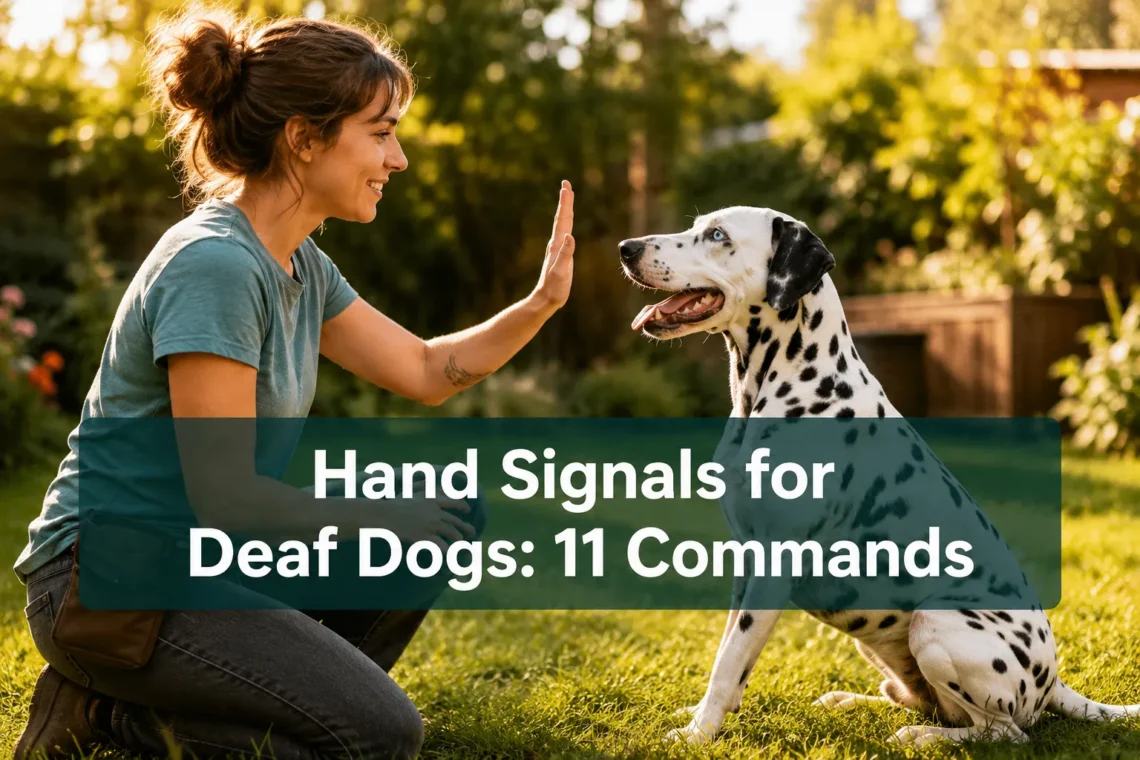
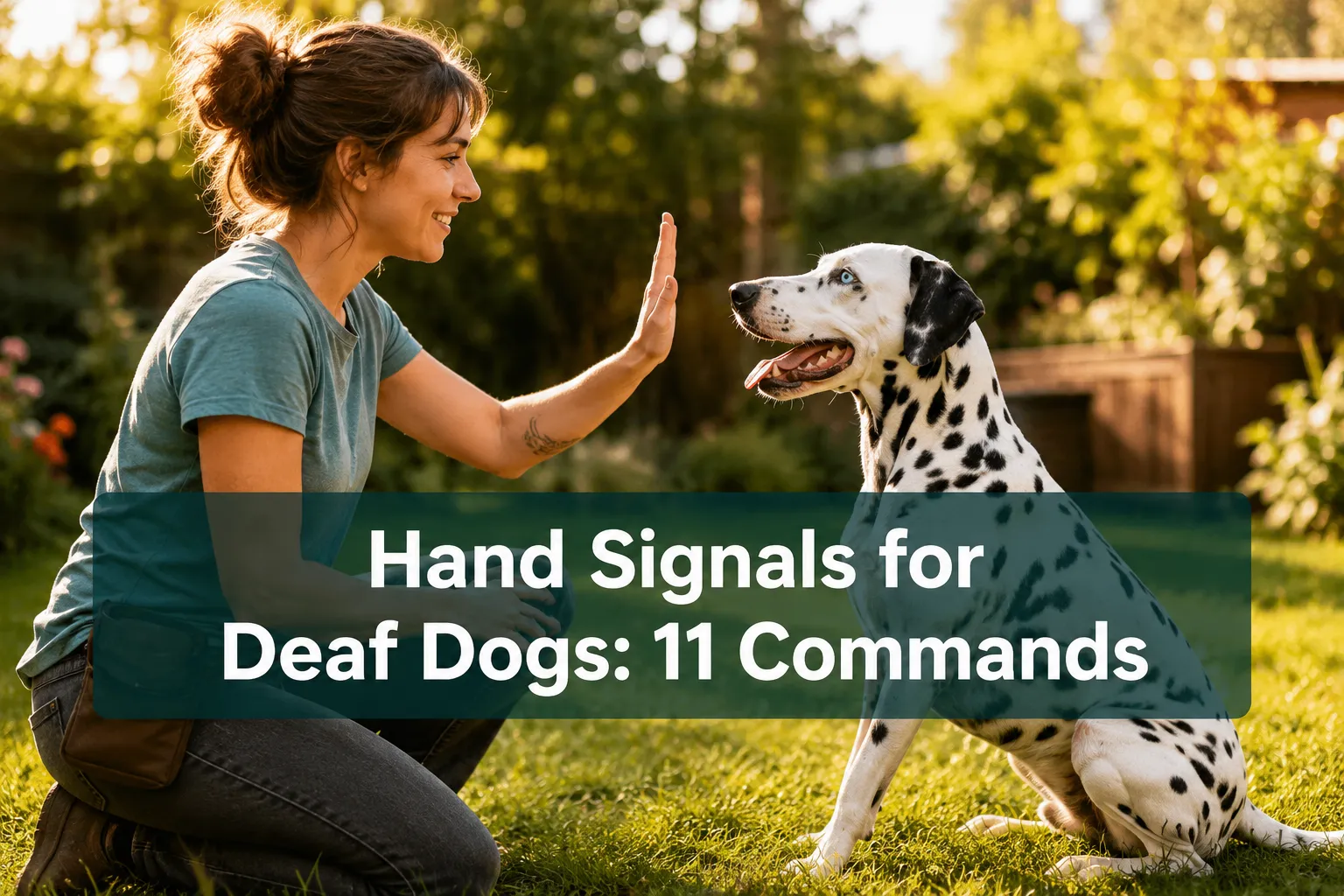
Quick Answer: Hand signals for deaf dogs are visual gestures that replace spoken commands, letting you communicate clearly without sound. Deaf dogs can learn all core obedience behaviors – sit, stay, come, down, heel, and more – using consistent visual cues paired with positive reinforcement. According to LSU Vet Med’s hand commands resource, many trainers recommend ASL-based signs so communication stays clear even when handlers change.
Key Takeaways
- 🐾 Deaf dogs can learn just as many commands as hearing dogs – the method just shifts from voice to hands.
- 👁️ “Attention” is the foundation: your dog must look at you before any hand signal works.
- ✋ Use the same gesture every single time – consistency is everything for a deaf dog.
- 🏆 Positive reinforcement (treats, thumbs-up, or a visual “yes” marker) replaces the clicker or verbal praise.
- 📋 ASL-inspired signs are a smart choice because they’re standardized and widely recognized.
- 🔦 Use floor vibrations, light flashes, or a gentle tap to get your dog’s attention first.
- 🐕 Deaf dogs are not harder to train – many respond faster to visual cues than hearing dogs do to voice.
- 📅 In 2026, resources for training deaf dogs are more accessible than ever, with video guides, printable charts, and nonprofit support all available free.
What Hand Signals Can Deaf Dogs Learn?
Deaf dogs can learn every command a hearing dog learns – the list is only limited by how many signs you’re willing to teach. Dr. Buzby’s ToeGrips guide to hand signals for dogs outlines 13 distinct visual commands, from basic obedience to everyday life cues like “walk” and “quiet.”
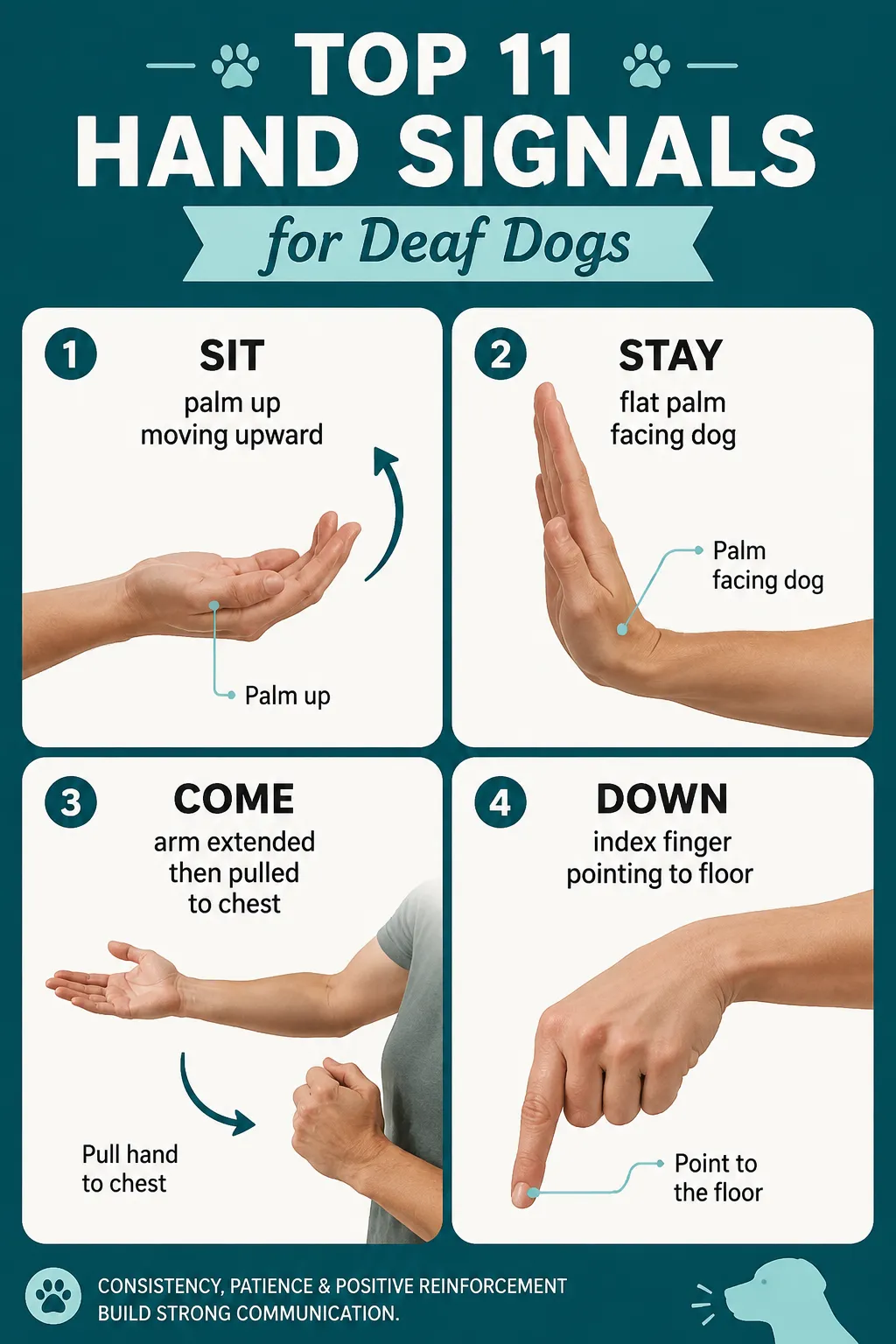
Here are the 11 most practical hand signals for deaf dogs to start with:
| Command | Hand Signal |
|---|---|
| Sit | Palm up, move hand upward |
| Down | Index finger or full hand pointing to the floor |
| Stay | Hand flat, palm facing the dog |
| Come | Arm extended, then pulled inward to chest |
| Heel | Pat your left thigh twice |
| Yes / Good | Thumbs-up (visual reward marker) |
| No | Finger wag or hand flat moving side to side |
| Look at me | Two fingers (index and middle fingers) pointed at your eyes |
| Drop it | Open palm facing up, then lower hand |
| Leave it | Hand flat, sweep away from the object |
| Go play | Open hand, wave outward |
These hand commands cover almost every daily situation a dog and owner face together. Once your dog knows these 11, you can expand using American sign language references to add signs for “car,” “toy,” “drink,” and more.
💡 Want to fast-track your dog’s obedience? This free dog training workshop uses the same methods service dog trainers rely on – it’s a great starting point whether your dog is deaf or hearing.
How to Get a Deaf Dog’s Attention Before Giving Commands
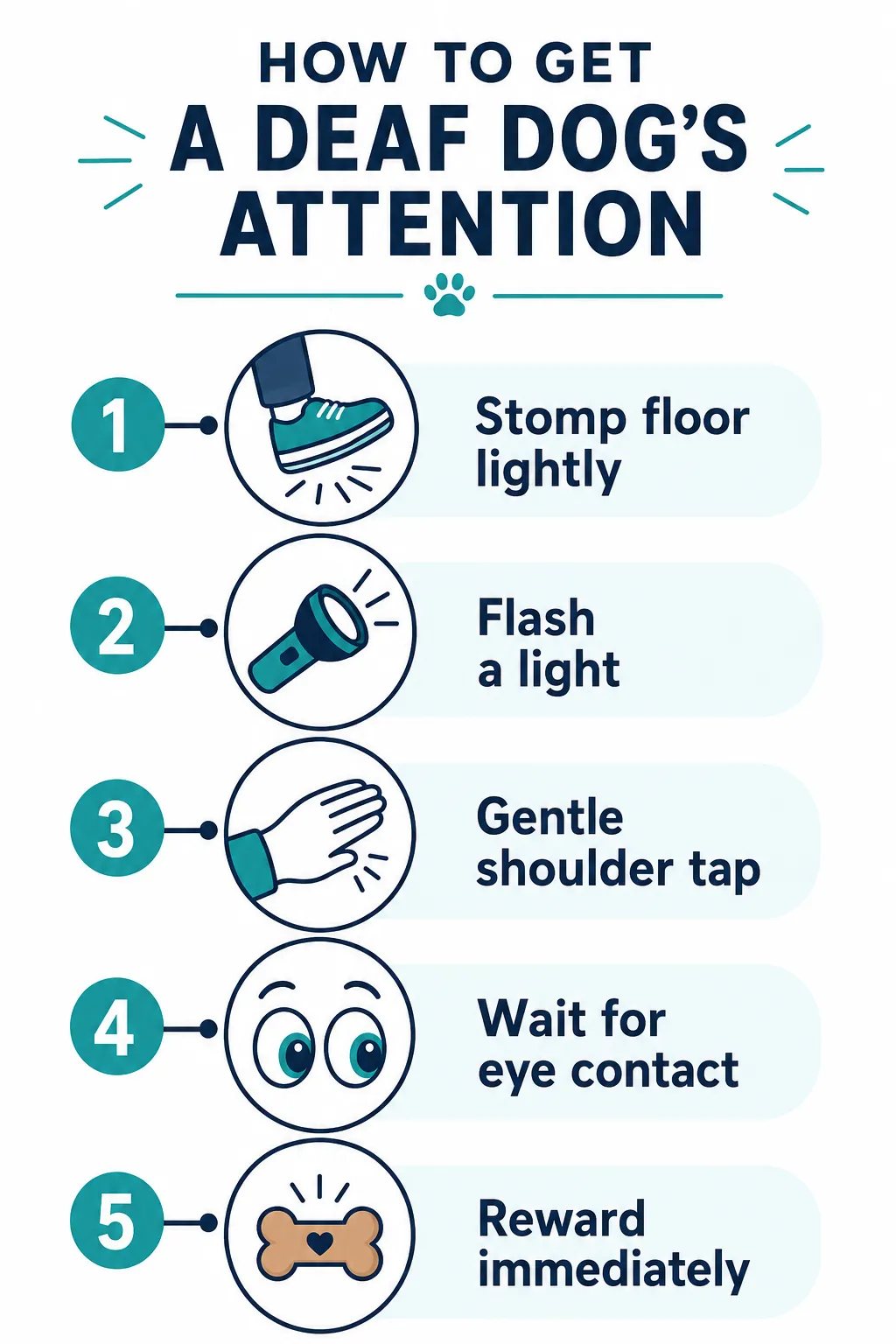
Getting your deaf dog’s attention is step one – no hand signal works if your dog isn’t looking at you. The “look at me” or attention cue is the single most important skill to teach first, and it unlocks every other command that follows.
Here’s how to build that attention habit:
- Stomp lightly on the floor – the vibration travels through the ground and your dog feels it.
- Flash a small flashlight or room light – a brief flicker gets attention without startling.
- Tap your dog gently on the shoulder – use this when you’re close by.
- Wait for eye contact, then immediately give your visual “yes” (thumbs-up) and a treat.
- Repeat this sequence daily until your dog checks in with you automatically.
Deaf Dogs Rock’s beginning sign training guide recommends pairing a thumbs-up or a specific “yes” gesture as a visual marker – the equivalent of a clicker – so your deaf dog knows the exact moment they got it right.
For the “look at me” sign itself, use your index and middle fingers pointed toward your own eyes. This is the same gesture used in ASL-based dog training and is easy for dogs to distinguish from other signals.
Hand Signals for Deaf Dogs: Sit, Stay, Down, Come, and Heel
These five commands form the backbone of any training program for a deaf dog. Unconditional Rescue’s deaf dog training guide confirms that sit, stay, come, and a “good job” thumbs-up are enough to cover most daily needs – and they’re the best place for beginners to start.
Sit: Hold your palm up and move your hand upward. Lure your dog into the sit position with a treat first, then fade the lure so the hand motion alone becomes the cue.
Stay: Hold your hand flat with palm facing the dog, like a “stop” signal. Take one step back, then return and reward. Gradually increase distance.
Down: Point your index finger – or your whole right hand – toward the floor. Some trainers use a downward sweep of the full arm. Pick one and stick with it.
Come: Extend your arm fully toward the dog, then sweep it back to your chest. D for Dog’s deaf dog hand signals resource notes that a big, exaggerated motion works best for recall because it’s visible from a distance.
Heel: Pat your left thigh twice. This tells your dog to walk close beside you on a loose leash.
For more dog hand commands beyond these basics, our guide to 15 powerful hand commands for dogs covers a wider range of signals that work for both deaf and hearing dogs.
Deaf Dog Training Hand Signals vs. Hearing Dogs: Is There a Difference?
Deaf dogs don’t need a completely different training system – they need the same system with sound removed. The core principles of positive reinforcement, clear cues, and consistent repetition apply equally to deaf dogs and hearing dogs.
The main differences are:
- Visual marker instead of verbal “yes”: A thumbs-up or a specific hand sign replaces the word “good boy” or a clicker sound.
- Attention cue is non-negotiable: With a hearing dog, you can call their name from across the room. With a deaf dog, you need a vibration, light flash, or tap first.
- Body language matters more: Deaf dogs read your posture, facial expression, and movement constantly. Be calm and consistent with your whole body, not just your hands.
According to Taste of the Wild’s beginner hand signals guide, the same hand cues should be used every time, whether or not verbal cues are possible – making this training approach equally valid for all dogs.
Our full breakdown of 10 dog training hand signals you can use without saying a word is a great companion resource here.
Can Deaf Dogs Learn as Many Commands as Hearing Dogs?
Yes – deaf dogs can learn as many commands as hearing dogs, and in some cases they pick up visual cues faster. There’s no cognitive difference between a deaf dog and a hearing dog; the only change is the communication channel.
Trainers at Unconditional Rescue note that many deaf dogs respond faster to visual cues than hearing dogs do to verbal ones, likely because dogs are naturally visual communicators. A 2025 video guide on “20 Visual ASL Signs to Teach Your Dog” demonstrates that trainers now routinely work with 15-20+ distinct visual commands for deaf dogs, including signs for drink, spin, and up/jump.
The key insight: A deaf puppy or adult deaf dog that gets consistent sign training from day one can reach the same obedience level as any hearing dog. The timeline is similar too – most dogs begin responding reliably to basic signs within 2-4 weeks of daily 5-10 minute sessions.
What Breeds Go Deaf Most Often?
Deafness in dogs is most common in breeds with white or merle coat patterns, linked to a lack of pigment-producing cells in the inner ear. LSU Vet Med’s research on canine deafness is one of the leading academic resources on this topic.
Breeds with higher rates of congenital deafness include:
- Dalmatian – the most studied breed for hereditary deafness
- Australian Shepherd – especially merle-coated individuals
- Bull Terrier – white-coated dogs particularly
- Boxer
- English Setter
- Catahoula Leopard Dog
A deaf puppy from any of these breeds benefits enormously from early sign training. Starting hand signal work at 8-10 weeks old, the same age you’d begin verbal training, gives the best results.
🐾 If you’re beginning training with a deaf puppy or newly adopted deaf dog, the free dog training workshop covers housebreaking and foundational obedience using methods that translate perfectly to visual-only training.
How to Know If Your Dog Is Deaf
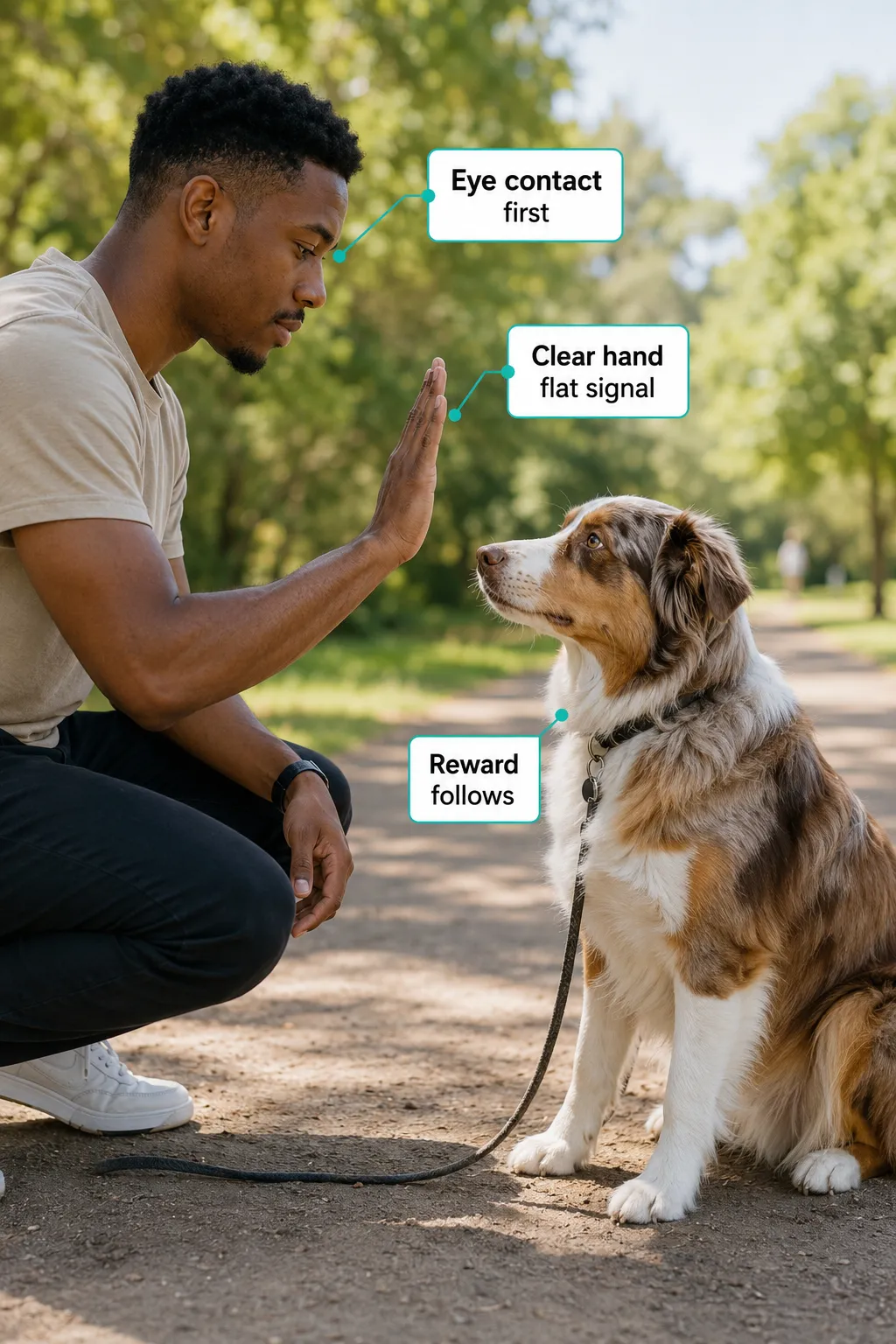
A dog may be deaf if it doesn’t respond to sounds that normally trigger a reaction – like a door knock, its name, or a squeaky toy behind its back. Deafness can be congenital (present at birth) or acquired through age, infection, or injury.
Signs your dog may be deaf:
- Doesn’t wake up when you enter the room unless it sees or smells you
- Startles easily when touched from behind (no warning from sound)
- Doesn’t respond to its name or loud noises
- Sleeps through sounds that wake other dogs
- Vocalizes unusually loudly (can’t self-regulate volume)
A formal diagnosis uses a BAER (Brainstem Auditory Evoked Response) test, available at veterinary neurology centers and some university vet schools. If you notice these stress signals in dogs alongside unresponsiveness to sound, a vet check is a good next step.
Best Hand Signals for Deaf Dogs Safety: Emergency Recall
Emergency recall is the most critical hand signal for deaf dog safety – it can prevent a dog from running into traffic or getting lost. The signal needs to be big, distinct, and heavily reinforced so your dog responds every single time.
How to build a rock-solid emergency recall:
- Choose a unique, exaggerated signal – both arms raised overhead works well because it’s visible from far away.
- Practice it only in controlled settings at first, with the highest-value treats you have.
- Never use this signal for anything other than “come to me right now.”
- Practice in the yard, at the park, and on a long leash before trusting it off-leash.
- Reinforce it monthly so it never fades.
D for Dog’s deaf dog hand signals guide also recommends teaching functional everyday signals like “walkies,” “dinner time,” and “someone at the door” – these reduce anxiety because your deaf dog always knows what’s coming next.
Common Mistakes When Training Deaf Dogs
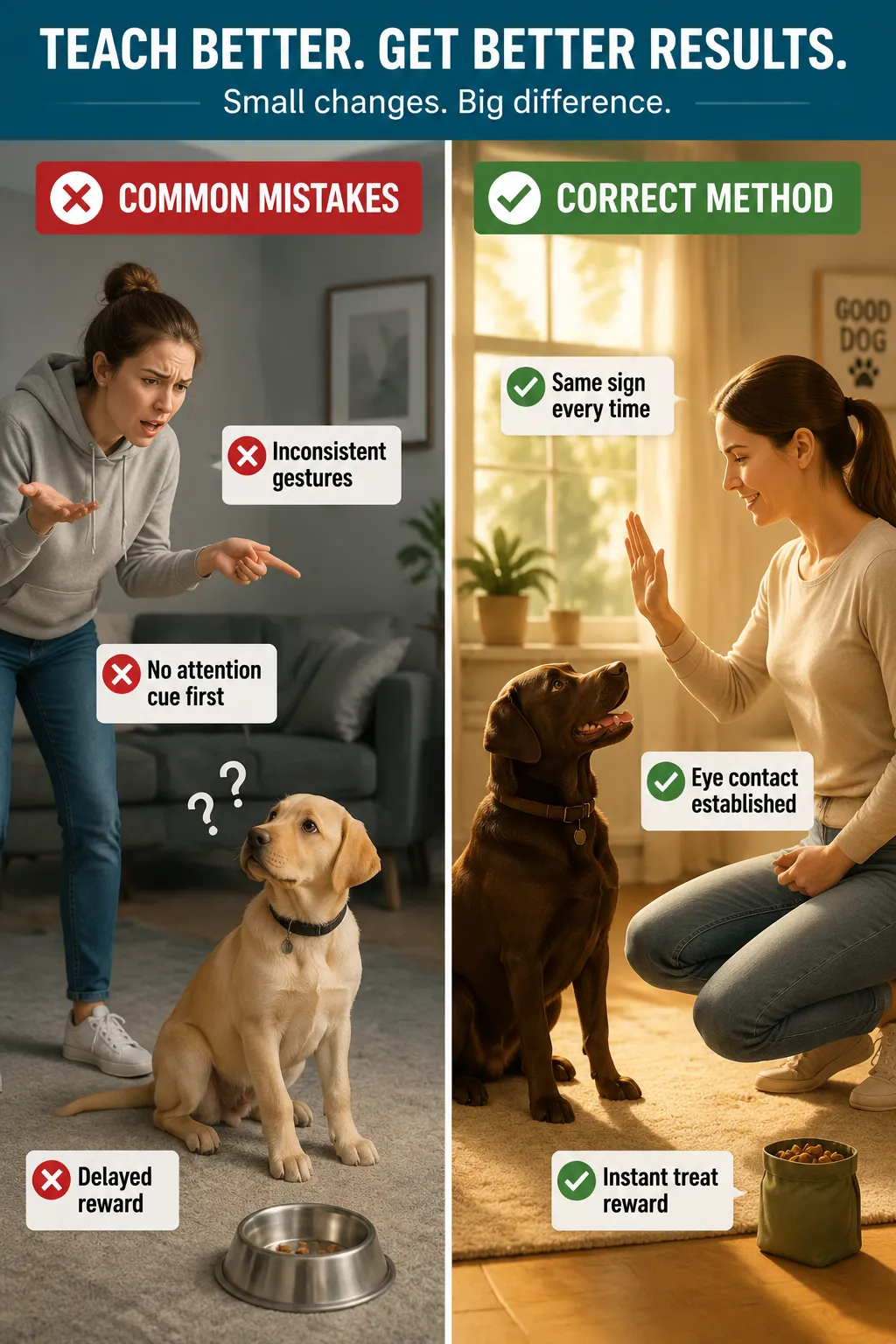
The most common mistake in training deaf dogs is using inconsistent gestures for the same command. Deaf dogs rely entirely on visual patterns, so a slightly different hand position can look like a brand-new signal to them.
Mistakes to avoid:
- Changing the sign – use the same hand signal every single time, no exceptions.
- Skipping the attention cue – giving a sign before your dog is looking at you wastes both your time.
- Delaying the reward – the visual “yes” marker (thumbs-up) must come within 1-2 seconds of the correct behavior.
- Using your left hand sometimes and right hand other times – pick your right hand (or left) as the primary signaling hand and stay consistent.
- Punishing instead of redirecting – deaf dogs can’t hear a sharp “no” tone of voice, so a calm hand flat signal for “no” paired with redirection works far better than any form of correction.
For a broader look at dog behaviour training principles that apply here, our 14-day dog training plan walks through a structured approach that works well for deaf dogs too.
How Long Does It Take to Train a Deaf Dog with Hand Signals?
Most deaf dogs begin responding reliably to basic hand signals within 2-4 weeks of consistent daily training. Full command fluency across 10-15 signs typically takes 2-3 months with short, frequent sessions.
Realistic timeline:
- Week 1-2: Attention cue and “yes” marker established
- Week 2-4: Sit, stay, and come are reliable in low-distraction environments
- Month 2: Down, heel, and no are solid; beginning sign training expands to 6-8 commands
- Month 3+: Dog generalizes commands to new locations; adding advanced or fun signs
The key variable is session frequency. Five to ten minutes twice a day beats one long session per week every time. Keep it short, keep it positive, and your deaf dog will surprise you.
Deaf Dog Training Tips for Beginners
Starting sign training with a deaf dog is simpler than most people expect. Proven Dog Training’s guide to visual cues and hand signals confirms that the lure-signal-reward method works just as well for deaf dogs as it does for hearing ones.
Beginner checklist:
- ✅ Start with the attention cue before any other sign
- ✅ Use high-value treats (small, soft, smelly)
- ✅ Keep sessions to 5-10 minutes maximum
- ✅ Always end on a success
- ✅ Use a thumbs-up or a specific “yes” hand sign as your visual marker
- ✅ Practice in quiet, familiar spaces before adding distractions
- ✅ Be patient – a deaf dog is learning a new language just like you are
Resources like Deaf Dogs Rock’s beginning sign training and the ilmdog deaf dog hand signals chart offer printable references you can keep on the fridge.
If you want a structured program, check out our 8 genius hand signals to train your dog faster for a step-by-step progression that works beautifully for deaf dogs.
Joining the Deaf Dog Community and Getting Support
You don’t have to figure this out alone – there’s a passionate, knowledgeable community built around supporting deaf dogs and their owners. Organizations like Deaf Dogs Rock provide resources, community forums, and advocacy for deaf dogs of all ages and breeds.
Ways to get support:
- Deaf Dogs Rock – nonprofit with training guides, a memory and honor wall, and donation options to support deaf dogs in rescue. You can make a difference in the life of a deaf dog by donating in honor of a loved one, canine or human.
- Online communities – Facebook groups and forums connect owners of deaf dogs worldwide.
- Printable charts – search for “deaf dog hand signals printable PDF free” to find ready-made sign language charts you can use at home.
- Books – two widely recommended reads are A Deaf Dog Joins the Family (covering training, education, and communication for a smooth transition) and Signing Made Easy (a complete program for learning sign language, including sentence drills and exercises for increased comprehension and signing skill).
- Video resources – YouTube has a growing library of ASL-based dog training videos, including full demonstrations of 20+ visual signs.
If you’re also working on general obedience alongside sign training, our 9 top commands for dogs smart daily training guide pairs well with this approach.
🐕 For a comprehensive foundation, the free dog training workshop is a first-of-its-kind online program that teaches you to train your dog to service-dog-level obedience – the techniques translate directly to hand signal training for deaf dogs.
FAQ
What are some signs that my dog is Deaf?
A dog that doesn’t respond to its name, loud noises, or sounds behind its back may be deaf. Other signs include sleeping through noises that wake other dogs, startling easily when touched unexpectedly, and vocalizing unusually loudly. A BAER test at a veterinary neurology clinic provides a definitive diagnosis.
How to communicate with deaf dogs?
Communicate with deaf dogs using consistent hand signals paired with a visual reward marker like a thumbs-up. Use floor vibrations, light flashes, or a gentle tap to get their attention first. ASL-based signs are a popular choice because they’re standardized. Positive reinforcement – treats and visual praise – makes the communication loop clear and motivating.
What not to do with a Deaf dog?
Don’t use inconsistent gestures for the same command, skip the attention cue before signing, or delay your reward after correct behavior. Avoid startling your dog by approaching from behind without warning. Never use punishment-based corrections – a deaf dog can’t hear tone of voice, so harsh methods cause confusion and fear without communicating anything useful.
How do you make a Deaf dog feel loved?
Make eye contact often and use your “yes” thumbs-up marker generously – it’s their version of hearing “good boy.” Use gentle touch, play sessions, and high-value treats as rewards. Establish predictable daily routines with visual cues for meals, walks, and bedtime so your deaf dog always knows what’s coming. Consistent, calm presence builds deep trust and security.
Conclusion
Training a deaf dog with hand signals is one of the most rewarding experiences a pet owner can have. Your dog isn’t limited by deafness – it’s just waiting for you to speak its language.
Your action steps starting today:
- Teach the attention cue first – thumbs-up as a “yes” marker, vibration or light to get focus.
- Add sit, stay, and come using the hand signals in the table above.
- Practice 5-10 minutes twice a day, always ending on a win.
- Expand to all 11 commands over 8-12 weeks.
- Connect with the deaf dog community for ongoing support and printable sign language charts.
In 2026, deaf dogs have more resources, more community support, and more trained advocates than ever before. Whether you’re welcoming a deaf puppy in january, adopting a rescue in march, or discovering your senior dog’s hearing loss in september, it’s never too late to start.
Your dog is watching you. Give them something great to see. 🐾