Last updated: September 26, 2026
Quick Answer: Positive reinforcement dog training works by rewarding your dog immediately after a desired behavior, making that behavior more likely to happen again. It’s backed by strong scientific evidence, recommended by major veterinary organizations, and works for dogs of all ages, breeds, and temperaments – including “stubborn” or reactive ones. The secret isn’t one big breakthrough. It’s a series of small wins, stacked daily.
Key Takeaways
- Positive reinforcement means adding something your dog enjoys (treat, praise, play) right after a good behavior to strengthen it.
- Reward timing matters a lot – deliver the reward within 1-3 seconds of the behavior.
- Research published in PLOS One shows reward-based training produces lower stress hormones and a more positive emotional state in dogs compared to aversive methods.
- Short sessions (5-10 minutes) with many small successes beat long, correction-heavy sessions every time.
- Positive reinforcement works for puppies, adult dogs, reactive dogs, and even dogs with aggression history.
- The “7 tiny wins” approach builds a dog who chooses to listen – not one who obeys out of fear.
- Major organizations including the WSAVA, AVSAB, and RSPCA now formally recommend reward-based methods exclusively.
- Food is the most reliable reward, but toys, play, and praise work too – especially for dogs who aren’t food-driven.
- Common mistakes include rewarding too late, using treats that aren’t motivating enough, and quitting sessions too early.
- Results can appear within days for simple behaviors, but reliable off-leash obedience typically takes several weeks of consistent practice.
What Is Positive Reinforcement Dog Training and How Does It Work?
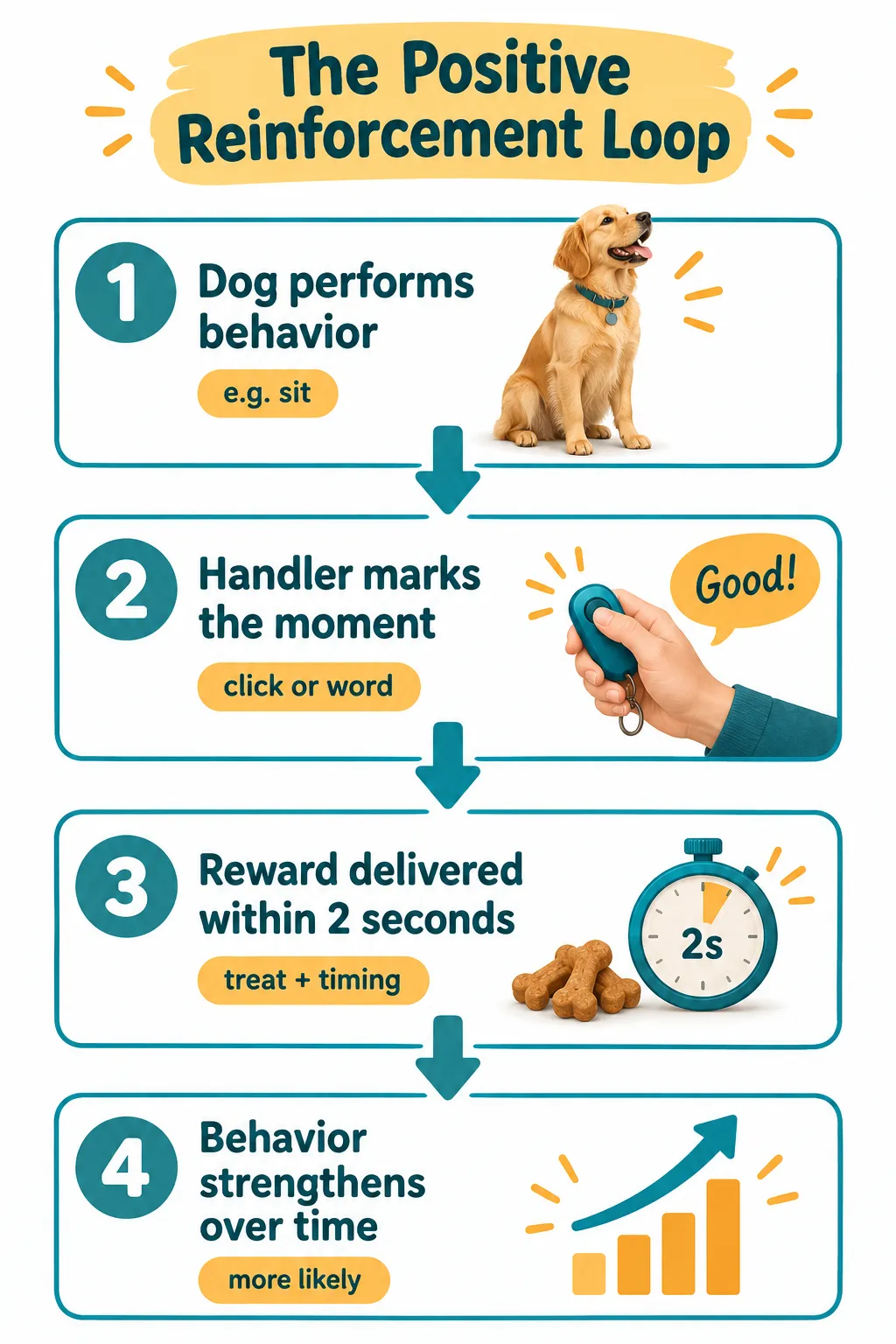
Positive reinforcement dog training means adding something your dog values – usually a treat, toy, or praise – immediately after a desired behavior occurs. That reward makes the behavior more likely to repeat. It’s one of the most well-supported methods in animal behavior science.
Here’s the basic loop:
- Dog performs the behavior (sits, comes when called, walks calmly on leash).
- You mark the exact moment with a word like “yes!” or a clicker click.
- You deliver the reward within 1-3 seconds so the dog connects the action to the outcome.
- You repeat across different settings until the behavior becomes automatic.
CareVet’s 2026 training guidance explains this loop clearly: mark the correct moment, deliver the reward fast, and repeat in multiple locations. Each repetition is a small win that builds a stronger, more reliable response.
Want to learn how to use a clicker to sharpen your timing? Check out this guide on how to use a clicker for dog training.
Why it works so well: Dogs repeat behaviors that feel good. When sitting earns a tasty treat, sitting becomes the dog’s default move when they want something. You’re not forcing compliance – you’re making good behavior the most rewarding option available.
Positive Reinforcement vs Punishment-Based Dog Training: Which Is Better?
Positive reinforcement is consistently better supported by evidence than punishment-based methods. The science on this has become increasingly clear in 2026.
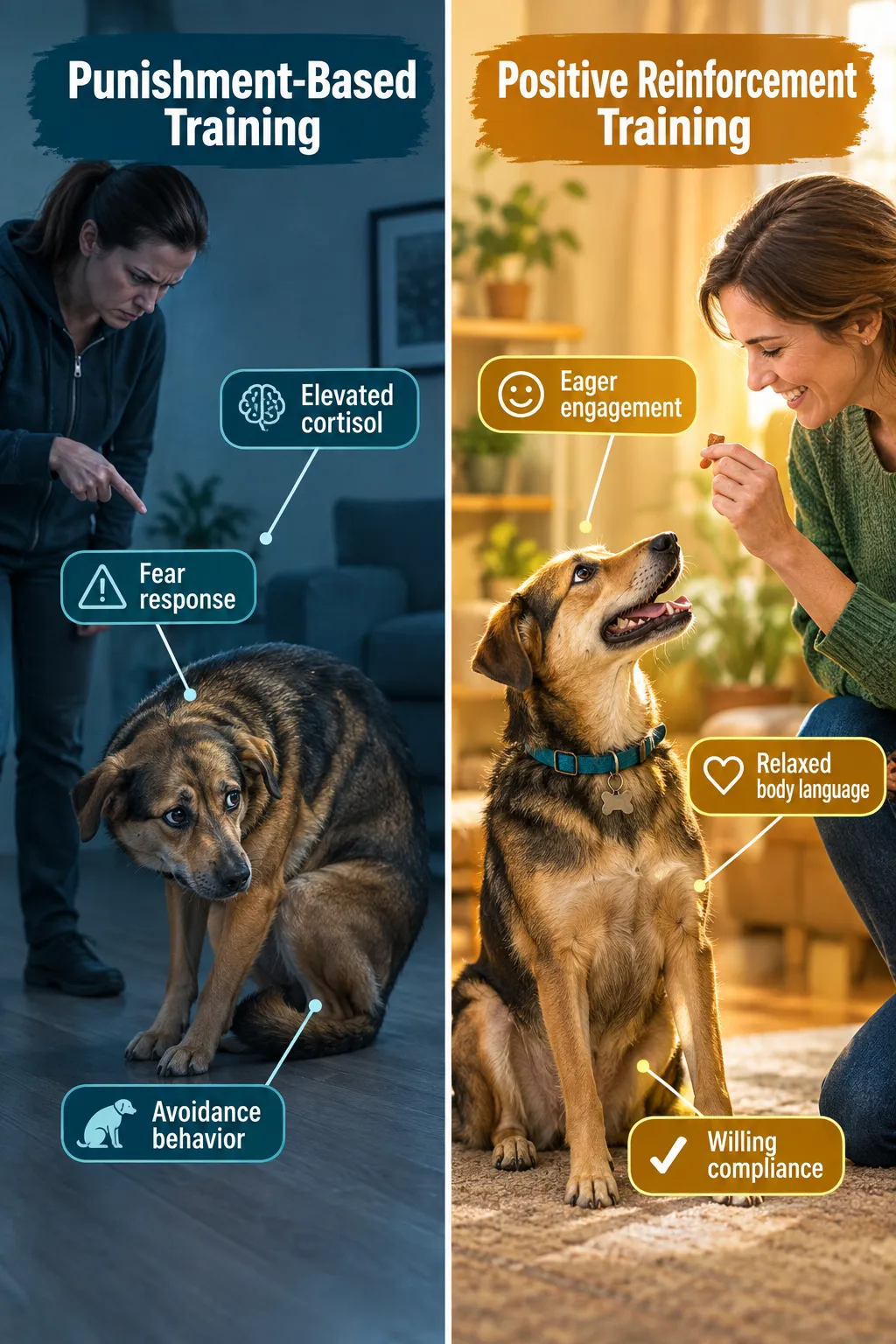
A PLOS One study found that dogs trained with aversive methods showed elevated cortisol (a stress hormone) and more negative emotional states. Dogs trained with reward-based methods showed the opposite – lower stress and more positive affect.
A 2026 Frontiers in Veterinary Science paper on professional trainers’ perspectives reports broad agreement that positive reinforcement leads to fewer behavior problems and comparable or better results than aversive approaches.
The AVSAB position is direct: reward-based methods should be used for all canine training, including for serious behavior problems. A University of Lincoln study, cited by AVSAB, showed that skilled positive reinforcement training outperformed electronic collar training in real-world scenarios.
Here’s a simple comparison:
| Factor | Positive Reinforcement | Punishment-Based |
|---|---|---|
| Stress levels | Low | High |
| Risk of aggression | Lower | Higher |
| Dog’s willingness | Eager | Avoidant |
| Long-term results | Strong | Inconsistent |
| Vet/welfare org support | Universal | Opposed |
The 2024 joint position paper from FVE, FECAVA, FEEVA, and WSAVA formally treats aversive tools like electric pulse collars as unacceptable from an animal welfare standpoint.
Bottom line: Punishment might stop a behavior in the moment, but it often creates fear, stress, and new behavior problems. Positive reinforcement builds a dog who actually wants to cooperate.
If you’re serious about training your dog the right way from the start, check out this Free Dog Training Workshop – a first-of-its-kind online workshop that teaches you to housebreak your dog, stop bad behaviors, and train them to be as obedient as service dogs, using the same methods professional service dog trainers use.
How Long Does It Take to See Results With Positive Reinforcement Training?
Most dogs show noticeable improvement in simple behaviors like sit, down, or name recognition within 3-7 days of consistent short sessions. Reliable off-leash behaviors or complex commands typically take 4-8 weeks of daily practice.
The key word is consistent. PetWorks’ 2026 training guide recommends 5-10 minute sessions, multiple times a day, focusing on building momentum through repeated small successes. That’s the “tiny wins” approach in action.
Realistic timelines:
- Basic commands (sit, down, stay): 1-2 weeks for a reliable indoor response.
- Loose leash walking: 3-6 weeks of consistent practice.
- Reliable recall: 4-8 weeks, starting in low-distraction environments.
- Off-leash obedience: Several months of proofing across different environments.
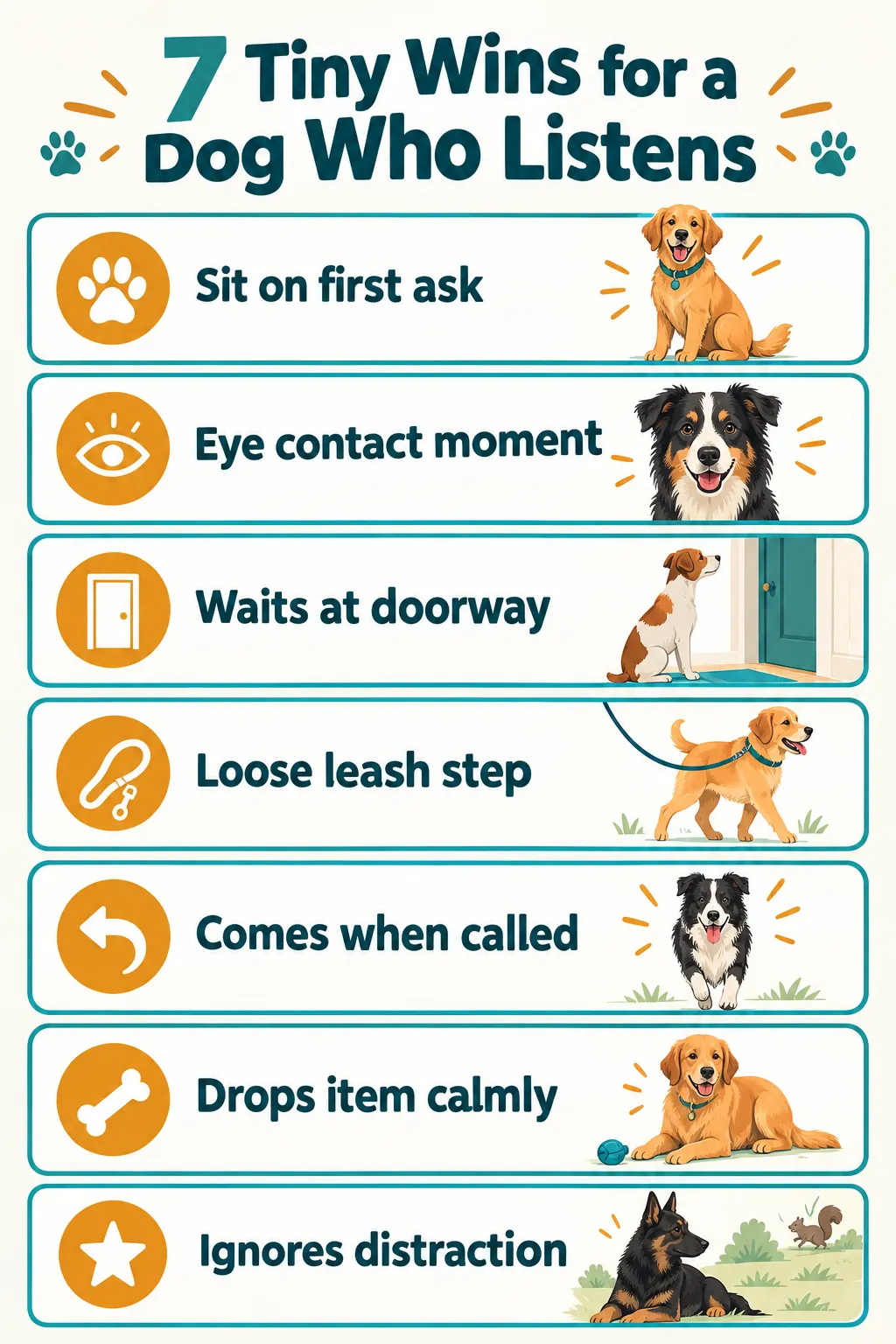
Don’t skip the small steps. Each tiny win – a single calm sit, one eye contact moment, one loose-leash step – is a deposit in the bank of a well-trained dog.
Positive Reinforcement Dog Training for Puppies vs Adult Dogs
Positive reinforcement works for both puppies and adult dogs, but the approach needs slight adjustments based on age.
Puppies have short attention spans and high energy. Keep sessions to 3-5 minutes. Use tiny, soft treats. Focus on one behavior at a time. The 15 puppy potty training tips guide is a great companion resource for new puppy owners.
Adult dogs can handle slightly longer sessions (5-10 minutes) and often have more impulse control. They may have existing habits to work through, which takes more patience – but they’re absolutely trainable. The idea that “you can’t teach an old dog new tricks” is simply not true.
Choose puppies if: You want to build behaviors from scratch with no competing habits.
Choose adult dogs if: You’re adopting and want a calmer starting point – adults often learn quickly once motivated.
For a structured approach that works at any age, the 14-day dog training plan lays out a daily routine you can follow from day one.
The 7 Tiny Wins That Build a Dog Who Wants to Listen
These are the small, daily moments where positive reinforcement dog training actually happens. Each one is a building block.
Win 1 – Sit on the first ask. Ask once, wait, reward the moment their bottom hits the floor. Don’t repeat the command. Repetition teaches dogs to ignore the first ask.
Win 2 – Voluntary eye contact. When your dog looks at you without being asked, mark it and reward. Eye contact is the foundation of attention and recall.
Win 3 – Waiting at doorways. Ask your dog to sit before going outside. Reward the pause. This builds impulse control in a real-life context.
Win 4 – One loose-leash step. On walks, the moment the leash goes slack, say “yes!” and keep moving as the reward. For more on this, see leash training a dog that pulls.
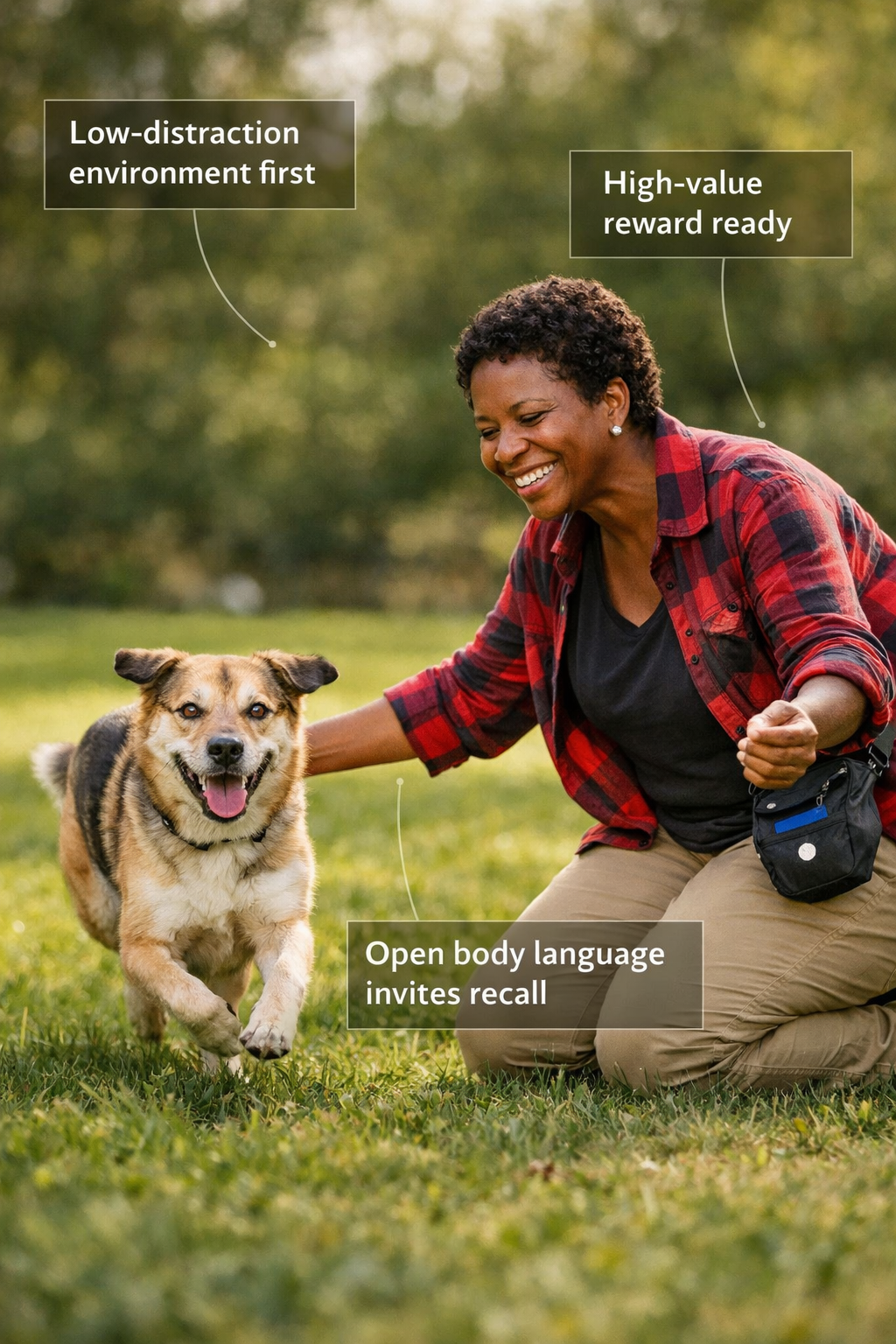
Win 5 – Coming when called. Practice recall in low-distraction environments first. Every successful recall earns a high-value reward. Never call your dog to scold them.
Win 6 – Dropping an item calmly. Trade the item for a treat. “Drop it” becomes a game, not a confrontation.
Win 7 – Ignoring a distraction. When your dog notices a squirrel or another dog and then looks back at you, reward that choice immediately. That’s self-regulation, and it’s huge.
“The goal isn’t a dog who obeys because they have to. It’s a dog who chooses to cooperate because it’s always been worth it.”
Common Mistakes People Make With Positive Reinforcement Dog Training
The most common mistakes are poor timing, inconsistent rewards, and accidentally reinforcing the wrong behavior. These are fixable once you know what to look for.
Mistake 1 – Rewarding too late. If you reward 5 seconds after the behavior, your dog is learning whatever they were doing at second 5 – not the sit you asked for. Aim for 1-3 seconds max.
Mistake 2 – Using boring treats. If your dog isn’t responding, the treat might not be motivating enough. Upgrade to real chicken, cheese, or hot dog pieces for training sessions.
Mistake 3 – Quitting on a failure. Always end sessions on a success, even if you have to ask for something easy. This keeps the dog’s confidence high.
Mistake 4 – Inconsistent rules. If jumping on guests is sometimes okay and sometimes not, your dog can’t learn the rule. Everyone in the house needs to respond the same way.
Mistake 5 – Rewarding attention-seeking bad behavior. Even negative attention (yelling, pushing away) can reinforce nuisance behaviors. Ignore minor unwanted behaviors when safe to do so. PetWorks advises focusing on reinforcing desirable behaviors rather than reacting to every unwanted one.
For a deeper look at training errors to avoid, the 15 terrible dog training mistakes guide covers the most damaging habits owners accidentally fall into.
Is Positive Reinforcement Training Good for Stubborn Dogs?
Yes – positive reinforcement is actually one of the best approaches for stubborn dogs. “Stubborn” usually means the dog hasn’t found a reward motivating enough, or the training hasn’t been clear enough.
Stubborn dogs often respond well when you:
- Find a higher-value reward (real meat beats dry kibble every time).
- Break behaviors into smaller steps so success comes faster.
- Train in a low-distraction environment first.
- Keep sessions short so the dog stays engaged.
For breed-specific stubborn tendencies, the 11 stubborn dog training tips guide has practical fixes that work across breeds.
Can You Use Positive Reinforcement to Train an Aggressive Dog?
Yes, and it’s often the safest and most effective approach for dogs with aggression. Punishment-based methods carry a documented risk of making aggression worse by adding fear and stress to an already reactive dog.
Positive reinforcement for aggressive dogs works by:
- Rewarding calm behavior around triggers at a safe distance.
- Gradually decreasing the distance to the trigger as the dog stays calm (this is called counter-conditioning and desensitization).
- Never forcing the dog into a situation that triggers a reaction.
Important: If your dog has bitten or shown serious aggression, work with a certified professional alongside positive training methods. For reactive dogs specifically, see how to train a reactive dog for a step-by-step approach.
Positive Reinforcement Dog Training for Recall and Off-Leash
Recall is one of the most important behaviors you can teach, and positive reinforcement is the gold standard method. The rule is simple: coming to you must always predict something good.
Steps to build a reliable recall:
- Start indoors with zero distractions. Say your dog’s name + “come,” then reward lavishly when they arrive.
- Move to a fenced yard. Increase distance gradually.
- Add mild distractions. Reward even more generously when they choose you over the distraction.
- Practice on a long line (15-30 foot leash) before going fully off-leash.
- Never punish a dog who comes to you, even if they took a while. You’re always rewarding the arrival.
For a detailed breakdown, how to train a puppy to come when called covers this step by step.
What If My Dog Isn’t Food Motivated? And Best Treats for Positive Reinforcement
Some dogs genuinely prefer toys, play, or praise over food. That’s fine – the reward just needs to be something your dog actually wants in that moment.
If your dog isn’t food motivated, try:
- A quick game of tug as the reward.
- Verbal praise paired with enthusiastic petting.
- Access to something they want (going outside, greeting another dog).
- Training before meals when the dog is slightly hungry.
Best treats for food-motivated dogs:
- Small, soft, smelly treats work best – think real chicken, cheese, or commercial soft training treats.
- Keep pieces tiny (pea-sized) so the dog doesn’t fill up fast.
- Vary the treats to keep interest high.
For homemade options, easy oatmeal dog treats are a simple, dog-approved choice you can make at home.
How Much Does Positive Reinforcement Dog Training Cost?
Costs vary widely depending on whether you train at home, take group classes, or hire a private trainer.
- DIY training at home: Essentially free beyond the cost of treats and any guides or courses you use.
- Group obedience classes: Typically $100-$200 for a 6-week course (varies by location and trainer).
- Private trainer sessions: Usually $75-$150 per session, depending on the trainer’s credentials and your area.
- Online programs and workshops: Range from free to a few hundred dollars for structured courses.
If budget is a concern, starting with a structured free resource is a smart move. The Free Dog Training Workshop is a great starting point – it’s a first-of-its-kind online workshop that teaches you to stop bad behaviors and train your dog to service-dog levels of obedience using the same methods professional trainers use, at no cost.
Do Professional Dog Trainers Use Positive Reinforcement Methods?
The overwhelming majority of certified professional dog trainers now use positive reinforcement as their primary method. This shift has accelerated significantly in the last few years.
The 2026 Frontiers in Veterinary Science survey of professional trainers reports broad agreement among professionals that reward-based methods produce fewer behavior issues and better long-term results. Major certifying bodies and veterinary organizations now explicitly recommend or require reward-based approaches.
Service dog trainers – who need the highest levels of reliability and precision – rely almost entirely on positive reinforcement. That’s why the “service dog standard” is such a meaningful benchmark for pet owners.
FAQ
Q: How old does my dog need to be to start positive reinforcement training?
A: You can start as early as 7-8 weeks old. Puppies learn from the moment they arrive home. Simple behaviors like sit and name recognition can be taught in the first week.
Q: How many treats will I need to use forever?
A: You won’t. Once a behavior is reliable, you can shift to intermittent rewards (rewarding every few times instead of every time), which actually makes behaviors stronger. You can also phase treats out gradually and replace them with life rewards like walks or play.
Q: Can I use positive reinforcement alongside saying “no”?
A: You can say “no” to interrupt a behavior, but the focus should be on redirecting to what you want and rewarding that. Saying “no” alone doesn’t teach the dog what to do instead.
Q: My dog does great at home but ignores me outside. What’s wrong?
A: This is a distraction problem, not a training failure. Practice in gradually more distracting environments. Use higher-value rewards outside. The behavior needs to be “proofed” across different locations.
Q: Is clicker training the same as positive reinforcement?
A: Clicker training is a type of positive reinforcement. The clicker marks the exact moment of the correct behavior with precision. You can also use a verbal marker like “yes!” if you don’t have a clicker.
Q: How do I stop my dog from jumping on people using positive reinforcement?
A: Reward four paws on the floor. Ask visitors to turn away and ignore jumping completely. The moment all four paws land, reward immediately. Consistency from everyone the dog meets is essential.
Q: What if my dog loses interest mid-session?
A: End the session. A dog who loses interest is telling you the session is too long, too hard, or the rewards aren’t good enough. Shorten sessions, lower the difficulty, or upgrade the treat.
Q: Can positive reinforcement fix resource guarding?
A: Yes, with care. The standard approach is to trade the guarded item for a high-value treat, teaching the dog that your approach predicts good things. For severe guarding, consult a certified behaviorist.
Conclusion
Positive reinforcement dog training isn’t complicated. It’s a series of small, well-timed moments where you catch your dog doing something right and make it worth their while to do it again.
The 7 tiny wins – from a voluntary sit to ignoring a distraction – are where real training happens. Not in dramatic correction moments, but in the quiet, consistent daily interactions that build trust and responsiveness over time.
Your actionable next steps:
- Pick one behavior to work on this week. Just one.
- Get high-value treats ready (real chicken or cheese beats dry kibble).
- Set a timer for 5 minutes and do three short sessions today.
- Mark the exact moment the behavior happens, then reward within 2 seconds.
- End every session on a success, even if it’s an easy one.
If you want a structured plan that takes you from basics to advanced obedience, the Free Dog Training Workshop walks you through the exact methods used by service dog trainers – covering housebreaking, stopping bad behaviors, and building reliable obedience from the ground up.
Your dog wants to get it right. They just need you to show them how.