

Last updated: August 30, 2026
Quick Answer: The 28-Day Dog Obedience Challenge is a structured, daily training program where you spend just 10 minutes a day working through core commands with your dog over four weeks. It works by building one skill at a time, adding difficulty gradually, and creating a consistent habit. Most dog owners see real, noticeable behavior changes by the end of week two.
Key Takeaways
- The 28-Day Dog Obedience Challenge uses short daily sessions (10-30 minutes) to build lasting obedience habits
- Week 1 focuses on foundation commands: sit, stay, come, and down
- Consistency matters more than session length – 10 focused minutes beats 60 distracted ones
- The challenge works for dogs of all ages, including stubborn breeds
- Positive reinforcement and high-value treats are the core tools
- You can run the challenge with multiple dogs, but train them separately
- After day 28, the work continues – maintenance sessions keep skills sharp
- App-based versions like PawChamp make daily tracking easy for busy owners
- Professional training is not required; most owners can do this at home
- Common mistakes include skipping days, training in distracting environments too early, and inconsistent cues
What Is a 28-Day Dog Obedience Challenge?
The 28-Day Dog Obedience Challenge is a month-long, home-based training program that breaks dog obedience into daily, manageable sessions. Each day has a specific goal, a specific command to practice, and a clear structure so you always know what to do next.
The idea is simple: instead of overwhelming yourself and your dog with long training sessions or expensive classes, you commit to one focused task per day for 28 days. By the end, your dog has been exposed to all the core commands, real-world distractions, and even vet and groomer behavior scenarios.
Programs like the Prestige Dog Training 28-day plan lay out daily objectives from day 1 (sit and stay) all the way through to a final review and celebration on day 28, making the structure easy to follow for any owner.
If you’re just starting out, this challenge is one of the most practical ways to build a well-behaved dog without spending a fortune.
How Does the 28-Day Dog Obedience Challenge Work?
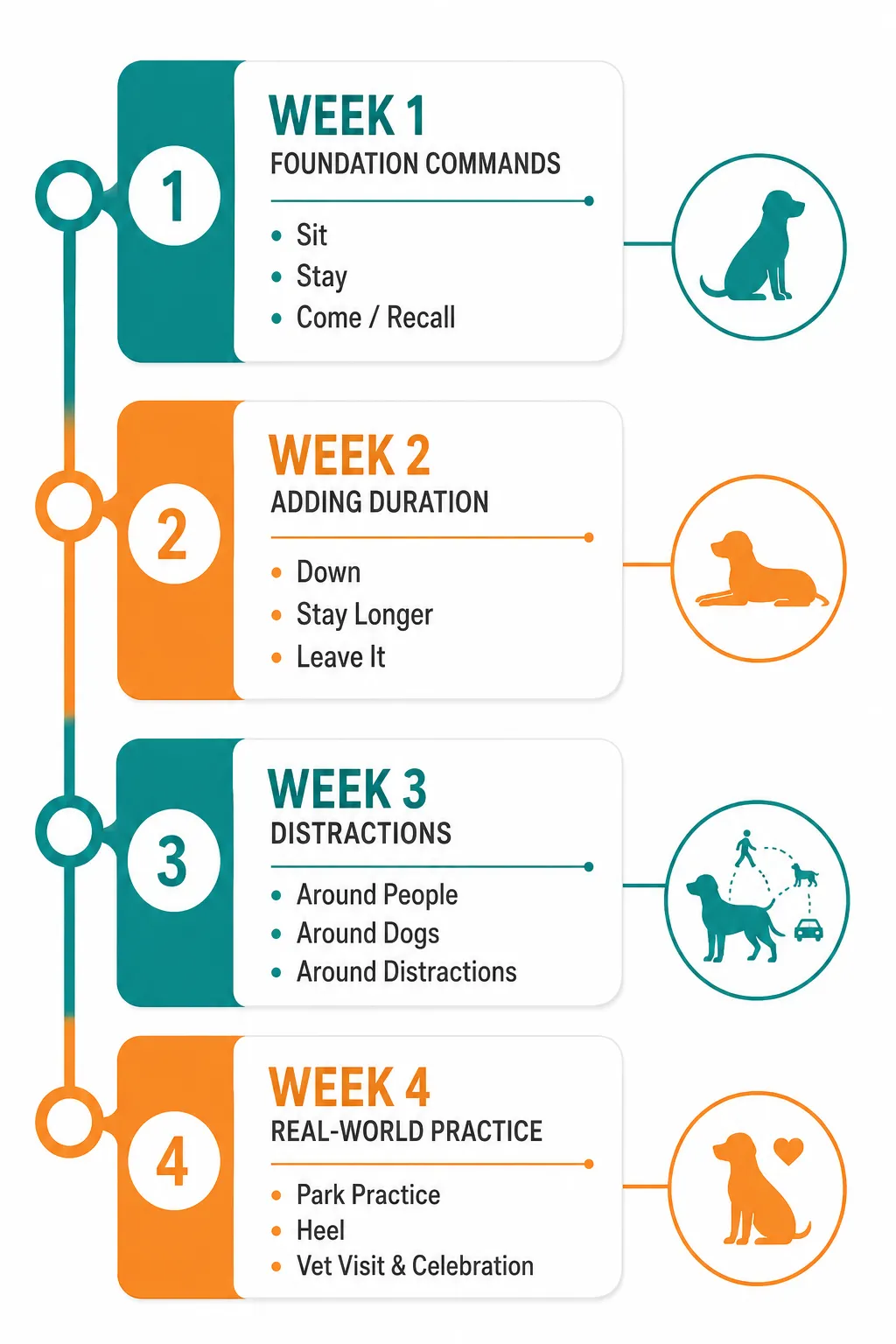
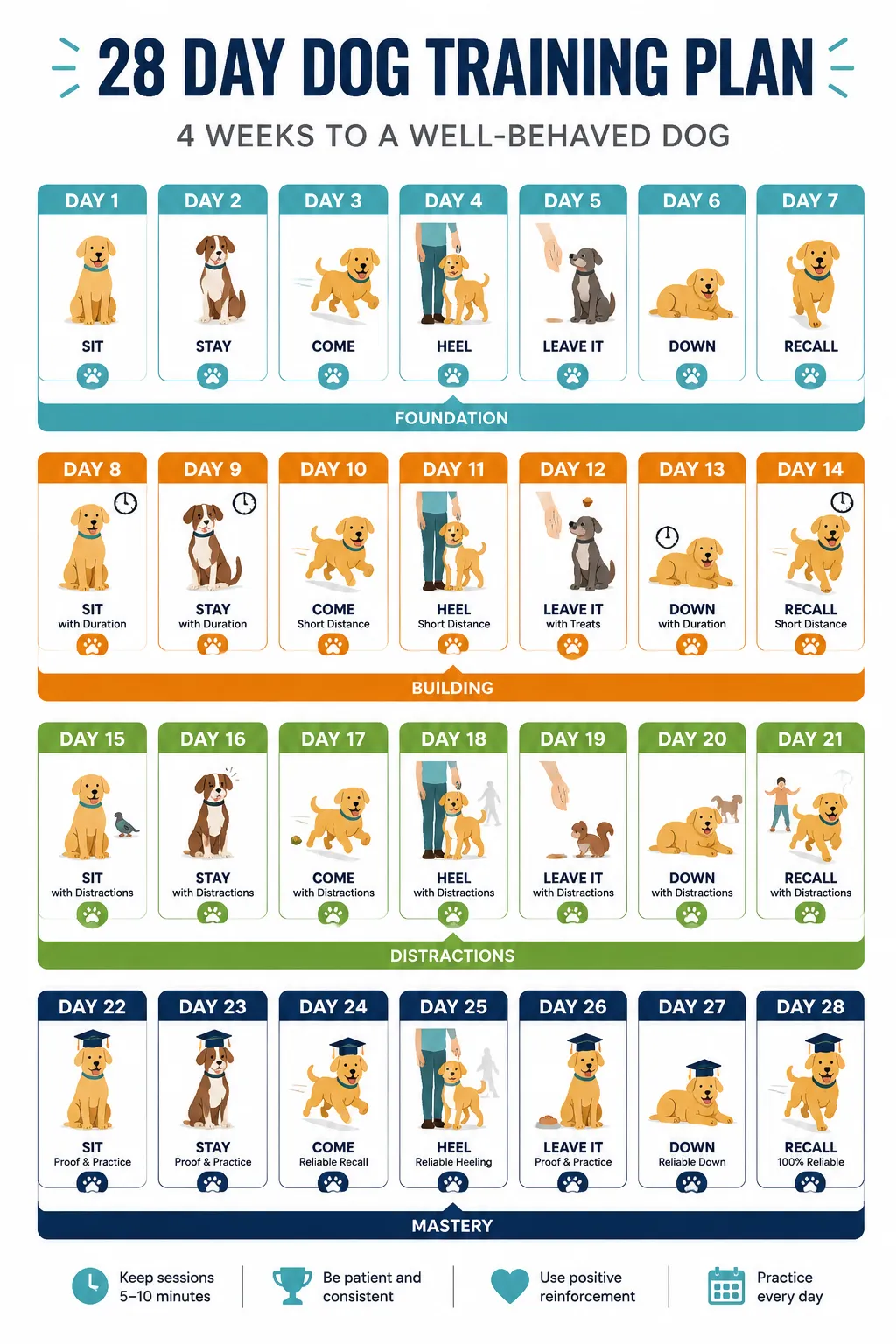
The challenge works by stacking skills week by week, so each new command builds on what your dog already knows. Here’s a simple breakdown of how a typical four-week plan flows:
Week 1 – Foundation:
- Day 1: Sit and stay
- Day 2: Recall (come)
- Day 4: Down
- Day 5: Leave it
- Day 6: Heel
Week 2 – Building Duration:
- Practice each command longer and with slight distance
- Add a second context (different room, backyard)
Week 3 – Adding Distractions:
- Train near mild distractions (TV on, another person in the room)
- Start short outdoor sessions
Week 4 – Real-World Practice:
- Practice in public settings
- Day 26: Vet and groomer behavior
- Day 27: Full review
- Day 28: Celebrate progress
The PawChamp 28-day challenge follows a similar format, offering one new trick or behavior per day to build focus and a stronger bond between dog and owner.
Pro tip: Keep a simple journal or use a tracking app to log each session. Seeing your progress builds motivation to keep going.
“Consistency is the single biggest factor in dog training success. Ten minutes every day beats two hours on the weekend every time.”
Can You Really Train a Dog in 28 Days?
Yes – with realistic expectations. You won’t produce a competition-level obedience dog in 28 days, but you absolutely can build a dog that reliably sits, stays, comes when called, walks on a loose leash, and ignores most distractions.
The key is what “trained” means. After 28 days, your dog will know the commands and respond to them in familiar environments. Generalizing those skills to every situation takes more time, but the foundation is solid.
Research from training communities consistently shows that short, focused sessions produce faster results than long, unfocused ones. A YouTube breakdown of the 10-minute training method explains that focusing on one behavior, one context, and one goal at a time in short bursts produces meaningful progress – especially when paired with clear markers and a high rate of reinforcement.
Bottom line: 28 days is enough to change your dog’s behavior noticeably. It’s not enough to “finish” training – because good training never really ends.
Speaking of fast results, if you want to accelerate your progress even further, check out this Free Dog Training Workshop – a first-of-its-kind online workshop that teaches you to housebreak your dog, stop bad behaviors, and train them to become as obedient as service dogs, using the same secret methods used by service dog trainers.
Is 10 Minutes a Day Enough to Train a Dog?
Ten minutes a day is enough – if those 10 minutes are focused, structured, and consistent. The key is quality over quantity.
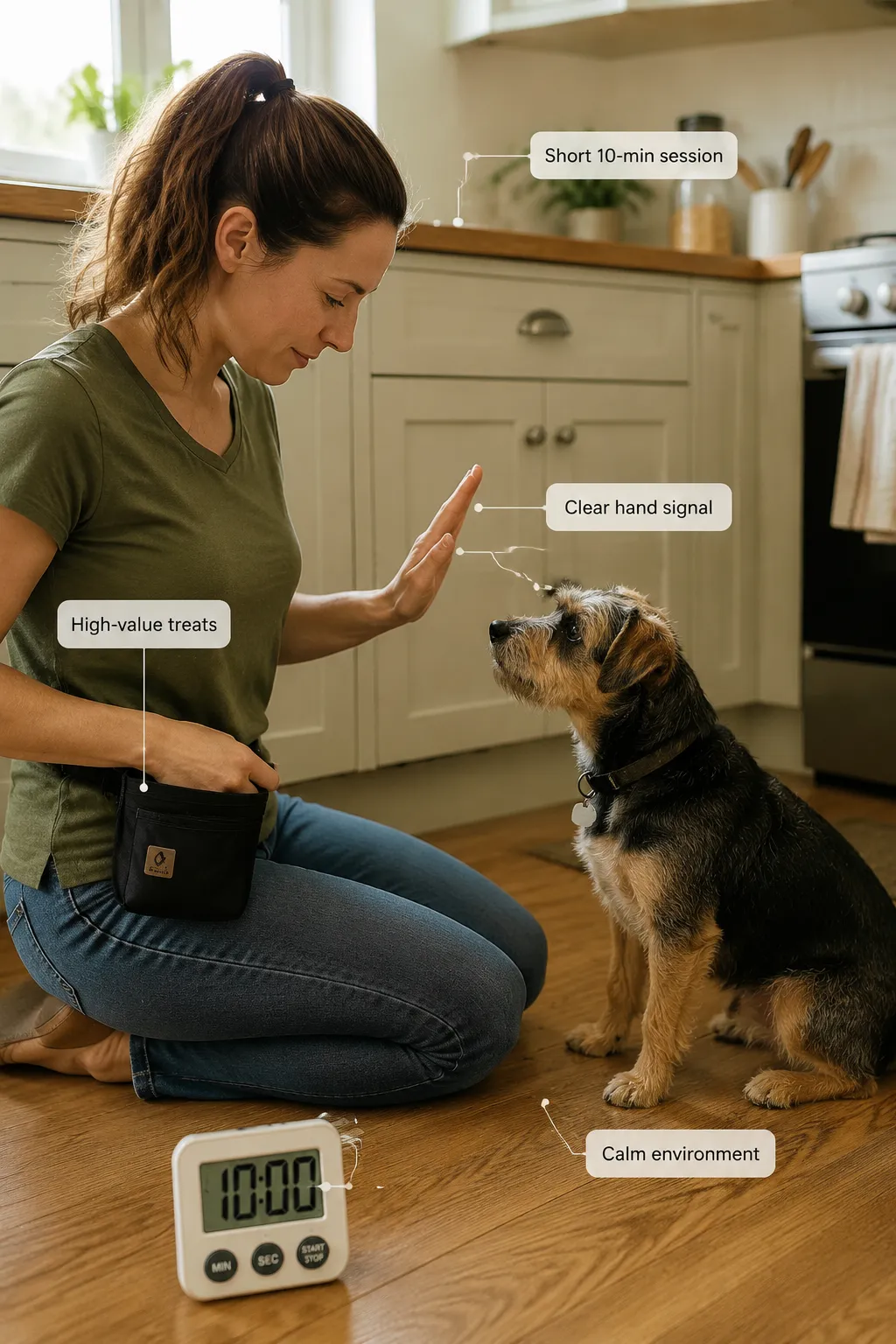
Dogs have short attention spans, especially puppies. A 10-minute session with clear cues, high-value treats, and zero distractions will outperform a 45-minute session where the dog is bored, confused, or overwhelmed.
Here’s what makes a 10-minute session effective:
- One goal only – pick one command or behavior per session
- High reinforcement rate – reward frequently, especially early on
- Clear markers – use a clicker or a consistent verbal marker like “yes”
- End on a win – always finish with something your dog does well
- Same time daily – routine helps dogs anticipate and engage
If you have a young puppy, check out the 4-month-old dog training 15-minute daily routine for age-appropriate session guidance.
For busy owners, pairing training with existing routines (before breakfast, after a walk) makes it easy to stay consistent. See our daily dog routine for busy owners for practical scheduling ideas.
What Commands Should I Teach in a 28-Day Challenge?
The core commands for a 28-day obedience challenge are: sit, stay, come (recall), down, leave it, and heel. These six behaviors cover the most important safety and manners skills any dog needs.
Here’s a suggested command progression:
| Week | Commands to Focus On |
|---|---|
| Week 1 | Sit, Stay, Come, Down |
| Week 2 | Leave It, Heel, Stay (longer duration) |
| Week 3 | Recall with distractions, Loose leash walking |
| Week 4 | All commands in new environments, Vet/groomer behavior |
For a deeper look at the top commands to prioritize, see our guide to 9 top commands for dogs and smart daily training.
Once your dog has the basics, you can add fun challenges. The 12 brain games for dogs that boost focus and beat boredom are a great way to keep your dog mentally engaged between sessions.
Does the 28-Day Challenge Work for Stubborn Dogs?
Yes, but it requires patience and the right approach. Stubborn dogs are often just dogs that haven’t found the right motivation yet. High-value treats (chicken, cheese, hot dog pieces) often work where kibble fails.
Tips for stubborn dogs:
- Find their currency – what does your dog go crazy for? Use that as a reward
- Shorten sessions – even 5 minutes works if the dog is engaged
- Reduce distractions – start in the quietest room in your house
- Never repeat commands – saying “sit, sit, SIT” teaches dogs to ignore the first cue
- Stay calm – frustration transfers to your dog and shuts down learning
If your dog pulls on the leash, that’s a separate challenge worth addressing alongside the 28-day plan. Our leash training guide for dogs that pull walks you through it step by step.
For dogs that chew everything, combine the challenge with strategies from our guide on how to stop dogs from chewing everything.
What Age Dog Can Do the Obedience Challenge?
The 28-Day Dog Obedience Challenge works for dogs of almost any age. Puppies as young as 8 weeks can start learning basic commands. Adult and senior dogs can absolutely learn new behaviors too – the saying “you can’t teach an old dog new tricks” is simply not true.
- Puppies (8-16 weeks): Keep sessions to 5 minutes, use tiny treat pieces, focus on sit and come first
- Adolescent dogs (4-18 months): Most distractible age – start in very low-distraction environments
- Adult dogs (18 months+): Can handle longer sessions and faster progression
- Senior dogs: Slower to generalize, but very capable – just be patient
For breed-specific guidance, our Labrador puppy training tips and German Shepherd obedience training guide cover age-specific approaches in detail.
28-Day Dog Obedience Challenge vs Professional Training
The 28-Day Dog Obedience Challenge is a strong alternative to professional training for most owners. Professional training costs significantly more and requires scheduling around class times. The challenge gives you flexibility and builds the owner-dog relationship directly.
Choose the 28-day challenge if:
- You have 10-15 minutes daily to commit
- Your dog has normal behavior issues (pulling, jumping, not coming when called)
- You want to build a stronger bond with your dog yourself
Consider professional training if:
- Your dog shows aggression toward people or other dogs
- Your dog has severe anxiety or fear-based behaviors
- You’ve completed the challenge and want to advance to competition-level obedience
The Prestige Dog Training 28-day plan is one of the most structured free resources available and covers everything from basic commands to public-setting practice.

28-Day Dog Obedience Challenge Cost
Most versions of the 28-Day Dog Obedience Challenge are free or very low cost. Here’s what to expect:
- Free online programs (like Prestige Dog Training): No cost
- App-based challenges (like PawChamp): Free with optional premium features
- Downloadable PDF guides on Etsy: Typically a few dollars for printable trackers and daily plans
- Treats and supplies: Budget for high-value treats – the biggest ongoing cost
The 28 Days to a Calmer Dog guide on Etsy is a beginner-friendly, low-cost option with printable daily trackers. Similarly, 28 Days of Dog Training Games and Challenges offers enrichment-focused daily activities that keep dogs mentally engaged throughout the month.
The real investment is your time, not your money.
Want to go deeper without spending much? The Free Dog Training Workshop uses the same methods service dog trainers rely on – and it costs nothing to attend.
Common Mistakes in 28-Day Dog Training
Even motivated owners make these mistakes. Knowing them in advance saves weeks of frustration.
- Skipping days – breaks the habit loop and slows progress significantly
- Training in distracting environments too early – your dog needs to succeed before you add challenge
- Using inconsistent cues – “come,” “here,” and “come here boy” are three different commands to a dog
- Repeating commands – say it once, wait, then help the dog succeed
- Training when frustrated – dogs read your energy; end the session and come back later
- Rewarding too late – the reward must come within 1-2 seconds of the behavior
- Moving too fast – if your dog is failing more than 20% of the time, go back a step
The Scribd 28-day obedience plan emphasizes starting in quiet locations, using high-value treats, and keeping sessions short and structured – all of which directly prevent these common errors.
What If My Dog Isn’t Responding to the Challenge?
If your dog isn’t responding, the most common fix is to make the task easier, not to push harder. Dogs fail when the criteria are too high, the environment is too distracting, or the reward isn’t motivating enough.
Troubleshooting steps:
- Drop back to the previous day’s task and rebuild confidence
- Switch to a higher-value treat
- Move to a quieter location
- Shorten the session to 5 minutes
- Check that your cue is clear and consistent
If your dog struggles with focus specifically, our 7 powerful playtime games that secretly train your dog can help build engagement before formal sessions.
Can I Do the Challenge With Multiple Dogs?
Yes, but train them separately – at least for the first three weeks. Training multiple dogs together creates competition, distraction, and confusion about who the cue is for.
How to manage multiple dogs:
- Train dog A while dog B is in another room or crate
- Keep sessions short so you can rotate quickly
- Once both dogs know a command reliably, practice together as a bonus exercise
What Happens After the 28-Day Challenge Ends?
The 28-day challenge is a starting point, not a finish line. After day 28, your dog knows the commands – but those skills need regular reinforcement to stay sharp.
Post-challenge maintenance plan:
- 5-minute daily review session covering 2-3 commands
- Monthly “challenge refreshers” adding new tricks or harder environments
- Incorporate commands into daily life (sit before meals, stay before going outside)
The 14-day dog training plan that actually works is a great follow-up resource to keep momentum going after your first 28 days.
FAQ
How long should each training session be in the 28-day challenge?
Ten minutes is the target for most adult dogs. Puppies under 4 months do best with 5-minute sessions. Never push past the point where your dog loses focus.
Do I need any special equipment?
No. High-value treats, a quiet space, and a consistent daily schedule are all you need. A clicker is helpful but optional.
What if I miss a day?
Just pick up where you left off. Don’t try to double up – one missed day won’t derail the challenge. Two or three in a row will.
Can I use the challenge for potty training too?
Obedience commands and potty training are separate skills. You can work on both at the same time, but keep them in separate sessions. See our 15 puppy potty training tips for a parallel plan.
Is the challenge suitable for rescue dogs?
Yes. Go slowly in week 1 and prioritize building trust before adding any pressure. Rescue dogs often need more time in low-distraction environments before progressing.
What breeds do best with the 28-day challenge?
All breeds can succeed. High-energy or working breeds (German Shepherds, Labs, Border Collies) often progress faster. Brachycephalic breeds or independent breeds (Basset Hounds, Chow Chows) may need more patience.
Can I combine the challenge with the 14-day dog training plan?
Absolutely. The 14-day plan is a great warm-up before starting the full 28-day challenge.
What if my dog already knows some commands?
Start from week 1 anyway, but move through familiar commands quickly. Use early days to proof existing skills in new environments rather than teaching from scratch.
Is the challenge backed by science?
The core methods (positive reinforcement, short sessions, clear markers, progressive difficulty) align with well-established animal learning principles. The specific “28-day” format is a practical structure, not a formally studied protocol.
Do I need to hire a trainer to guide me through it?
No. The challenge is designed for self-guided home training. If you want extra support, a free resource like the Free Dog Training Workshop can fill the gap without the cost of a private trainer.
Conclusion
The 28-Day Dog Obedience Challenge works because it removes the two biggest barriers to training: not knowing what to do and not doing it consistently. Ten minutes a day, one command at a time, for 28 days – that’s a formula almost any dog owner can stick to.
Start with day 1. Don’t overthink it. Grab some high-value treats, find a quiet spot, and ask your dog to sit. That’s the whole plan for day one.
By day 28, you’ll have a dog that responds to your cues, walks better on a leash, and is genuinely more enjoyable to live with. And you’ll have built a training habit that keeps paying off long after the challenge ends.
Your next steps:
- Pick your start date and mark day 28 on your calendar
- Stock up on high-value treats
- Download a free daily tracker or use the PawChamp app
- Bookmark the 9 top commands for dogs guide for reference
- Join the Free Dog Training Workshop to learn the same methods service dog trainers use – it’s free, and it will make your 28 days significantly more effective.
You’ve got this. And so does your dog. 🐾