

Last updated: July 22, 2026
Quick Answer: The best Labrador puppy training tips focus on starting early (from day one at home), using short positive reinforcement sessions, and preventing bad habits before they become routine. Labs are eager to please and food-motivated, which makes them highly trainable – but their energy and mouthiness can spiral fast without consistent guidance from the start.
Key Takeaways
- Start training the moment your Lab puppy comes home – ideally at 8 weeks old
- Keep sessions to 3-5 minutes, several times a day, always ending on a win [3]
- Positive reinforcement works best for Labs – punishment increases anxiety and can trigger new problems [8]
- Socialization between 8-16 weeks is the single biggest factor in preventing fear and reactivity later [2]
- Redirect biting and chewing onto toys immediately – never use hands as play objects
- “Four paws on the floor” should be rewarded every single greeting to stop jumping early [7]
- Crate training helps prevent accidents and gives your Lab a safe, calm space [2]
- Use your puppy’s daily food as training rewards to keep motivation high without overfeeding [7]
- Leash manners and impulse control need to start indoors before heading outside [10]
- Labs are not harder to train than most breeds – they’re actually among the easiest when guided correctly
What Are the Most Common Bad Habits in Labrador Puppies?
Labrador puppies most commonly develop jumping on people, nipping and mouthing, pulling on the leash, chewing furniture, and ignoring recall commands. These habits form quickly because Labs are high-energy and social – and most of them start as cute puppy behaviors that owners accidentally reinforce.
Here are the top bad habits to watch for:
- Jumping up on guests and family members for attention
- Mouthing and nipping during play, especially with children
- Pulling hard on the leash the moment they hit the sidewalk
- Counter surfing and stealing food from tables
- Excessive barking when bored or under-stimulated
- Bolting through doors without waiting for permission
- Chewing shoes, furniture, or cables when unsupervised
The good news? Every single one of these is preventable with the right approach from day one. That’s what these Labrador puppy training tips are designed to do – stop the habit before it even starts.
How Early Should You Start Training a Labrador Puppy?
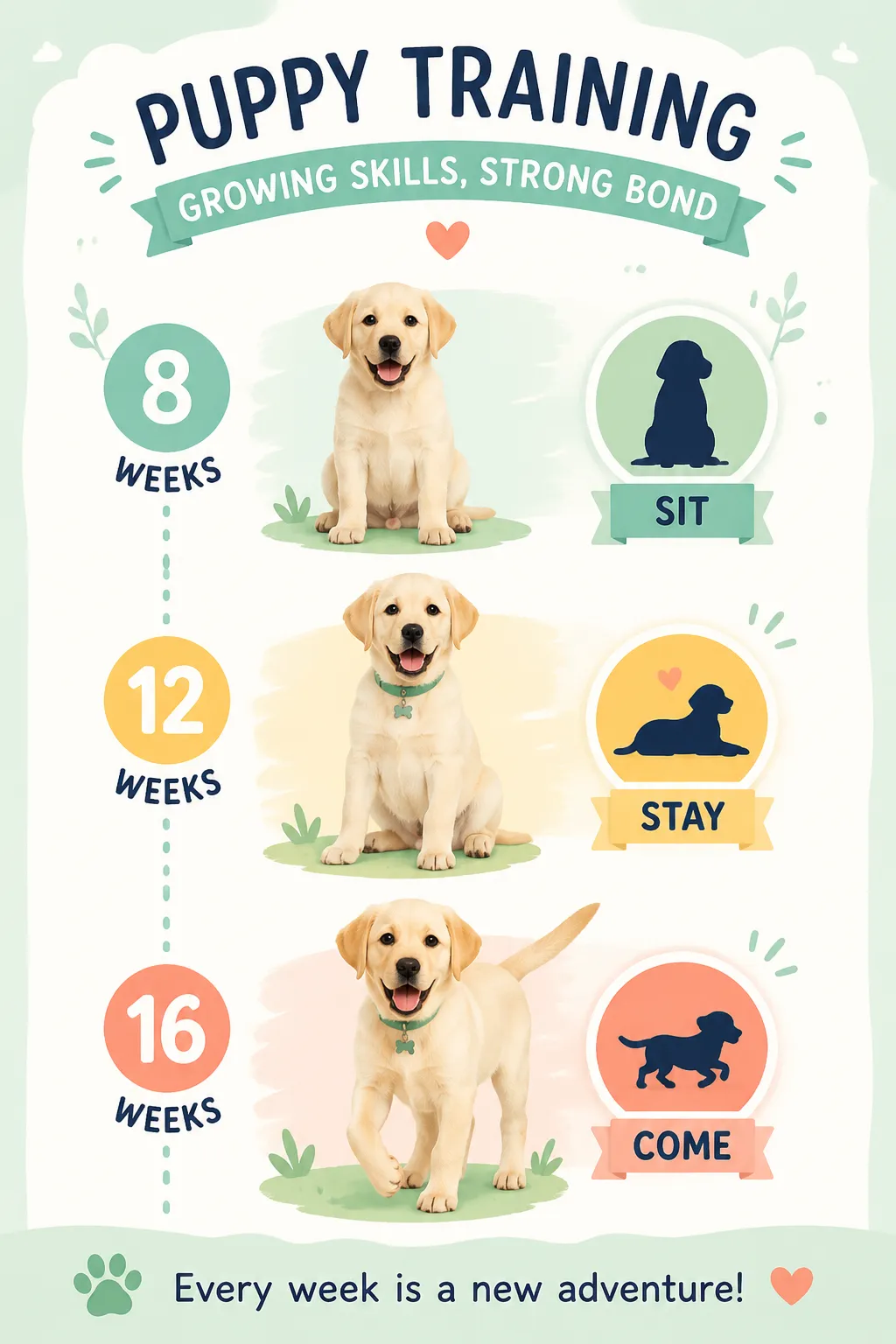
Start training your Labrador puppy the day you bring them home – typically at 8 weeks old. Puppies are already learning from their environment at this age, so every interaction is a lesson whether you plan it or not. [5]
The American Kennel Club’s Labrador training milestone guide confirms that 8-12 weeks is the ideal window for name recognition, basic cues like “sit,” and early crate and potty training. [5]
Age-by-age training roadmap:
| Age | Focus Areas |
|---|---|
| 8-10 weeks | Name, sit, crate intro, potty schedule |
| 10-12 weeks | Stay, come, leash intro indoors |
| 12-16 weeks | Leave it, down, socialization outings |
| 4-6 months | Impulse control, longer stays, loose leash |
| 6+ months | Proofing commands in distracting environments |
Don’t wait until your puppy is “older and ready.” That window between 8 and 16 weeks is the most teachable period of your Lab’s life. [2]
Labrador Puppy Training vs Other Dog Breeds – Which Is Easier?
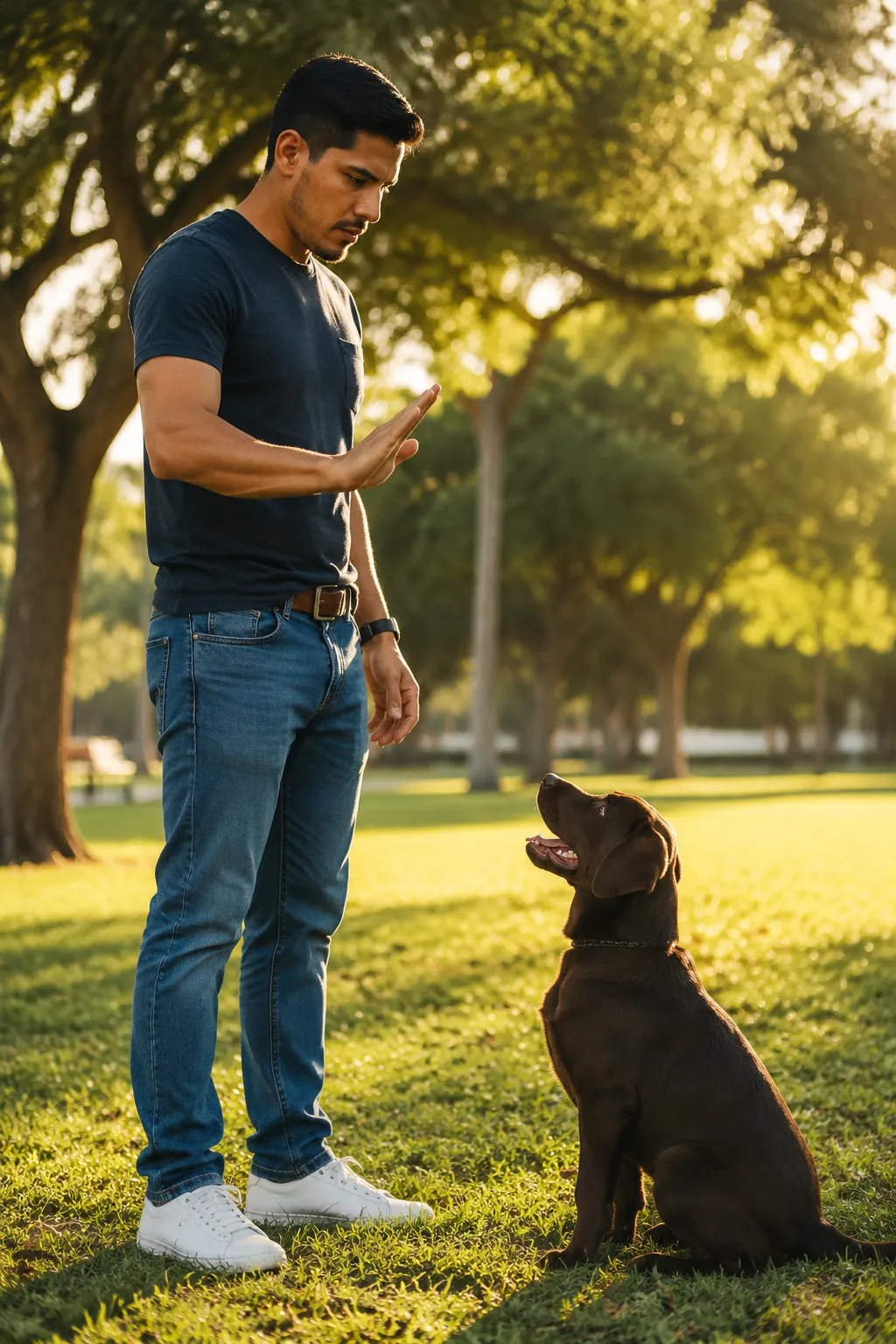
Labradors are genuinely easier to train than most breeds. They’re ranked among the top five most trainable dogs by multiple canine behavior experts, largely because of their food motivation, eagerness to please, and social nature. [1]
Compared to independent breeds like Beagles or Huskies, Labs respond faster to positive reinforcement and are less likely to ignore commands for the sake of following their nose. That said, their energy level and mouthiness can make early training feel chaotic if you’re not prepared.
Labs vs other popular breeds:
- vs Golden Retrievers – very similar in trainability; Labs tend to be slightly more energetic
- vs German Shepherds – Shepherds may pick up commands faster, but Labs are more forgiving of inconsistency
- vs Beagles – Labs are significantly easier to recall and redirect (see these Beagle facts for context)
- vs Huskies – Labs are much more handler-focused and food-motivated
Bottom line: if you’re consistent and use rewards, a Lab puppy is one of the most rewarding breeds to train. [3]
Best Positive Reinforcement Techniques for Lab Puppies
Positive reinforcement – rewarding the behavior you want – is the most effective training method for Labrador puppies. Labs are highly food-motivated, which makes treat-based training fast and fun. [8]
Key techniques that work well for Labs:
- Lure and reward – hold a treat near the puppy’s nose to guide them into position (like “sit”), then reward the moment they do it
- Marker training – say “yes!” or use a clicker the instant the correct behavior happens, then follow with a treat
- Capturing – reward your puppy whenever they naturally do something you like (lying calmly, sitting without being asked)
- Shaping – reward small steps toward a goal behavior, gradually raising the bar
💡 Pro tip: Measure out your puppy’s daily kibble and use a portion of it as training rewards throughout the day. This keeps motivation high without overfeeding. [7]
Avoid punishment-based methods. Research consistently links harsh corrections with increased anxiety, fear, and even aggression in dogs – especially high-drive breeds like Labs. [8] [3]
For more hands-on ideas, check out these fun dog training tricks your dog will love learning once your Lab has the basics down.
How Long Should Labrador Puppy Training Sessions Be?
Keep training sessions to 3-5 minutes each, repeated 3-5 times per day. Young Lab puppies have short attention spans, and long sessions lead to frustration, zoning out, or stress-related behaviors like nipping. [3] [6]
Rules for effective short sessions:
- Always end on a success – ask for something easy if the puppy is struggling
- Train before meals when your puppy is hungry and motivated
- Use a calm, upbeat voice – Labs pick up on your energy fast
- Stop before the puppy loses interest, not after
- As your puppy matures (4-6 months), you can extend sessions to 10-15 minutes
Short, frequent sessions beat one long session every time. Think of it like reps at the gym – consistency compounds. [14]
Labrador Puppy Biting and Nipping – How to Stop It
Redirect biting immediately onto a toy, and withdraw attention the moment your puppy mouths your skin. Never use your hands as play objects – this is the single most common mistake new Lab owners make. [7]
Labs mouth more than many breeds because of their retriever instincts. It’s normal, but it needs redirecting from day one.
Step-by-step approach:
- Keep a toy within reach during every play session
- The moment teeth touch skin, say “ouch” calmly and freeze
- Redirect immediately to the toy – praise and play when they take it
- If biting continues, end the play session with a brief time-out (30-60 seconds)
- Reward “gentle mouth” or calm behavior with attention and treats
For a deeper breakdown of this issue, read our guide on how to make a puppy stop biting – it covers the most common mistake owners make that actually makes biting worse.
Common mistake: Pulling your hand away quickly or yelping loudly can accidentally excite a Lab puppy and increase biting. Stay calm and still first, then redirect.
Potty Training a Labrador Puppy – Step by Step
Take your Lab puppy outside every 30-60 minutes, immediately after waking, after meals, and after play. Use a consistent cue word, reward the moment they go in the right spot, and never punish accidents indoors. [2] [5]
The core potty training schedule:
- First thing in the morning – carry the puppy outside before they have a chance to squat
- After every meal – wait 10-15 minutes, then go out
- After every nap
- After every play session
- Right before bed
Crate training is a powerful support tool here. Most Labs naturally avoid soiling their sleeping area, so a correctly sized crate (just big enough to stand and turn around) helps predict and prevent accidents. [2]
For a full breakdown of the process, our puppy potty training guide covers every scenario including nighttime accidents and regression.
Also check out these 15 puppy potty training tips that actually work for stubborn cases.
Labrador Puppies Jumping on People – Solutions That Actually Work
Teach “four paws on the floor” from the very first day. Every time your Lab puppy jumps up, turn away and ignore them completely. The moment all four paws hit the ground, reward immediately with calm praise or a treat. [7] [10]
Labs jump because it works – people laugh, make eye contact, or pet them. Remove the reward and the behavior fades fast.
What to do:
- Ask every visitor to follow the same rule – consistency is everything
- Never knee the puppy, push them, or shout (this can increase excitement or cause fear)
- Teach an incompatible behavior like “sit” for greetings – a sitting dog can’t jump
- Reward the sit heavily every single time a guest arrives
For more detailed strategies, see our full guide on how to stop a dog from jumping on people.
What Age Can You Start Obedience Training With a Lab Puppy?
You can start basic obedience training at 8 weeks old. At this age, Labs can learn sit, stay, come, and name recognition using short, reward-based sessions. [5] [1]
Formal group obedience classes are typically recommended from 12-16 weeks, after initial vaccinations. These classes double as socialization opportunities, which is a huge bonus for Labs.
Foundation commands to teach first:
- Name recognition – the base of all future training
- Sit – the most useful impulse-control cue you’ll teach
- Come – critical for safety, start in low-distraction areas
- Stay – builds self-control and focus
- Leave it – prevents counter surfing, chewing hazards, and food stealing
Once you have these five solid, almost every other behavior problem becomes easier to manage. [5]
Labrador Puppy Training Mistakes to Avoid
The biggest mistakes in Labrador puppy training are inconsistency, sessions that are too long, and accidentally rewarding bad behavior with attention. Harsh punishment is also a major issue – it suppresses behavior temporarily but often creates fear and anxiety. [3] [8]
Top mistakes and how to fix them:
- ❌ Letting the puppy jump “just this once” – every exception reinforces the habit
- ❌ Repeating commands multiple times – say it once, then help the puppy succeed
- ❌ Training when you’re frustrated – Labs read your mood and shut down
- ❌ Using the crate as punishment – it should be a calm, positive space
- ❌ Skipping socialization because “they seem fine” – fear issues develop slowly
- ❌ Giving attention when the puppy whines in the crate – wait for quiet, then reward
💬 “I made every one of these mistakes with my first Lab, Biscuit. He was 18 months old before I realized I’d been rewarding his jumping by pushing him off and laughing. The fix took three weeks once I stopped. Prevention would have taken three days.”
Do Labrador Puppies Need Professional Training or Can You Do It Yourself?
Most Lab owners can successfully train their puppy at home using consistent positive reinforcement. Labs are one of the most owner-friendly breeds to train, and a solid home routine covers the basics well. [1] [3]
Choose professional training if:
- Your puppy shows signs of fear, aggression, or extreme reactivity
- You’re a first-time dog owner feeling overwhelmed
- Basic commands aren’t sticking after 4-6 weeks of consistent effort
- You want to pursue advanced skills like therapy work or competition
A group puppy class (not private training) is a great middle ground – it gives you professional guidance while also socializing your Lab around other dogs and people. [5]
If you’re handling things yourself, a structured plan helps a lot. Our 14-day dog training plan gives you a day-by-day framework that works even for beginners.
Labrador Puppy Socialization Tips and Timeline
Socialize your Lab puppy between 8 and 16 weeks – this is the critical window where positive exposure to new people, animals, sounds, and surfaces has the biggest long-term impact. [2] [13]
Weekly socialization checklist:
- Week 1-2 at home: new surfaces (grass, tile, carpet, gravel), household sounds, gentle handling
- Week 3-4: meet calm, vaccinated dogs; car rides; different people (hats, uniforms, children)
- Week 5-8: puppy classes, pet-friendly stores, outdoor environments, crowds
Keep every new experience positive – use treats and play to build confidence. One bad experience during this window can have a lasting effect, so go at your puppy’s pace. [2]
For puppies showing early signs of reactivity, our guide on how to socialize a reactive dog walks through a calm, step-by-step method.
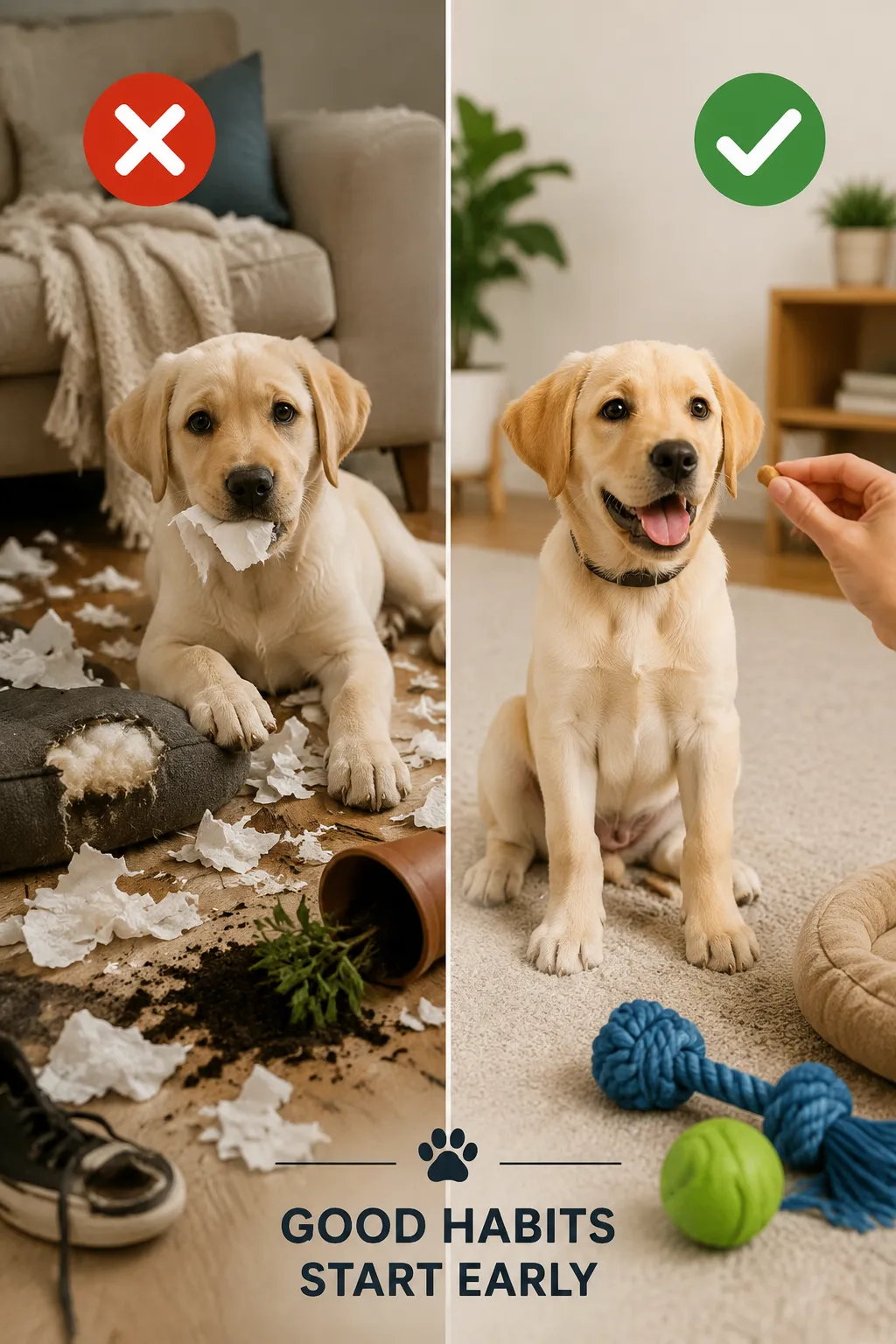
Labrador Puppies Chewing Everything – How to Redirect
Labs chew because they’re teething, bored, or under-stimulated – not to spite you. The fix is management plus redirection, not punishment. [7] [10]
Practical steps:
- Puppy-proof the space – remove cables, shoes, and anything chewable from reach
- Rotate a small set of 3-4 toys so they stay novel and exciting
- When the puppy chews something wrong, calmly remove it and hand them a toy
- Reward the moment they chew the right thing
- Use frozen Kongs or chew toys to occupy them during downtime
💡 Boredom is the biggest driver of destructive chewing in Labs. Mental stimulation matters as much as physical exercise. Try brain games for dogs to tire out that busy Lab brain.
Labrador Puppy Training Tools and Equipment – What Actually Works
The tools that work best for Lab puppies are a properly sized crate, a 6-foot flat leash, a well-fitted flat collar or harness, high-value treats, and a clicker or marker word. That’s genuinely all you need to start. [7] [10]
What works:
- Crate – size matters; too large and the puppy will use a corner as a bathroom [2]
- Flat collar or front-clip harness – for leash training without pulling pressure on the throat
- Clicker or verbal marker – precise timing speeds up learning significantly
- High-value treats – small, soft, smelly treats (chicken, cheese) for new or difficult tasks
- Standard kibble – for easy, familiar tasks during daily practice
What to skip:
- Retractable leashes – they teach pulling and reduce control
- Choke chains or prong collars – linked to increased anxiety and fear responses [8]
- Spray bottles – ineffective and can damage trust
For a complete list of what to have ready before your puppy arrives, see our new puppy checklist.
FAQ
Q: When should I start Labrador puppy training?
Start the day you bring your puppy home – typically at 8 weeks old. Every interaction teaches something, so structured training from day one prevents bad habits from forming. [5]
Q: How many times a day should I train my Lab puppy?
Aim for 3-5 short sessions of 3-5 minutes each. Frequency matters more than length at this age. [3]
Q: My Lab puppy ignores the “come” command. What am I doing wrong?
You’re likely calling them when they’re distracted, or the reward isn’t high enough. Start in a quiet room, use a high-value treat, and never call your puppy to scold them. Check out our guide on how to train a puppy to come when called.
Q: Is it too late to train a Lab puppy at 6 months?
No – 6 months is still young. Training takes longer if bad habits are already set, but Labs remain highly trainable well into adulthood. Consistency is the key.
Q: Should I use a clicker for Lab puppy training?
A clicker is helpful but not required. A consistent verbal marker like “yes!” works just as well if you use it at the exact moment the correct behavior happens. [8]
Q: How do I stop my Lab puppy from pulling on the leash?
Stop walking the moment the leash goes tight. Wait for the puppy to return to your side, reward, then continue. It’s slow at first but builds the habit fast. Start indoors before adding outdoor distractions. [10]
Q: My Lab puppy whines all night in the crate. Is this normal?
Yes, for the first few nights. Place the crate near your bed so the puppy can hear and smell you. Only let them out when they’re quiet – even briefly – to avoid rewarding the whining. [2]
Q: Can Labs be trained without treats?
Treats speed up training significantly for Labs. You can phase them out gradually once a behavior is solid, but using them early is the fastest path to a well-trained dog. [1]
Q: What’s the difference between a Lab puppy and an adult Lab for training?
Puppies learn faster in the socialization window (8-16 weeks) but have shorter attention spans. Adult Labs can focus longer but may need more repetitions to unlearn existing habits.
Q: How do I stop my Lab from chewing furniture?
Manage the environment (remove access), redirect to appropriate chew toys immediately, and increase mental and physical exercise. Punishment after the fact does not work – Labs don’t connect it to the earlier behavior. [7]
Conclusion
The best Labrador puppy training tips all point to one core truth: prevention beats correction every time. A few minutes of consistent training each day, starting at 8 weeks, builds the foundation for a calm, confident, well-mannered Lab.
Your action plan for this week:
- Set a potty schedule and stick to it – every 30-60 minutes during the day
- Start one 5-minute training session per day on “sit” and name recognition
- Introduce the crate with positive associations (treats, meals, toys inside)
- Plan two new socialization experiences for this week
- Decide on your house rules now – jumping, furniture, greetings – and be consistent from day one
Labs are genuinely one of the best dogs to train. They want to work with you. Give them clear guidance, short sessions, and plenty of rewards – and you’ll have a dog that makes you look like a professional trainer by the time they’re six months old.
References
[1] How To Train A Lab Puppy – https://www.masterclass.com/articles/how-to-train-a-lab-puppy
[2] Labrador Puppy – https://puppypups.net/labrador-puppy/
[3] Labrador Puppy Training 101 Essential Tips – https://www.joiipetcare.com/blogs/advice/labrador-puppy-training-101-essential-tips
[5] Train Labrador Retriever Puppy Milestone Timeline – https://www.akc.org/expert-advice/puppy-information/train-labrador-retriever-puppy-milestone-timeline/
[6] Times of India – How to Train a Labrador Retriever Puppy – https://timesofindia.indiatimes.com/life-style/relationships/web-stories/how-to-train-a-labrador-retriever-puppy-10-easy-steps-every-owner-should-follow/photostory/123803153.cms
[7] Labrador Retriever Training – https://www.zoomroom.com/tips/breeds/labrador-retriever/
[8] How To Train Labrador Puppy – https://articles.hepper.com/how-to-train-labrador-puppy/
[10] Labrador Training – https://www.allthingsdogs.com/labrador-training/