Last updated: September 4, 2026
Quick Answer: Keeping fleas off your dog requires year-round prevention – not just a summer treatment. The most effective approach combines a vet-recommended preventive product, regular flea checks, whole-home treatment, and treating every pet in the household at the same time. Missing any one of these steps is usually why fleas keep coming back.
Key Takeaways
- 🐾 Year-round flea prevention is more effective than seasonal treatment – fleas can survive indoors during winter
- 🐾 Treat every pet in the home at the same time, or reinfestation is almost guaranteed
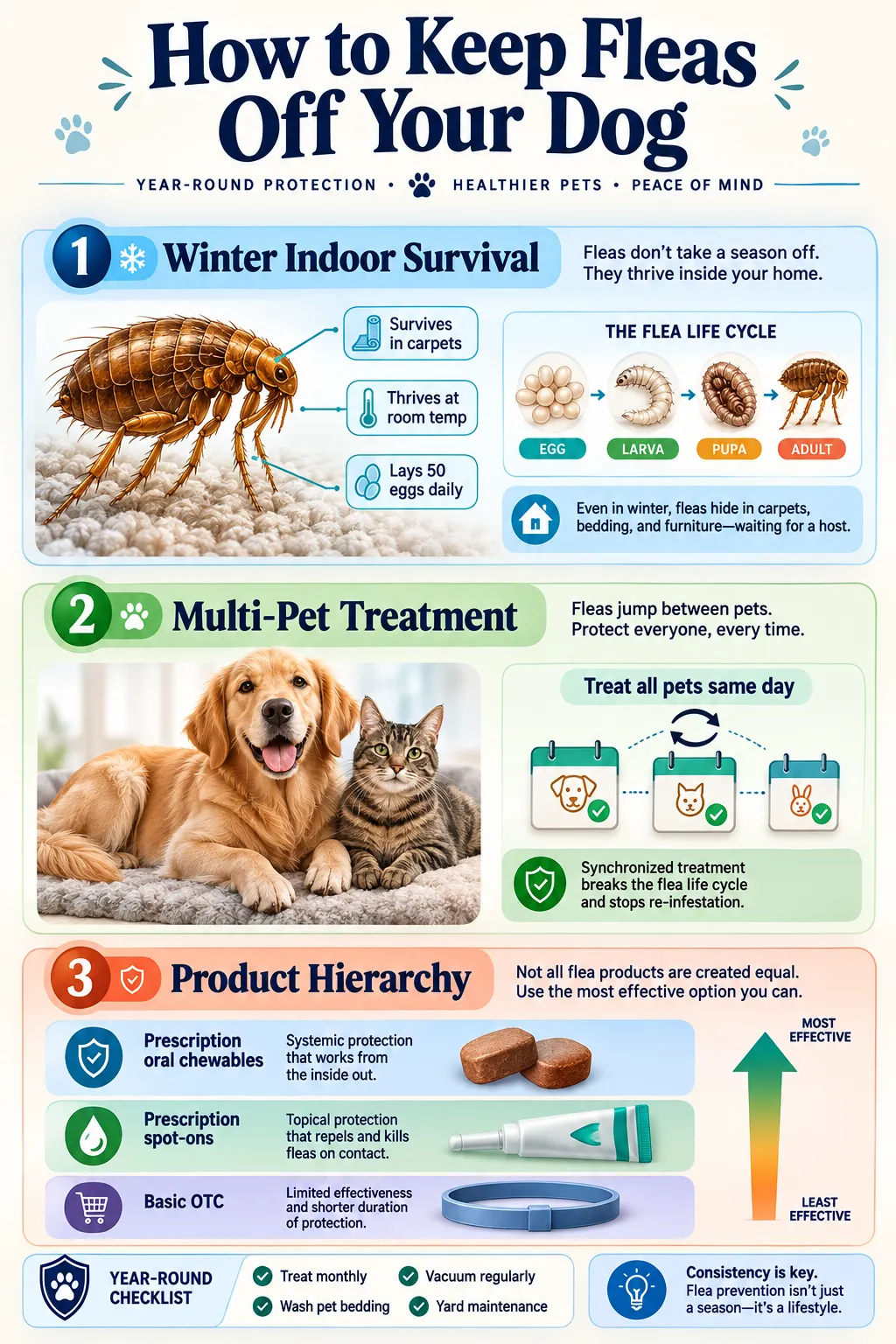
- 🐾 Oral chewables and prescription spot-ons generally outperform basic over-the-counter products
- 🐾 Never use cat flea products on dogs – some ingredients are toxic to dogs
- 🐾 Flea dirt in your dog’s coat is a warning sign that fleas are already present
- 🐾 Puppies under 8 weeks need special age-safe products – most standard treatments are not approved for very young pups
- 🐾 Dogs that swim frequently need water-resistant topical products or oral preventives
- 🐾 Vacuuming alone is not enough – you need to treat carpets, bedding, and yard too
- 🐾 Fleas are disease vectors, not just an itch problem – they can transmit tapeworms and cause anemia
- 🐾 If your dog is still getting fleas despite prevention, the source is likely your home environment, not product failure
What Are the Best Flea Prevention Methods for Dogs?
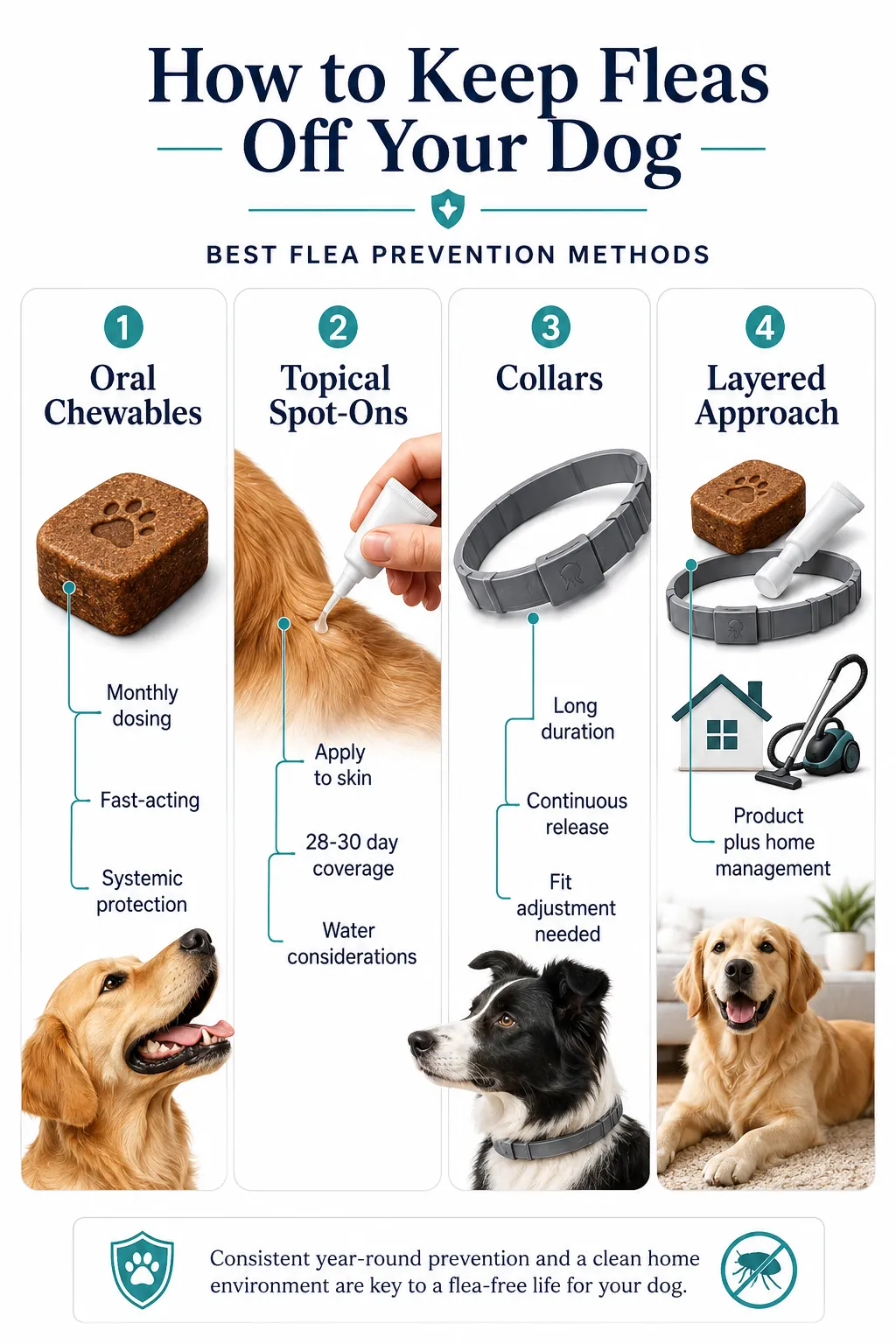
The best flea prevention for dogs in 2026 combines a fast-acting, vet-recommended product with consistent home management. No single product works in isolation – the most successful owners use a layered approach.
Here’s a breakdown of the main options:
| Method | How It Works | Duration | Best For |
|---|---|---|---|
| Oral chewables (e.g., Simparica, NexGard) | Kills fleas after they bite | 1-3 months | Most dogs, especially active ones |
| Topical spot-on | Applied to skin, spreads through coat | 1 month | Dogs that don’t swim often |
| Flea collar (e.g., Seresto) | Releases active ingredient over time | Up to 8 months | Low-maintenance households |
| Flea shampoo | Kills fleas on contact | Hours only | Supplement, not standalone |
| Prescription all-in-one | Covers fleas, ticks, heartworm | 1-3 months | High-risk or multi-parasite environments |
According to Cornell University’s Riney Canine Health Center, modern isoxazoline-class oral preventives (like Simparica Trio) are among the most effective options currently available. They work systemically, meaning fleas must bite your dog to be killed – but they die quickly and don’t survive to reproduce.
Choose oral preventives if your dog swims, gets bathed frequently, or lives in a high-flea-risk area. Choose topical spot-ons if your dog rarely gets wet and you want a repellent effect too.
How Often Should I Give My Dog Flea Treatment?
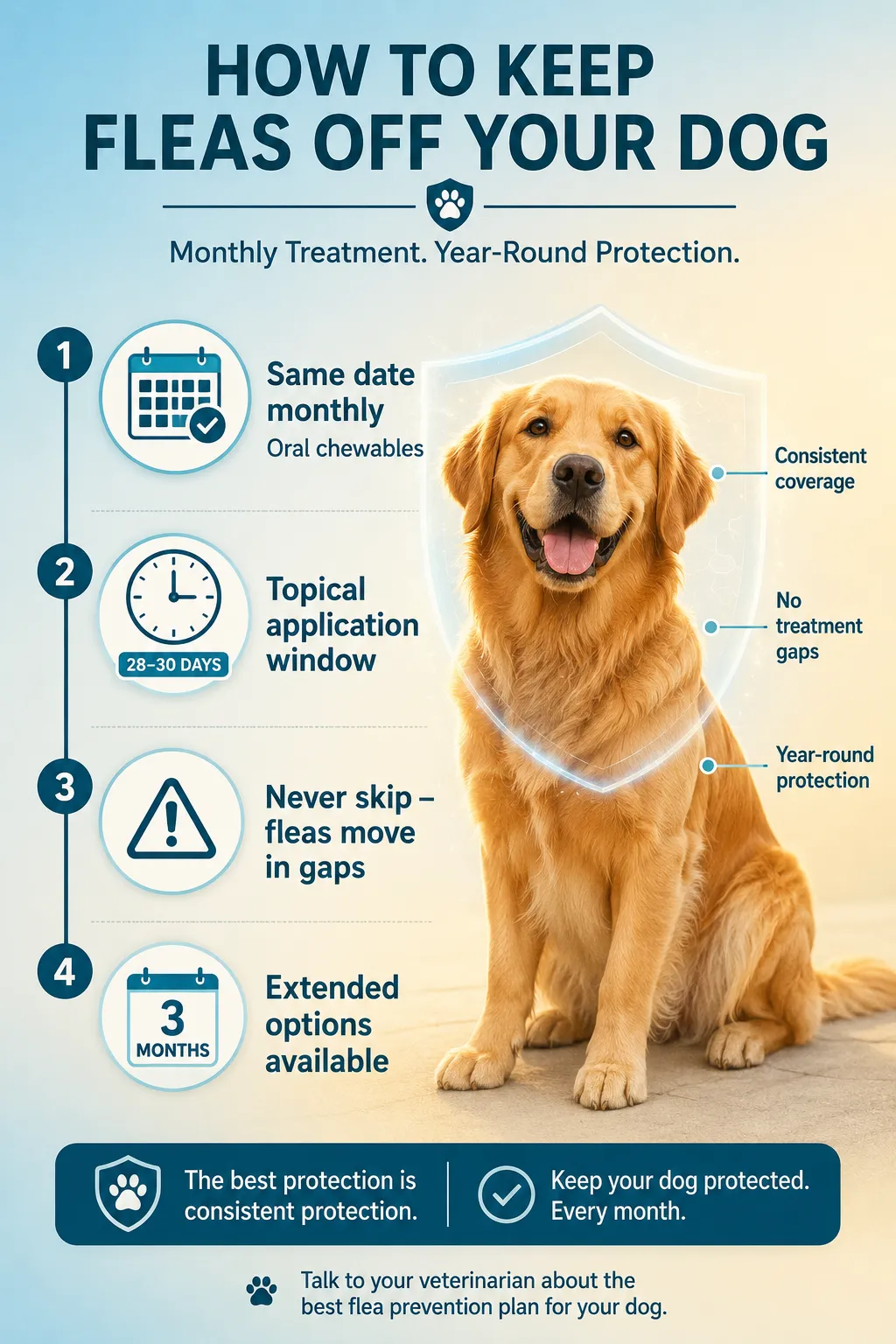
Most flea treatments for dogs are given monthly, but some options last up to three months. The key is consistency – a gap in coverage is when fleas move in.
- Monthly oral chewables: Give on the same date each month
- Monthly topical spot-ons: Apply every 28-30 days, not “when you remember”
- Flea collars: Replace every 6-8 months depending on the brand
- Multi-month oral products: Follow the product label exactly
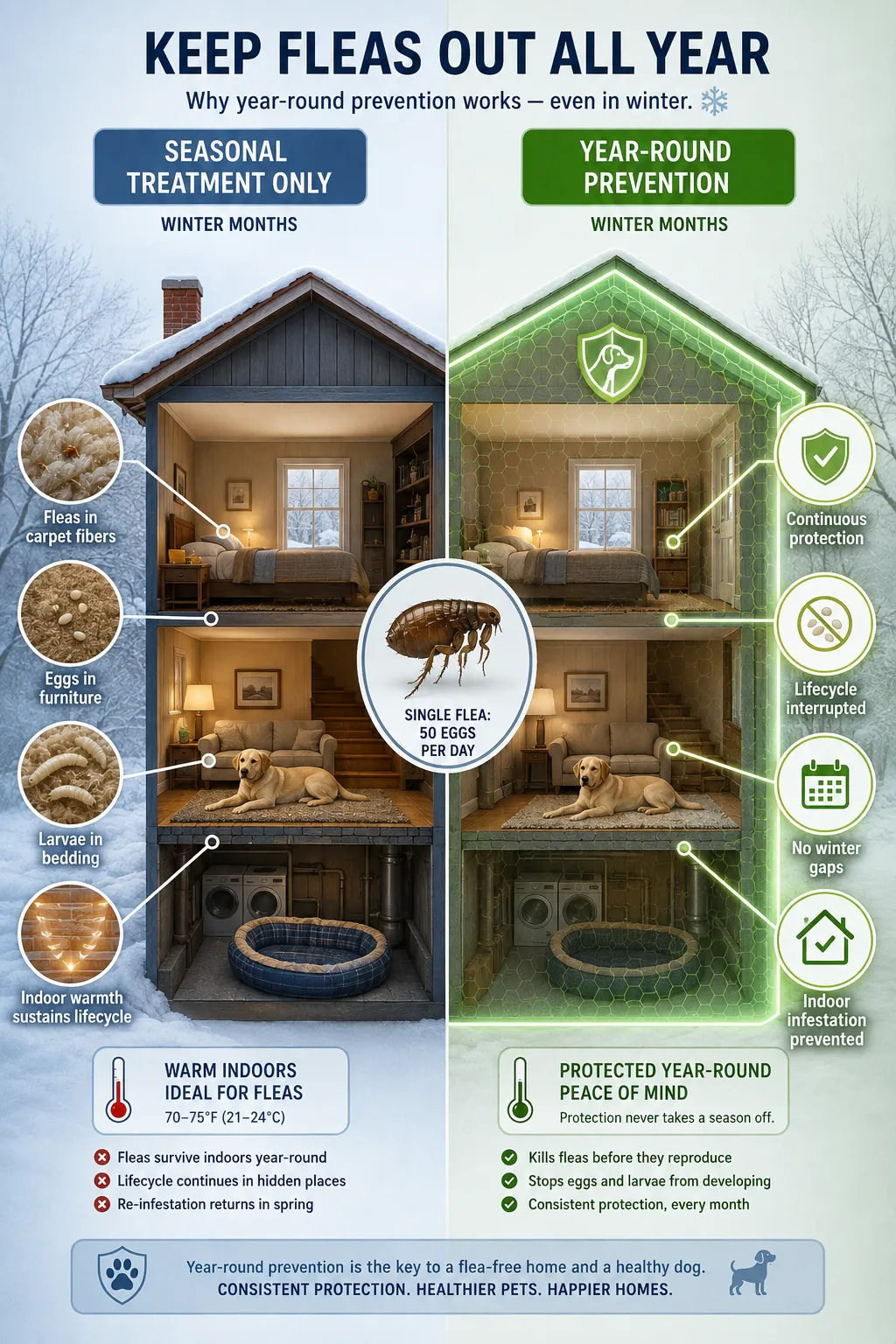
VCA Animal Hospitals notes that many owners skip doses during cooler months, which is one of the most common reasons infestations recur. Fleas can survive indoors year-round in heated homes, so a missed winter dose can lead to a spring outbreak.
Pro tip: Set a phone reminder the day you give each dose. It takes 30 seconds and saves you weeks of dealing with an infestation.
Do I Need Year-Round Flea Prevention or Just Summer?
Year-round prevention is strongly recommended by most veterinarians, even in cooler climates. Fleas don’t just disappear in winter – they thrive indoors where temperatures stay warm.
A single flea can lay up to 50 eggs per day. Those eggs fall off your dog and land in carpets, bedding, and furniture cracks. The larvae and pupae can lie dormant for months, then hatch when conditions improve.
Climate change has also extended flea and tick seasons in many regions. What used to be a “flea season” from spring to fall is now effectively year-round in much of the US and UK.
Bottom line: If your dog goes outside at all, or if other pets or people come into your home, year-round prevention is the safer choice. The CDC’s flea prevention guidance also supports continuous prevention as the most reliable strategy.
Natural Flea Prevention for Dogs That Actually Work
Some natural methods do help reduce flea exposure, but none are reliable as a standalone prevention strategy. They work best as a supplement to a proven product.
What has some evidence behind it:
- Regular bathing with a gentle dog shampoo can wash off fleas temporarily
- Flea combing daily catches fleas before they reproduce
- Diatomaceous earth (food-grade only) applied to carpets can kill fleas in the environment – not on your dog
- Keeping grass short in your yard reduces flea habitat
What doesn’t work well:
- Garlic and onion – toxic to dogs, not effective against fleas
- Essential oils (tea tree, eucalyptus) – many are toxic to dogs even in small amounts
- Brewer’s yeast – no strong evidence it repels fleas
If your dog has a sensitive stomach or skin reactions to commercial products, talk to your vet before switching to natural-only prevention. You can also check out 9 ways to boost your dog’s immune system naturally to support your dog’s overall health alongside flea prevention.
Flea Prevention for Dogs With Sensitive Skin
Dogs with skin sensitivities need extra care when choosing flea prevention. Some topical products can cause irritation, hair loss, or allergic reactions at the application site.
Best options for sensitive dogs:
- Oral preventives – since they work internally, they skip the skin entirely
- Hydrolyzed or gentle-formula collars – some collars are formulated for sensitive pets
- Vet-prescribed options – a vet can match the safest product to your dog’s specific sensitivities
Signs your dog is reacting to a topical product: redness, scratching at the application site, hair loss, or lethargy after application. If you notice any of these, contact your vet.
PetMD’s flea and tick prevention guide recommends always doing a small patch check when switching topical products, and to never apply a new product right before a weekend when your vet’s office may be closed.
It’s also worth noting that flea allergy dermatitis (FAD) is one of the most common skin conditions in dogs. A single flea bite can trigger intense itching in allergic dogs – so prevention is even more critical for them. If you’re noticing unusual scratching or stress behaviors, these 12 stressed dog signs most owners miss might help you spot what’s going on.
Prescription Flea Prevention vs. Over-the-Counter: Which Is Better?
Prescription flea prevention is generally more effective and safer than over-the-counter options, especially for dogs with health conditions or in high-risk environments. That said, some OTC products work well for low-risk dogs.
Prescription advantages:
- Formulated and dosed precisely by weight and species
- Covers multiple parasites (fleas, ticks, heartworm, mites) in one product
- Backed by more rigorous clinical testing
- Vet can monitor for reactions
OTC advantages:
- No appointment needed
- Lower upfront cost
- Widely available
The AKC’s flea and tick prevention tips note that many OTC products use older active ingredients that fleas have developed resistance to in some regions. If you’ve tried OTC products and still see fleas, resistance may be the issue – not user error.
Choose prescription if: your dog is in a high-flea area, has health conditions, or OTC products haven’t worked. Choose OTC if: your dog is healthy, low-risk, and you’ve had success with a specific product before.
Can I Use Cat Flea Prevention on My Dog?
No – never use cat flea prevention products on a dog, and never use dog products on a cat. This is a serious safety issue, not just a labeling technicality.
Some cat flea products contain permethrin, which is safe for dogs but highly toxic to cats. Conversely, some formulations designed for cats are not dosed correctly for dogs and can cause underdosing or adverse reactions.
Always check that any product you use is:
- Labeled specifically for dogs
- Dosed for your dog’s exact weight range
- Appropriate for your dog’s age (puppies need age-specific products)
This is one of the most common – and most dangerous – mistakes pet owners make. If you accidentally apply the wrong product, contact your vet or the ASPCA Animal Poison Control Center immediately.
How Much Does Flea Prevention for Dogs Cost?
Flea prevention costs vary widely depending on the product type, your dog’s size, and whether you need a prescription.
General cost ranges (estimates, will vary by region and retailer):
- Basic OTC topical (monthly): roughly $10-20 per month
- Prescription oral chewable (monthly): roughly $20-50 per month
- Long-lasting flea collar: roughly $50-70 for 6-8 months
- All-in-one prescription (flea, tick, heartworm): roughly $30-60 per month
Treating a full flea infestation – including your home and yard – can cost several hundred dollars and weeks of effort. Year-round prevention is almost always cheaper than dealing with an outbreak.
Modern Animal’s flea and tick prevention blog points out that many pet owners underestimate the total cost of an infestation: professional extermination, replacement bedding, multiple vet visits, and the time investment of daily vacuuming and washing.
What’s the Difference Between Flea Prevention and Flea Treatment?
Flea prevention stops fleas from establishing on your dog. Flea treatment eliminates an existing infestation. They often use similar products, but the context and approach are different.
- Prevention: Given to a flea-free dog on a regular schedule to stop fleas from reproducing and infesting
- Treatment: Given to a dog that already has fleas, combined with aggressive home and environment treatment
When treating an active infestation, you need to address all life stages – eggs, larvae, pupae, and adults. Adult fleas on your dog represent only about 5% of the total flea population in your home. The other 95% are in your carpets, furniture, and yard as eggs and larvae.
For a full guide on getting rid of an existing problem, see how to get rid of fleas on dogs.
Why Is My Dog Still Getting Fleas Even With Prevention?
If your dog is still getting fleas despite using a prevention product, the most likely cause is environmental reinfestation – not product failure.
Common reasons prevention fails:
- Missed or late doses – even a few days late can leave a window open
- Improper application of topical products (applied to fur instead of skin)
- Bathing too soon after applying a topical (most need 48 hours to absorb)
- Only treating the dog, not the home – the environment is the main reservoir
- Not treating all pets in the household
- Insecticide resistance – fleas in some regions have developed resistance to older active ingredients
The Royal Veterinary College’s pet flea guidance emphasizes that treating the environment is just as important as treating the animal. Vacuuming daily, washing all pet bedding weekly in hot water, and using an environmental flea spray with an insect growth regulator (IGR) are all necessary steps.
Also check out dog grooming tips at home – regular grooming sessions are a great opportunity to do flea checks.
Flea Prevention for Puppies Under 8 Weeks – and When to Start
Most flea prevention products are not approved for puppies under 8 weeks old. Very young puppies need age-specific, gentle options.
For puppies under 8 weeks:
- Use a fine-tooth flea comb daily to physically remove fleas
- Bathe with a very gentle, fragrance-free puppy shampoo if needed
- Keep their environment clean and treat the mother dog and home instead
- Ask your vet before applying any product – even “natural” ones
When to start regular prevention:
- Most oral and topical products are approved from 8 weeks and a minimum weight (often 4-5 lbs)
- Check the product label for the minimum age and weight
- Start prevention as early as the product allows – the earlier you establish the habit, the better
PDSA’s guide on fleas in dogs recommends speaking with your vet at your puppy’s first health check about the right product and timing for their specific breed and size.
Best Flea Prevention for Dogs That Swim a Lot
Dogs that swim frequently need either an oral preventive or a water-resistant topical product. Standard topical spot-ons can wash off and lose effectiveness after repeated water exposure.
Best choices for water-loving dogs:
- Oral chewables (NexGard, Simparica, Bravecto) – unaffected by water since they work internally
- Water-resistant topicals – check the label; some are rated for a certain number of baths or water exposures
- Flea collars – some are water-resistant, but check the specific product’s rating
Tips for swimming dogs:
- Wait at least 48 hours after applying any topical before your dog swims
- Reapply topicals on schedule even if your dog swims frequently
- Consider switching to oral prevention if your dog swims more than twice a week
Common Mistakes People Make With Flea Prevention
Even well-meaning dog owners make these errors regularly. Fixing just one or two of these can make a big difference.
- Treating only the dog – 95% of fleas live in the environment, not on your pet
- Stopping prevention in winter – indoor fleas don’t care about the season
- Using the wrong weight dosage – underdosing is ineffective, overdosing can be harmful
- Applying topicals to wet fur – it won’t absorb properly
- Not treating all pets – one untreated cat or dog keeps the cycle going
- Waiting until you see fleas – by then, there are already hundreds of eggs in your home
- Relying on flea shampoo alone – it kills fleas on contact but has zero residual effect
- Skipping the yard – shaded, moist areas in your yard are prime flea habitat
Fact: A female flea can lay up to 2,000 eggs in her lifetime, according to Cornell’s flea health topic page. That’s why catching an infestation early – or preventing one entirely – is so much easier than treating one.
FAQ
Q: How do I know if my dog has fleas if I can’t see them?
A: Look for “flea dirt” – tiny black specks at the base of your dog’s tail or belly. Place the specks on a damp white paper towel. If they turn reddish-brown, it’s flea dirt (digested blood), which confirms fleas are present.
Q: Can fleas make my dog seriously ill?
A: Yes. Fleas can transmit tapeworms, cause flea allergy dermatitis, and in heavy infestations can cause anemia – especially in puppies and small dogs. They are disease vectors, not just a nuisance.
Q: How long does it take to get rid of fleas completely?
A: Expect 3-4 months of consistent treatment to break the full flea life cycle. Adult fleas are only a small part of the population – eggs and pupae in your home take time to hatch and be eliminated.
Q: Is a flea collar as effective as a monthly chewable?
A: For some dogs, yes. High-quality collars like Seresto release active ingredients continuously for up to 8 months. However, oral chewables tend to act faster and are unaffected by bathing or swimming.
Q: Can I use a flea comb as the only prevention method?
A: No. Flea combing is a great detection tool and can remove some fleas, but it won’t prevent infestation or address eggs and larvae in the environment.
Q: What should I do if my dog has a reaction to a flea product?
A: Wash the product off immediately with mild soap and water if it’s a topical. Contact your vet or the ASPCA Animal Poison Control Center right away. Bring the product packaging with you.
Q: Do I need to treat my yard even if my dog mostly stays indoors?
A: If your dog goes outside at all – even briefly – yard treatment is worth doing. Fleas can hitch a ride inside on your dog, your shoes, or clothing.
Q: Are natural flea collars safe and effective?
A: Most natural flea collars (using essential oils) have limited evidence of effectiveness and some can cause skin irritation. They are not a reliable substitute for proven prevention products.
Q: Can my dog get fleas from other dogs at the park?
A: Yes. Fleas can jump from one dog to another, or from flea-infested grass to your dog. Dogs that visit dog parks, groomers, or boarding facilities are at higher risk.
Q: How do I keep fleas off my dog naturally between treatments?
A: Daily flea combing, regular bathing, keeping your yard mowed short, and washing your dog’s bedding weekly are the most practical natural steps. These reduce exposure but should not replace a proven preventive product.
Conclusion
Learning how to keep fleas off your dog is one of the most practical things you can do for your pet’s health and comfort. The 9 tricks that most owners miss come down to a few core habits: use a proven product year-round, treat your whole home and yard – not just your dog, check every pet in the household, and do regular flea checks so you catch problems early.
Your next steps:
- Talk to your vet at your next visit about the best flea prevention product for your dog’s age, weight, and lifestyle
- Set a monthly reminder to stay on schedule with doses
- Wash all pet bedding this week in hot water – it’s a free, immediate step
- Do a flea comb check on your dog today to establish a baseline
- If you’re already dealing with an infestation, read our full guide on how to get rid of fleas on dogs for a step-by-step plan
A flea-free dog is a happier, healthier dog – and it’s much easier to prevent an infestation than to treat one. Start today, stay consistent, and you’ll be in great shape.