

Last updated: September 6, 2026
Quick Answer: Australian Shepherd training tips work best when they combine short, reward-based sessions with mental challenges that match the breed’s high intelligence. Aussies are not hard to train – they are hard to bore. Give your dog a job, keep sessions under 15 minutes, and use high-value rewards to hold his focus consistently.
Key Takeaways
- Start training your Aussie puppy as early as 7-8 weeks old for the best results
- Keep every training session to 5-15 minutes to prevent mental fatigue
- Positive reinforcement is the gold standard – aversive tools are rejected by expert consensus
- Mental stimulation is just as important as physical exercise for this breed
- Early socialization prevents wariness with strangers and other dogs
- Herding instincts don’t disappear – channel them into structured jobs and training games
- Consistency of cues across all people in the household is non-negotiable
- Separation anxiety is common in Aussies and needs proactive training from puppyhood
What Makes Australian Shepherds Hard to Train (And Why Most People Get It Wrong)
Australian Shepherds are not difficult to train because they are stubborn. They are difficult to train because they are smarter than most training plans give them credit for. When a dog can learn a new trick in under five repetitions, a slow or repetitive session feels like torture to him.
Many people think their Aussie is being “bad” when he checks out, starts sniffing the ground, or begins nudging their hand mid-session. That’s not defiance – that’s a bored dog telling you the plan needs an upgrade.
According to Bark Busters’ Australian Shepherd training guide, this breed ranks among the top herding dogs for working intelligence, which means they pick up commands fast but also get frustrated fast when under-stimulated.
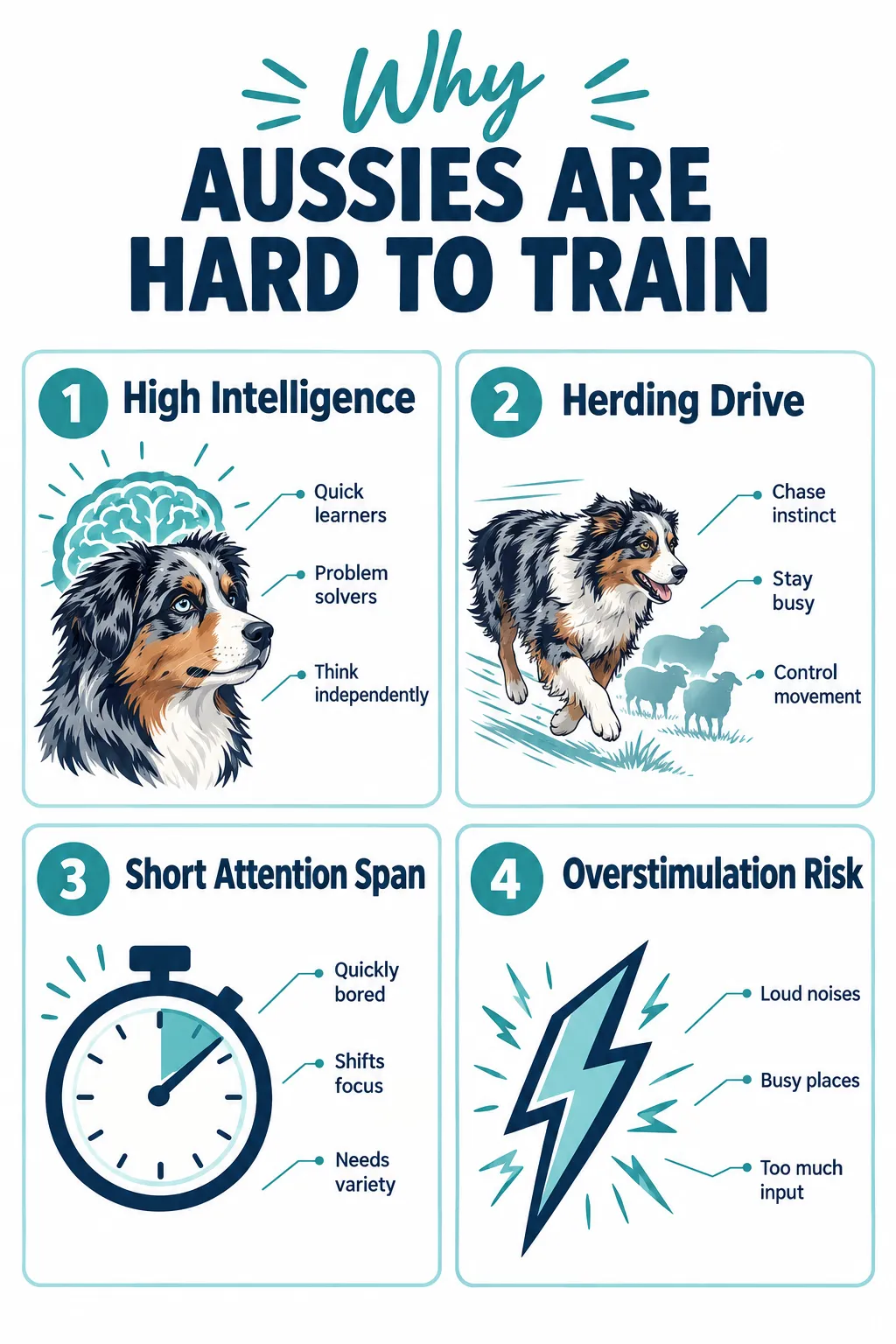
Here are the real reasons training an Aussie can feel like a challenge:
- They think ahead. Your dog may already be anticipating your next cue before you give it, which leads to jumping the gun on commands.
- They get overstimulated quickly. A loud environment or too many people can make it nearly impossible for him to focus.
- They need a leader, not just a trainer. Aussies want to work with you, not just for you.
- Repetition kills their motivation. Drilling the same command 20 times in a row will make your pup shut down.
The fix? Shorter sessions, smarter structure, and rewards that actually excite him. That’s the foundation of every good Australian Shepherd training tip in this guide.
💡 If you want to fast-track results, check out this Free Dog Training Workshop – a first-of-its-kind online program that teaches you the same methods used by service dog trainers to stop bad behaviors and build real obedience.
When Should You Start Training an Australian Shepherd Puppy?
Start training your Australian Shepherd puppy the day he comes home – typically around 7 to 8 weeks old. At this age, a puppy’s brain is like a sponge, and even short 3-5 minute sessions can build habits that last a lifetime.
According to the AKC’s Aussie puppy training timeline, the socialization window closes around 12-16 weeks, making early exposure to people, sounds, and other dogs critical for a well-adjusted adult dog.
Here’s a simple puppy training schedule by life stage:
| Age | Focus Areas | Session Length |
|---|---|---|
| 7-12 weeks | Sit, name recognition, crate intro | 3-5 minutes |
| 3-6 months | Come, stay, leash manners, socialization | 5-10 minutes |
| 6-12 months | Down, leave it, impulse control | 10-15 minutes |
| 1 year+ | Advanced commands, agility, trick training | 15-20 minutes |
Don’t wait until your pup is six months old to “start real training.” By then, you’ve already missed the easiest window. Even simple things like teaching him to sit before meals or wait at the door build the foundation for everything else.
For a full structured approach, our 14-day dog training plan walks you through exactly what to work on each day.
Positive Reinforcement Training for Australian Shepherds: The Method That Actually Works
Reward-based training is the most effective and humane method for Australian Shepherds, and it’s backed by the strongest scientific evidence available. The American Veterinary Society of Animal Behavior states clearly that positive training methods produce better long-term behavior outcomes than punishment-based approaches.
For Aussies specifically, positive training methods work so well because this breed is highly motivated by both food and play. You don’t need to “dominate” your dog – you need to make yourself the most interesting thing in the room.
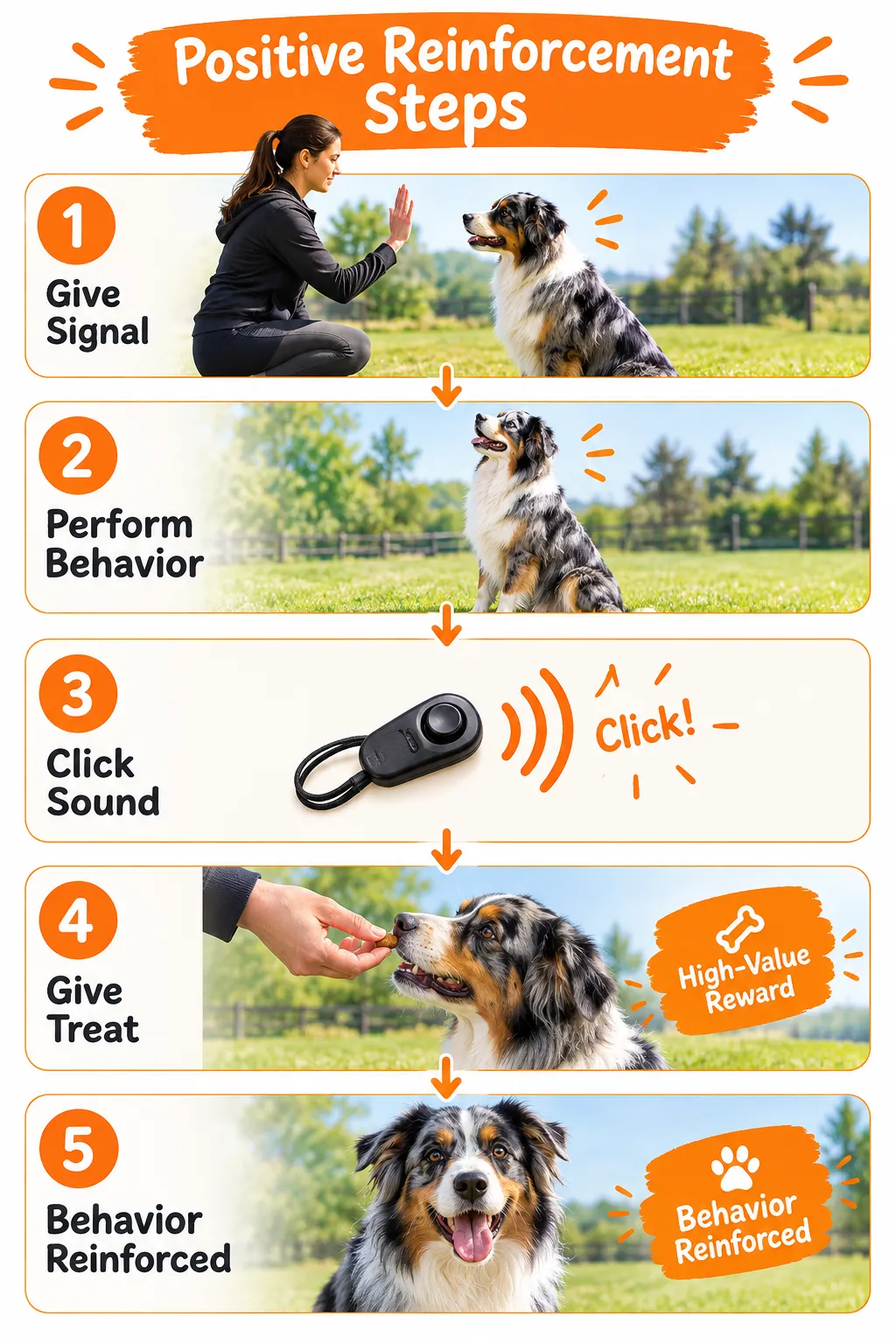
Best treats and rewards for training Australian Shepherds:
- Small, soft treats (pea-sized) that he can eat quickly without breaking focus
- High-value options: real chicken, cheese, freeze-dried liver
- Toy rewards for dogs who are more play-motivated than food-motivated
- Verbal praise combined with a physical reward for the strongest reinforcement
Common mistake: Using the same treat every single session. Vary your rewards to keep his anticipation high. Think of it like a slot machine – unpredictable rewards are actually more motivating than guaranteed ones.
Clicker training for Australian Shepherds works extremely well because the click gives a precise, consistent marker that tells your dog exactly which behavior earned the reward. If you’re new to this, our guide on how to use a clicker for dog training covers everything you need to get started.
Does clicker training work for Aussies? Yes – in fact, the precision of a clicker is especially useful for this breed because they learn so fast. The click captures the exact moment of correct behavior before your dog moves on to the next thing.
The Herding Drive Isn’t Going Away – Here’s How to Work With It
The herding instinct in an Australian Shepherd is not a behavior problem – it is a deeply wired biological drive that has been selectively bred for generations. Trying to suppress it entirely will frustrate both you and your dog. The smarter approach is to channel it.
Zoom Room’s breed guide for Australian Shepherds notes that urban herding behaviors – like chasing bikes, nipping at children’s heels, or circling other dogs – are normal dog behavior expressions of a working instinct that has nowhere productive to go.
Here’s how to redirect herding energy into structured outlets:
- Agility training – Aussies are born for this. The combination of physical movement and mental problem-solving makes agility one of the best outlets for herding breeds.
- Herding balls – Large, horse-sized balls that your dog can push and “herd” around the yard satisfy the instinct without targeting people or other animals.
- Treibball – A sport where dogs herd large exercise balls into a goal. It’s perfect for Aussies and can be learned at training classes.
- Trick training sequences – Teaching a chain of tricks back-to-back mimics the decision-making flow of herding work.
“Give your Aussie a job and he becomes a partner. Leave him with nothing to do and he’ll create his own job – usually one you won’t like.”
If your dog is nipping at kids or other dogs during play, that’s a sign he needs more structured outlets, not just more exercise. Nipping is a herding behavior, not aggression, but it still needs to be addressed. Our guide on how to train a reactive dog has practical steps for managing this.
Exercise Is Not Enough – Mental Work Is the Missing Piece
Many Aussie owners think a long run will solve everything. It won’t. Physical exercise tires the body, but mental stimulation tires the brain – and for a high-intelligence herding dog, brain fatigue is what actually produces calm, settled behavior at home.
Woofz’s Australian Shepherd training resource recommends that Aussies receive at least 1-2 hours of physical activity daily, but also emphasizes that puzzle toys, training games, and scent work are equally important for preventing destructive behavior.
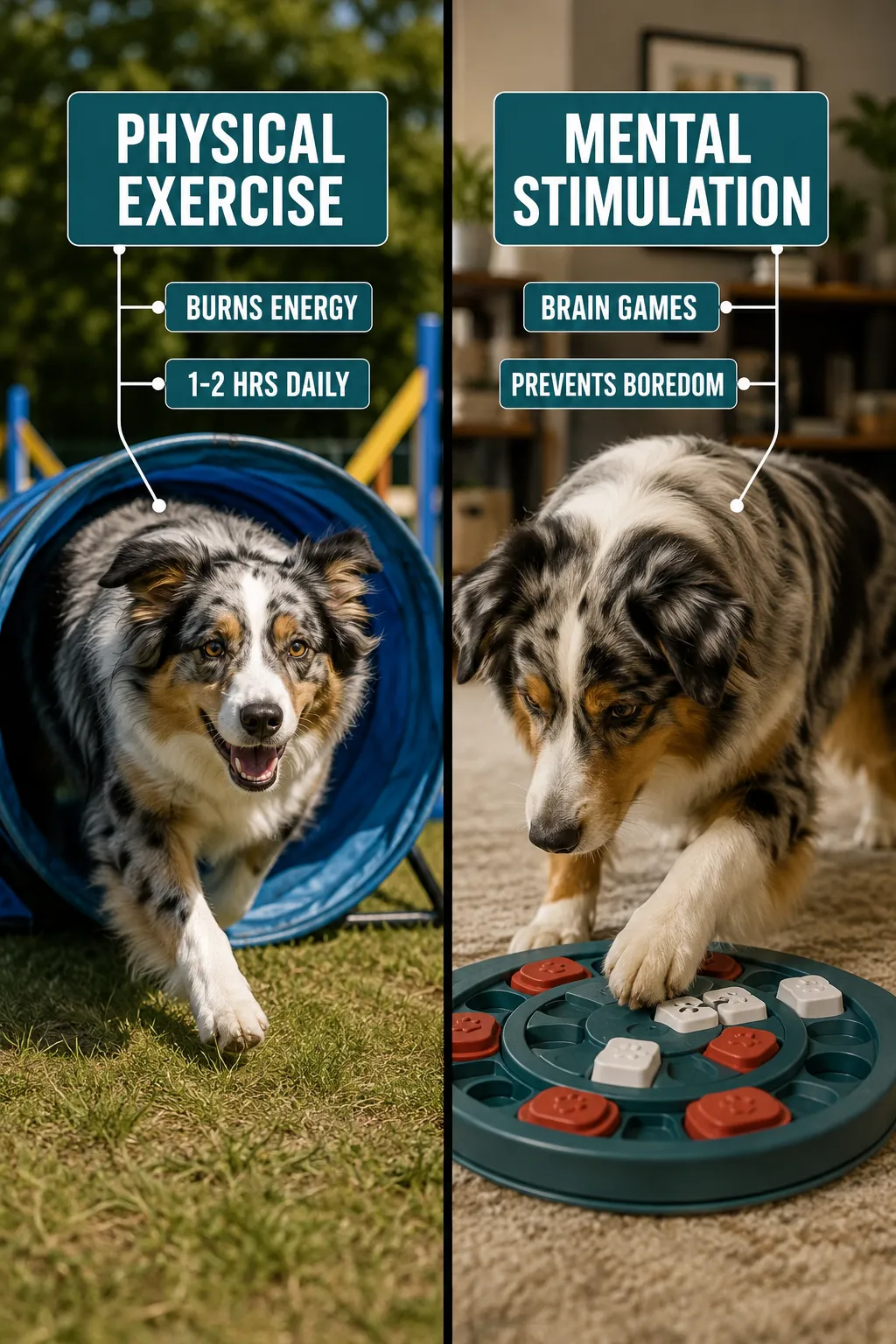
Mental enrichment ideas that work:
- Puzzle feeders – Make him work for his meals instead of eating from a bowl
- Scent work – Hide treats around the house or yard and let him find them
- Training games – Short, fun sessions where he learns new things keep his mind sharp
- Brain games for dogs – Structured cognitive challenges that build focus over time
How much exercise do Australian Shepherds need during training?
Adult Aussies need 1-2 hours of vigorous physical activity per day, according to Lyka’s Australian Shepherd training guide. For a puppy, use the “5 minutes per month of age” rule – so a 4-month-old pup gets about 20 minutes of structured exercise per session.
A good rule of thumb: do a 10-minute brain game or training session before a walk, not after. A mentally engaged dog is a calmer dog on leash.
How long does it take to train an Australian Shepherd?
Basic obedience (sit, stay, come, down) can be solid within 4-8 weeks of consistent daily training sessions. Advanced skills and reliable off-leash behavior typically take 6-12 months of ongoing work. Aussies learn fast – the timeline depends more on your consistency than on the dog.
Socialization: Preventing Wariness With Strangers and Other Dogs
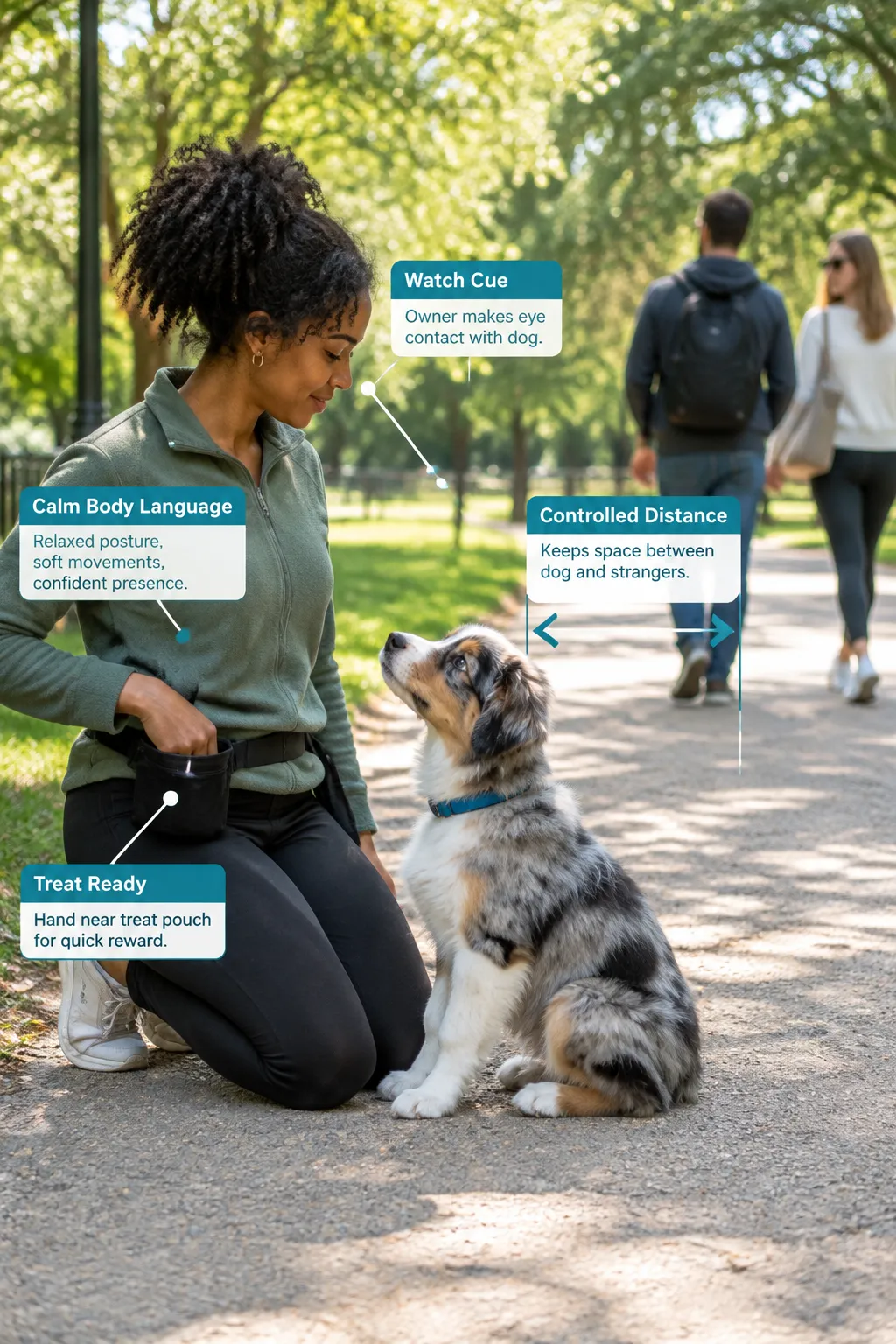
Early socialization is one of the most important Australian Shepherd training tips you can act on, and the window is shorter than most people think. Aussies that don’t get broad, positive exposure to people, dogs, and environments before 16 weeks often develop wariness or reactivity that’s much harder to address later.
PawTracks’ guide on Australian Shepherd training highlights that this breed can be naturally reserved with strangers – not aggressive, but watchful. That watchfulness can tip into anxiety or reactivity without proper early exposure.
How to socialize your Aussie puppy correctly:
- Introduce new people, places, and sounds gradually – don’t flood him
- Keep each new experience positive by pairing it with treats and calm praise
- Watch his body language – if he’s stiff, whale-eyed, or trying to hide, you’ve pushed too far
- Enroll in puppy training classes where he can interact with other dogs in a controlled setting
- Expose him to urban environments: traffic, crowds, skateboards, strollers
For adult Aussies: Socialization doesn’t stop at puppyhood. Regular, positive exposure to other dogs and new people throughout adulthood maintains the social skills he built early on.
If your dog already shows anxiety around strangers, our tips on keeping your dog calm around visitors offer a practical starting point.
Australian Shepherd Training Mistakes to Avoid
The most common Australian Shepherd training mistakes come down to three things: sessions that are too long, cues that are inconsistent, and not addressing separation anxiety early. Avoiding these three errors alone will put you ahead of most Aussie owners.
WikiHow’s guide on training an Australian Shepherd and NAHF’s training resource both emphasize that this breed needs clear, consistent communication more than most other breeds.
Top training mistakes to avoid:
- Sessions over 20 minutes – His focus will drop and he’ll start making mistakes, which is discouraging for both of you
- Repeating a cue multiple times – Saying “sit, sit, SIT” teaches him that the first cue is optional
- Skipping crate training – A crate gives your dog a safe, calm space and directly supports separation anxiety prevention
- Inconsistent rules – If one person lets him on the couch and another doesn’t, he learns that rules are negotiable
- Training only indoors – Aussies need to learn to focus in distracting outdoor environments too
- Punishing normal dog behavior – Herding, barking at movement, and high energy are not “bad” – they need redirection, not punishment
Australian Shepherd training vs other herding breeds:
Compared to Border Collies, Aussies tend to be slightly more people-oriented and easier to motivate with play and affection. Compared to Cattle Dogs, they’re generally more sensitive to tone and respond better to gentle correction. Compared to other breeds outside the herding group, they need significantly more mental engagement to stay focused during training sessions.
For more on avoiding common errors, our list of 15 terrible dog training mistakes applies directly to Aussie owners.
Australian Shepherd Training for Separation Anxiety
Separation anxiety is one of the most common behavioral problems in Aussies, and it needs to be addressed proactively – ideally starting in puppyhood before it becomes a crisis. Because this breed bonds deeply with their people, being left alone can trigger real distress.
Signs of separation anxiety include destructive chewing, excessive barking, house soiling only when alone, and pacing or drooling near doors and windows.
How to train an Aussie for alone time:
- Start with very short departures (30 seconds) and build gradually
- Never make arrivals and departures emotional – keep them calm and low-key
- Use a crate or safe room as a positive “den,” not a punishment
- Give him a high-value chew or puzzle toy only during alone time so he associates it with something good
- Practice “out of sight” exercises indoors – go to another room, come back, reward calm behavior
This is one area where professional help is genuinely worth the investment. Australian Shepherd training cost with a professional typically runs $50-$150 per group class session or $100-$300 per private session depending on your location. For complex separation anxiety, a certified applied animal behaviorist is the most effective option.
💡 Before spending that money, try the Free Dog Training Workshop – it covers housebreaking, bad behaviors, and building obedience using the same methods professional service dog trainers use, completely free.
Are Australian Shepherds Easy or Hard to Train? The Honest Answer
Australian Shepherds are easy to train basic commands but challenging to train for reliable, distraction-proof behavior. They learn quickly, which is an advantage – but that same intelligence means they get bored fast and will test boundaries if training isn’t engaging enough.
For first-time dog owners, an Aussie can feel overwhelming. For experienced owners who understand how to channel the breed’s energy, they’re one of the most rewarding dogs to train. The key is matching your training approach to the dog’s actual needs – not treating him like a Golden Retriever who just needs patience.
If you’re raising an Australian Shepherd for the first time, our deep-dive Australian Shepherd facts guide will give you a strong foundation for understanding the breed before you start.
Frequently Asked Questions
Are Australian Shepherds difficult to train?
Australian Shepherds are not difficult to train – they are one of the most intelligent herding breeds and pick up commands quickly. The challenge is keeping them engaged. They get bored with repetitive sessions and need mental stimulation alongside physical exercise. With short, reward-based training sessions and consistent rules, most Aussies become highly obedient dogs.
What are some tricks to train an Australian Shepherd?
Aussies excel at trick training because they love to learn and work with their owners. Great tricks to start with include spin, roll over, shake, fetch by name, and weave through legs. Once basic obedience is solid, you can move into agility, treibball, and scent work. Check out 15 fun dog training tricks for step-by-step ideas your dog will genuinely enjoy.
What are common Aussie behavioral problems?
The most common behavioral problems in Australian Shepherds include herding and nipping at children or other animals, separation anxiety, excessive barking, destructive chewing when bored, and reactivity toward strangers or other dogs. Most of these behaviors are normal dog behavior expressions of the breed’s working instincts – they need redirection and structured outlets, not punishment.
How to tire out an Australian Shepherd?
The most effective way to tire out an Aussie is to combine physical exercise with mental stimulation. A 45-minute run alone won’t do it – but a 30-minute run followed by a 10-minute training session or puzzle feeding will. Agility, scent work, herding sports, and training games drain both body and brain, producing the calm, settled behavior most owners want at home.
Conclusion: Your Next Steps With Australian Shepherd Training Tips
Training an Aussie is one of the most rewarding things you can do with this breed – when you do it right. The seven core principles covered here are not complicated, but they do require consistency.
Here’s what to do this week:
- Start a 5-minute training session today – even just sit and stay, done well, builds the habit
- Add one mental enrichment activity – a puzzle feeder or a hide-and-seek game counts
- Audit your socialization plan – is your dog getting regular, positive exposure to new things?
- Pick one mistake from the list above and actively work to correct it
- Consider a structured program if you want faster results
Every dog is different, and every Aussie has his own personality. But the fundamentals of good training – short sessions, clear cues, high-value rewards, and genuine mental engagement – work for every dog at every life stage.
💡 Ready to take it further? The Free Dog Training Workshop is a first-of-its-kind online program that teaches you to train your dog to service-dog-level obedience – covering housebreaking, bad behaviors, and focus – using proven, science-backed methods, completely free.
Your Aussie is smart enough to learn almost anything. The question is whether your training plan is smart enough to teach him.