
Last updated: September 14, 2026
Quick Answer: If your dog is choking, stay calm and act fast. Open the mouth, check for a visible object, and remove it only if you can clearly see it. If the airway stays blocked, perform the Heimlich maneuver for dogs – 3 to 5 firm upward thrusts just below the ribcage – then head to an emergency vet immediately, even if the object comes out.
Key Takeaways
- Choking in dogs is a true emergency – every second counts when the airway is blocked
- Signs include gagging, pawing at the mouth, distress, and blue or grey gums
- Never do a blind finger sweep; only remove an object you can clearly see
- The Heimlich maneuver for dogs uses 3-5 upward abdominal thrusts just behind the ribcage
- Technique differs for small dogs vs. large dogs – force and position both matter
- Back blows between the shoulder blades can help when thrusts alone don’t work
- Always visit a vet after any choking episode, even if your dog seems fully recovered
- Prevention – choosing the right toys and food sizes – is the best long-term care strategy
Signs Your Dog Is Choking: What to Look For
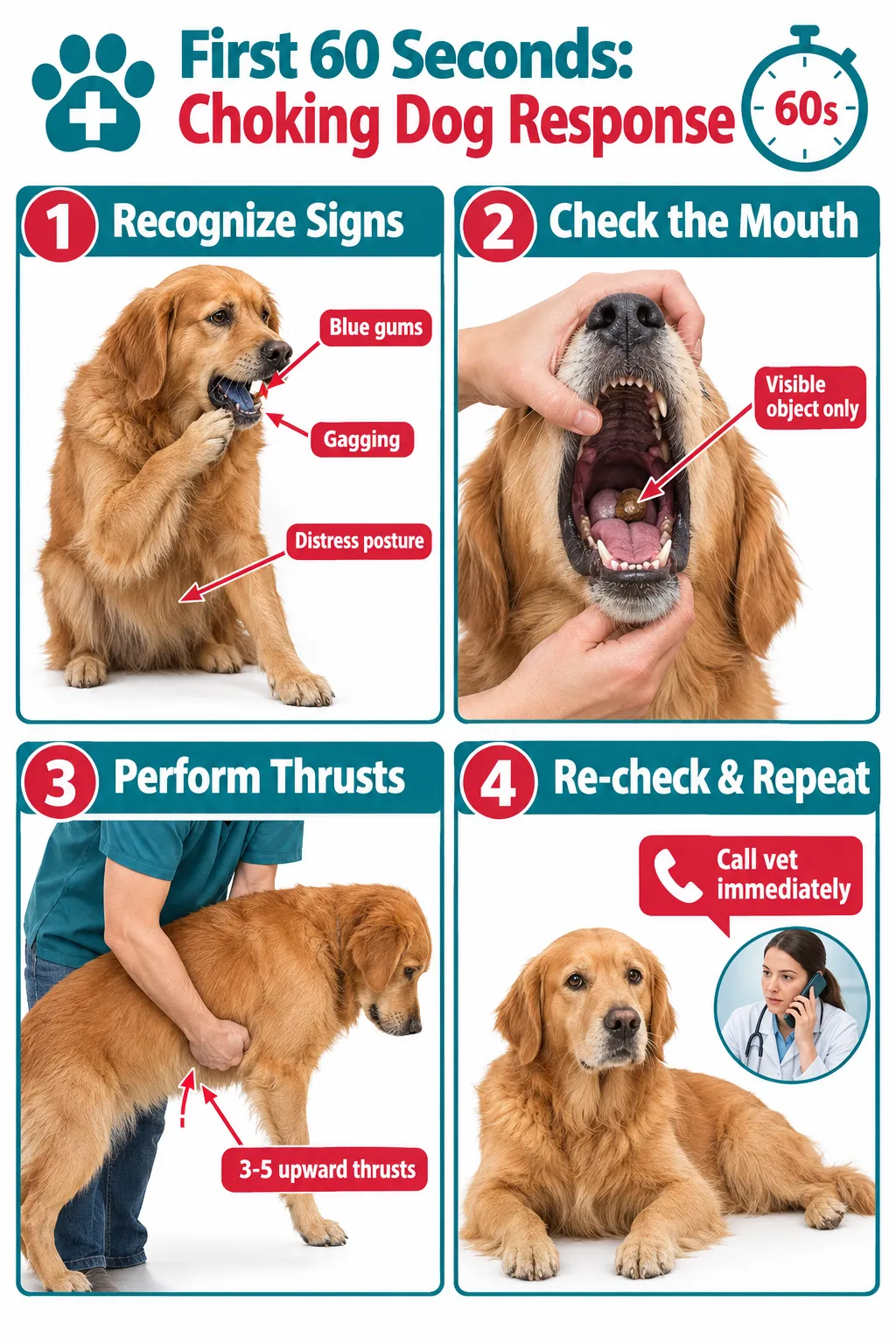
Choking dogs show sudden, dramatic distress that is different from a regular cough or gag. The most reliable signs are pawing at the mouth, retching without producing anything, and visible panic. In severe cases, gums turn blue or grey, which means oxygen is not reaching the blood and you have seconds to act.
Watch for these warning signs:
- Pawing or scratching at the mouth or throat
- Gagging or retching with no result
- Sudden, extreme distress or panic
- Labored or noisy breathing
- Drooling more than usual
- Blue, grey, or pale gums (a critical sign of oxygen loss)
- Collapse or loss of consciousness in severe cases
💡 Key distinction: If your dog can still cough forcefully and breathe between coughs, the airway may be only partially blocked. According to emergency pet care guidance, a dog that can still move air may be monitored briefly while you prepare for a vet visit – but if breathing stops or gums change color, act immediately.
What Causes Dogs to Choke – and How to Prevent It
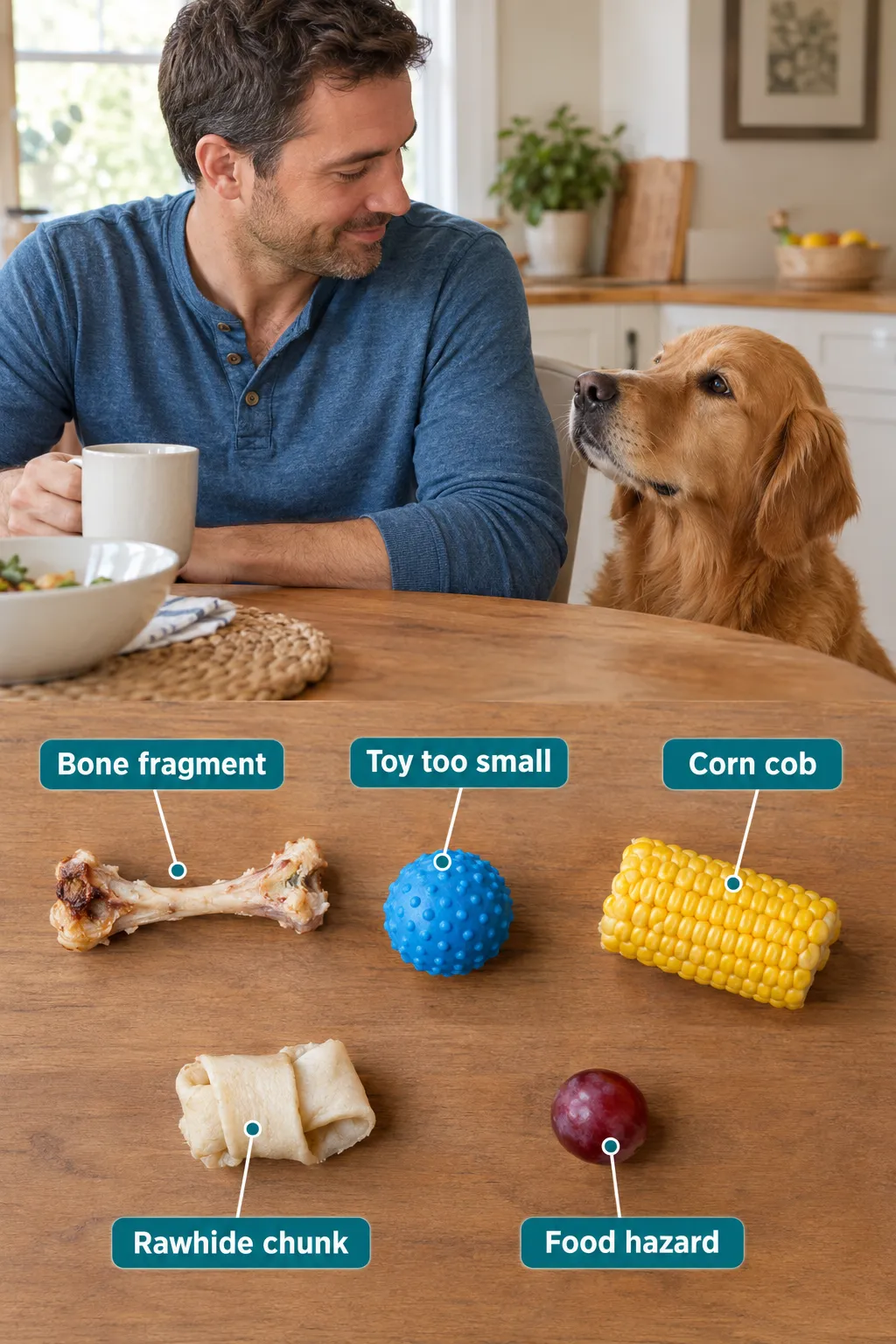
Dogs choke most often because they eat or play too fast, swallowing objects that get lodged in the throat. Understanding the causes helps you reduce the risk before an emergency ever happens.
Common causes of choking in dogs:
- Bones (especially cooked chicken or fish bones that splinter)
- Toys that are too small for the dog’s size
- Rawhide chews that soften and clump
- Corn cobs, large food chunks, or hard treats
- Balls or squeaky toys with pieces that break off
- Sticks and outdoor debris
Prevention tips:
- Always choose toys sized appropriately for your dog – a ball that fits entirely in the mouth is a choking risk
- Supervise dogs with chews and remove them when they get small enough to swallow whole
- Feed at a normal pace; use a slow-feeder bowl if your dog gulps food
- Keep small household objects off the floor, especially around puppies
If you’re thinking about homemade treats, check out what dogs can eat and what to avoid before preparing anything new. And if you want to make birthday treats, review safe DIY dog food ideas to keep things fun and safe.
What to Do If Your Dog Is Choking – The First 60 Seconds
When a dog is choking, your first 60 seconds follow a clear sequence: recognize, check the mouth, act, and get to a vet. Emergency pet care experts describe this minute-one algorithm as the difference between a dog that survives and one that doesn’t.
Step-by-step guide:
- Stay calm. Your dog will sense your panic, which makes restraint harder.
- Restrain the dog safely. Hold the dog firmly but without crushing pressure.
- Open the mouth. Use both hands – one on the upper jaw, one on the lower – and look inside.
- Remove a visible object only. If you can clearly see the object, use your fingers or a tool to carefully pull it out. PetMD’s emergency choking guidance and Hill’s Pet Nutrition both warn against blind finger sweeps – pushing deeper into the throat can lodge the object more tightly and cause throat injury.
- If the object is not visible or won’t come free, perform the Heimlich maneuver for dogs (see next section).
- After each set of thrusts, re-check the mouth and remove anything that has been dislodged.
- Call your vet or an emergency animal hospital while you work, or have someone else make the call.
⚠️ Do not spend more than 60 seconds on home interventions before arranging transport to a clinic. Time is the most critical factor in choking care.
How to Do the Heimlich Maneuver for Dogs – Step by Step
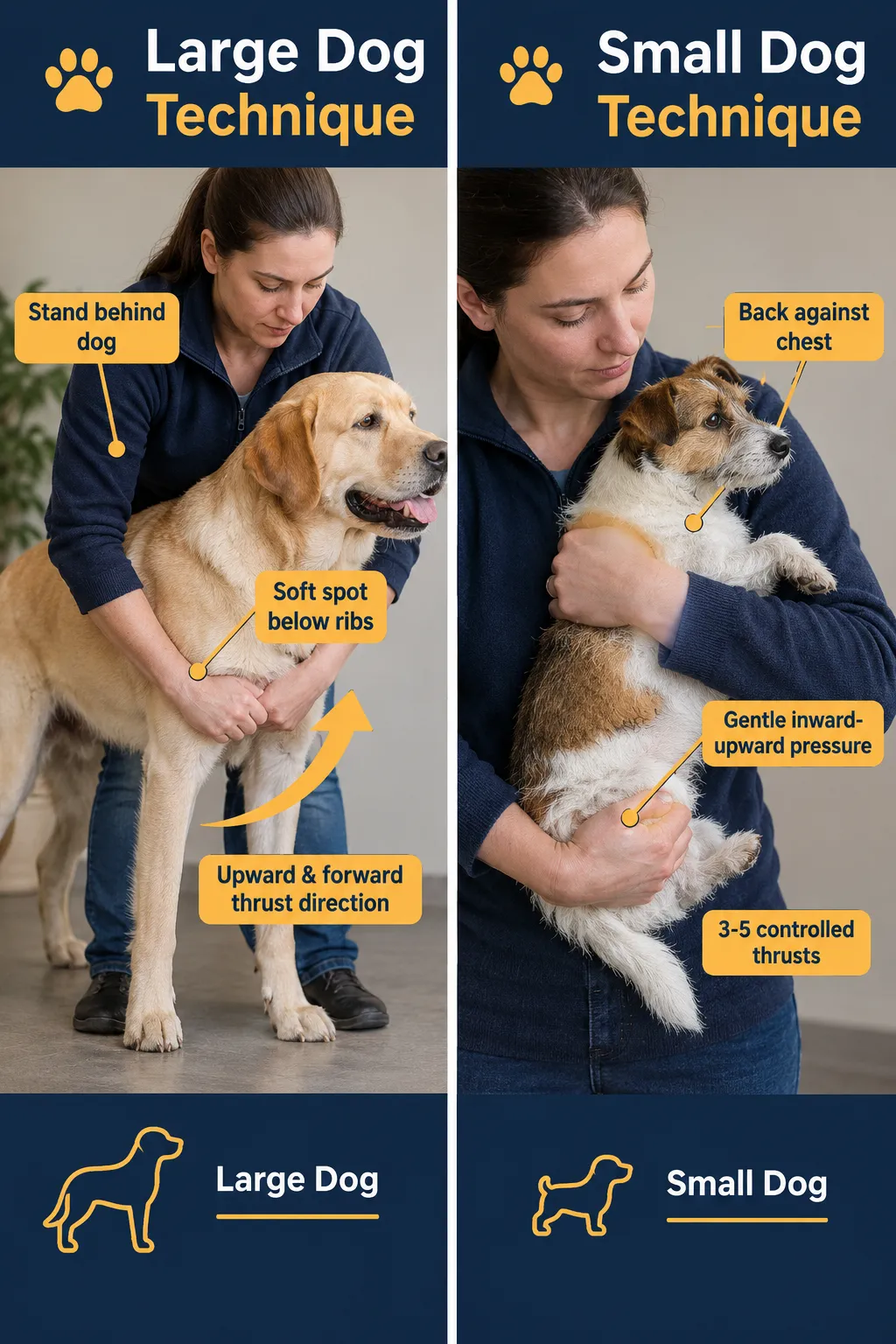
The Heimlich maneuver for dogs works by using quick abdominal compression to force air up from the lungs, pushing the lodged object out of the throat. The technique is adapted from the human Heimlich but adjusted for a dog’s body shape and size.
Heimlich Maneuver for Large Dogs
For large dogs that are standing, the AVMA’s pet first-aid guidance recommends this approach:
- Stand or kneel behind the dog.
- Wrap both arms around the dog’s belly, just behind the ribcage.
- Make a fist with one hand and place it on the soft spot just below the ribs.
- Cover your fist with your other hand.
- Deliver 3 to 5 firm, quick thrusts – pushing inward and upward toward the spine and head.
- After each set, open the mouth and check for the dislodged object.
- Repeat if needed, then go straight to a veterinary clinic.
Heimlich Maneuver for Small Dogs
For small dogs, the technique changes because of their size and fragility. Chewy’s veterinary-reviewed guide recommends:
- Hold the small dog with its back against your chest, facing away from you.
- Find the soft spot just below the ribcage.
- Use two fingers to deliver 3 to 5 gentle but firm inward-and-upward thrusts.
- Use noticeably less force than you would for a large dog – the goal is to compress the abdomen, not crush it.
- After each set, check the mouth for the object.
🐾 For dogs you can lift: You can also lay the dog on its back on a firm surface and perform the thrusts from above, pressing gently inward and upward with two fingers just behind the ribcage.
Back Blows as an Additional Tool
If abdominal thrusts alone don’t work, Hill’s Pet and Chewy’s guide both describe using back blows. Lift the dog’s hind legs slightly (like a wheelbarrow position) and deliver 3 to 5 firm strikes between the shoulder blades with the flat of your hand. Alternate between back blows and abdominal thrusts until the object is expelled.
Common Mistakes When Performing the Heimlich on a Dog
Most errors happen because owners panic, which is completely understandable. Knowing the common mistakes in advance helps you perform heimlich correctly under pressure.
Mistakes to avoid:
- Blind finger sweeps – pushing your fingers into the throat without seeing the object can drive it deeper
- Too much force on small dogs – excessive pressure can fracture ribs or bruise abdominal organs, especially in toy breeds and elderly patients
- Too little force on large dogs – the thrust needs to be firm enough to move air upward
- Stopping too soon – if the first set of thrusts doesn’t work, re-check the mouth and try again
- Skipping the vet visit – even if the object comes out, internal bruising or a secondary object may remain
Texas A&M University’s College of Veterinary Medicine – part of the texas amp university veterinary medicine amp biomedical sciences program, covering medicine amp biomedical sciences – notes that the maneuver can cause internal injury if performed incorrectly, reinforcing why a post-choking vet check is essential for all patients.
What to Do After Your Dog Stops Choking
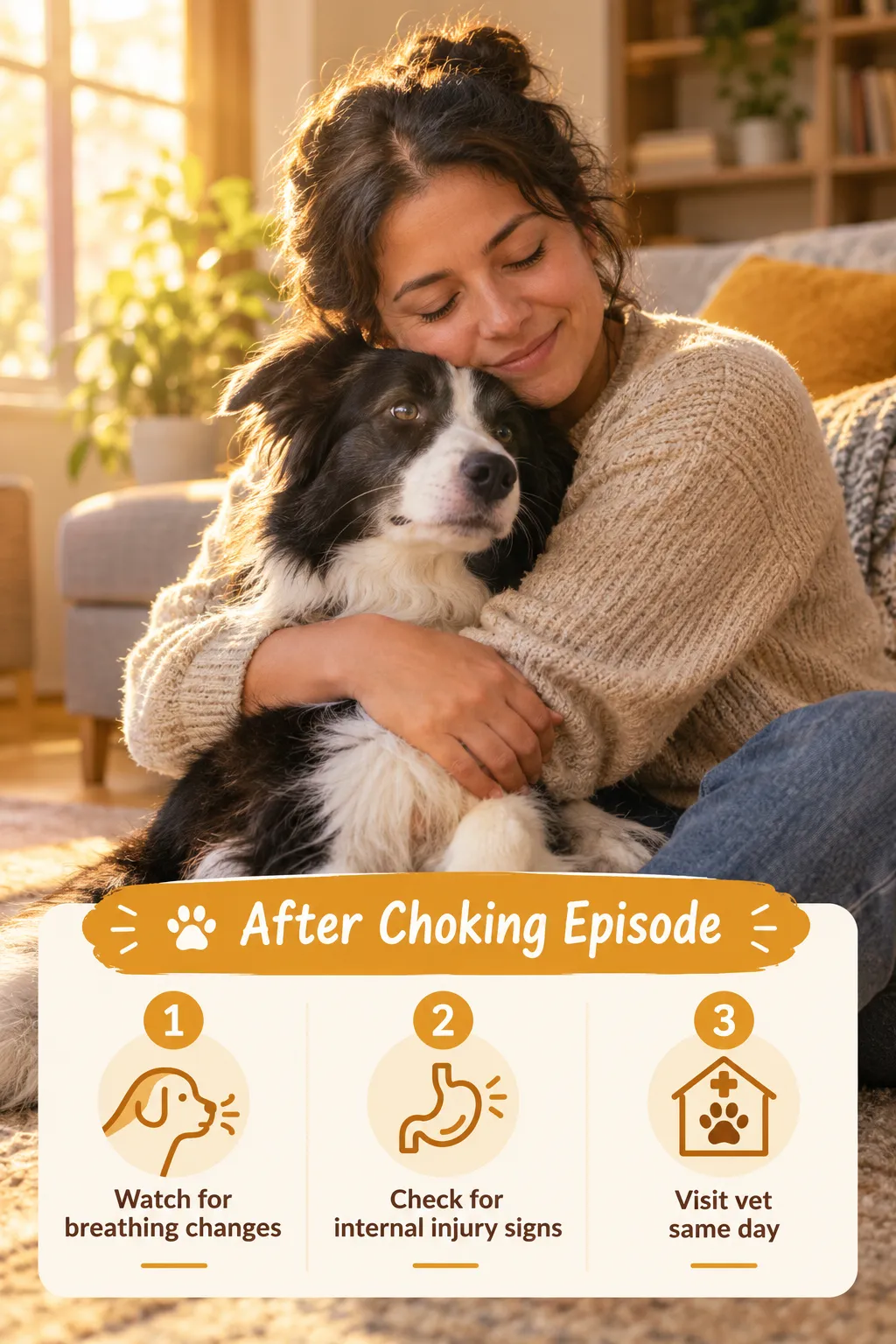
Once the object is out and your dog can breathe again, the emergency care isn’t over. Even when a dog appears fully recovered, internal bruising, a secondary lodged piece, or throat trauma may still be present.
Post-choking care checklist:
- Stop performing thrusts as soon as the dog breathes normally
- Keep the dog calm and still
- Check the mouth one more time for remaining fragments
- Watch for labored breathing, coughing, or signs of pain over the next hour
- Contact your vet or an emergency animal hospital the same day – this is not optional
- Note what the object was, if you know, so the vet can assess the risk of internal damage
If your dog loses consciousness before or after the object is expelled, Texas A&M’s veterinary guidance recommends transitioning to canine CPR – chest compressions at around 100 to 120 per minute – while continuing to clear the airway and transporting to an emergency vet.
For broader guidance on keeping your dog healthy day to day, our guide on what to give a sick dog naturally covers safe home remedies every owner should know.
Is the Heimlich Maneuver Safe for Dogs?
Yes, the Heimlich maneuver is appropriate and potentially life-saving for dogs with a complete airway obstruction, when performed correctly. Dogster’s veterinary review and Spot & Tango’s guide both confirm that the abdominal-thrust technique is the right intervention for a dog that cannot breathe due to a lodged object.
The key safety rules are:
- Use controlled, upward thrusts – not random or sideways pressure
- Modulate force by size – less force for small dogs and puppies, more for large dogs
- Stop as soon as the dog can breathe and cough on their own
- Always follow up with a vet visit to check for internal injury
The risks of not acting – brain damage from oxygen deprivation within minutes – far outweigh the risks of performing the maneuver correctly.
When to Call an Emergency Vet Instead of (or Alongside) Doing the Heimlich
Call an emergency vet immediately if your dog is choking – the maneuver and the phone call should happen at the same time if possible. The Heart of Suwannee Animal Hospital’s blog notes that foreign-body airway obstruction is one of the most frequent reasons dogs need urgent veterinary care, and outcomes depend heavily on speed.
Call or go to an emergency vet right away if:
- The object won’t come out after 2 to 3 rounds of thrusts
- The dog loses consciousness
- Gums are blue, grey, or white
- The dog is a puppy, elderly, or has a known heart or respiratory condition
- You are unsure whether the dog is choking or having a seizure or cardiac event
If you’re in the Memphis area, PetVax Complete Care Centers – with locations in East Memphis, Midtown Memphis, Bartlett, Cordova, and Germantown – offer urgent and emergency vet care for dogs and cats during regular clinic hours. Search for memphis bartlett cordova or memphis bartlett locations online to find the nearest clinic. PetVax is part of the PetVet Care Centers Network, which means patients receive consistent, high-quality care across locations. New patients are welcome, and the team offers wellness plans to support ongoing pet health. Contact the hospital directly for emergency instructions if your dog is choking or showing other concerning signs.
Preventing Future Choking Episodes
The best emergency care is the kind you never need. After a choking scare, most dog owners want to know how to make sure it never happens again.
Practical prevention steps:
- Audit your dog’s toys – replace any that are small enough to fit fully in the mouth or that break into small pieces. Check out tips on how to keep your dog occupied with toys safely.
- Supervise all chew sessions – never leave a dog alone with a rawhide, bully stick, or bone
- Use size-appropriate food – cut large treats into smaller pieces, especially for small dogs
- Slow down fast eaters – a slow-feeder bowl can reduce gulping significantly
- Take a pet first-aid course – practicing the correct hand placement before an emergency greatly improves your ability to perform heimlich maneuver dogs correctly under pressure. The AVMA’s pet first-aid brochure recommends owners get trained rather than relying solely on written guides.
- Know your vet’s emergency contact number – save it in your phone now, not during a crisis
Also review 15 everyday foods that can kill your dog so you can remove hazards from your dog’s environment before they become a problem.
FAQ
What is the 7-second rule for dogs?
The 7-second rule suggests that if a dog is actively choking and cannot breathe, you have roughly 7 seconds to begin intervention before oxygen deprivation starts causing damage. It’s a reminder to act immediately rather than waiting to see if the dog resolves the obstruction on its own. If your dog is choking, start your response right away and call a vet simultaneously.
What do you do when your dog is choking?
Stay calm, restrain the dog, and open the mouth to check for a visible object. Remove it only if you can clearly see it – never do a blind sweep. If the airway stays blocked, perform the Heimlich maneuver for dogs: 3 to 5 firm upward thrusts just behind the ribcage. Re-check the mouth after each set, and head to an emergency vet immediately regardless of outcome.
Does Heimlich maneuver work on dogs?
Yes, the Heimlich maneuver works on dogs and is the recommended first-aid response for a complete airway obstruction. The technique uses abdominal compression to force air upward from the lungs, dislodging a stuck object. It must be adapted for the dog’s size – gentler and with two fingers for small dogs, full-fist thrusts for large dogs. Always follow up with a vet visit after performing it.
What if my dog has something stuck in his throat but not choking?
If your dog is still breathing, coughing, and not in severe distress, the airway is likely only partially blocked. Do not attempt the Heimlich maneuver yet. Open the mouth carefully and look for a visible object. If you can see it and safely reach it, remove it. If not, call your vet immediately for guidance and monitor your dog closely for any worsening signs like labored breathing or blue gums.
Conclusion
A choking dog is one of the most frightening emergencies a pet owner can face. The good news is that knowing the Heimlich maneuver for dogs – and practicing it before you ever need it – can genuinely save your dog’s life.
Your action plan:
- Save your vet’s emergency contact number right now
- Learn the signs of choking so you can recognize them instantly
- Practice the hand position for abdominal thrusts so it feels natural
- Review your dog’s toys and treats for choking hazards this week
- Consider taking a pet first-aid course – it covers choking, CPR, and other emergencies
Your dog trusts you completely. A few minutes of preparation today could be the most important care you ever give them.