Last updated: October 14, 2026
Quick Answer: Yes, dachshunds can absolutely learn impressive tricks – but they need short sessions, high-value rewards, and training that feels like a game rather than a drill. The best dachshund dog tricks work with the breed’s hunting instincts and independent personality, not against them. Keep sessions to 5-10 minutes, always end on a win, and your “stubborn” sausage dog will surprise you.
Key Takeaways 🐾
- Dachshunds are smart but independently wired – stubbornness is roughly 50% genetic, so training must feel like the dog’s idea
- Keep trick training sessions to 5-10 minutes, two to four times per day
- High-value, tiny treats delivered with precise timing are the single biggest driver of success
- Avoid tricks that involve repeated jumping or prolonged standing on hind legs – dachshunds have serious spinal vulnerability
- Nose-driven tricks (find it, scent games) are the easiest wins for this breed
- Consistency across all family members matters more than most owners realize
- Old dachshunds can learn new tricks – the method just needs slight adjustments
- Always end every session on a success, no matter how small
Are Dachshunds Easy to Train?
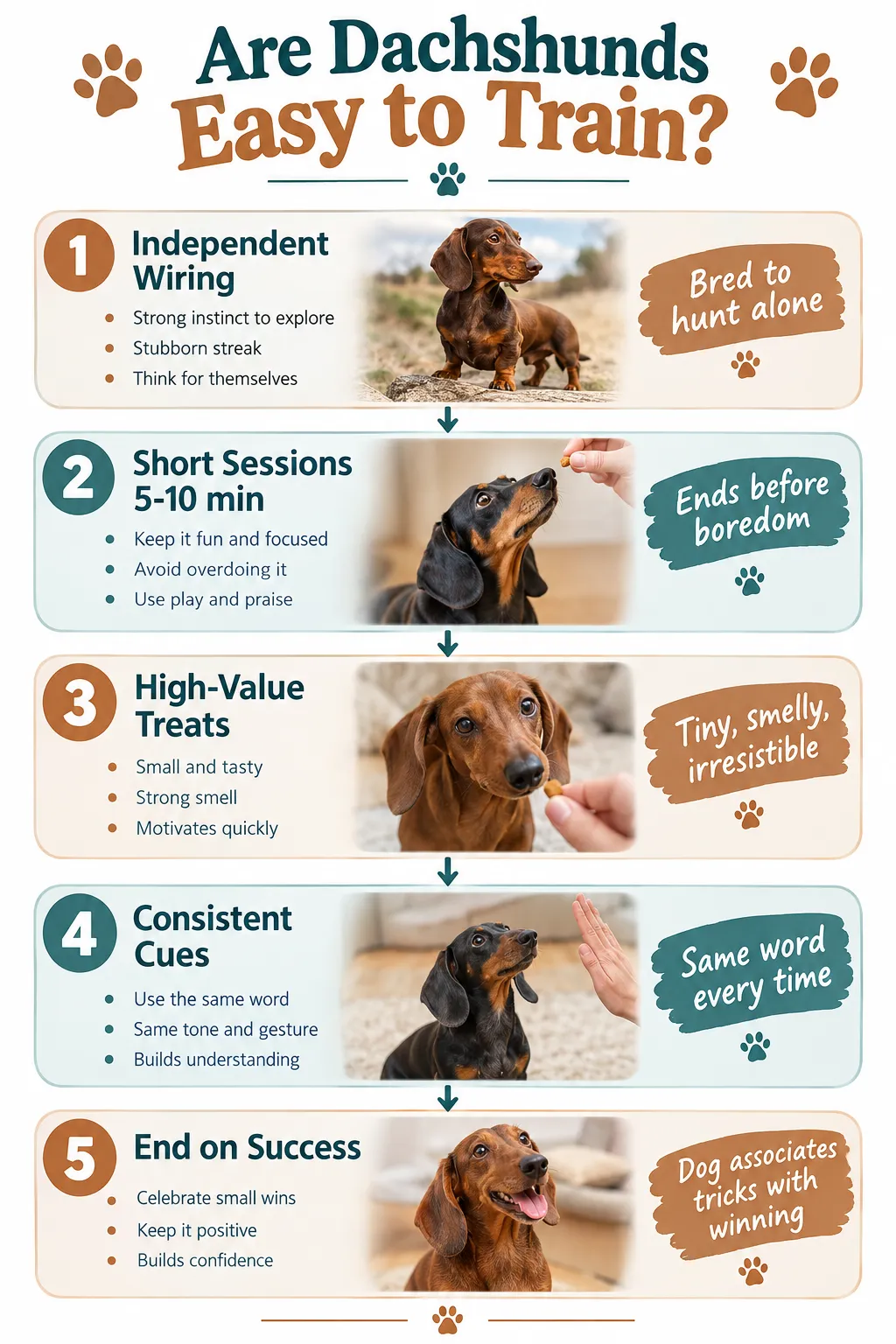
Dachshunds are intelligent, but they are not easy to train in the traditional sense. They were bred to hunt independently underground, which means they have a built-in “what’s in it for me?” attitude that can feel like stubbornness.
According to research on dachshund behavior, independence in the breed is roughly 50% heritable. That means you’re not dealing with a badly behaved dog – you’re dealing with a dog that was literally designed to make its own decisions.
The good news? That same intelligence makes them excellent trick learners when you approach training correctly. Frame every session as a puzzle or a hunting game, and a dachshund will work hard for you.
If you’re also dealing with housebreaking challenges alongside trick training, check out these puppy potty training tips that actually work even for stubborn puppies – many of the same principles apply.
What Makes Dachshunds Stubborn?
Stubbornness in dachshunds comes from their breeding, not bad character. These dogs were developed to chase prey into underground burrows and make independent hunting decisions without human guidance.
That heritage creates a dog that questions commands rather than automatically obeying them. When a dachshund ignores your cue, it isn’t being defiant – it’s running a quick cost-benefit analysis.
A few key factors that fuel the stubbornness:
- Genetic independence – hardwired to work alone
- Sensitive nature – harsh corrections make them dig in harder, not comply faster
- Scent distraction – their nose can override everything else
- Inconsistent rules – dachshunds exploit any gap in the household routine
The fix is to make tricks feel like the dog’s idea by using rewards, short sessions, and game-based training rather than repetitive drills.
What Tricks Can Dachshunds Learn?
Dachshunds can learn a wide range of tricks – from basic obedience behaviors to genuinely impressive show-off moves. The key is choosing tricks that suit their body type and personality.
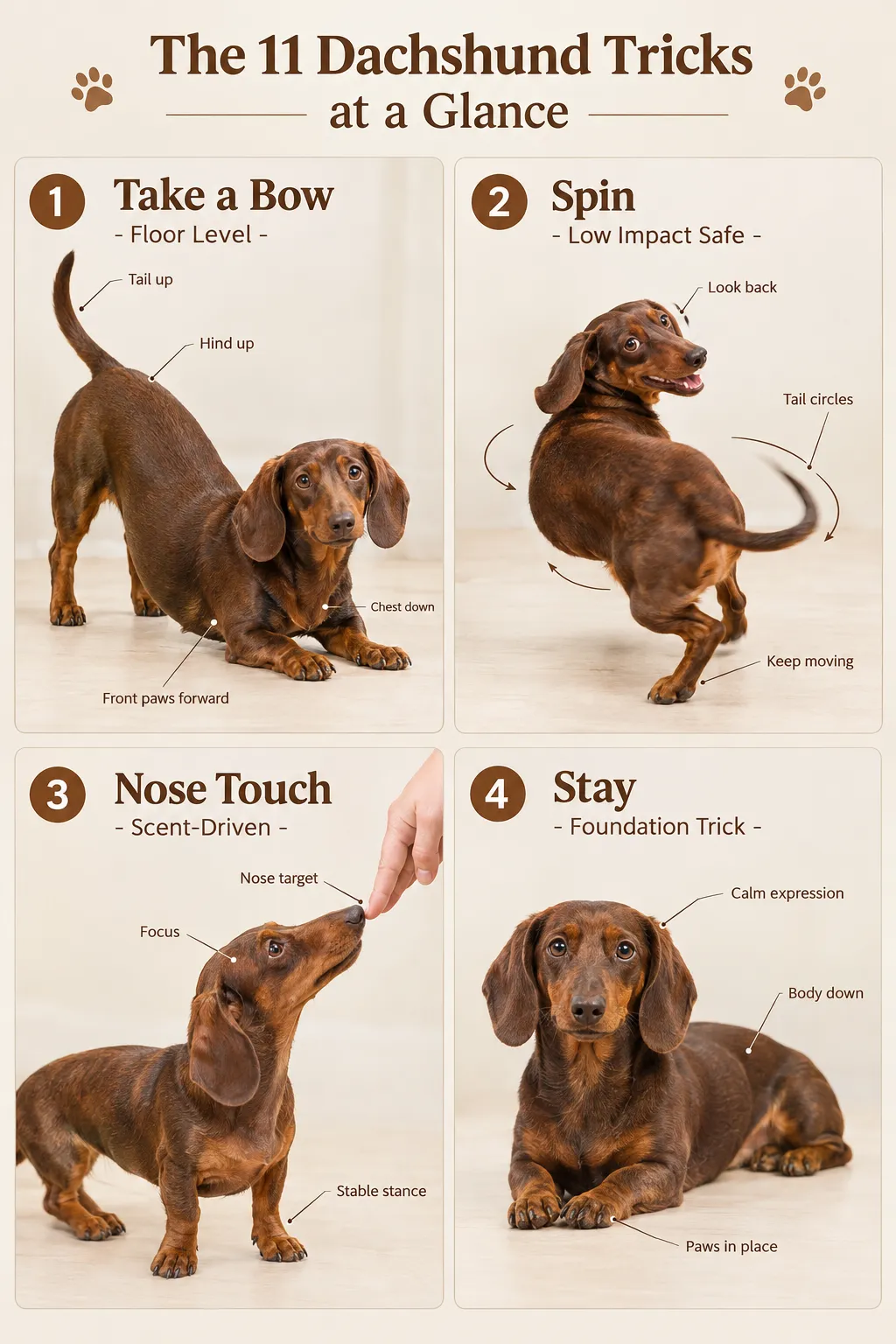
Here are the 11 best dachshund dog tricks, from easiest to most impressive:
1. Sit
The foundation of everything. Lure the nose upward with a treat until the bottom goes down, then mark and reward. Most dachshunds get this in a few sessions.
2. Down
From sit, lower the treat slowly toward the floor between the front paws. This is a floor-level trick that’s safe for the spine.
3. Stay
Start with one second, then build duration slowly. Use a calm verbal release cue like “free” so the dog knows exactly when the trick is done.
4. Take a Bow
Ask the dog to stretch its front legs forward while keeping the back end up. This is a natural stretch dachshunds do anyway – just capture it with a cue.
5. Spin
Lure the nose in a circle close to the floor. Add the cue “spin” once the dog is reliably following the lure. Easy, low-impact, and looks great.
6. Nose Touch (Target)
Hold out a flat hand and reward the dog for touching it with its nose. This becomes a building block for more advanced tricks and is especially effective for scent-driven breeds.
7. Find It
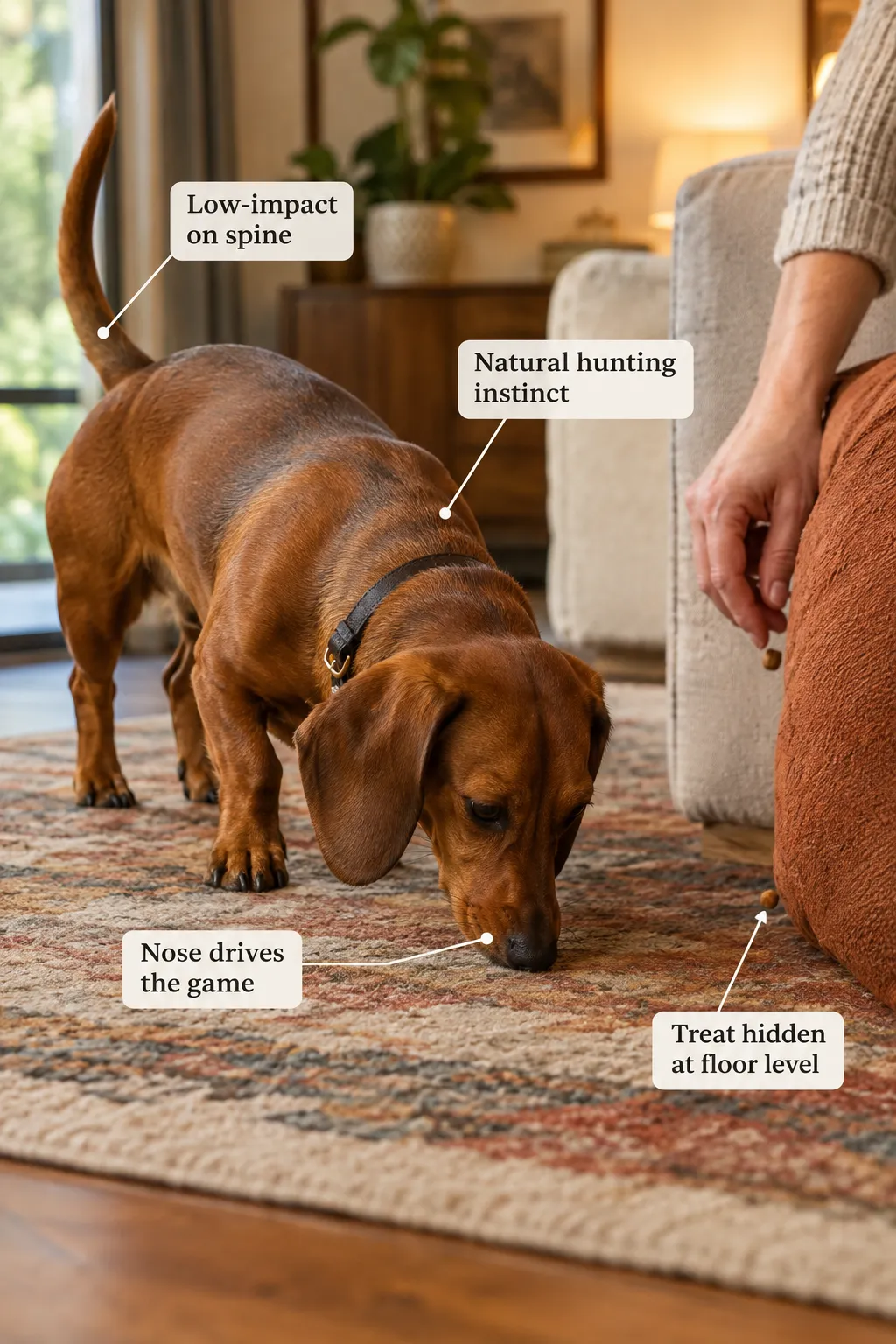
Toss a treat on the floor and say “find it.” Then hide treats around the room and let the dog hunt. This is arguably the most natural trick for a dachshund – it uses their hunting heritage directly.
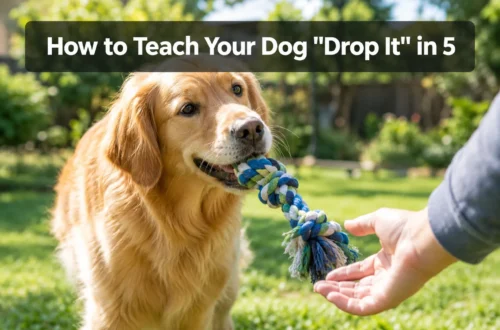
8. Leave It / Drop It
Essential for safety and impulse control. Reward heavily when the dog looks away from a forbidden item.
9. Roll Over
From a down position, lure the nose toward the shoulder until the dog tips over. Keep the movement slow and reward each small step.
10. Heel (Parade Walk)
Use a favorite toy held at your left side to bring the dog into position, then add forward movement with the cue “heel.” This turns disciplined leash work into a flashy performance.
11. Wait (at Furniture Edges)
Teach the dog to pause at the edge of the couch or bed and wait to be lifted down. This combines safety with a polished, show-off behavior – and protects the spine.
💡 Want to fast-track all of this? This free dog training workshop uses the same methods service dog trainers use to housebreak dogs, stop bad behaviors, and build real obedience – and it’s available online, completely free.
How to Train a Dachshund to Do Tricks: The Method That Works
The method matters more than the trick itself. Dachshunds respond to a specific training structure, and deviating from it leads to the frustration most owners complain about.
Follow this structure for every session:
- Pick one trick per session – don’t jump between behaviors
- Set a timer for 5-10 minutes – stop before the dog loses interest
- Use a lure first – guide the behavior with a treat in your hand
- Mark the moment – say “yes!” or use a clicker the instant the dog does the right thing
- Reward immediately – timing matters more than the treat itself
- Add the cue word only after the dog is reliably doing the behavior
- End on a success – always finish with something the dog knows well
This structure works because it keeps the dog’s cost-benefit calculator in your favor. The dog keeps choosing to engage because winning feels good.
For more ideas on making training sessions genuinely fun, see these 7 powerful playtime games that secretly train your dog.
Dachshund Trick Training Treats and Rewards
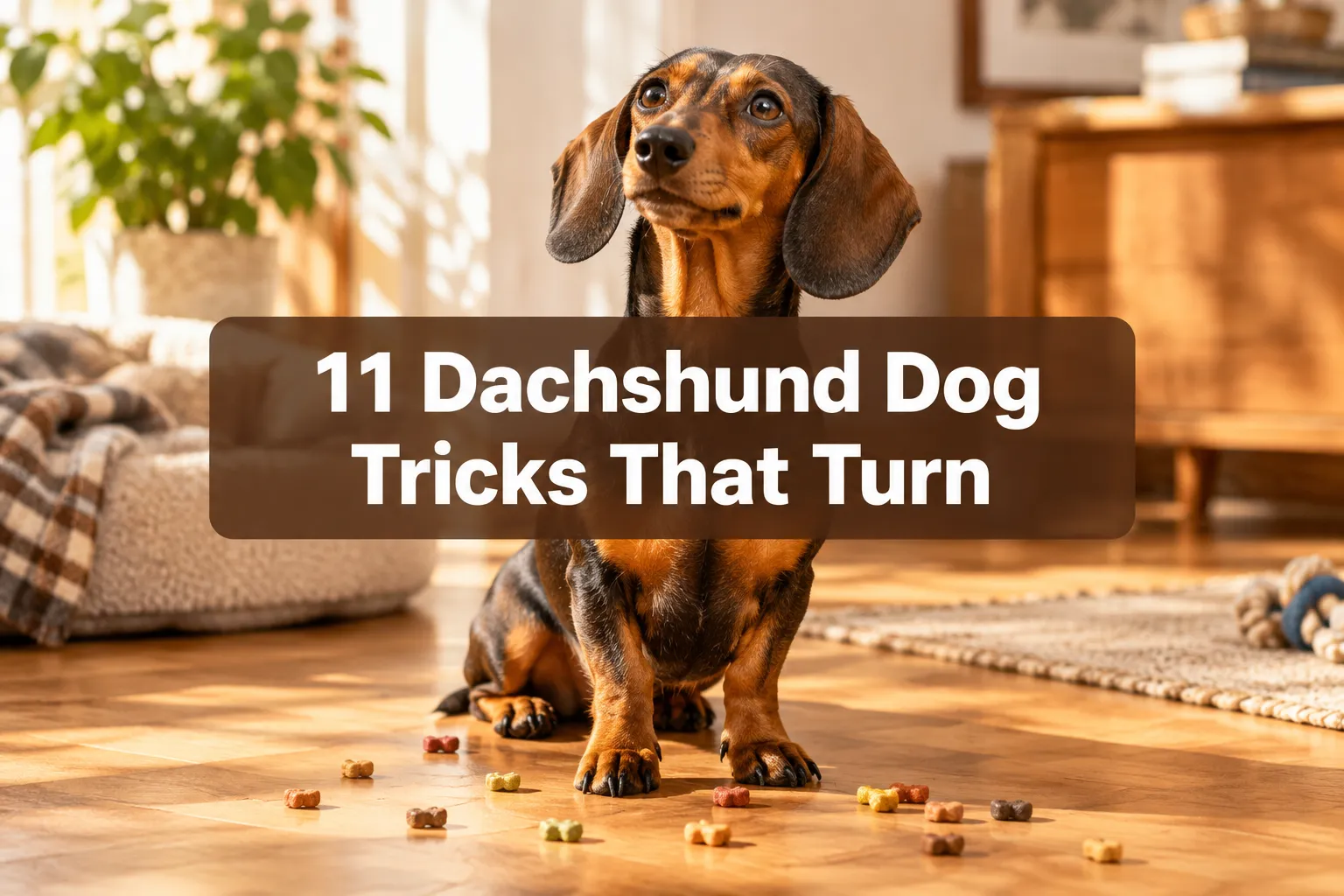
High-value treats are non-negotiable for dachshund dog tricks. A piece of dry kibble won’t cut it when you’re competing with a scent trail or a squirrel outside the window.
Best treat options:
- Tiny pieces of cooked chicken or turkey
- Small bits of cheese
- Commercial soft training treats cut into pea-sized pieces
- Freeze-dried liver or salmon
Keep treats tiny – about the size of a pea. This prevents overfeeding during multiple daily sessions and keeps the dog hungry for more. The timing of the reward matters more than the treat itself, but using something genuinely exciting makes the timing land harder.
If you want to make your own training treats, these chicken bone broth gummy treats for dogs are easy to cut into small pieces and dachshunds go wild for them.
Dachshund Training Tips and Tricks: Consistency Is Everything
The single most overlooked factor in dachshund trick training is consistency across the whole household. Dachshunds quickly exploit any gap in the rules – if one family member lets the dog skip a “sit” before dinner, the dog learns that “sit” is optional.
Rules for consistency:
- Use the same cue word for every command, every time
- Everyone in the house follows the same rules
- Keep the training schedule stable – same times each day works best
- Never reward a behavior you don’t want repeated
Also, avoid harsh corrections. Dachshunds are sensitive dogs. A sharp correction doesn’t make them comply – it makes them shut down or become more resistant. Redirect and reward instead.
For more on handling a dog that pushes boundaries, these 11 stubborn dog training tips that actually work are worth bookmarking.
Do Dachshunds Have Short Attention Spans?
Yes – dachshunds have relatively short attention spans for formal training, especially when distractions are present. Their nose is always working, and any interesting scent can pull focus instantly.
This isn’t a flaw. It’s a feature of the breed. Work with it by:
- Training in a low-distraction environment first
- Gradually adding distractions as the trick becomes reliable
- Switching up the order of commands so the dog stays mentally engaged
- Practicing tricks in multiple locations to build durable behavior
Training in varied environments is especially important for dachshunds. A trick learned only in the kitchen will often fall apart at the park. Proof each trick in at least three different locations before calling it solid.
Dachshund Back Problems: Which Tricks to Avoid
This is the most important safety section in this entire guide. Dachshunds are prone to Intervertebral Disc Disease (IVDD) – a serious spinal condition related to their long body and short legs.
Always support both the front and back of the body when lifting a dachshund, and avoid tricks that put repeated stress on the spine.
Tricks to avoid or limit:
- Repeated jumping on and off furniture
- Prolonged “beg” position (sitting upright on hind legs for more than a second or two)
- Jumping through hoops at height
- Any trick that involves twisting the spine sharply
Safer alternatives:
- All floor-level tricks (spins, bows, nose targets, find it)
- “Wait” at furniture edges instead of jumping down
- Crawl instead of jump
- Slow, supported roll-over with no forced movement
The “wait at furniture edges” trick from the list above is a perfect example of combining spine safety with show-off behavior.
Easiest Tricks to Teach a Dachshund
The easiest dachshund dog tricks are the ones that align with natural behaviors the dog already does. You’re capturing and naming something, not forcing a new movement.
Top 5 easiest tricks for beginners:
| Trick | Why It’s Easy |
|---|---|
| Sit | Natural resting position, easy to lure |
| Find It | Uses hunting instinct directly |
| Nose Touch | Short behavior, fast to reward |
| Take a Bow | Dogs stretch naturally – just capture it |
| Spin | One fluid motion, easy to lure in a circle |
Start with “find it” if your dachshund is particularly resistant to formal training. It doesn’t feel like a drill – it feels like hunting. Most dachshunds love it immediately.
How Long Does It Take to Train a Dachshund?
Most dachshunds learn a basic trick within 3-7 days of short daily sessions, but making it reliable in different environments takes 2-4 weeks of consistent practice.
The timeline depends on:
- The dog’s age – younger dogs often learn faster, but seniors can still learn
- Session consistency – two to four sessions per day beats one long session
- The trick’s complexity – “sit” takes days, “roll over” might take two weeks
- Distraction level – a trick learned at home needs extra proofing outdoors
Don’t measure progress in days. Measure it in successful repetitions. If the dog gets it right 8 out of 10 times in a new location, that trick is solid.
Can Old Dachshunds Learn New Tricks?
Yes, older dachshunds can absolutely learn new tricks. The process is slightly slower, and you may need to adjust for physical limitations, but the learning ability doesn’t disappear with age.
For senior dachshunds:
- Avoid high-impact movements – stick to floor-level tricks
- Shorten sessions to 3-5 minutes instead of 10
- Use softer treats if the dog has dental issues
- Be patient with slower response times – it’s not stubbornness, it’s age
Mental stimulation through trick training is actually beneficial for older dogs. These DIY mental stimulation games for dogs work well alongside trick training for senior dachshunds.
Dachshund Training Mistakes to Avoid
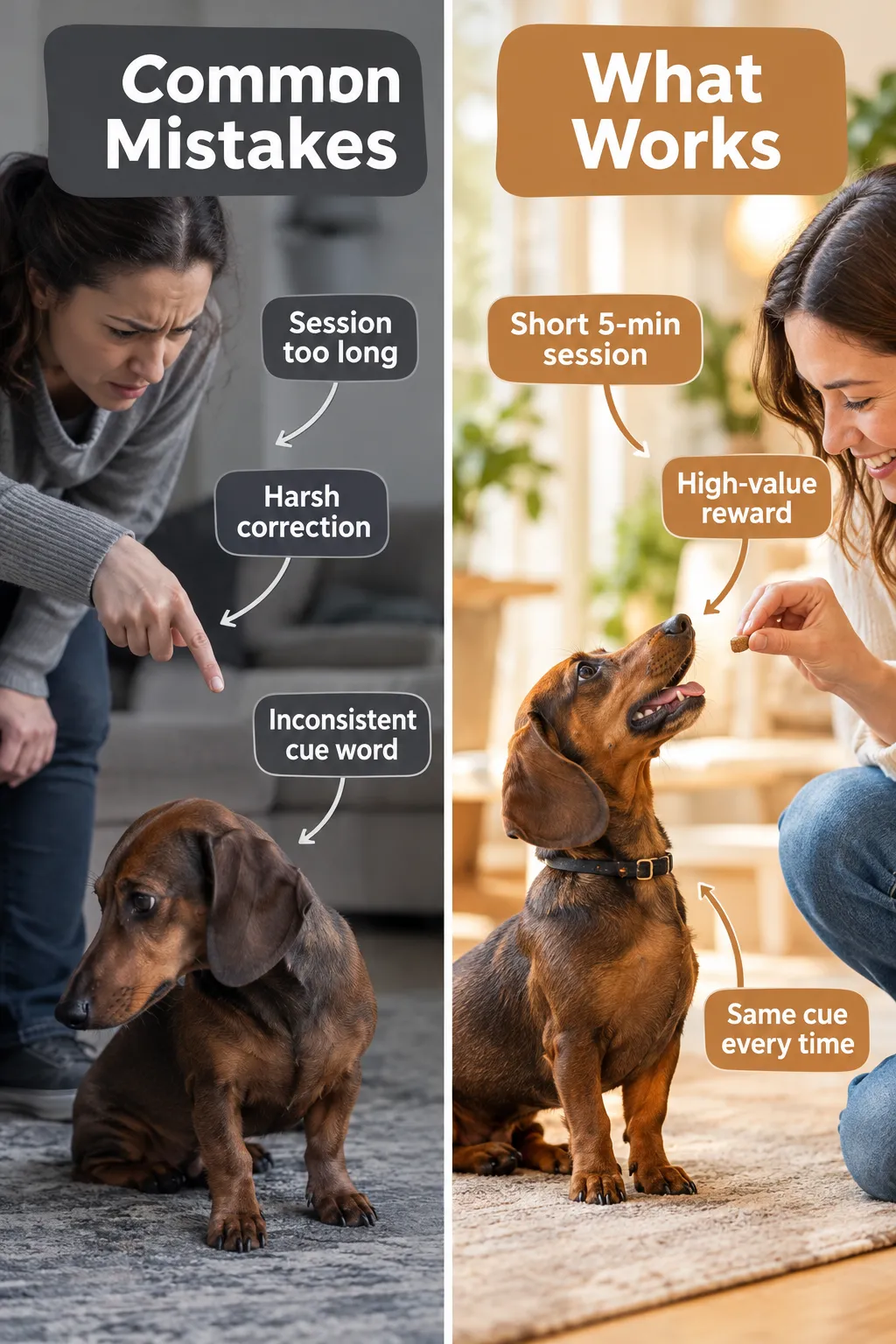
Most dachshund training failures come from the same handful of mistakes. Knowing them ahead of time saves a lot of frustration.
The biggest mistakes:
- Sessions that run too long – anything over 10 minutes invites defiance
- Repeating a cue the dog is ignoring – saying “sit, sit, SIT” teaches the dog that one “sit” means nothing
- Inconsistent rules – if the behavior is sometimes allowed, it’s always allowed in the dog’s mind
- Skipping the lure phase – expecting the dog to understand a verbal cue before it’s been paired with a reward
- Punishing confusion – if the dog gets it wrong, it probably doesn’t understand yet, not disobeying
- Training only in one location – tricks won’t hold up in new environments
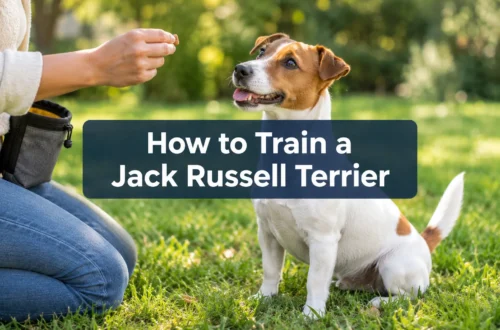
For a deeper look at handling a dog that resists commands, see how to train a Jack Russell Terrier – the terrier group shares a lot of the same independent traits as dachshunds.
Agility Tricks for Small Dogs Like Dachshunds
Dachshunds can participate in modified agility – but the standard course needs adjustment for their body type. The spine is the limiting factor.
Safe agility-style tricks for dachshunds:
- Weave through legs – low to the ground, no jumping
- Tunnel crawl – natural for a dog bred to go underground
- Target touch on a mat – “go to your mat” builds distance and directional work
- Slow, low jumps – bar set at or below elbow height only
Avoid standard agility jumps at full height. The landing impact is hard on the dachshund spine, especially repeated over a full course.
The tunnel is a natural fit – dachshunds were literally bred to go through underground passages. Many take to it faster than any other agility obstacle.
🎓 If you want a structured approach to all of this, the free dog training workshop at this link walks you through the exact methods used by service dog trainers – covering everything from basic obedience to stopping bad behaviors, all in one place.
FAQ
Q: Can dachshunds learn tricks as quickly as other breeds?
A: They can learn just as many tricks, but the process takes more patience. Dachshunds question commands rather than automatically obeying, so expect a slightly longer timeline than you’d see with a retriever or border collie.
Q: What is the best age to start teaching dachshund tricks?
A: Start as early as 8-10 weeks with very simple behaviors like “sit” and “name recognition.” From 4-6 months, add loose-leash basics and recall. Advanced tricks can begin from 6 months onward.
Q: How many tricks can a dachshund learn?
A: There is no firm limit. With consistent training, a dachshund can learn dozens of tricks over its lifetime. The bottleneck is always the owner’s consistency, not the dog’s capacity.
Q: My dachshund knows a trick at home but ignores me outside. Why?
A: The trick hasn’t been “proofed” in new environments yet. Practice the same trick in at least three different locations before expecting it to hold up outdoors with distractions.
Q: Is clicker training good for dachshunds?
A: Yes. A clicker gives precise timing that verbal markers sometimes miss. The click marks the exact moment of the correct behavior, which speeds up learning for independent-minded dogs.
Q: Should I use punishment if my dachshund refuses a trick?
A: No. Punishment makes dachshunds more resistant, not more compliant. If the dog refuses, go back to an easier version of the trick, get a success, and end the session.
Q: How do I stop my dachshund from getting bored mid-session?
A: End the session before boredom hits. Five minutes of engaged training beats ten minutes of a distracted dog. Watch for yawning, sniffing the floor, or looking away – those are early signs the session should wrap up.
Q: Can I teach a dachshund to jump through a hoop?
A: Only at very low heights – bar at or below elbow level. Repeated jumping at height puts dangerous stress on the dachshund spine. A ground-level hoop the dog steps through is a safer option.
Q: What if my dachshund only performs tricks when I have treats?
A: This means the treat was never faded out. Once the dog knows a trick reliably, start rewarding intermittently – every other time, then every third time. Unpredictable rewards actually increase persistence.
Q: Are miniature dachshunds easier to train than standard dachshunds?
A: Both sizes share the same temperament and training needs. Size doesn’t significantly change trainability. The same short sessions, high-value treats, and consistent cues apply to both.
Conclusion
Dachshunds are not difficult dogs – they’re just dogs that need the right approach. The 11 dachshund dog tricks in this guide are chosen specifically to work with the breed’s instincts, protect the spine, and keep sessions short enough that your sausage dog stays engaged.
Your action plan:
- Start with “find it” and “sit” this week – both are easy wins
- Keep every session under 10 minutes and always end on a success
- Use tiny, high-value treats and reward with precise timing
- Pick one family member to establish the tricks first, then bring in the rest of the household once the cues are solid
- Avoid any trick that involves repeated jumping or prolonged hind-leg standing
- Practice each trick in at least three different locations before calling it reliable
The “stubborn sausage dog” reputation is mostly a training method problem, not a dog problem. Work with the wiring, keep it fun, and your dachshund will show off for anyone who’ll watch.
For more on caring for your dachshund beyond training, the long hair dachshund care guide covers everything from grooming to health basics.
Ready to go further? This free online dog training workshop is a first-of-its-kind resource that teaches you the same methods professional service dog trainers use – covering housebreaking, obedience, and stopping problem behaviors, all for free.