Last updated: September 17, 2026
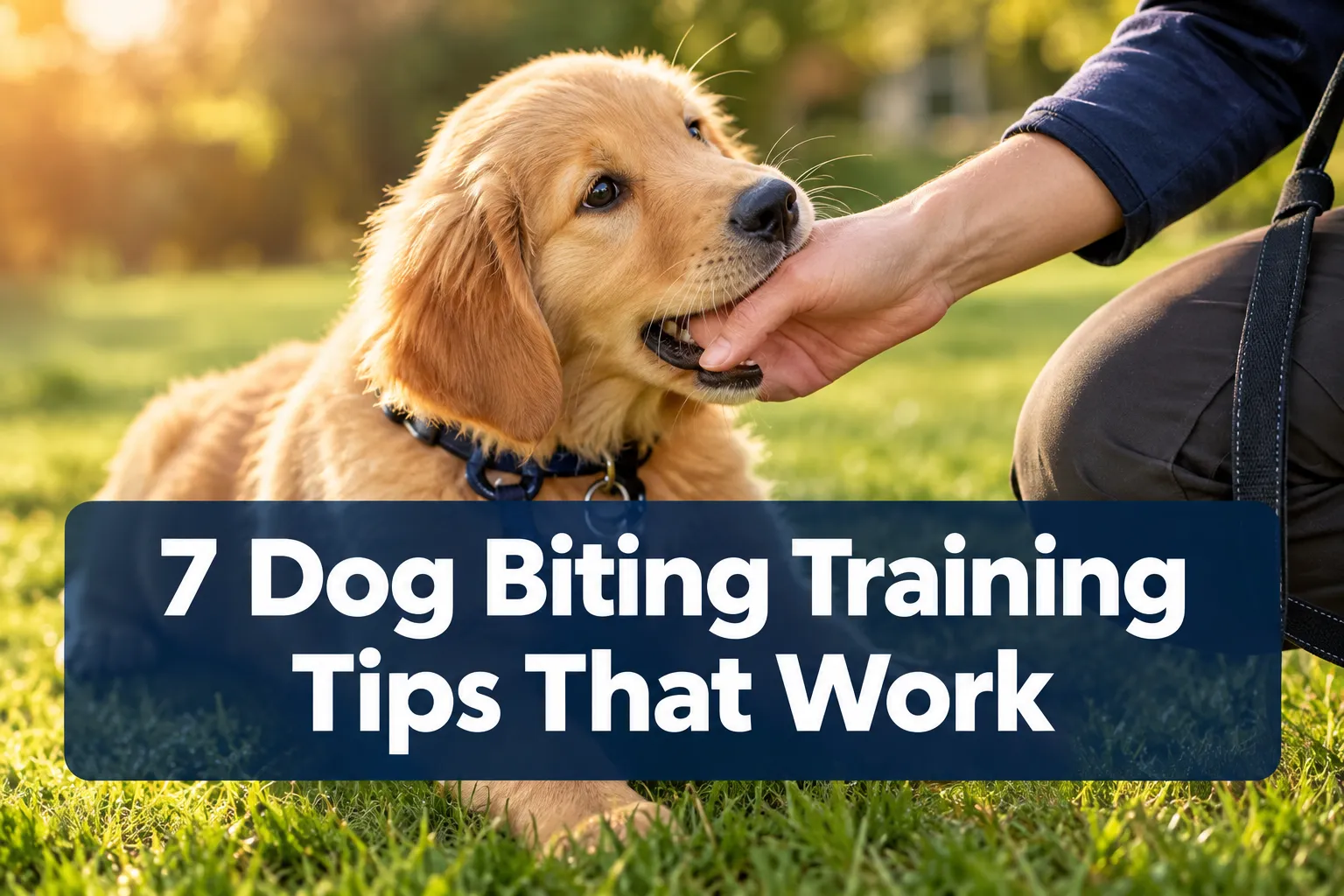
Quick Answer: Saying “No!” alone fails because it gives your dog no clear information about what to do instead. The most effective dog biting training tips combine immediate feedback, a brief pause in play, and consistent redirection to a toy – so your dog learns that biting ends the fun, every single time. Start the day your puppy arrives home, and apply the same response every time teeth touch skin.
Key Takeaways
- “No!” without a consequence teaches dogs nothing – you need a clear, consistent reaction plus a redirect
- Puppy biting is normal exploration; adult dog biting may signal fear, pain, or frustration
- The freeze-pause-redirect method works faster than verbal corrections alone
- Positive reinforcement (rewarding calm behavior) outperforms punishment every time
- Every person in the household must respond the same way or training breaks down
- Calm time-outs of 30-60 seconds are more effective than scolding
- Most puppies show significant improvement within 2-4 weeks of consistent training
- If biting is sudden, severe, or unprovoked in an adult dog, see a vet first
- Professional help is worth it when biting escalates or causes injury
- Training an older dog not to bite is absolutely possible – it just takes more patience
Why Does My Dog Bite and How Do I Stop It?
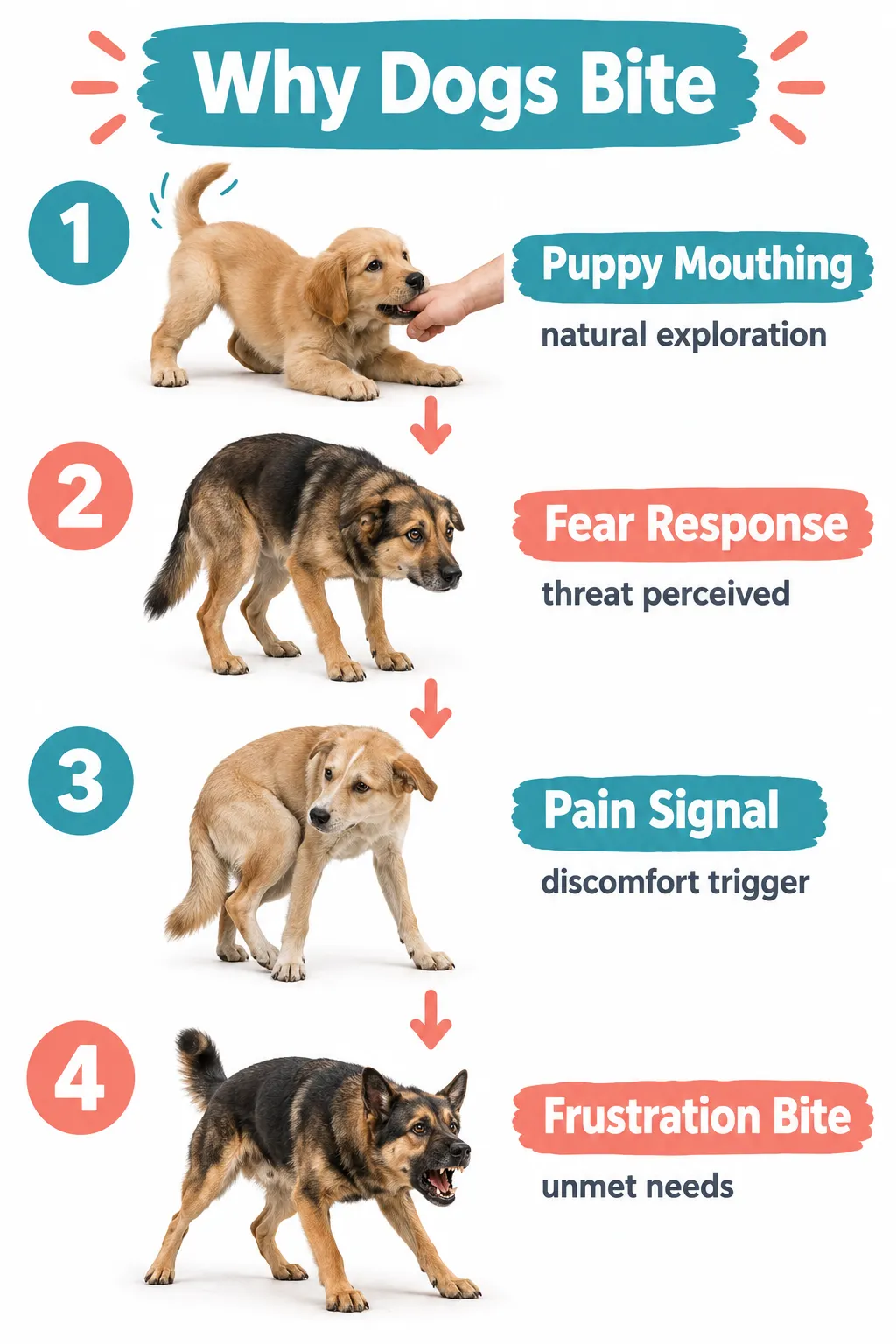
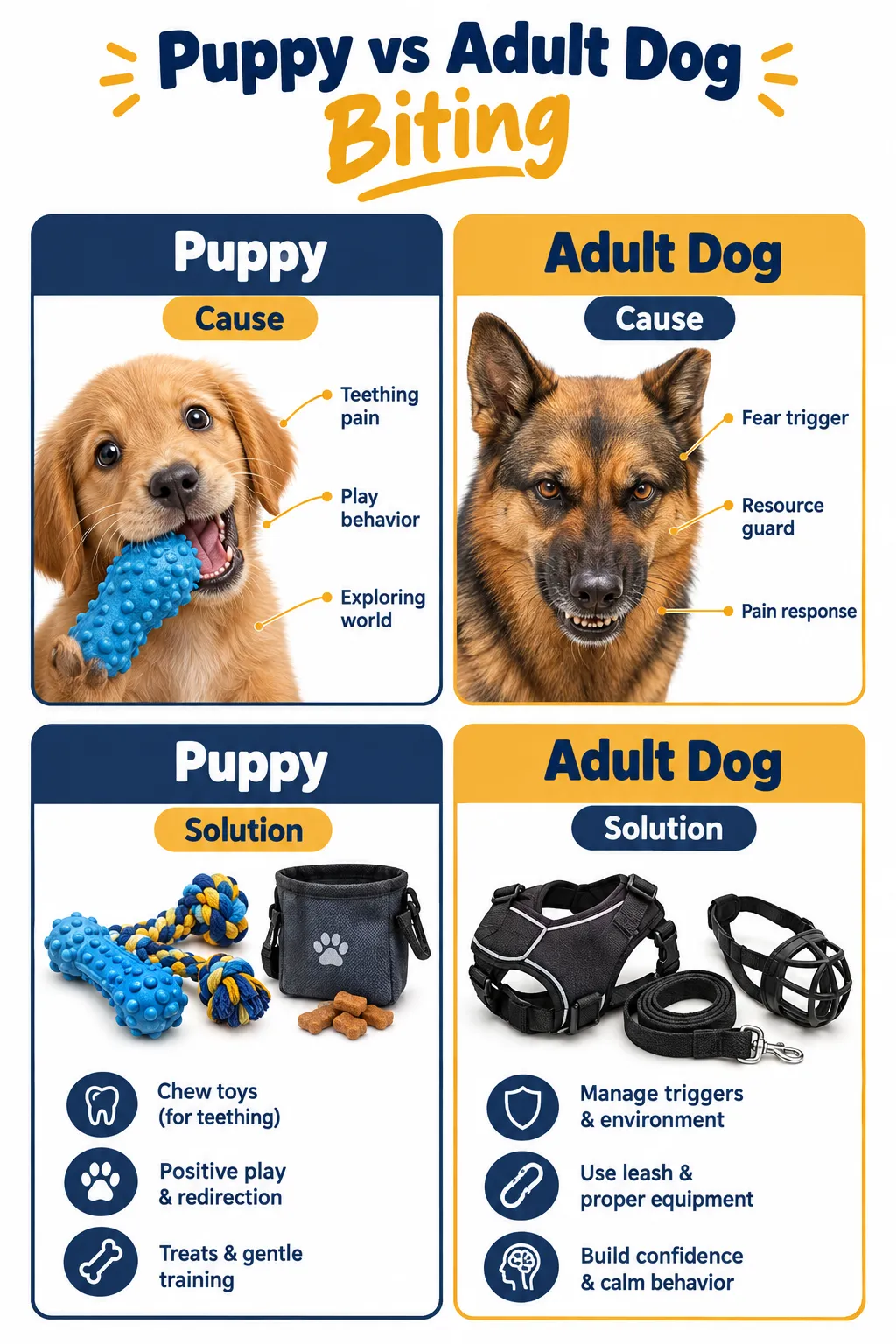
Dogs bite for a reason – and that reason is almost never spite. Biting is communication. Puppies explore the world with their mouths. Adult dogs bite when they feel afraid, in pain, or pushed past their comfort zone.
Common triggers include:
- Teething discomfort in puppies under 6 months
- Fear or anxiety – feeling cornered or threatened
- Pain – a dog that suddenly starts biting may be hurting
- Frustration – unmet needs like exercise or mental stimulation
- Resource guarding – protecting food, toys, or space
- Over-arousal during rough play
According to Kansas State University’s dog bite prevention guidance, biting more often reflects fear or frustration than “dominance” – which means punishment-based responses often make the problem worse, not better.
To stop it, you need to address the cause AND teach an alternative behavior. That’s the foundation of every tip in this article.
Want a shortcut to faster results? This Free Dog Training Workshop uses the same methods service dog trainers rely on – it covers stopping bad behaviors like biting, housebreaking, and building real obedience, all online and at your own pace.
What’s the Difference Between Puppy Biting and Aggressive Biting?
Puppy biting is normal – it’s how young dogs explore and play. Aggressive biting is a warning signal that something is wrong.
Here’s how to tell them apart:
| Puppy Mouthing / Play Biting | Aggressive Biting |
|---|---|
| Soft, bouncy body language | Stiff, frozen body posture |
| Wiggly tail, relaxed face | Hard stare, raised hackles |
| Triggered by play or excitement | Triggered by approach, touch, or perceived threat |
| Pressure is usually light | Pressure is hard and intentional |
| Puppy disengages easily | Dog holds on or snaps repeatedly |
If your dog shows the signs in the right column, don’t try to train through it alone. That’s a job for a certified behavior professional.
For most puppies and young dogs, mouthing is just a habit that needs reshaping. The ASPCA’s guidance on puppy mouthing and nipping confirms that play biting is developmentally normal and responds well to consistent training.
Why Does “No!” Not Work for My Biting Dog?
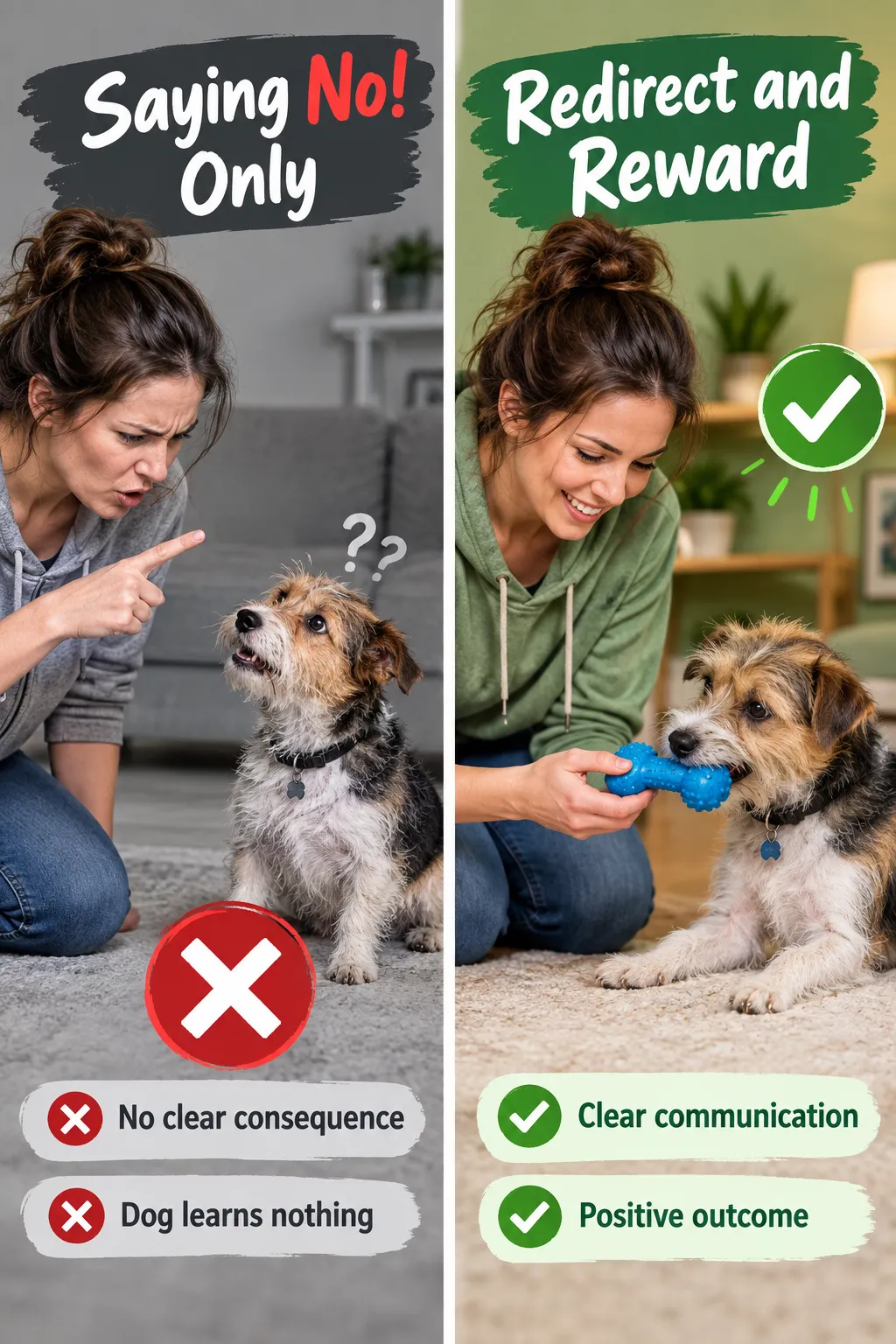
“No!” fails because it’s not a complete instruction. It tells your dog to stop, but not what to do instead – and dogs need that second part.
Think of it this way: if someone said “No!” every time you reached for a glass of water, but never showed you where the cups were, you’d be confused too.
There are three more reasons “No!” loses its power:
- It’s overused. When dogs hear “No!” for everything, it loses meaning fast.
- It comes too late. Dogs need feedback within 1-2 seconds of a behavior.
- It has no consequence. If play continues after “No!”, the dog learns nothing changes.
The fix is a structured response – mark the bite, stop the fun briefly, then redirect. That’s where the real dog biting training tips start.
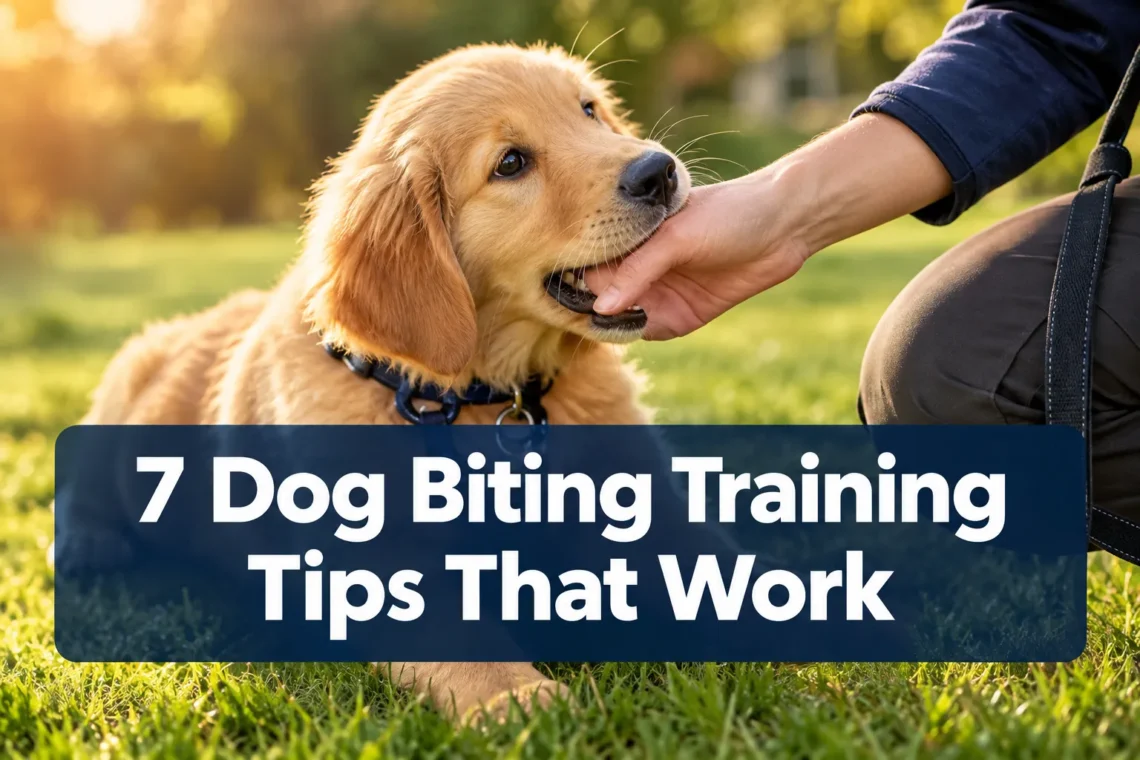
7 Dog Biting Training Tips That Actually Work
These are the methods that consistently outperform verbal corrections alone. Use them together for best results.
Tip 1: Use the “Ouch” Method With an Immediate Play Pause
The moment teeth touch skin, say “Ouch!” or “Too bad!” in a calm, clear voice – then go completely still for 10-30 seconds. Don’t pull away fast (that triggers the chase instinct). Just freeze.
This mimics how puppies teach each other. When one bites too hard, the other yelps and stops playing. The biter learns: hard pressure = no more fun.
PetMD’s puppy biting training guide recommends pairing the verbal marker with an instant stop in interaction, which is far more effective than saying “No!” without any follow-through.
Tip 2: Walk Away and End the Interaction
After your freeze, calmly stand up and walk away for 30-60 seconds. No eye contact, no talking, no fuss.
This is the “biting makes people disappear” lesson. Dogs are social animals – losing your attention is genuinely unpleasant for them.
Come back only when your dog is calm. Then resume interaction and redirect to a toy.
Tip 3: Redirect to a Chew Toy Immediately
Always have a chew toy within reach during play. The second you feel teeth, redirect – offer the toy before your dog escalates.
This teaches your dog that toys are the acceptable bite outlet, not your hands or feet. Check out these 7 powerful playtime games that secretly train your dog for ideas on building good habits through play.
Tip 4: Use Calm Time-Outs (Not Punishment)
If the bite-pause-redirect cycle isn’t working in the moment, calmly place your dog in a crate, pen, or separate room for 30-60 seconds.
No scolding. No drama. Just a quiet break.
The goal is to link biting with the end of social time – not to frighten your dog. Fear-based responses increase anxiety and can escalate biting, according to this 2026 guide on stopping puppy biting without punishment.
Tip 5: Reward Calm, Non-Biting Behavior
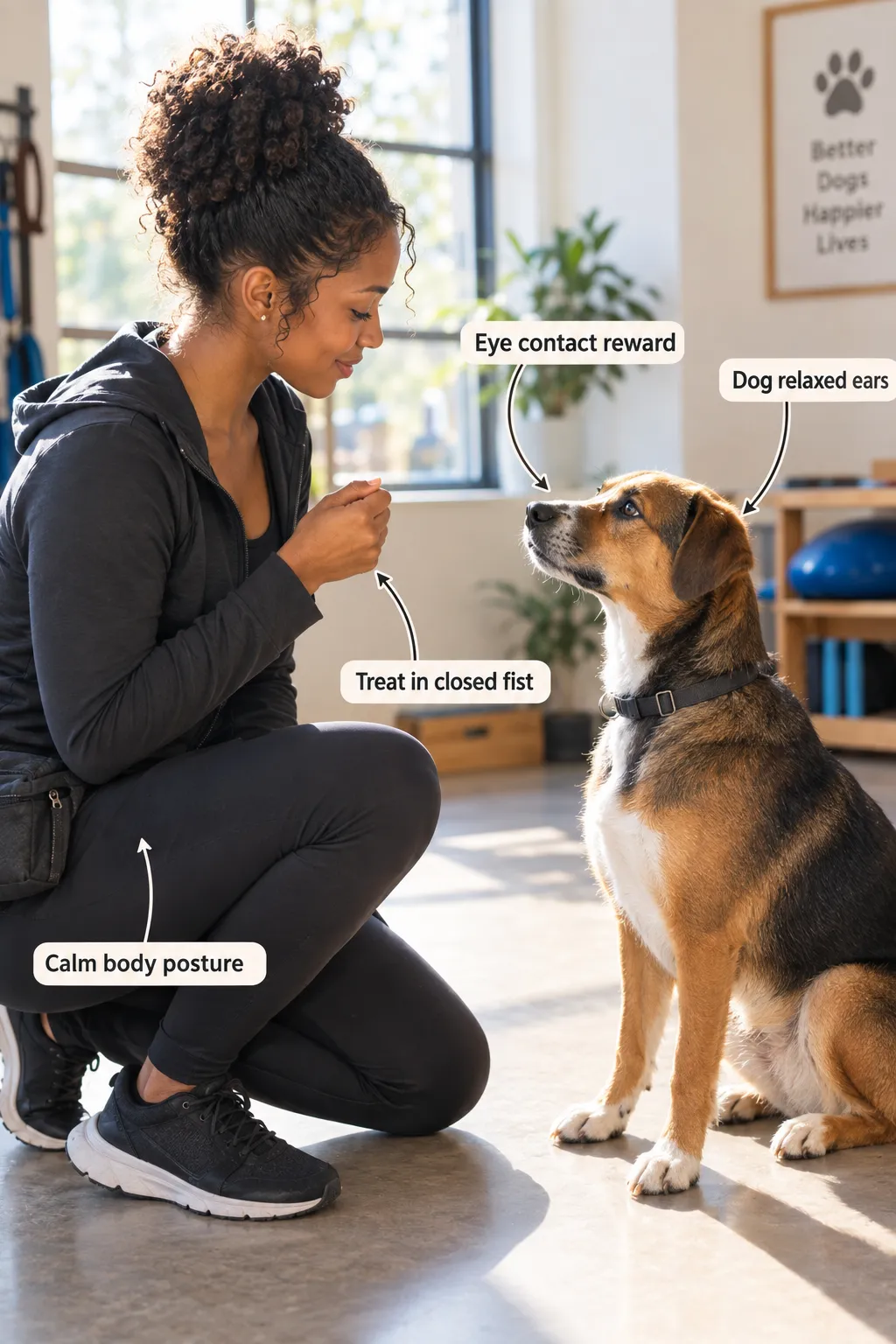
This one gets skipped a lot – but it’s critical. When your dog plays gently or takes a toy instead of your hand, reward that immediately with a treat or praise.
You’re not just stopping bad behavior. You’re building the behavior you want.
Tip 6: Lower the Bite-Pressure Threshold Gradually
Don’t expect your puppy to go from hard biting to zero biting overnight. Start by only reacting to the hardest bites. Once those stop, react to medium pressure. Then light pressure.
This progressive approach – called bite inhibition – teaches your dog to have a reliably soft mouth in all situations. The AKC’s guide to stopping puppy biting describes this as one of the most important skills a dog can learn.
Tip 7: Get Every Person in the Household on the Same Page
This is the tip that makes or breaks everything else. If one person lets the dog bite during play, all your hard work unravels.
Every family member must use the same response – every time, the moment teeth touch skin. Inconsistency is the number one reason these methods fail.
Print out a simple rule card if you need to. Seriously, it helps.
How to Train a Dog Not to Bite Without Punishment
Punishment-based methods – hitting, alpha rolls, shock tools – don’t just fail to fix biting. They can make it worse.
When you punish a dog for growling or snapping, you may suppress the warning signs without addressing the cause. That’s how dogs go from “growling occasionally” to “biting without warning.”
The science-backed alternative has three pillars, according to a 2026 framework for stopping puppy biting:
- Redirection – always offer a toy as an alternative
- Desensitization – gradually lower the acceptable bite pressure
- Consistency – every household member responds the same way
Positive reinforcement isn’t just “nicer.” It’s more effective, faster, and builds a dog that trusts you – which is the foundation of all good training. If you want to go deeper on this approach, the 9 smart dog discipline training tips on Wuffology are worth reading.
Is My Dog Biting Because of Anxiety or Aggression?
Anxiety and aggression can look similar but need different approaches.
Anxiety-driven biting usually happens when a dog feels trapped, overwhelmed, or unable to escape. Signs include: yawning, lip-licking, whale eye (showing whites of eyes), tucked tail, and biting when cornered.
Aggression-driven biting tends to be more forward-facing – stiff posture, hard stare, lunging, and biting when resources or territory are involved.
Many dogs show both. A fearful dog that feels it can’t escape may become aggressive.
If you’re not sure which you’re dealing with, check out this guide on how to stop dog aggression at home using vet-approved tips – and consider a vet visit to rule out pain as a factor.
The bottom line: if biting is rooted in anxiety, adding punishment makes the anxiety worse. Calm, positive training – plus reducing triggers – is the right path.
Dog Bite Training for Adult Dogs vs. Puppies
The core methods are the same, but adult dogs may need more time and management.
Puppies are in a critical learning window. Bite inhibition learned before 4-5 months tends to stick. Start the day they come home.
Adult dogs can absolutely learn not to bite – but old habits are harder to shift. You may also be working against a history of fear, poor socialization, or previous punishment.
For adult dogs who mouth or play-bite, the same freeze-redirect-reward cycle works. Just expect 4-8 weeks of consistent effort rather than 2-4 weeks.
For adult dogs with a history of serious biting, management (leashes, gates, muzzles) is essential while you work on training. Don’t put people at risk while you’re in the process.
If you have a puppy and want a full structured plan, the 14-day dog training plan that actually works is a great place to start.
Speaking of structured plans – the Free Dog Training Workshop is a first-of-its-kind online program that teaches you to stop bad behaviors like biting using the same secret methods professional service dog trainers use – and it’s completely free to join.
What to Do If Your Dog Bites You During Training
Stay calm. Your reaction in the next 10 seconds matters more than anything.
- Don’t jerk away or yell – this can escalate the situation
- Go limp and still – remove the excitement from the moment
- Calmly end the session – no punishment, just a quiet exit
- Assess the bite – clean any wound immediately, even small ones
- Note what triggered it – time of day, what you were doing, any warning signs
If the bite broke skin, seek medical attention. Dog bites can cause infection even when they look minor.
After the incident, think about what led up to it. Was the dog tired? Over-stimulated? Did you miss warning signs? That information shapes your next training session.
For more on reading your dog’s signals before biting happens, the guide on how to train a reactive dog has excellent practical advice.
Common Mistakes People Make When Training Dogs Not to Bite
These are the errors that keep owners stuck for months:
- Inconsistency – letting biting slide sometimes, correcting it other times
- Delayed reactions – responding 5+ seconds after the bite (too late for the dog to connect)
- Rough play that encourages biting – wrestling, letting the dog mouth hands “just for fun”
- Skipping the redirect – ending play without offering an alternative
- Using fear or pain – which suppresses warning signs and increases risk
- Giving up too soon – most dogs need 3-6 weeks of consistent work
- Only one person training – if the rest of the household doesn’t follow through, progress stalls
The 15 terrible dog training mistakes article covers many of these in detail – worth a read if you feel stuck.
How Long Does It Take to Train a Dog Not to Bite?
For most puppies with consistent training, noticeable improvement comes within 2-4 weeks. A reliably soft mouth usually takes 6-8 weeks.
For adult dogs with established biting habits, expect 4-12 weeks depending on the severity and cause.
Factors that speed things up:
- Starting early (puppy stage is ideal)
- Every household member using the same approach
- Short, frequent training sessions (5-10 minutes, several times a day)
- Removing triggers where possible
- Combining bite training with basic obedience
Factors that slow things down:
- Inconsistent responses
- Underlying fear or anxiety not being addressed
- Medical pain not identified or treated
- Continuing rough play that reinforces biting
When Should You Get Professional Help for a Biting Dog?
Get professional help immediately if:
- The biting is sudden and out of character (rule out pain first – see a vet)
- Bites are hard enough to break skin
- Your dog shows no warning signs before biting
- The dog bites children or vulnerable people
- Biting is getting worse despite consistent training
- You feel unsafe managing your dog
Look for a certified professional dog trainer (CPDT-KA) or a veterinary behaviorist (DACVB) for serious cases. Avoid anyone who uses dominance-based or punishment-heavy methods for biting – the risk of escalation is real.
Conclusion
Saying “No!” is a starting point, not a solution. The dog biting training tips that actually work all share the same core logic: give fast, clear feedback, end the fun briefly, and redirect to something acceptable – every single time, from every person in the house.
Your action steps starting today:
- Pick one method – start with the freeze-and-redirect technique
- Brief every household member so the response is consistent
- Keep a chew toy within reach during every play session
- Track your dog’s triggers so you can reduce them
- Give it at least 3 weeks before judging results
If you want a structured, step-by-step system rather than piecing it together yourself, the Free Dog Training Workshop walks you through stopping biting and other bad behaviors using proven service dog training methods – it’s free, online, and designed for regular dog owners just like you.
You’ve got this. Consistency beats intensity every time.
FAQ
Q: My puppy bites constantly during play. Is this normal?
Yes, for puppies under 6 months, frequent mouthing during play is completely normal. It’s how they explore and interact. The goal is to teach bite inhibition – gradually reducing pressure and frequency – not to eliminate all mouthing overnight.
Q: Should I use a spray bottle to stop my dog from biting?
No. Spray bottles are a mild aversive that rarely work long-term and can increase anxiety. They don’t teach the dog what to do instead. Redirect and reward methods are more effective and don’t damage your relationship.
Q: My dog only bites strangers. What should I do?
This is likely fear-based. Avoid forcing greetings, give your dog space to approach on their own terms, and work with a professional trainer on controlled socialization. Never push a fearful dog past its threshold.
Q: Can I use a clicker for bite training?
Yes – a clicker is excellent for marking the exact moment your dog chooses the toy over your hand. Check out how to use a clicker for dog training for a full guide.
Q: My dog bites when I take away a toy or food. Is that aggression?
That’s resource guarding – a specific form of biting that needs its own training approach. Don’t force items away. Instead, teach a “drop it” or “leave it” command using positive reinforcement, and trade high-value items for treats.
Q: At what age should puppy biting stop?
Most puppies naturally reduce biting as adult teeth come in around 6-7 months. With consistent training, you should see a reliably soft mouth by 4-6 months. If biting is still a serious problem at 8+ months, seek professional guidance.
Q: Is it ever okay to let my dog mouth my hands?
Very gentle mouthing with no pressure is tolerated by some trainers as a form of affection. However, for most households – especially with children – a zero-tolerance policy for teeth on skin is clearer and safer.
Q: My dog growls before biting. Should I correct the growl?
No – never punish growling. Growling is a warning. If you suppress it, your dog may skip the warning and bite without notice. Instead, address what’s causing the discomfort.
Q: Do bite inhibition classes work for adult dogs?
Yes, though they take longer. Adult dogs can learn new bite thresholds with consistent training. Group classes also help with socialization, which can reduce anxiety-driven biting.
Q: How do I stop my puppy from biting my feet and ankles?
Stop moving the moment it happens – movement triggers the chase instinct. Redirect to a toy immediately. For persistent ankle biters, keep a toy in your pocket or nearby at all times during active periods.