

Last updated: November 11, 2026
A Dalmatian puppy is born pure white, no spots at all, and that single fact surprises more new owners than almost anything else about the breed. This Dalmatian Dogs Puppy Guide walks you through what actually happens from birth to adulthood, so you know what’s normal, what costs to expect, and how to train a dog that’s famously smart, famously energetic, and not always easy for beginners.
Quick Answer
Dalmatian puppies are born completely white and develop their first spots around 10 to 14 days old, with new spots continuing to emerge until roughly 12 to 18 months of age. They grow in three broad stages (baby, puppy, adolescent/adult), need firm but positive training starting in the first weeks home, and typically cost between $800 and $2,500 from a reputable breeder.
Key Takeaways
- Dalmatian puppies have no spots at birth; markings start showing around day 10-14, according to AKC guidance on Dalmatian spots.
- Spots keep appearing and darkening for up to 12-18 months.
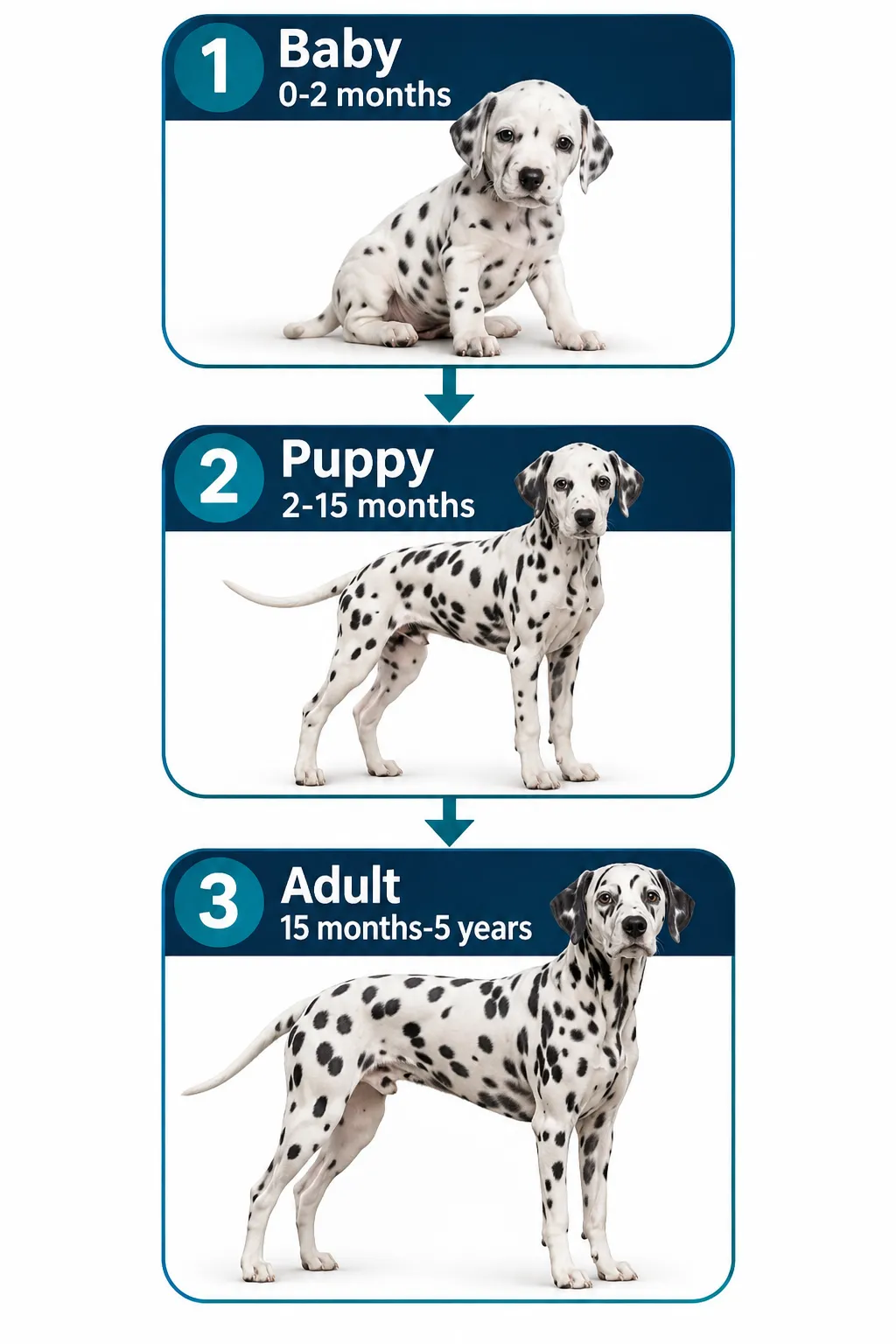
- Growth runs through three stages: baby (0-2 months), puppy (2-15 months), adult (15 months-5 years).
- Adolescence hits around 6 months; mental maturity arrives closer to 14 months.
- Dalmatians are high-energy, intelligent, and sensitive, so harsh correction backfires.
- Roughly 10-12% of Dalmatians are born deaf in one or both ears, a known breed health concern.
- They’re not ideal for first-time owners who want a low-key, low-exercise dog.
- Apartment living is possible only with serious daily exercise commitment.
What Do Dalmatian Puppies Look Like When They’re Born
Newborn Dalmatian puppies are solid white with pink skin, no spots anywhere on their body. This catches a lot of new owners off guard because every adult Dalmatian photo they’ve seen is covered in marks.
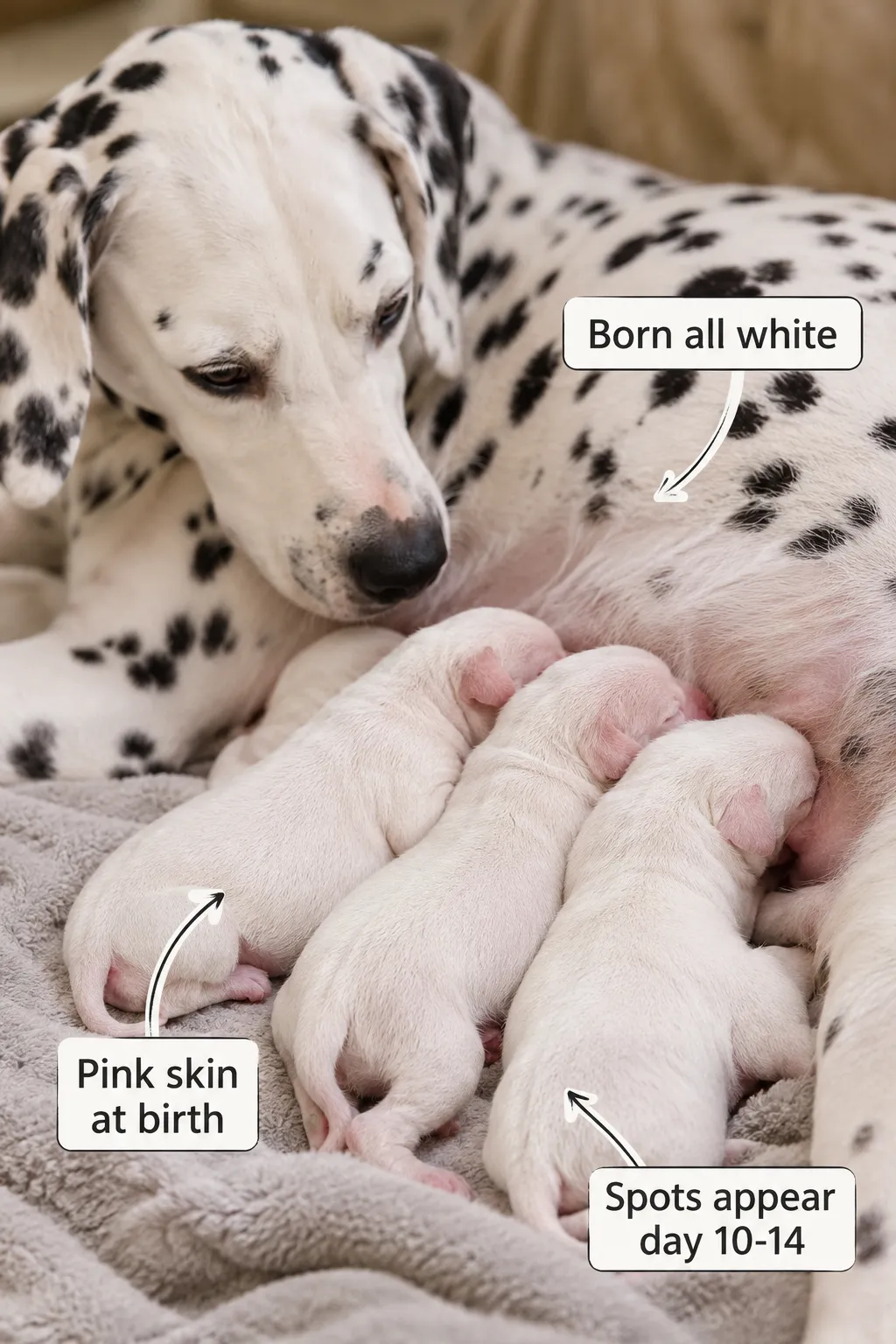
At birth, puppies weigh around 11 to 20 ounces and are blind, deaf, and totally dependent on mom. Their eyes and ears stay closed for roughly 10 to 14 days, which lines up almost exactly with when the first spots begin showing through the skin, as noted by Cuteness’s breakdown of Dalmatian puppy development.
During this newborn-to-6-week window, puppies rely entirely on touch and smell, start forming social bonds with littermates, and build the sensory foundation for everything that follows. This is also when breeders should start early handling and gentle exposure to sound and touch, something covered in our first week with a new puppy survival guide.
When Do Dalmatian Puppies Develop Their Spots
Dalmatian puppies start developing visible spots around 10 to 14 days old, and new spots keep appearing and darkening for the next 12 to 18 months. The pattern is genetically fixed before birth, but the skin pigment simply hasn’t surfaced yet at delivery.
The science here is genuinely interesting. IFLScience’s report on Dalmatian spot genetics explains that spot location and pattern are predetermined at the genetic level, even though they’re invisible at birth. By 3 to 4 weeks, most puppies show clear black or liver-colored markings. Dogster’s guide on Dalmatian coat development notes that spots can continue to multiply and deepen well past the puppy’s first birthday.
Common mistake: assuming a puppy’s final coat pattern is “locked in” by 8 weeks. It isn’t. Spots will keep shifting, darkening, and sometimes multiplying for over a year.
How Fast Do Dalmatian Puppies Grow
Dalmatian puppies grow quickly through three recognized life stages: baby (0-2 months), puppy (2-15 months), and adult (15 months to 5 years). Most of the dramatic height and weight gain happens in the first year.
A rough growth timeline:
- 0-2 months: Nursing, weaning, first vaccinations, rapid weight gain
- 2-6 months: Teething, house-training, and the start of structured obedience work
- 6-15 months: Adolescence, with growth spurts, mood swings, and testing boundaries
- 15 months-5 years: Physical and mental maturity settles in
According to FurryCritter’s Dalmatian juvenile development notes, the juvenile/adolescent phase between 3 and 18 months brings the fastest behavioral change, not just physical growth. Adult Dalmatians typically reach 45 to 70 pounds and stand 19 to 24 inches tall, per Royal Canin’s Dalmatian breed profile.
Decision rule: if your puppy is still growing fast in height past 12 months, that’s normal for this breed; don’t panic if they seem “lanky” at 9 months.
How Much Do Dalmatian Puppies Cost From A Breeder
Dalmatian puppies from a reputable breeder typically cost $800 to $2,500, depending on lineage, location, and health testing. Puppies from champion bloodlines or breeders who screen for deafness and urinary issues tend to sit at the higher end.
Watch out for “free Dalmatian puppies” listings online. Legitimate breeders rarely give puppies away, and free or very cheap puppies often come without health testing, vaccinations, or proper socialization. Rescue adoption is a more reliable low-cost route, usually $150 to $400 in adoption fees.
Budget beyond the purchase price too: vet visits, food, crate, and training supplies easily add another $500+ in the first year.
Are Dalmatians Good Dogs For First Time Owners
Dalmatians are not the easiest choice for first-time dog owners because they’re high-energy, strong-willed, and need consistent structure from day one. They can work for a dedicated beginner willing to commit to daily exercise and training, but they’re a poor fit for anyone wanting a low-maintenance pet.
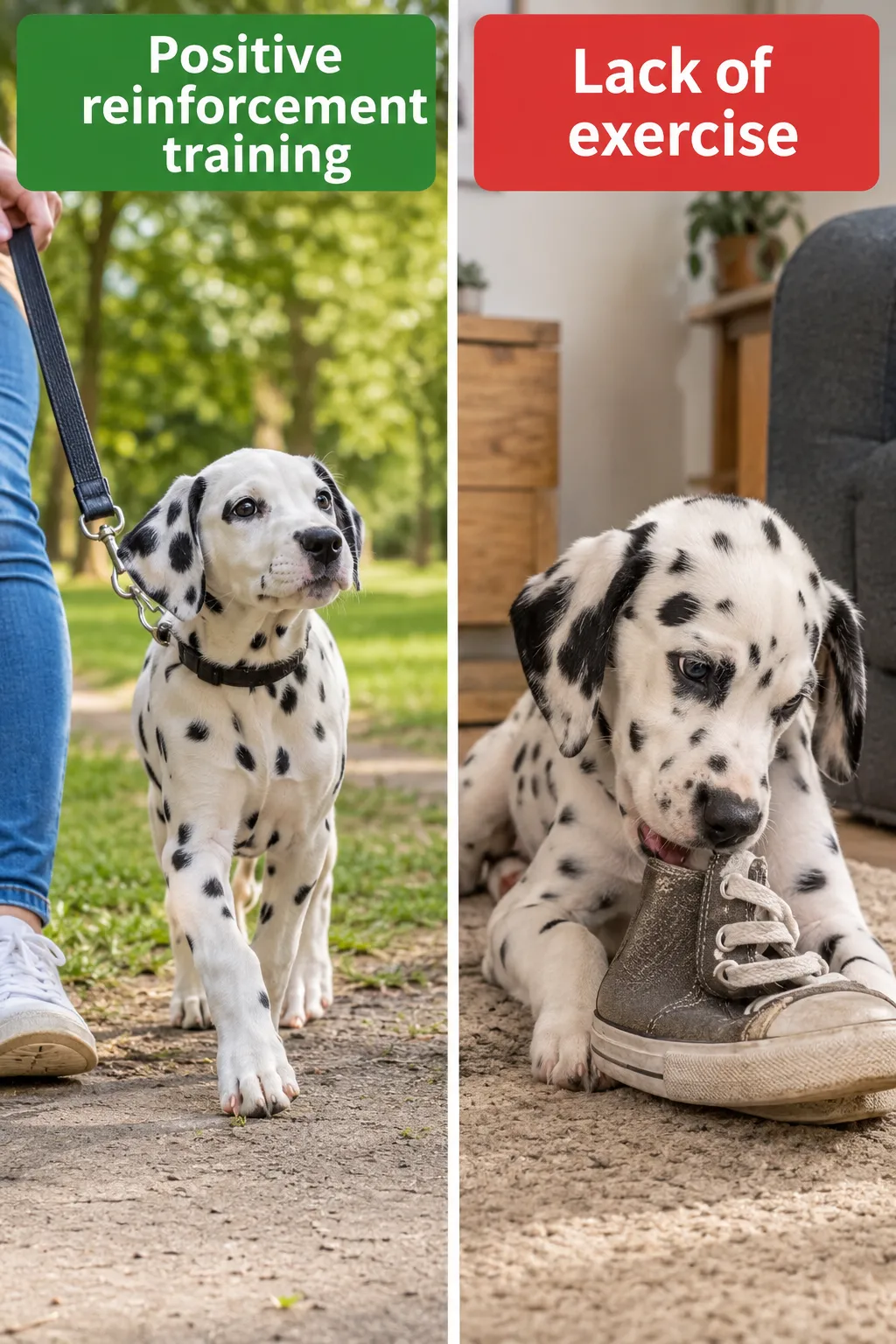
PetMD’s Dalmatian breed overview describes them as athletic, loyal, and people-oriented, but also prone to boredom-driven destruction without enough physical and mental stimulation.
Choose a Dalmatian if you run, hike, or jog regularly and want a workout partner. Avoid one if you’re gone 9+ hours a day or want a couch companion.
This is one reason some people ask “why are Dalmatians not popular” compared to easier breeds like Labs or Golden Retrievers. Reddit threads full of Dalmatian puppy guide discussions consistently mention the exercise demands as the top regret among new owners.
What Should I Know About Training A Dalmatian Puppy
Dalmatian puppies respond best to positive reinforcement training started early, around 8 weeks, with short, consistent sessions. They’re smart enough to learn fast but sensitive enough that harsh corrections cause fear or stubbornness instead of compliance.
Key training basics:
- Start basic commands (sit, stay, come) by 8-10 weeks
- Use treats, praise, and play as rewards, never punishment-based methods
- Begin crate and potty training immediately using our puppy potty training guide
- Socialize with other dogs and people before 16 weeks
- Build on top commands for dogs once basics are solid
Mental maturity doesn’t arrive until around 14 months, so expect adolescent pushback starting around 6 months. This is normal, not a sign your training failed.
Dalmatian Puppies Vs Other Spotted Dog Breeds
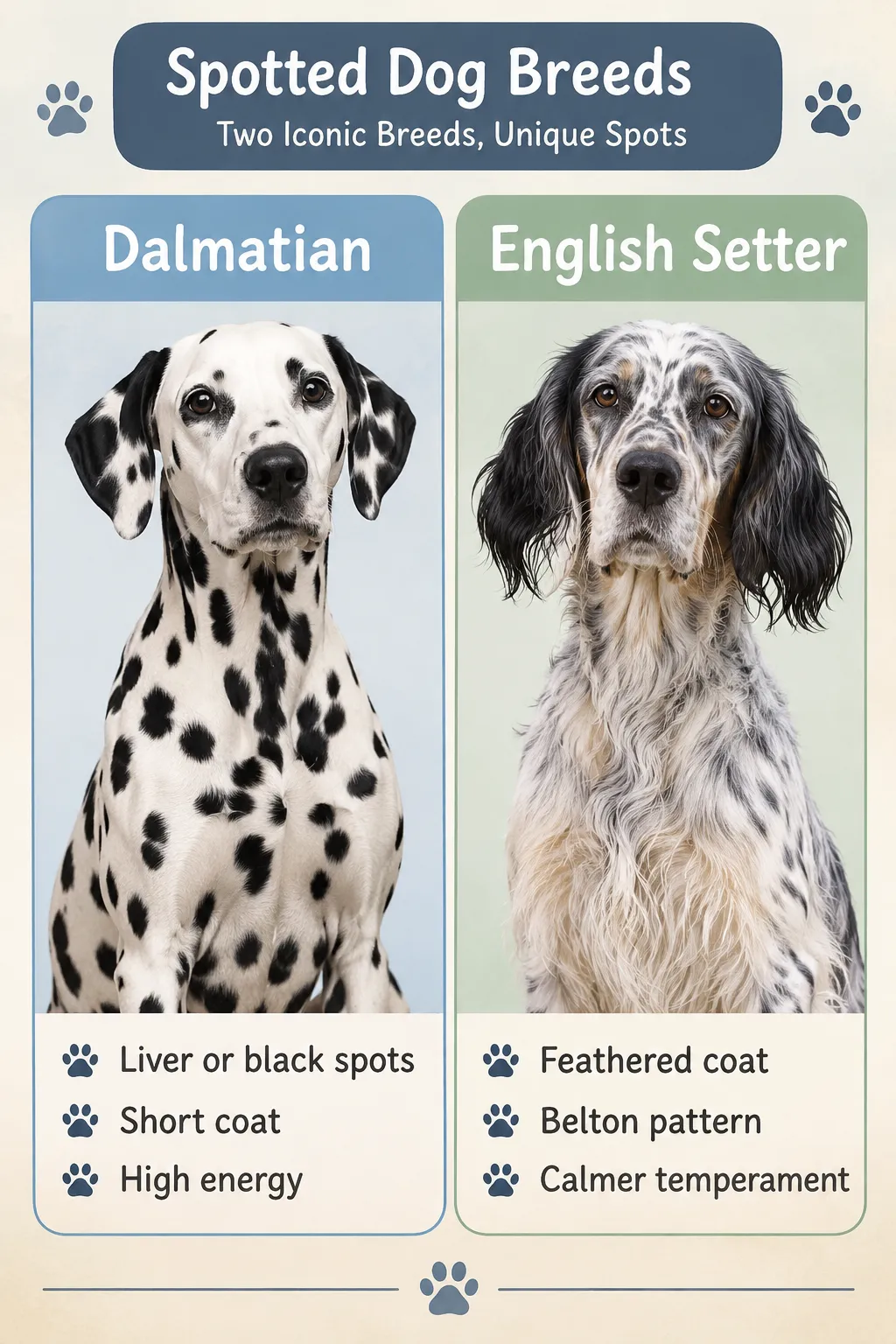
Dalmatians are the most recognizable spotted breed, but they differ sharply from other spotted dogs like English Setters or Australian Cattle Dogs in coat texture, energy level, and origin. Dalmatians have short, dense coats with round black or liver spots; English Setters have feathered coats with a “belton” ticking pattern instead of true spots.
| Breed | Spot Pattern | Coat Type | Energy Level |
|---|---|---|---|
| Dalmatian | Round black/liver spots | Short, dense | Very high |
| English Setter | Belton ticking | Long, feathered | Moderate |
| Australian Cattle Dog | Mottled/speckled | Short, double coat | Very high |
According to Wikipedia’s Dalmatian breed entry, the breed’s history as a carriage and firehouse dog explains its unusually high stamina compared to most spotted companion breeds.
Common Health Issues In Dalmatian Puppies
Dalmatians carry a higher-than-average risk of congenital deafness and urinary stones, both tied to breed-specific genetics. Roughly 10 to 12% of Dalmatians are born deaf in one or both ears, making hearing screening important before you bring a puppy home.
Other common issues include:
- Hyperuricemia, which raises the risk of urinary and bladder stones
- Skin allergies and hot spots, which you can learn more about in our guide to why dogs get hot spots
- Hip dysplasia, less common but still present in the breed
Ask breeders for BAER hearing test results on both parents and the litter. Zooplus’s Dalmatian breed guide recommends this as a standard screening step.
How To Handle A Hyperactive Dalmatian Puppy
A hyperactive Dalmatian puppy almost always needs more structured exercise and mental work, not less interaction. These dogs were bred to run alongside carriages for hours, so 60 to 90 minutes of real activity daily is often the baseline, not the max.
Practical fixes:
- Add structured puppy exercise ideas beyond just yard time
- Use food puzzles and scent games for mental tiring
- Break exercise into two or three sessions instead of one long walk
- Address destructive chewing early using our guide to stop dogs from chewing everything
Edge case: a Dalmatian puppy that stays hyperactive even after heavy exercise may be anxious rather than just energetic; check environment, routine, and separation stress before assuming it’s purely physical energy.
Are Dalmatian Puppies Good With Kids
Dalmatian puppies can be excellent with kids when properly socialized and when both the dog and children are taught to interact respectfully. Their size and energy mean rough, unsupervised play with very young toddlers isn’t a great match.
They tend to bond closely with their whole family and do best in households where kids are old enough to understand not to tease, startle, or over-handle a young dog. Supervised introductions and consistent rules for both the puppy and the kids make the biggest difference in outcomes.
What’s The Best Food For Dalmatian Puppies
The best food for Dalmatian puppies is a high-quality, moderate-protein diet low in purines, since the breed’s unique uric acid metabolism raises urinary stone risk. Many vets recommend diets specifically formulated for Dalmatians or at least low-purine protein sources.
Practical feeding notes:
- Avoid excessive organ meat and high-purine proteins
- Keep fresh water available at all times to support urinary health
- Feed puppy-specific formulas until closer to 12-15 months
- Ask your vet about Dalmatian-specific commercial diets
Can Dalmatian Puppies Live In Apartments
Dalmatian puppies can live in apartments, but only with a serious daily exercise commitment of an hour or more, since the breed’s energy needs don’t shrink to fit smaller spaces. Without that commitment, apartment living tends to produce a frustrated, destructive dog.
If you’re set on a smaller space, pair apartment life with daily runs, dog park visits, and consistent training. Compare this against genuinely apartment-friendly options in our guide to small dog breeds for apartment living if you’re still deciding.
Deaf Dalmatian Puppies: How To Train Them
Deaf Dalmatian puppies can be trained effectively using hand signals and vibration cues instead of verbal commands. Training takes more patience and consistency but works well once the dog learns to watch for visual cues.
Steps that work:
- Start with eye contact training so the puppy checks in visually
- Use consistent hand signals for sit, stay, come, and no
- Pair signals with a vibrating collar for recall at a distance (never shock)
- Leverage our hand signals for deaf dogs guide for a full command list
- Use a leash or long line outdoors since recall by voice isn’t possible
Dalmatian Puppy Vaccination And Shot Schedule
Dalmatian puppies follow the standard canine vaccination schedule: core shots start around 6-8 weeks and continue every 3-4 weeks until about 16 weeks old. Rabies vaccination typically follows at 12-16 weeks, depending on local law.
A general outline:
- 6-8 weeks: DHPP (distemper, hepatitis, parvo, parainfluenza)
- 10-12 weeks: DHPP booster
- 14-16 weeks: Final DHPP booster, rabies vaccine
- 12-16 months: Booster round, then annual or triennial boosters after
Always confirm the exact schedule with your vet, since timing varies slightly by region and vaccine brand.
A Quick Note On Doing Your Own Research
If you’re researching breeders or rescues online, you’ve probably run into a screen that says your google anfrage wird verifiziert, asking you to confirm you’re not a bot before you can fortfahren. This is normal: once the anfrage wird verifiziert, you can usually continue wenigen sekunden later. If diese seite stalls, just aktualisiere diese seite and try again; it does nicht mean the listing is fake, and once verified kannst you move weiter without issue in a matter of seconds.
Frequently Asked Questions
Dalmatian dogs puppy guide for beginners: where should I start?
Start with socialization, basic commands, and daily exercise planning before bringing the puppy home. New owners should also line up a vet and confirm breeder health testing first.
Why are Dalmatians not popular compared to other breeds?
Dalmatians require more exercise, training consistency, and grooming attention than many popular breeds, which discourages casual or first-time owners.
Can I find Dalmatian puppies for free?
Free Dalmatian puppies are rare and usually come without health screening or vaccinations. Rescue adoption is a safer low-cost alternative, typically $150-$400.
What is the average Dalmatian dog price from a breeder?
Reputable breeders typically charge $800 to $2,500 depending on bloodline, location, and health testing.
What is Dalmatian dog temperament like?
Dalmatians are loyal, intelligent, high-energy, and sensitive, doing best with active owners and positive training methods.
What is a Dalmatian Dog Teddy and is it a real breed mix?
“Dalmatian Dog Teddy” generally refers to plush toys or nicknames for fluffy-coated Dalmatian mixes, not an official breed recognized by major kennel clubs.
When do Dalmatian puppies get their full spot pattern?
Most spots appear by 3-4 months, but new spots can keep emerging until 12-18 months old.
Conclusion
Dalmatian puppies are a striking, high-energy breed that reward owners who commit to real exercise and consistent, positive training. They’re born white, earn their spots over the first year and a half, and need an active household to thrive.
If you’re considering one, talk to a breeder about hearing tests, plan for 60+ minutes of daily exercise, and start training in the first week home using our potty training guide as a starting point. Done right, a Dalmatian becomes a loyal, athletic companion for years to come.