

Last updated: November 6, 2026
Most golden retriever behavior problems trace back to one thing: owners wait too long to start. The social window that shapes a dog’s entire personality closes by around 12 weeks of age, and what happens inside that window matters more than almost anything you’ll do later.
Quick Answer
Start training your golden retriever puppy the day you bring them home, usually around 8 weeks old. Focus on short, positive sessions (3-5 minutes), consistent potty routines, crate introduction, and gentle socialization with new people, sounds, and surfaces. Avoid waiting for “full” vaccination to begin controlled social exposure, since missed socialization carries greater long-term behavioral risk than the disease risk when you follow vet guidance.
Key Takeaways
- Begin basic training and potty routines around 8 weeks old, not later.
- Keep sessions to 3-5 minutes, several times a day, using food and praise.
- Crate training should start immediately as a safe, calm space, never punishment.
- Golden retrievers are generally easy to train thanks to their eagerness to please.
- Socialization matters more in weeks 3-12 than at any later point in life.
- Potty training typically takes 4-6 months to become fully reliable.
- You don’t need a professional trainer, but group classes can speed things up.
- Over-training is possible; watch for fatigue, shutting down, or ignoring cues.
- Apartments can work for golden retriever puppies with enough daily exercise.
What age should I start training my golden retriever puppy
You can start training the moment your puppy arrives home, typically around 8 weeks old. This includes name recognition, potty routines, crate comfort, and gentle leash exposure.
The American Veterinary Society of Animal Behavior has long emphasized that the primary socialization window runs from roughly 3 to 12 weeks of age, which is why the first 12 weeks at home shape a puppy’s lifelong temperament. Waiting until a puppy is “fully vaccinated” at 4-5 months to begin socializing often means missing this window entirely.
Veterinary guidance updated in October 2026 recommends starting organized puppy classes once the puppy has at least one set of vaccines and the first deworming done at least seven days before class, usually around 8-10 weeks. At home, you can begin even sooner with low-risk basics like sit, come, and settling on a mat.
Decision rule: if your puppy is home and eating solid food, start today. Don’t wait for a milestone that doesn’t exist.
Best way to housetrain a golden retriever puppy
The best housetraining method combines a fixed potty schedule with crate support and the same outdoor spot every time. Take your puppy out first thing in the morning, after every meal, after naps, and after play.
Golden retriever puppies have small bladders and limited control in the early weeks. A general rule many trainers use is one hour of bladder control per month of age, though this varies by individual dog.
Here’s a simple daily structure:
- Wake up: out immediately
- After breakfast: out within 10-15 minutes
- After each nap: out right away
- After play sessions: out again
- Before bed: one last trip
If you’re dealing with accidents indoors, our ultimate puppy potty training guide breaks down troubleshooting steps. Owners in colder climates should also check our winter potty training tips, since cold weather often slows progress.
Common mistake: punishing accidents after the fact. Puppies don’t connect the correction to something that happened minutes earlier; it just teaches them to hide when they need to go.
How to stop a golden retriever puppy from biting and nipping
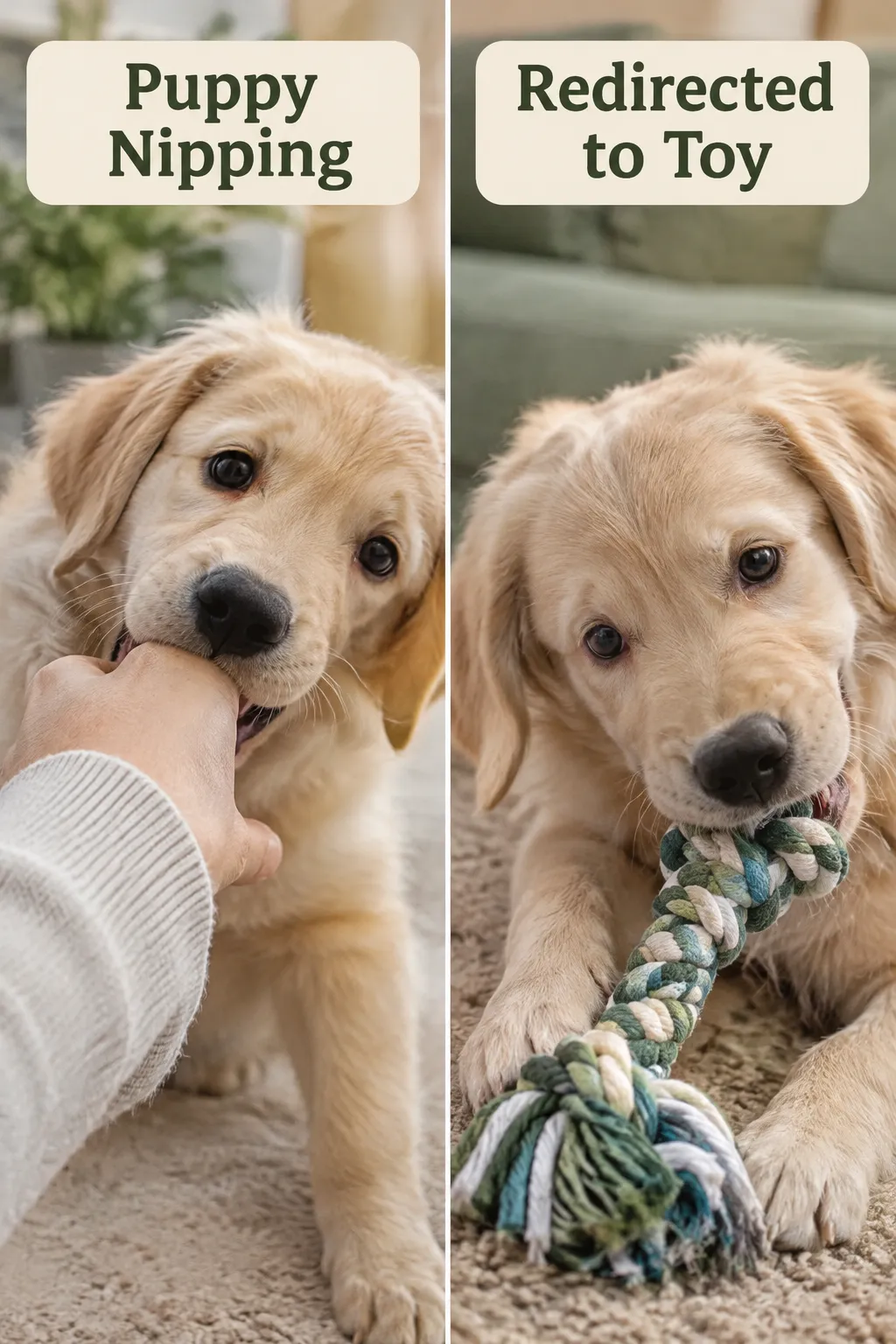
Golden retriever puppies bite and nip because they’re exploring the world with their mouths, not because they’re aggressive. Redirect the behavior to appropriate chew toys and stop play the moment teeth touch skin.
When your puppy mouths your hand, let out a short “ouch” and withdraw attention for 10-15 seconds. Then offer a toy or chew instead. This mimics how littermates teach bite inhibition.
Our guide on how to stop puppy biting fingers covers more specific redirection techniques, and 7 dog biting training tips that work offers additional troubleshooting if the behavior persists past 5 months.
Edge case: if biting is paired with growling or stiff body language rather than playful energy, that’s worth discussing with your vet or a certified trainer early, since it’s less common but shouldn’t be ignored.
Golden retriever puppy won’t listen, what am I doing wrong
If your puppy isn’t listening, the most common causes are sessions that are too long, rewards that aren’t motivating enough, or practicing in an environment with too many distractions. Shorten sessions and go back to a quieter space.
Golden retrievers are smart, but a puppy’s attention span at 8-10 weeks is only a few minutes. Expecting a 20-minute obedience drill is setting both of you up to fail.
Check these variables before assuming your puppy is being stubborn:
- Is the treat actually exciting to your puppy right now?
- Are you training right before a nap, when they’re already tired?
- Is there a louder, more interesting distraction nearby?
- Are you repeating the cue word multiple times instead of once?
If frustration is building on both sides, our 5 ways to train your disobedient dog walks through resets that work even when nothing else has.
Do I need a professional trainer or can I train myself
Most golden retriever owners can handle the first 12 weeks themselves using short, positive sessions at home. A professional trainer or group class becomes more valuable for structured socialization, specific behavior problems, or if you want expert feedback on technique.
Golden retrievers respond well to reward-based training from Chewy’s golden retriever guide, which notes the breed’s natural eagerness to please makes them one of the more forgiving breeds for first-time trainers to work with.
Choose a trainer if: you’re seeing early signs of fear or reactivity, you want controlled off-leash socialization with screened puppies, or you simply want accountability to stay consistent. Choose DIY if you’re comfortable researching methods and have time for daily short sessions; our golden retriever training at home resources can guide the basics.
Crate training vs free roam for golden retriever puppies
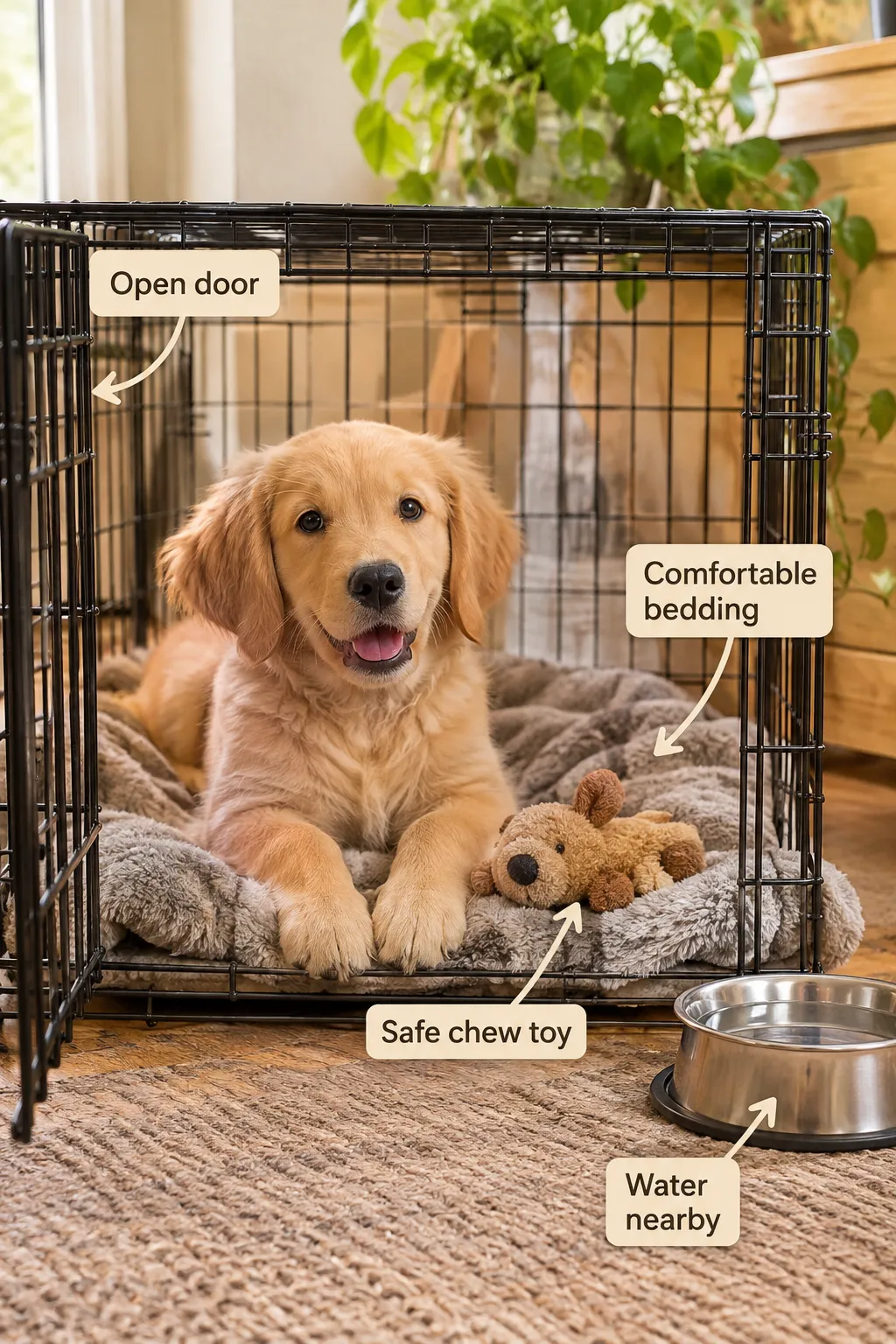
Crate training is generally the safer, more effective choice for golden retriever puppies during the first 12 weeks. A crate supports potty training, prevents destructive chewing, and gives your puppy a secure space to settle.
Crate training frameworks recommend introducing the crate as a cozy sleeping area with meals and chews inside, never as punishment. This helps puppies develop calm alone time and makes overnight potty training far more reliable.
Free roam can work later, once your puppy is reliably housetrained and has outgrown destructive chewing, usually well past 6 months. If your puppy struggles with crying at night in the crate, our guide on how to stop puppy from crying in crate at night covers gradual desensitization steps.
Common mistakes people make training golden retriever puppies
The biggest mistakes are inconsistent cues across family members, training sessions that run too long, and skipping socialization because of vaccination worries. All three slow progress significantly.
Other frequent errors include:
- Using different words for the same command (“down” vs “lay down”)
- Training only when the puppy is already overstimulated
- Forcing contact with new people or dogs instead of letting the puppy approach
- Expecting potty training to be done by 12 weeks (it usually isn’t)
Expert behavior resources from PetMD’s socialization guide stress that experiences must be graded to the puppy’s personality and kept below the fear threshold, backing off immediately if signs of stress appear. Forcing exposure often backfires and creates the exact fear response you’re trying to prevent.
For a broader list of pitfalls, see 15 terrible dog training mistakes.
How often should I train my golden retriever puppy each day
Aim for three to five short sessions per day, each lasting only 3-5 minutes. Spreading training throughout the day matches a young puppy’s attention span far better than one long session.
Breed-specific guidance for golden retrievers suggests leveraging their natural enjoyment of games with very short reward-based sessions multiple times daily in the first 12 weeks, rather than long drills. Our 10-minute dog training session explains why brief, focused practice often outperforms longer sessions anyway.
Quick example: five minutes after breakfast on sit and name recognition, five minutes mid-afternoon on leash manners, five minutes before bed on settling on a mat. That’s 15 minutes of real training spread naturally through the day.
Are golden retrievers good for first-time dog owners
Yes, golden retrievers are widely considered one of the better breeds for first-time owners because of their eagerness to please, food motivation, and generally stable temperament. This doesn’t mean they’re low-maintenance; they still need daily exercise and consistent structure.
They do best with owners willing to commit to the early socialization window and short daily training. First-time owners who skip structure in the first 12 weeks sometimes find golden retrievers become boisterous and harder to manage as adolescents, simply from excess, undirected energy.
Best treats and rewards for golden retriever puppy training
Small, soft, high-value treats work best for golden retriever puppy training because they can be eaten quickly without breaking the flow of a session. Pea-sized pieces of cooked chicken, cheese, or commercial training treats are common choices.

Our beef lung dog treats for training guide covers a high-value option many trainers favor, and 12 easy no-bake dog treats offers homemade alternatives if you’d rather control the ingredients yourself.
Decision rule: use your puppy’s regular kibble for easy tasks at home, and save the high-value treats for distracting environments or new skills.
Golden retriever puppy potty training tips that actually work
The tips that consistently work are a fixed schedule, the same outdoor spot every trip, and immediate praise the second your puppy finishes outside. Consistency matters more than any specific product or trick.
Veterinary and training sources recommend beginning potty training immediately upon bringing the puppy home around 8 weeks, taking them out several times daily and within minutes after eating, waking, or playing. If you’re training in an apartment without a yard, the apartment potty training method covers logistics specific to that setup.
Can you over-train a golden retriever puppy
Yes, over-training is possible, and it usually shows up as a puppy that disengages, yawns repeatedly, or starts ignoring cues it previously knew well. This is a sign to stop, not push harder.
Keep sessions short (3-5 minutes) and always end on a successful repetition so the puppy associates training with winning, not frustration. If you notice shutdown behavior, our 11 stubborn dog training tips covers how to rebuild motivation gently.
How much does professional golden retriever puppy training cost
Professional puppy training costs vary widely by region and format, with group classes generally costing less than private one-on-one sessions. Exact pricing depends heavily on your trainer and location, so it’s worth calling a few local options for current rates rather than relying on a national average.
If cost is a barrier, DIY training using short daily sessions and the resources in this guide can cover most of what a basic puppy class teaches.
Is a golden retriever puppy right for apartments
Golden retriever puppies can do well in apartments if owners commit to sufficient daily exercise and mental stimulation, since the breed was developed for an active, working role. Without enough outlets, they tend to become destructive or overly vocal.
If you’re considering this setup, our puppy exercise ideas and puppy dog energy fixes guides offer practical ways to burn energy in smaller spaces.
FAQ
Are Golden Retrievers easy to train?
Yes, golden retrievers are generally easy to train compared to many breeds because of their eagerness to please and strong food motivation. They still require consistency, short daily sessions, and early socialization to reach their full potential as calm, well-mannered adult dogs.
What should I do on day 1 of training my puppy?
On day 1, focus on settling your puppy into the home, introducing the crate as a calm space, learning their name, and starting a basic potty schedule. Avoid overwhelming them with new people or long training sessions in the first 24 hours.
How long does a golden retriever stay as a puppy?
Golden retrievers are generally considered puppies until around 12-18 months, though they reach most of their adult height by 12 months. Mentally, many golden retrievers retain playful, puppy-like energy well into their second year.
How long to potty train a golden retriever puppy?
Most golden retriever puppies are mostly reliable by 4-6 months with consistent routines, though full reliability can take longer for some individual dogs. Crate training and a fixed schedule from week one significantly speed up this timeline.
Conclusion
The first 12 weeks aren’t about teaching your golden retriever puppy tricks; they’re about building the foundation everything else rests on. Start the day you bring your puppy home. Keep sessions short, keep the crate positive, and keep exposing your puppy to new people, sounds, and places in small, manageable doses.
Mistakes along the way are normal and won’t derail your puppy’s development if you stay consistent. Pick one thing from this guide, maybe the potty schedule or the 5-minute training sessions, and start today. Small, steady effort over these 12 weeks pays off for years.