Last updated: September 26, 2026
Quick Answer: Potty training dogs in apartments is fully achievable without a yard. The key is picking one fixed indoor or balcony potty spot, following a tight age-based schedule, and rewarding your dog within 2-3 seconds of success. Most dogs trained consistently in apartments reach reliable bathroom habits within 4-8 weeks.
Key Takeaways
- 🐾 Pick one dedicated potty spot and never rotate it – consistency is everything
- ⏰ Puppies need a bathroom break every 1-2 hours; adult dogs every 3-4 hours
- 🎯 Rewards must happen within 2-3 seconds of the dog finishing to be effective
- 🌿 Indoor grass pads and balcony tray systems are the top solutions for no-yard apartments
- 🔔 Bell training is a highly effective apartment-specific method for signaling potty needs
- 🚫 Never punish old accidents – it confuses dogs and slows progress
- 📅 A consistent daily schedule is more important than any product or tool
- 🏠 Crate training between breaks dramatically reduces indoor accidents
- 🐕 Small dogs need more frequent breaks than large dogs due to smaller bladders
- 🩺 If training stalls, rule out a medical issue before changing your approach
What Is the Apartment Potty Training Method?
The apartment potty training method is a structured approach to house training dogs in homes without a backyard. It combines a fixed potty spot, a tight schedule, crate confinement between breaks, and immediate positive rewards.
Unlike traditional yard-based training, this method relies on indoor grass pads, balcony stations, or frequent elevator trips to a designated outdoor spot. According to the AKC’s apartment potty training guidance, the core principles of supervision, routine, and reward apply just as strongly in apartments as in houses with yards.
The method works for puppies and adult dogs alike. The main adjustment is accounting for limited space and the extra time it takes to reach an outdoor spot.
How to Potty Train a Dog in an Apartment Without a Yard
You can successfully potty train a dog in an apartment by combining an indoor potty station, a strict schedule, and crate training. No yard is needed when you set up the right system indoors.
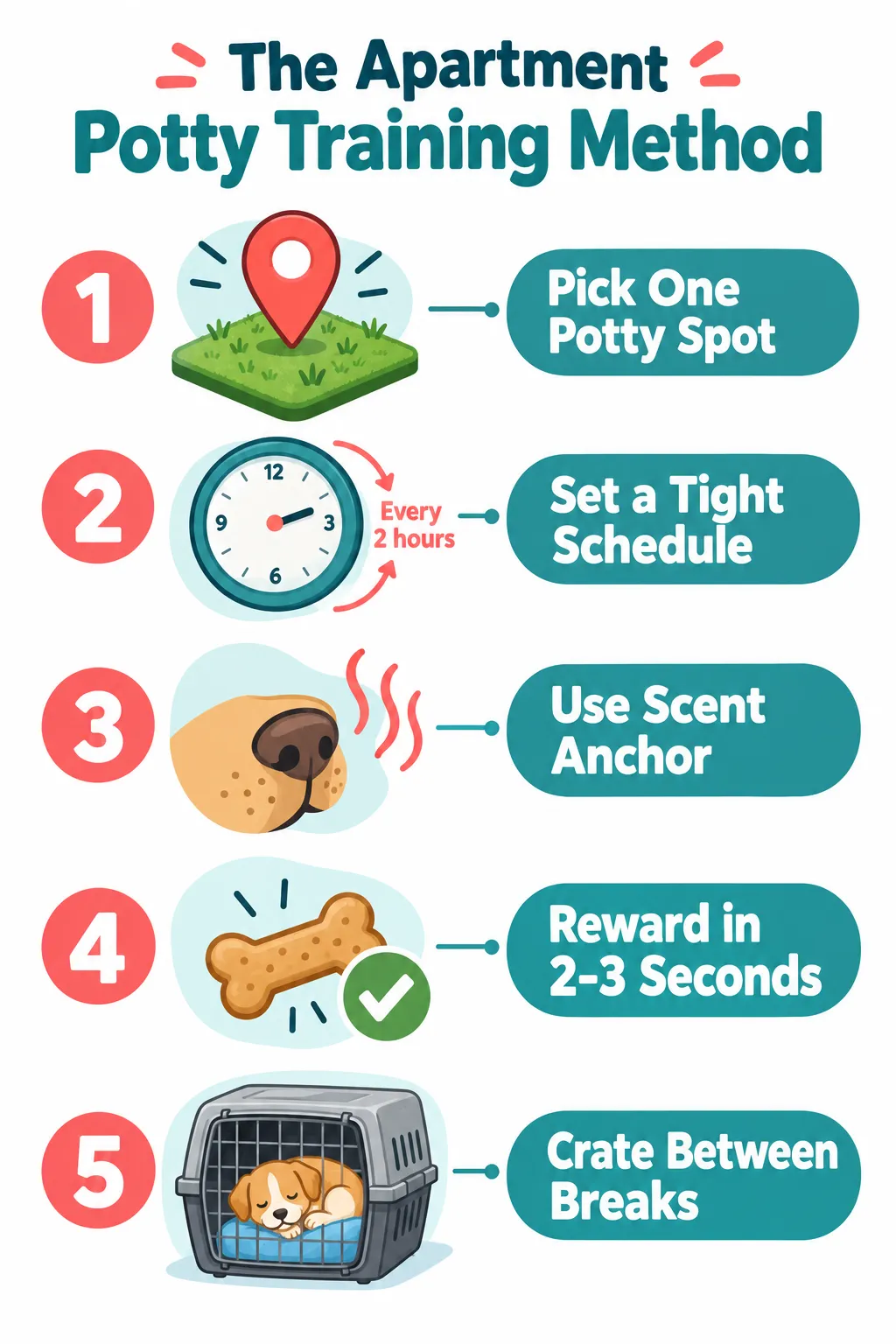
Here are the 7 core tricks that work:
1. Pick one fixed potty spot
Choose a single location – a bathroom corner, balcony, or hallway nook – and always bring your dog there. Consistency builds the habit faster than anything else.
2. Use a scent attractant
Dogs return to spots where they smell their own scent. Use a potty training spray or save a small piece of a used pad to anchor the new spot. This “chemical attraction” shortens the learning curve.
3. Set a schedule and stick to it
Take your dog to the potty spot first thing in the morning, after every meal, after naps, after play, and right before bed. For puppies, add breaks every 1-2 hours in between.
4. Use a crate between breaks
Dogs instinctively avoid soiling their sleeping area. A properly sized crate limits roaming and reduces accidents when you can’t actively supervise. Check out The Ultimate Puppy Potty Training Guide for detailed crate sizing tips.
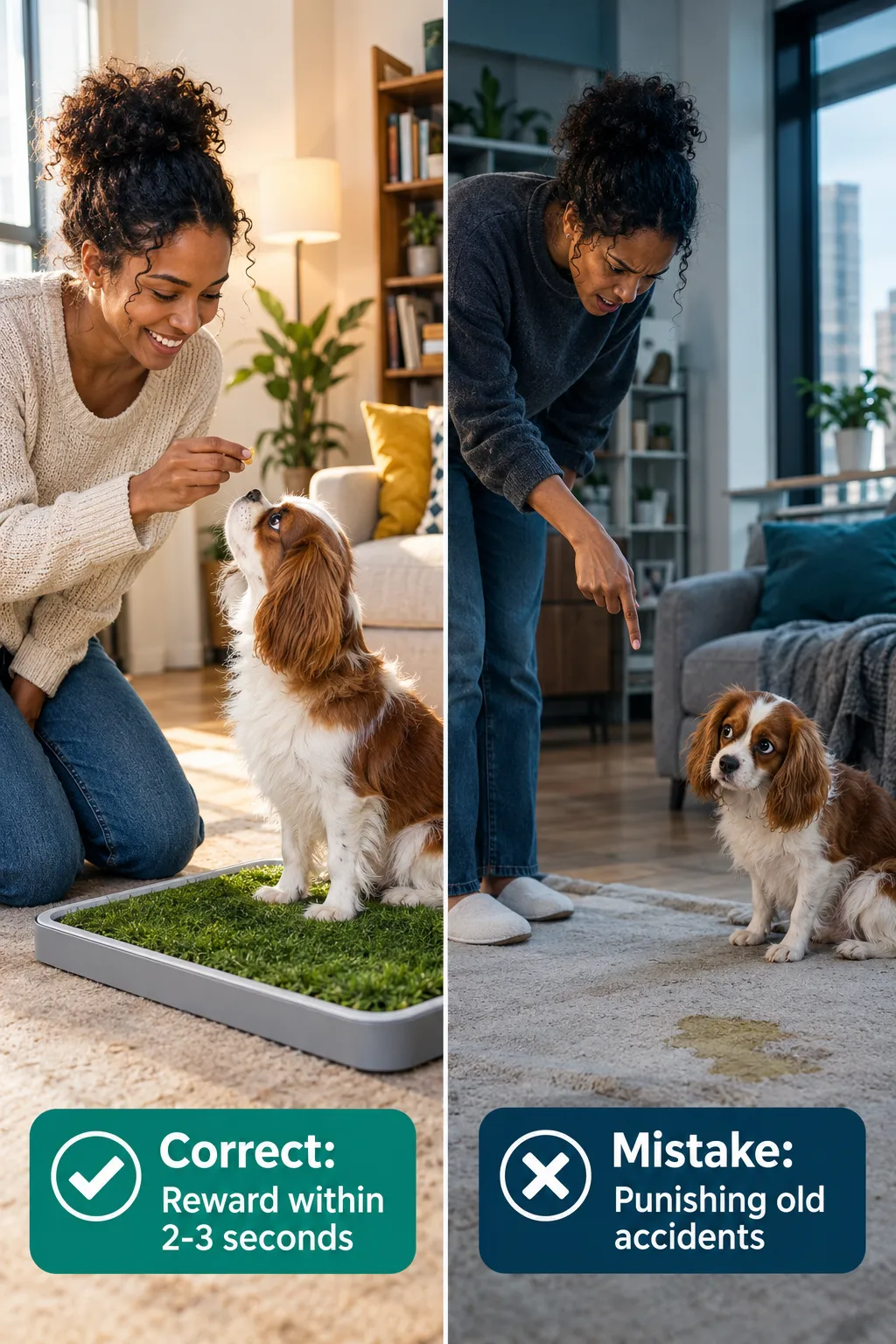
5. Reward within 2-3 seconds
VCA Animal Hospitals confirms that the reward window is critical – praise or a treat must come within 2-3 seconds of the dog finishing, not when you’re back inside.
6. Supervise actively or confine
If your dog isn’t in the crate, keep them in the same room as you. Use a leash indoors if needed. Unsupervised roaming is the fastest path to accidents.
7. Clean accidents with an enzyme cleaner
Regular cleaners don’t fully remove the scent. Enzyme-based cleaners break down the odor so your dog isn’t drawn back to the same spot.
Best Potty Training Pads for Apartment Dogs
The best potty pads for apartment dogs are large, highly absorbent, and either scented with an attractant or made from realistic artificial grass. The right choice depends on your dog’s size and your apartment layout.
Here’s a quick comparison of the main options:
| Option | Best For | Key Advantage |
|---|---|---|
| Disposable pee pads | Puppies, temporary use | Cheap, easy to swap out |
| Reusable washable pads | Adult dogs, long-term use | Eco-friendly, cost-effective |
| Artificial grass tray | Dogs transitioning to outdoor | Mimics real grass texture |
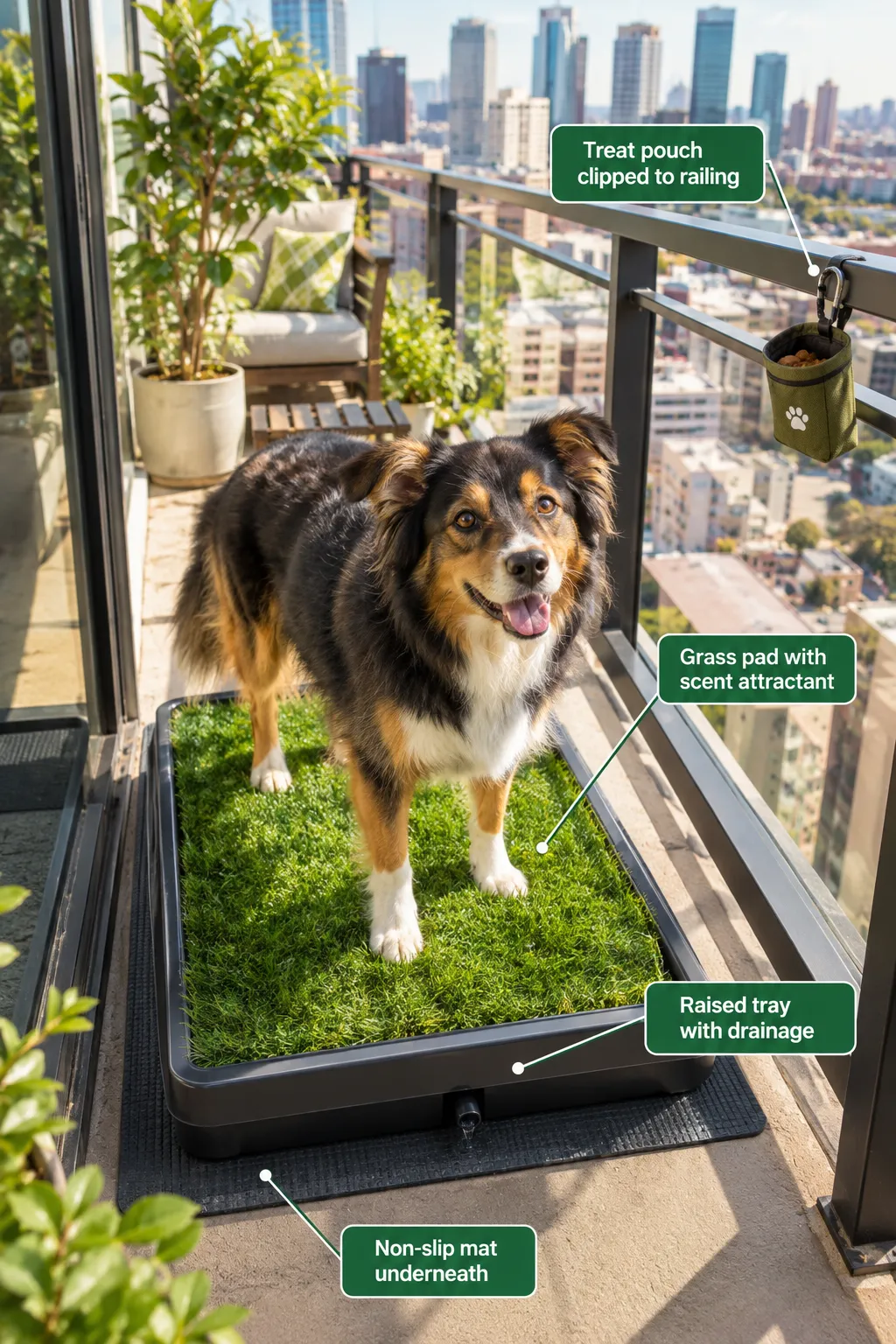
| Balcony grass system | High-rise apartment dogs | Outdoor feel, drains easily |
For apartment dogs being trained long-term, an artificial grass tray is often the best investment. It bridges the gap between indoor pads and outdoor grass, which helps if you eventually want your dog to potty outside.
How Long Does It Take to Potty Train a Dog in an Apartment?
Most dogs reach reliable potty habits in an apartment within 4-8 weeks of consistent training. Puppies under 6 months may take longer because their bladder control is still developing.
Several factors affect the timeline:
- Age – Younger puppies take longer; adult dogs often learn faster
- Consistency – Irregular schedules add weeks to the process
- Breed – Some breeds are naturally more stubborn (check our guide on 15 puppy potty training tips for stubborn puppies)
- Previous habits – A dog with a history of indoor accidents needs more time to unlearn the behavior
Quick rule: If you’re not seeing improvement after 2 weeks of consistent effort, revisit your schedule and rule out a medical issue with your vet.
Potty Training Small Dogs vs Large Dogs in Apartments
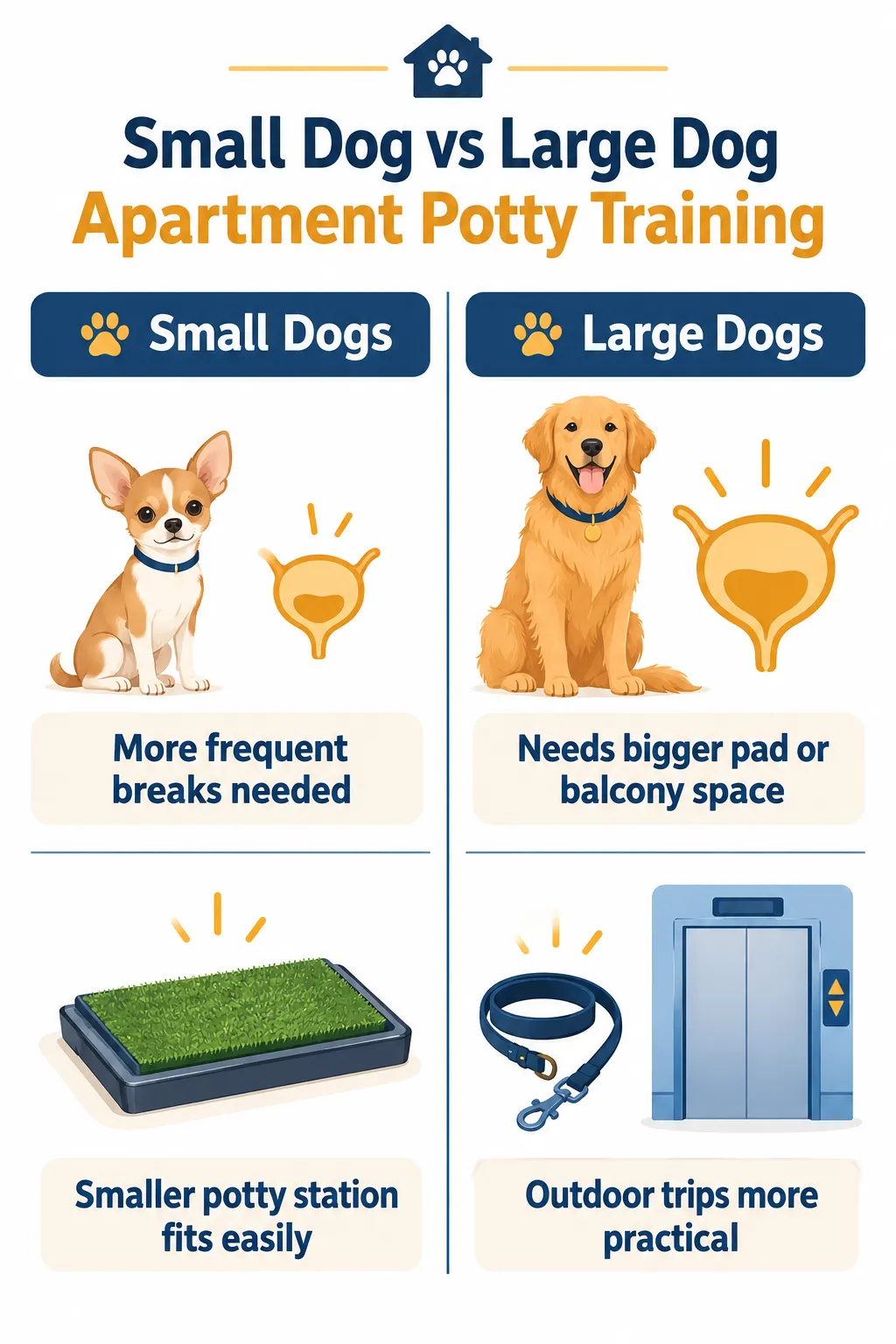
Small dogs need more frequent bathroom breaks than large dogs because of their smaller bladder capacity. Large dogs can hold it longer but need more physical space for a comfortable potty station.
Small dogs (under 20 lbs):
- Break every 1-2 hours for puppies, every 2-3 hours for adults
- A compact grass pad fits easily in a bathroom or balcony corner
- More prone to “small dog syndrome” – owners let accidents slide, which slows training
Large dogs (over 40 lbs):
- Can typically hold it for 3-4 hours once fully trained
- Need a larger pad or a balcony grass tray with a drainage system
- Outdoor trips via elevator are often more practical as the primary method
For breed-specific guidance, our French Bulldog potty training guide and Maltese puppy potty training guide cover small-breed apartment challenges in detail.
Apartment Potty Training Bell Training Method
Bell training is a method where you hang a small bell near the door or potty area and teach your dog to ring it when they need to go. It works extremely well in apartments because it gives dogs a clear, consistent way to communicate.
How to set it up:
- Hang a bell at your dog’s nose level near the door or potty station
- Every time you take your dog to potty, gently guide their nose or paw to ring the bell first
- Say a cue word like “outside” or “potty” as they ring it
- Immediately take them to the potty spot and reward success
Most dogs pick up bell ringing within 1-2 weeks. The key is never skipping the bell step, even when you’re in a hurry.
Common mistake: Rewarding the bell ring itself instead of the potty behavior. Always wait until they’ve actually gone before giving the treat.
Potty Training Puppies in Apartments vs Adult Dogs
Puppies and adult dogs require different strategies in apartment settings. Puppies need a more intensive schedule and more supervision, while adult dogs may need to unlearn old habits first.
For puppies:
- Expect accidents – their bladder muscles aren’t fully developed until around 4-6 months
- Use the crate heavily between scheduled breaks
- Keep potty trips short and focused – no playtime until after they’ve gone
- Our 14-day dog training plan includes a puppy-specific daily structure that works well in apartments
For adult dogs:
- If they were previously yard-trained, they may resist indoor pads at first
- Use a scent attractant to make the indoor spot more appealing
- Be patient – it can take 2-4 weeks to shift an established habit
PAWS Chicago’s housetraining guide notes that adult dogs can absolutely be retrained with consistent positive methods – it just takes a bit more patience.
Indoor Potty Training vs Outdoor Potty Training – Which Is Better?
For apartment dogs, the best approach depends on your floor level, your dog’s size, and your daily schedule. Neither method is universally better – they each have real trade-offs.
Indoor potty training (pads/grass trays):
- ✅ Available 24/7, no weather issues
- ✅ Great for high-rise apartments or owners with limited mobility
- ❌ Some dogs struggle to switch to outdoor later
- ❌ Requires regular cleaning to control odor
Outdoor potty training (scheduled trips outside):
- ✅ Cleaner long-term habit, especially for larger dogs
- ✅ Easier transition if you move to a house later
- ❌ Requires elevator trips, which adds 5-10 minutes per break
- ❌ Not practical for puppies who need breaks every hour
Many apartment owners use a hybrid approach – an indoor pad for overnight and emergencies, plus scheduled outdoor trips during the day. This balances convenience with long-term habit building. You can find more outdoor-focused strategies in our guide on how to train a dog to potty outside.
Best Potty Training Schedule for Apartment Dogs
A consistent daily schedule is the single most important factor in potty training dogs in apartments. Without structure, even the best tools won’t produce reliable results.
Sample schedule for a puppy (8-16 weeks):
| Time | Action |
|---|---|
| 6:00 AM | Wake up – immediate potty trip |
| 6:30 AM | Breakfast, then potty 15-20 min later |
| 8:00 AM | Potty break |
| 10:00 AM | Potty break |
| 12:00 PM | Lunch, then potty 15-20 min later |
| 2:00 PM | Potty break |
| 4:00 PM | Potty break |
| 6:00 PM | Dinner, then potty 15-20 min later |
| 8:00 PM | Potty break |
| 10:00 PM | Final potty trip before bed |
For adult dogs, you can stretch breaks to every 3-4 hours. CareCredit’s house training guide recommends always taking dogs out after waking, eating, and playing – those three triggers cover the majority of potty needs.
Common Mistakes When Potty Training Apartment Dogs
The most common mistakes in potty training dogs in apartments are inconsistent schedules, punishing old accidents, and giving too much unsupervised freedom too soon.
Here are the top errors to avoid:
- Punishing accidents after the fact – Dogs don’t connect punishment to something that happened more than a few seconds ago. It only creates anxiety. See our full list of 15 terrible dog training mistakes to avoid.
- Rotating the potty spot – Moving the pad to different rooms confuses your dog. Pick one spot and keep it there.
- Skipping crate time – Letting a puppy roam freely between breaks almost guarantees accidents.
- Rewarding too late – Waiting until you’re back inside to give a treat means the dog doesn’t connect the reward to the behavior.
- Giving up too early – Two weeks of effort feels long, but most dogs need 4-8 weeks of consistency.
Expert note: Best Friends Animal Society recommends consulting a certified trainer or vet behaviorist if your dog shows no improvement after several weeks of consistent positive training – there may be an underlying medical or behavioral issue.
What to Do If Your Dog Won’t Potty Train in an Apartment
If your dog isn’t making progress after 3-4 weeks of consistent effort, start by ruling out a medical cause. Urinary tract infections, bladder issues, and anxiety can all mimic poor potty training.
Troubleshooting steps:
- Visit your vet – Rule out UTIs, bladder stones, or hormonal issues
- Audit your schedule – Are you truly consistent, or are weekends looser than weekdays?
- Check the potty spot – Is it clean? Dogs often refuse soiled pads
- Try a different surface – Some dogs strongly prefer grass over pads, or vice versa
- Reduce freedom – Go back to basics with crate confinement and supervised-only time
- Use a stronger attractant spray – Some dogs need a stronger scent cue to target the right spot
The 7-Day Potty Training resource for apartment dogs also suggests keeping a simple accident log – noting the time and location of each accident often reveals a pattern you can fix with a schedule adjustment.
Potty Training Dogs in Apartments With Neighbors and Limited Space
Living in a shared building adds extra pressure – accidents in hallways or on shared balconies create real problems with neighbors. The solution is a combination of tight supervision and a reliable indoor station.
Practical tips for shared-building apartment life:
- Always carry waste bags and clean up immediately in shared spaces
- Use a waterproof tray under your grass pad to prevent leaks onto floors below
- Train your dog to go on command (“go potty”) so outdoor trips are quick and efficient
- If your dog barks or whines to signal potty needs, address that with calm dog training methods to avoid neighbor complaints
- Keep a small enzyme cleaner spray near the door for immediate hallway cleanup
Limited space isn’t a dealbreaker. Even a small bathroom corner with a grass tray is enough for most dogs under 30 lbs.
Do Apartment Dogs Need More Frequent Potty Breaks?
Yes – apartment dogs generally need more frequent breaks than dogs with yard access, because they can’t self-regulate by stepping outside whenever they need to. The owner controls every single bathroom opportunity.
For puppies, this means breaks every 1-2 hours during waking hours. For adult dogs, every 3-4 hours is typically sufficient, though individual dogs vary. High-energy breeds or dogs with anxiety may need more frequent trips regardless of age.
Paws Tales’ apartment dog potty training guide emphasizes that apartment dogs benefit from enrichment and routine beyond just potty breaks – a mentally stimulated dog is less likely to have stress-related accidents indoors.
FAQ
Q: Can I potty train a puppy in a high-rise apartment?
Yes. Use an indoor grass tray or pee pad as the primary potty station. Elevator trips for outdoor breaks are great when time allows, but a reliable indoor option is essential for puppies who need breaks every 1-2 hours.
Q: How do I stop my apartment dog from peeing on the carpet?
Use an enzyme cleaner on every accident spot to eliminate the scent. Increase supervision, reduce free-roaming time, and stick to a strict schedule. If accidents keep happening in the same spot, block access to that area temporarily.
Q: What’s the best indoor potty solution for a large dog in an apartment?
A large artificial grass tray with a drainage tray underneath works best. For dogs over 50 lbs, frequent outdoor trips via a scheduled routine are usually more practical long-term.
Q: Is it bad to use both pads and outdoor trips?
No – a hybrid approach works well for most apartment dogs. Use pads for overnight and emergencies, and outdoor trips as the primary method during the day. Just keep the indoor pad in one fixed spot.
Q: How do I transition my dog from indoor pads to going outside only?
Gradually move the pad closer to the door over several weeks, then eventually outside the apartment door, then to the outdoor spot. Reward outdoor success heavily during the transition.
Q: My dog uses the pad sometimes but not always. What’s wrong?
Inconsistency usually means the schedule has gaps. Track when accidents happen and add a potty break 15-20 minutes before those times. Also make sure the pad is clean – most dogs won’t use a heavily soiled pad.
Q: At what age can I start potty training a puppy in an apartment?
You can start as early as 8 weeks. Keep expectations realistic – puppies under 12 weeks have very limited bladder control. Focus on building the habit and routine rather than expecting perfection.
Q: Does bell training really work for apartment dogs?
Yes, and it works especially well in apartments because it gives dogs a clear signal to communicate. Most dogs learn to ring the bell within 1-2 weeks of consistent practice.
Q: How do I handle potty training when I work from home vs. when I’m at the office?
Create the same schedule for both situations. When you’re away, use a crate or a puppy-proofed pen with a pad inside. A dog walker or neighbor check-in helps for puppies who can’t hold it for 8 hours.
Q: Should I use punishment if my dog has an accident?
Never. Punishment after the fact confuses dogs and can create anxiety that makes training harder. Simply clean the spot thoroughly and adjust your schedule to prevent the next accident.
Conclusion
Potty training dogs in apartments is genuinely doable – it just requires a few smart adjustments compared to yard-based training. The biggest wins come from picking one fixed potty spot, following a tight age-based schedule, using the crate between breaks, and rewarding success within seconds.
Your action steps starting today:
- Set up your indoor potty station in one fixed spot
- Write out a daily schedule based on your dog’s age
- Stock up on enzyme cleaner and high-value treats
- Start bell training at the potty station
- Track accidents for the first week to spot schedule gaps
Stick with it for 4-8 weeks and you’ll have a reliably house-trained apartment dog – no backyard required. 🐾