Last updated: October 7, 2026
Quick Answer: A homemade dog paw lotion is a DIY moisturizing balm made from pet-safe ingredients like shea butter, coconut oil, beeswax, olive oil, and vitamin E. It soothes dry, cracked paw pads and creates a protective barrier against rough surfaces, salt, and extreme temperatures. You can make a basic batch in under 15 minutes with ingredients you may already have at home.
Key Takeaways
- The five best ingredients for homemade dog paw lotion are shea butter, coconut oil, beeswax, a carrier oil (olive or sweet almond), and vitamin E oil.
- A simple recipe uses 1 tbsp each of shea butter, coconut oil, and beeswax – melted together and stored in a small jar.
- Never use human hand lotion on your dog’s paws – it often contains fragrances, alcohols, or humectants that can irritate canine skin.
- Apply a pea-sized amount per pad for small dogs and a dime-sized amount for medium to large dogs.
- Homemade paw lotion lasts about 2 months at room temperature, or 2 weeks if you skip preservatives and refrigerate it.
- Dogs with deep cracks, bleeding, or signs of infection need a vet visit – not just a DIY balm.
- Avoid tea tree oil, propylene glycol, and synthetic fragrances in any paw product.
- Puppies can use paw lotion, but use the smallest amount possible and watch for licking.
- Apply 2-3 times per week in summer and 3-4 times per week in winter for best results.
- Coconut oil is safe for dog paws and is one of the most versatile ingredients in any paw care recipe.
What Is Dog Paw Lotion and Why Do Dogs Need It?
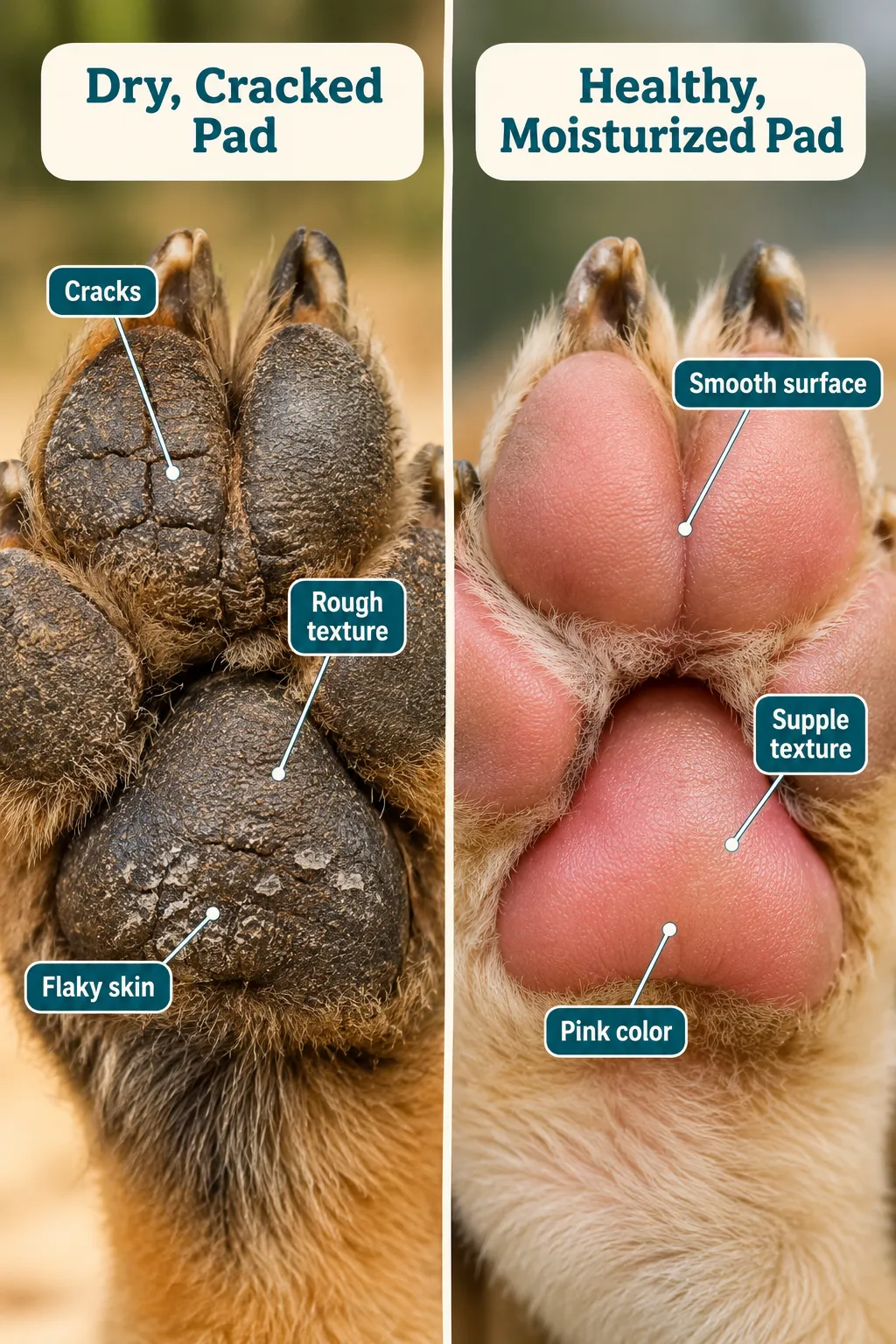
Dog paw lotion is a moisturizing product applied directly to a dog’s paw pads to soften, protect, and heal dry or damaged skin. Paw pads are thick but surprisingly vulnerable – they absorb heat from pavement, get dried out by cold air and road salt, and take a beating on rough terrain.
Unlike human skin, a dog’s paw pads have a unique keratin structure that can crack when they lose moisture. Once cracked, those pads become painful and can let in bacteria. A good paw lotion or balm works by doing three things at once: sealing in moisture (occlusive), softening the skin (emollient), and drawing water into the pad surface (humectant).
According to veterinary paw care guidance, balms are most useful for dogs that walk on salted sidewalks in winter, hot pavement in summer, or rough hiking trails year-round. They’re also helpful for dogs that spend a lot of time indoors on heated floors, which can dry pads out faster than most owners expect.
If your dog is already dealing with red, irritated paws, check out these soothing homemade remedies for red sore dog paws for extra relief options.
What Causes Dry Paws in Dogs?
Dry paws in dogs are most often caused by environmental exposure – hot pavement, cold weather, road salt, and rough surfaces are the top culprits. But there are several other causes worth knowing.
Common causes of dry dog paws:
- Hot pavement in summer draws moisture out of pads and can cause surface burns
- Road salt and de-icing chemicals in winter strip natural oils from pad skin
- Low indoor humidity during heated winter months
- Allergies – both food and environmental allergies can cause dry, itchy pads
- Nutritional deficiencies, especially low omega fatty acids
- Age – senior dogs often develop thinner, more fragile pads that dry out faster
- Autoimmune conditions like hyperkeratosis, which causes excessive keratin buildup
If your dog’s paws are chronically dry despite regular moisturizing, it’s worth talking to your vet. Sometimes dry paws are a symptom of something bigger, like a food sensitivity or a hormonal imbalance.
Best Ingredients for Homemade Dog Paw Balm
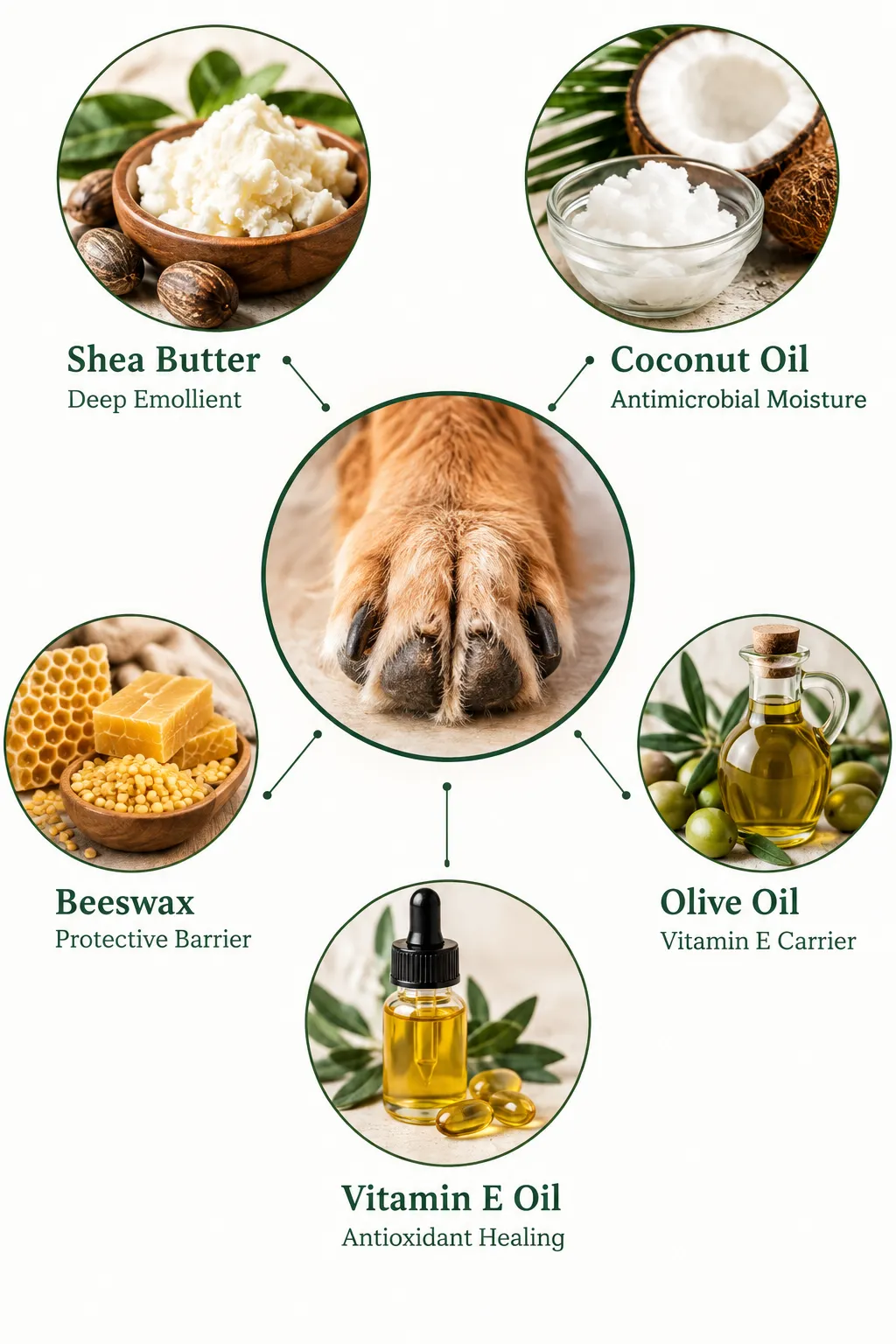
The five best ingredients for a homemade dog paw lotion are shea butter, coconut oil, beeswax, a liquid carrier oil, and vitamin E. Each one plays a specific role – and together they cover every layer of paw pad care.
Here’s a breakdown of what each ingredient does:
| Ingredient | Role | Why It Works |
|---|---|---|
| Shea Butter | Deep emollient | Softens and nourishes dry keratin |
| Coconut Oil | Moisturizer + mild antimicrobial | Hydrates and helps resist minor bacteria |
| Beeswax | Occlusive barrier | Locks in moisture, protects from elements |
| Olive or Sweet Almond Oil | Carrier oil + lubrication | Adds vitamin E, improves spreadability |
| Vitamin E Oil | Antioxidant + healing support | Supports skin repair, extends shelf life |
According to canine paw science research, these five categories – plant butters, coconut oil, wax, carrier oils, and humectants – consistently appear in the most effective paw balm formulas because they address the full occlusive/emollient/humectant framework that paw pad keratin needs.
Ingredients to avoid:
- Tea tree oil (toxic to dogs at concentrations above 1-2%)
- Propylene glycol (can cause contact dermatitis in sensitive dogs)
- Synthetic fragrances or alcohols
- Honey (can support bacterial growth in an unpreserved product)
How to Make Dog Paw Lotion at Home – Homemade Dog Paw Lotion Recipe With Shea Butter
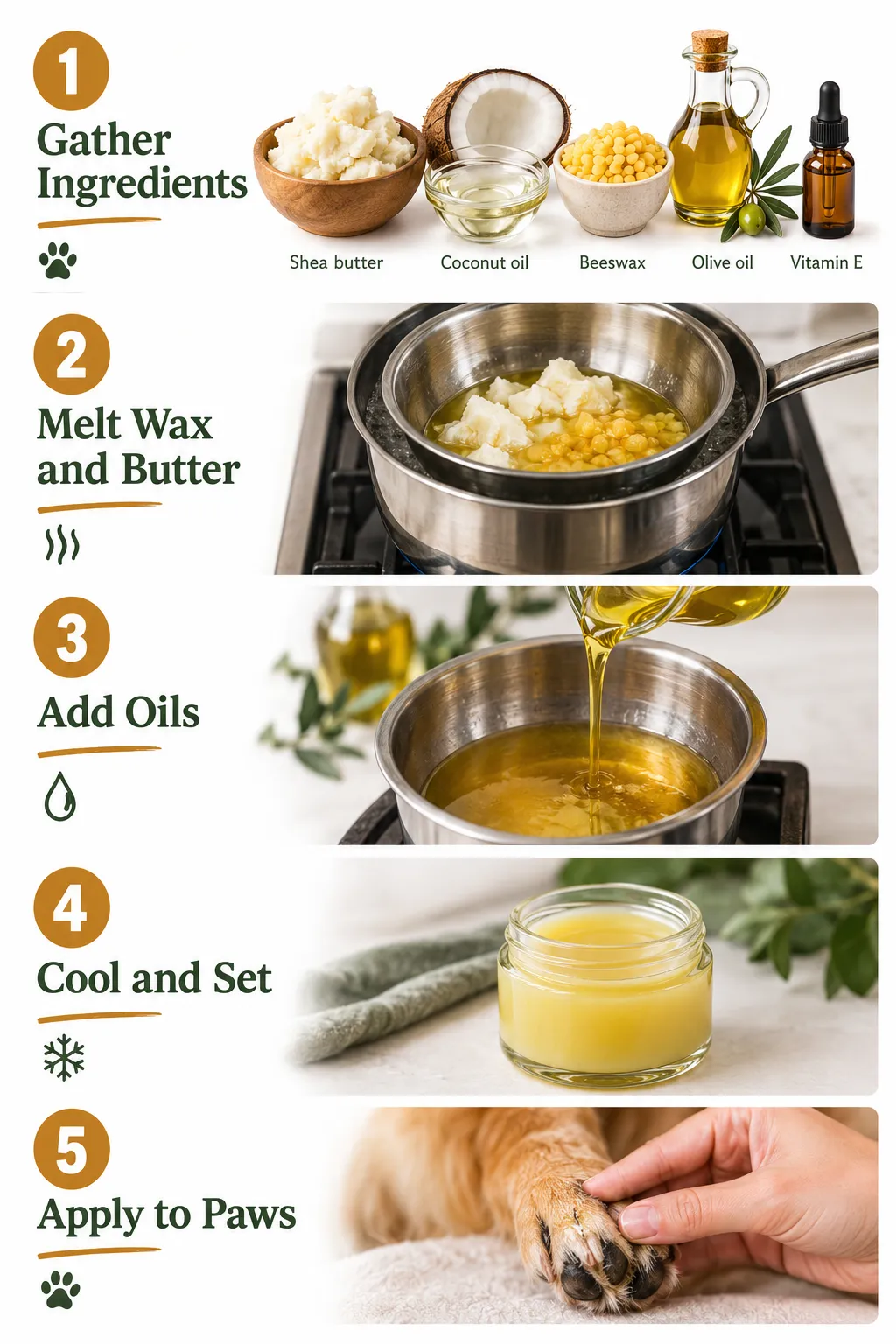
Making a homemade dog paw lotion takes about 10-15 minutes and requires just a few simple ingredients. The most popular recipe uses equal parts shea butter, coconut oil, and beeswax – it’s balanced, easy to adjust, and works for most dogs.
Basic Recipe (makes about 2 oz):
- 1 tbsp shea butter
- 1 tbsp coconut oil
- 1 tbsp beeswax pellets
- 1 tsp olive oil or sweet almond oil
- Optional: 2-3 drops vitamin E oil
Steps:
- Set up a double boiler – a small glass bowl over a pot of simmering water works perfectly.
- Add beeswax pellets first since they take the longest to melt.
- Add shea butter and coconut oil once the wax begins to soften.
- Stir gently until everything is fully melted and combined.
- Remove from heat and stir in olive oil and vitamin E.
- Pour into a small tin or glass jar and let it cool completely before sealing.
- Label with the date.
For a richer formula that works well on severely cracked paws, the AKC’s winter paw balm recipe suggests using 2 tbsp each of olive or sweet almond oil and coconut oil, 1 oz shea butter, and 4 tsp beeswax for a slightly firmer balm that holds up better in cold weather.
Homemade Dog Paw Lotion vs Store-Bought – Which Is Better?
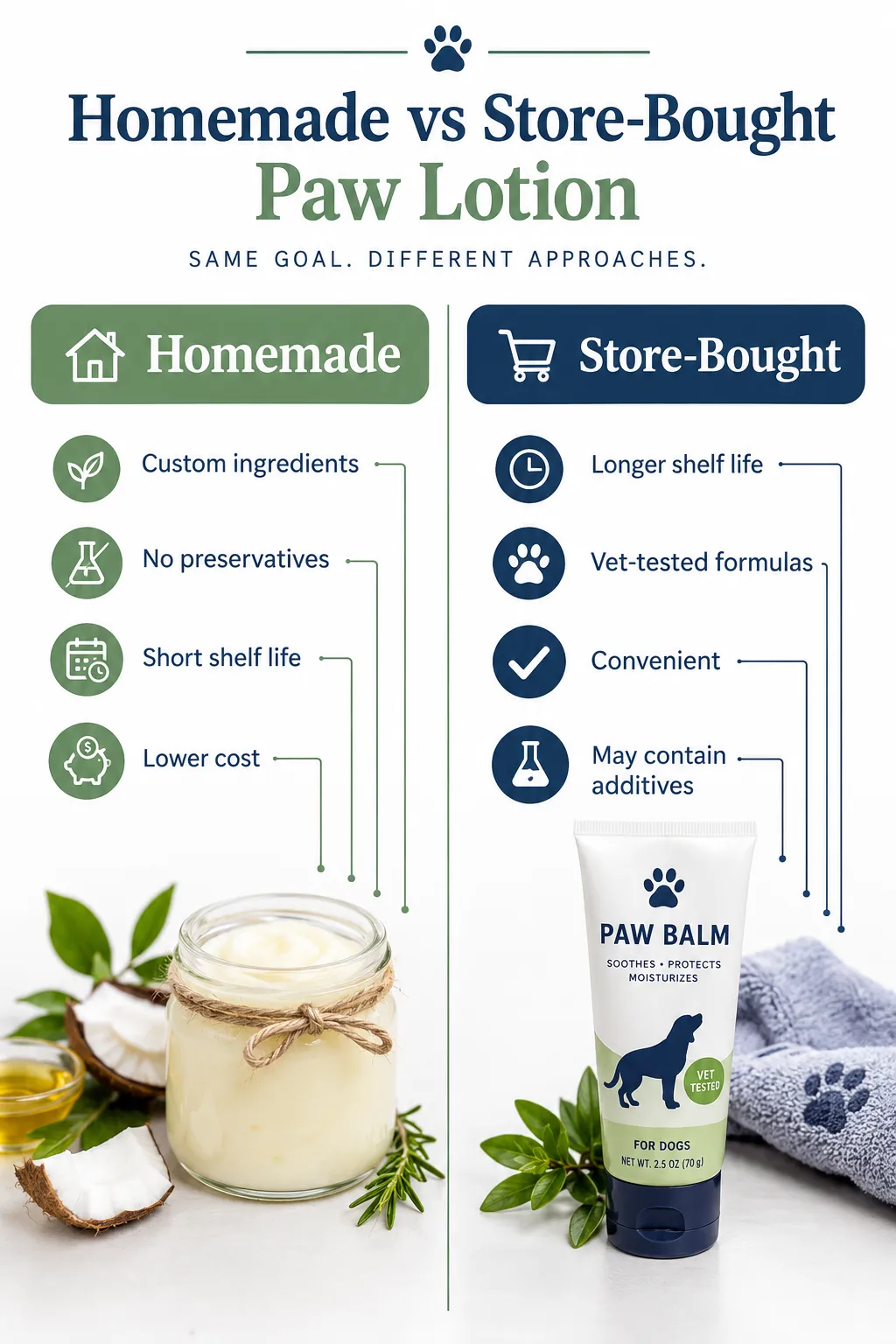
Homemade dog paw lotion gives you full control over ingredients and is often cheaper per ounce, but store-bought balms offer longer shelf life and tested formulations. The right choice depends on your dog’s needs and how much time you want to invest.
Homemade pros:
- You know exactly what’s in it
- No synthetic preservatives or mystery additives
- Cost-effective for multi-dog households
- Easily customized for sensitive skin
Homemade cons:
- Short shelf life (2 weeks to 2 months depending on storage)
- No standardized testing or dosage guidance
- Requires time and sourcing ingredients
Store-bought pros:
- Longer shelf life with commercial preservatives
- Often vet-tested or vet-endorsed
- Convenient and ready to use
Store-bought cons:
- May contain essential oils or additives you’d rather avoid
- More expensive over time
- Ingredient lists can be unclear
According to gear and product reviews from late 2026, the best commercial paw balms use the same core ingredients as good DIY recipes – shea butter, beeswax, coconut oil, and food-grade carrier oils. The key difference is the preservative system and the quality control behind the formula.
Choose homemade if: your dog has known sensitivities, you want to avoid specific additives, or you enjoy DIY pet care.
Choose store-bought if: you want a ready-to-use product with a longer shelf life and you don’t have time to make small batches regularly.
Is Coconut Oil Safe for Dog Paws?
Yes, coconut oil is safe for dog paws and is one of the most versatile ingredients in any homemade paw care recipe. It provides both moisture and mild antimicrobial support, which makes it useful for pads that are dry and slightly irritated.
Coconut oil is rich in medium-chain fatty acids, particularly lauric acid, which has well-documented mild antimicrobial properties. When applied topically, it softens the pad surface and helps reduce minor inflammation.
One thing to keep in mind: dogs will often lick their paws after application. Coconut oil is generally safe if ingested in small amounts, but large quantities can cause digestive upset. Apply a thin layer and distract your dog for a few minutes after application to let it absorb.
Plain, unrefined (virgin) coconut oil is the best choice. Avoid refined coconut oil with added fragrances or processing agents.
If your dog is constantly licking their paws even without lotion applied, that may be a separate issue worth addressing. This guide on home remedies to stop your dog from licking its paws covers some practical solutions.
Can I Use Human Lotion on My Dog’s Paws?
No – you should not use regular human hand or body lotion on your dog’s paws. Human lotions often contain ingredients that are irritating or harmful to dogs, including fragrances, alcohols, and chemical humectants like propylene glycol.
As veterinary guidance from VetExplainsPets explains, human skin products are formulated for human skin pH and barrier function, which differs significantly from canine skin. What’s gentle on human hands can cause contact dermatitis, redness, or worse on a dog’s pads – especially if the dog licks the product off.
Stick to products specifically formulated for dogs, or make your own using the pet-safe ingredients listed above.
Dog Paw Lotion for Dry Cracked Paws
For dry, cracked paws, you need a formula that’s heavier on the occlusive and emollient side – more beeswax and shea butter, with enough carrier oil to help the balm penetrate the cracks. A standard moisturizing lotion often isn’t enough for deep dryness.
According to dry cracked dog paw treatment guidance, a recipe using 2 tbsp each of coconut oil, shea butter, beeswax, and olive or sweet almond oil – plus optional vitamin E drops – works well for more severe dryness because the higher wax and butter ratio creates a thicker, longer-lasting barrier.
For cracked paws specifically:
- Clean the paw gently with warm water and dry thoroughly before applying
- Use a slightly warmed balm so it spreads into cracks more easily
- Apply at night so your dog isn’t walking on it immediately
- Cover with a clean dog sock for 10-15 minutes if your dog tolerates it
When to see a vet instead: Deep fissures that bleed, pads that show signs of infection (redness, heat, odor), or paws that don’t improve after 1-2 weeks of consistent care all need professional attention. Severe cases may require prescription keratolytics. You can also explore why dogs chew on their paws if cracking seems linked to a behavioral pattern.
How Often Should I Apply Paw Lotion to My Dog?
Apply paw lotion 2-3 times per week in summer and 3-4 times per week in winter. Seasonal conditions change what your dog’s pads need, so it’s worth adjusting your routine accordingly.
Seasonal application guide:
- Winter: Apply a wax-heavy balm 3-4 times per week, both before and after walks. Pre-walk application protects against salt and ice. Post-walk application replenishes moisture stripped by cold and chemicals.
- Summer: Use a lighter emollient balm 2-3 times per week, ideally in the evening. Avoid applying right before walks on hot pavement – over-softened pads are more vulnerable to heat damage.
- Year-round maintenance: Once or twice a week is usually enough for dogs with naturally healthy pads.
For application, use about a pea-sized amount per pad for small dogs (under 25 lbs) and a dime-sized amount for medium to large dogs (25-80 lbs). Massage it in for 15-20 seconds until the pad looks slightly shiny but not greasy, according to detailed paw balm usage guidance.
How Long Does Homemade Dog Paw Lotion Last?
A preservative-free homemade dog paw lotion lasts about 2 weeks when refrigerated, or up to 2 months at room temperature if stored in a cool, dry place. Because homemade balms lack commercial preservatives, small batch sizes are essential.
Watch for these signs that your batch has gone bad:
- Rancid or “off” smell
- Cloudy or discolored appearance
- Texture changes (separation, graininess)
If you notice any of these, discard the batch and make a fresh one. Label every jar with the date you made it so you never have to guess.
Making small batches – about 1-2 oz at a time – is the safest approach. It takes just minutes to make a new batch, and you avoid the risk of applying a degraded product to your dog’s skin.
Dog Paw Lotion for Sensitive Skin and Can Puppies Use Paw Lotion?
For dogs with sensitive skin, keep the recipe as simple as possible – shea butter, coconut oil, and beeswax with no added essential oils or fragrance. Fewer ingredients means fewer potential irritants.
Puppies can use paw lotion, but use the smallest amount possible. Puppy pads are naturally softer than adult pads, so they rarely need heavy moisturizing. A thin layer of plain coconut oil is often enough for young dogs. The main concern with puppies is ingestion – they tend to lick more, so apply right before a short walk or playtime to minimize licking.
For senior dogs, paw balm reviews for older dogs recommend sticking to natural plant butters and vegetable waxes with gentle carrier oils, since older dogs often have thinner, more fragile pads that react more strongly to harsh ingredients.
If your senior dog also has joint issues, pairing paw care with good nutrition can help overall comfort. Check out these homemade dog food recipes for senior dogs for ideas on supporting their health from the inside out.
Does My Dog Really Need Paw Lotion, or Is It Unnecessary?
Most dogs benefit from occasional paw lotion, but not every dog needs it daily. Dogs that spend most of their time indoors on smooth surfaces with minimal outdoor exposure often have naturally healthy pads that don’t need regular moisturizing.
The dogs that benefit most are those exposed to extreme temperatures, rough terrain, road salt, or dogs with naturally dry skin. If your dog’s pads feel smooth and flexible with no visible cracking or roughness, a monthly application is plenty.
Think of it this way: paw lotion is preventive care, not a daily necessity for every dog. Starting a routine before the harsh winter or summer season hits is smarter than waiting until pads are already cracked and painful.
FAQ
Can I use olive oil instead of coconut oil in homemade dog paw lotion?
Yes. Olive oil works well as a carrier oil in homemade paw balm. It’s rich in vitamin E and provides good lubrication. It’s slightly lighter than coconut oil, so it works best combined with a firmer butter or wax rather than as a standalone moisturizer.
What’s the difference between paw lotion and paw balm?
Paw lotion is typically lighter and more liquid, while paw balm is thicker and wax-based. Balms provide a stronger protective barrier and are better for winter use. Lotions absorb faster and suit mild dryness or summer maintenance.
How do I get my dog to stop licking the paw lotion off?
Apply the lotion right before a walk or mealtime to distract your dog. You can also use a clean dog sock over the paw for 10-15 minutes after application. Most dogs lose interest once the balm has absorbed.
Can I add lavender essential oil to homemade dog paw lotion?
It’s best to skip essential oils entirely in homemade paw balms. Even “dog-safe” essential oils can cause irritation when licked repeatedly, and concentrations are hard to control in small DIY batches.
Is beeswax safe for dogs?
Yes, beeswax is safe for dogs topically. It’s a natural, non-toxic ingredient that creates a protective film over the pad. It’s also safe if small amounts are ingested during licking.
How do I know if my dog’s paws need lotion or a vet visit?
Use lotion for mild dryness, roughness, or minor chapping. See a vet if pads are bleeding, deeply cracked, swollen, hot to the touch, or if your dog is limping or excessively licking one paw.
Can I use mango butter instead of shea butter?
Yes. Mango butter and cocoa butter are both good alternatives to shea butter. They have similar emollient properties and work well in the same ratios. Cocoa butter has a firmer texture, so slightly reduce the beeswax if you use it.
Is homemade paw lotion safe for all dog breeds?
Generally yes, as long as you stick to the safe ingredient list. Dogs with known skin allergies or autoimmune conditions should have any new topical product approved by a vet first.
How do I store homemade dog paw lotion?
Store in a small glass jar or tin with a tight lid. Keep it in a cool, dry place away from direct sunlight. Refrigerate if you want to extend shelf life beyond 2 months.
What’s the best time of day to apply paw lotion?
Evening is ideal. Your dog’s pads have time to absorb the lotion overnight without the friction of walking. Avoid applying right before outdoor walks, especially in summer.
Conclusion
Making a homemade dog paw lotion is one of the simplest, most affordable things you can do for your dog’s comfort and health. With just five ingredients – shea butter, coconut oil, beeswax, a carrier oil, and vitamin E – you can put together a batch that rivals many commercial products, without the additives or mystery ingredients.
Your next steps:
- Check your dog’s paw pads today – run your thumb across each pad and feel for roughness, cracks, or dryness.
- Gather your ingredients (most are available at grocery or health food stores).
- Make a small 1-2 oz test batch using the basic recipe above.
- Apply once and watch for any reaction over 24 hours before making it a regular routine.
- Adjust your application frequency based on the season and your dog’s individual needs.
If your dog’s paws are already in rough shape, don’t wait. Start with a gentle application tonight and build from there. And if you notice signs of infection or deep cracking that doesn’t improve, book a vet appointment – some paw problems need more than a DIY fix.
For more ways to care for your dog at home, explore these 7 DIY dog conditioner recipes for softer, shinier fur or learn about dog yeast infection paw remedies if your dog’s paws seem persistently irritated.