

Last updated: September 20, 2026
Quick Answer: Getting 2 dogs to get along starts long before they ever share the same space. The most effective approach is a structured, gradual introduction on neutral ground – with one handler per dog, loose leashes, and short timed greetings. Most dogs can learn to coexist peacefully when owners prepare properly and move at the dogs’ pace.
Key Takeaways 🐾
- Always introduce dogs on neutral territory first – never at home on the first meeting
- Use one handler per dog so neither animal feels cornered or overwhelmed
- Keep first greetings to just 3-5 seconds, then create distance and repeat
- Watch for stress signals: stiff body, raised hackles, hard stare, or tucked tail
- Separate food bowls, beds, and toys are non-negotiable after the new dog comes home
- Most dogs take 2 to 4 weeks to settle into a comfortable routine together
- Dogs with a history of aggression may need a professional trainer before any introduction
- Scent swapping before the meeting can reduce tension on the actual first meet
- Parallel walking is the single most recommended technique by trainers and shelters in 2026
- Forcing interaction too fast is the #1 mistake owners make
Why Knowing How to Get 2 Dogs to Get Along Matters More Than You Think
Roughly 44% of U.S. households own at least one dog, and many eventually add a second – often underestimating how much the first dog’s world is about to change. Knowing how to get 2 dogs to get along isn’t just about avoiding fights. It’s about protecting both animals from chronic stress, which affects their health, behavior, and quality of life.
If you’re struggling with other behavior challenges too, check out this Free Dog Training Workshop – a first-of-its-kind online program that teaches you to stop bad behaviors and train your dog to be as obedient as a service dog, using the same methods real service dog trainers use.
Dogs are social animals, but they’re also territorial. A new dog entering the home is a major event for the resident dog. When the introduction goes wrong, it can create lasting fear or aggression between the two animals – problems that are much harder to fix after the fact.
The good news? With the right preparation, most dogs can learn to live together happily. Here are the 7 things you need to do before they ever meet face to face.
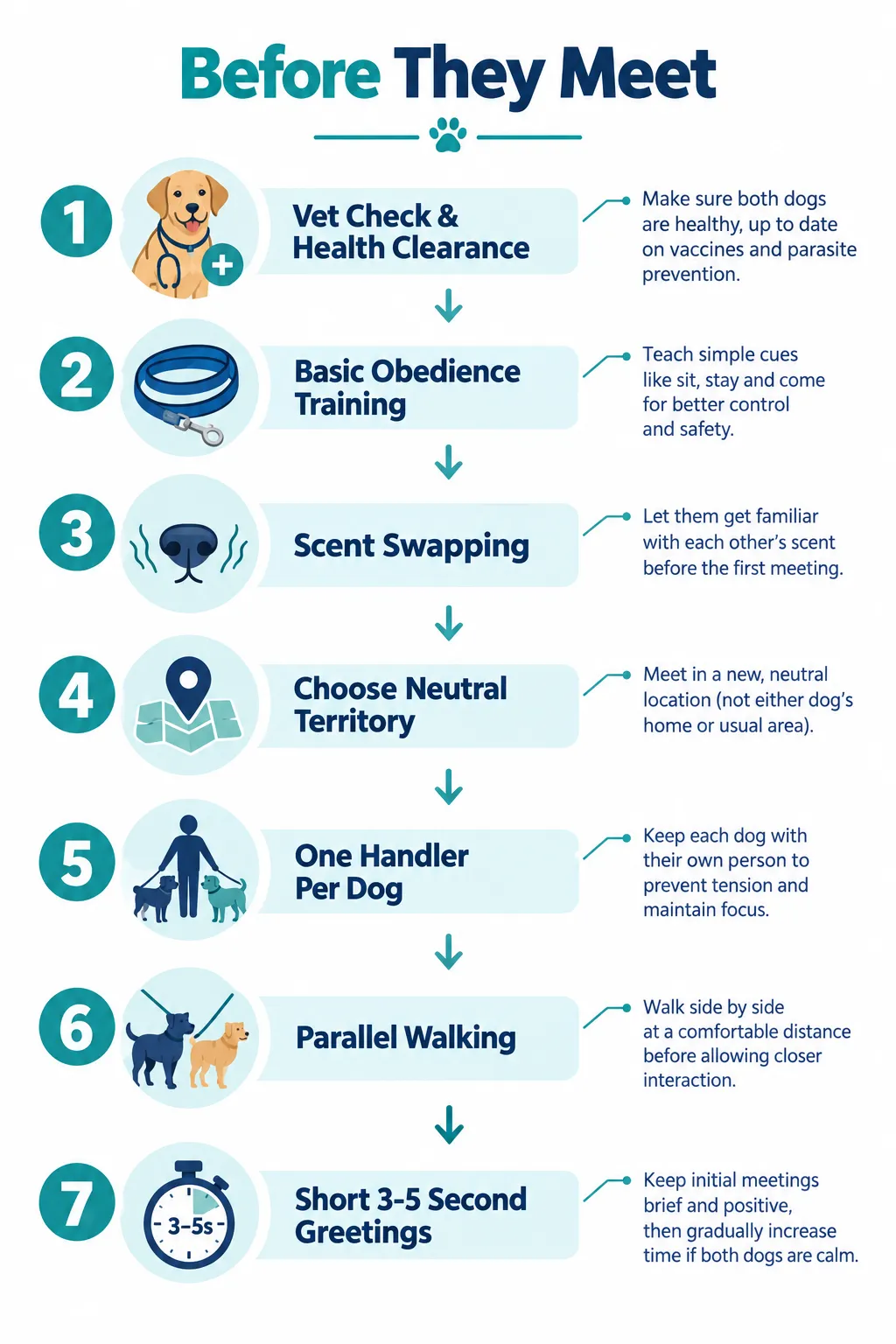
The 7 Things to Do Before Your Dogs Meet
These steps apply whether you’re adopting from a shelter, buying from a breeder, or taking in a friend’s dog. Do all 7 before the first meeting, and you’ll stack the odds heavily in your favor.
1. Get Both Dogs Vet-Checked
Before any introduction, both dogs should be up to date on vaccinations and free from illness or parasites. A sick or uncomfortable dog is far more likely to react defensively. Check our vet-approved dog health checklist to make sure both animals are in good shape before the big day.
2. Train Basic Obedience First
A dog that responds to “sit,” “stay,” and “leave it” is dramatically easier to manage during introductions. According to guidance from professional trainers, pre-meeting obedience training gives you real control if things get tense. Even a few days of practice makes a difference.
3. Swap Scents Before the Meeting
Give each dog a blanket or toy that smells like the other dog a few days before they meet. Let them sniff it, ignore it, sleep on it. This reduces the “stranger alarm” response on the actual meeting day. Best Friends Animal Society recommends this as a simple but effective pre-introduction step.
4. Choose Neutral Territory
Pick a location neither dog considers “theirs” – a park, a quiet street, or a neighbor’s yard. PDSA’s dog introduction guidance is clear: home introductions almost always go worse than neutral-ground meetings because the resident dog feels the need to defend its space.
5. Recruit a Second Handler
You need one calm, confident person per dog. If you’re alone, ask a friend or family member to help. Trying to manage two dogs by yourself during a first meeting is a recipe for tangled leashes and rising tension.
6. Use Loose Leashes
Tight leashes communicate tension to dogs. Practice walking your dog on a loose leash before the meeting day. Rover’s introduction guide highlights that leash tension is one of the most overlooked triggers for reactive behavior during introductions.
7. Plan for Short, Timed Greetings
Have a plan to keep first interactions to 3-5 seconds, then walk the dogs apart, let them decompress, and try again. This “sniff and move” approach prevents the buildup of arousal that leads to snapping or fighting.
What Does It Mean When Dogs Get Along vs. When They Don’t?
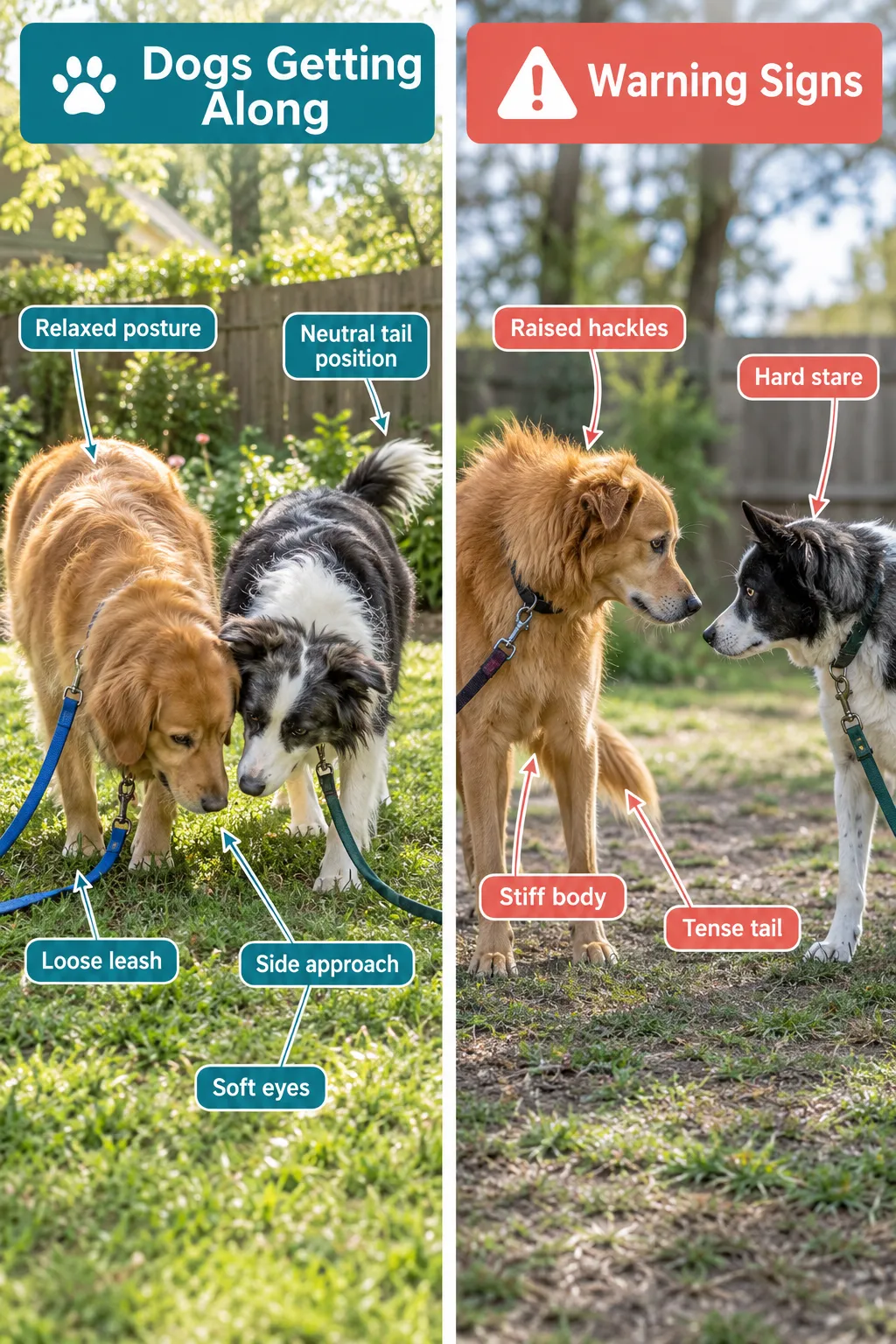
Dogs that get along show relaxed, loose body language – soft eyes, wagging tails in a neutral position, and easy breathing. They may sniff each other, play bow, or simply walk near each other without tension.
Dogs that are NOT getting along show very different signals. Watch for:
- Stiff, rigid body posture
- Raised hackles (fur along the spine standing up)
- Hard, unblinking stare
- Growling, snapping, or lunging
- Tail held high and stiff (not a happy wag)
- One dog constantly trying to escape the other
Understanding why dogs put their ears back and other subtle body language cues can help you catch stress signals early – before they escalate into something more serious.
Quick rule: If either dog freezes completely and holds its breath, separate them immediately. That stillness before a storm is a well-documented warning sign.
Should You Introduce Dogs on Neutral Ground or at Home First?
Always start on neutral ground. This is one of the most consistent recommendations across shelters, trainers, and welfare organizations in 2026.
The resident dog’s home is its territory. Bringing a new dog straight into that space triggers a defensive response in many dogs – even ones that are generally friendly. Humane World’s introduction resources strongly recommend outdoor, neutral-territory introductions as the first step.
After a successful neutral meeting, you can bring the new dog toward the home gradually – starting in the yard, then moving inside together.
Best Way to Introduce a New Dog to the Dog Already Living With You
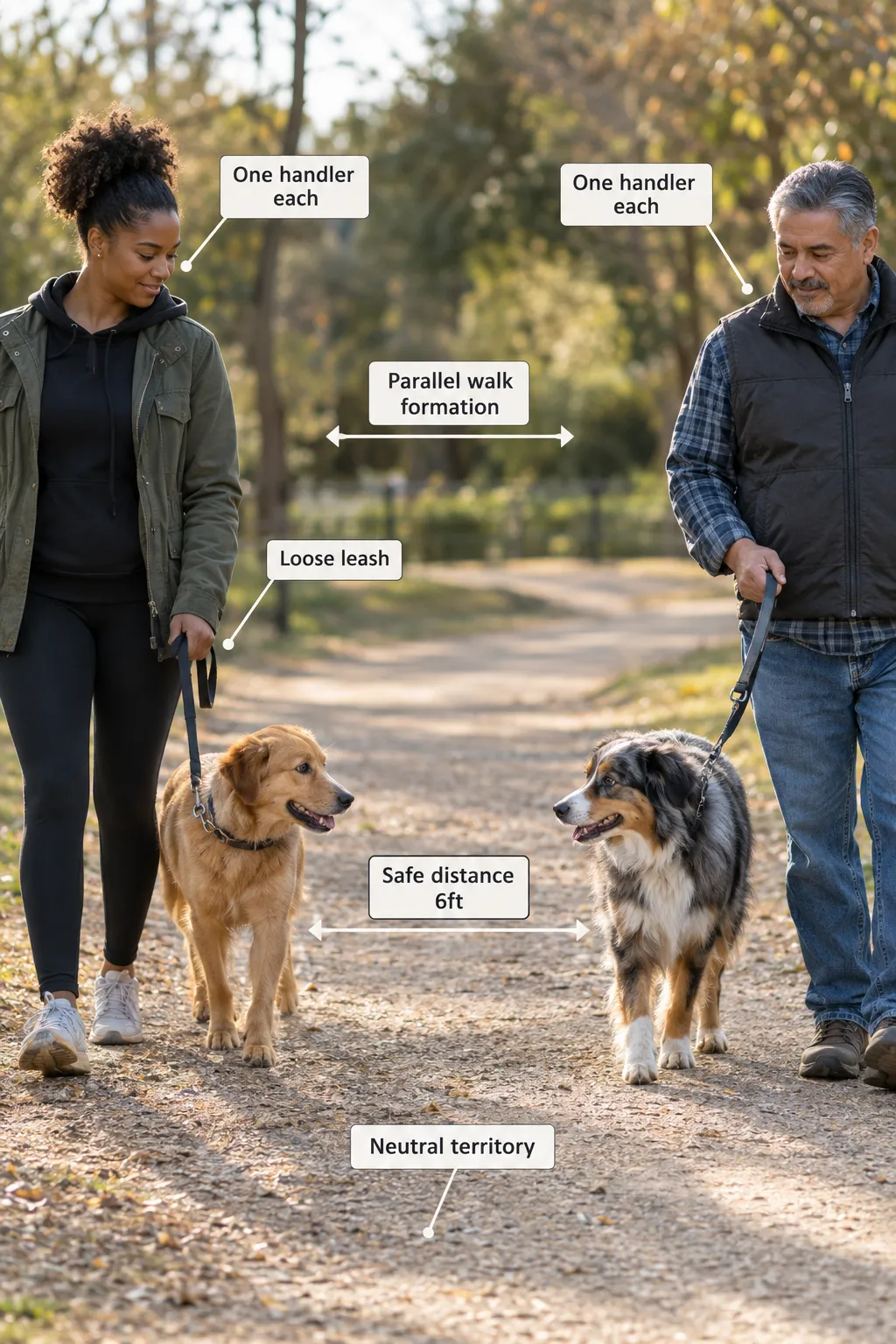
The parallel walk method is the gold standard. Here’s how it works:
- Start with both dogs on leashes, about 10-15 feet apart, walking in the same direction
- Let them notice each other without forcing interaction
- Gradually close the distance over 10-15 minutes as both dogs stay relaxed
- Allow a brief side-by-side sniff (not head-on – that’s confrontational)
- Walk apart again, then repeat
- End the session while both dogs are still calm
VCA Hospitals’ guide to getting a second dog recommends this staged approach and notes that rushing the greeting is the most common owner mistake.
Head-on approaches are a major trigger. Dogs that meet nose-to-nose on a tight leash are being set up to fail. Always aim for side approaches and parallel movement.
What Mistakes Do People Make When Introducing Two Dogs?
The biggest mistakes are rushing, forcing, and assuming “they’ll work it out.”
Common introduction mistakes:
- Bringing the new dog straight into the house without a neutral meeting first
- Letting the dogs “sort it out” during a fight instead of separating them
- Using a tight leash that signals anxiety to both dogs
- Allowing long, intense first greetings instead of short, calm ones
- Not removing high-value resources (food bowls, favorite toys, bones) before the first home visit
- Expecting the resident dog to be immediately happy about the new arrival
- Skipping obedience training before the introduction
Whole Dog Journal’s introduction advice notes that many owners also make the mistake of punishing growling – which actually removes a dog’s warning signal and can make bites more likely.
How Long Does It Take for Two Dogs to Bond and Accept Each Other?
Most dogs need 2 to 4 weeks to establish a comfortable routine together. Full bonding – where they actively seek each other out and play freely – can take anywhere from a few weeks to a few months.
Some pairs click within days. Others take longer, especially if one dog is older or more set in its ways. PetMD’s dog behavior guidance suggests that patience and consistent management in the first month are the biggest predictors of long-term success.
Factors that affect the timeline:
- Age difference between the dogs
- Whether both dogs have lived with other dogs before
- Energy levels and breed temperament
- Quality of the initial introduction
- How consistently the owner manages resources and space at home
Can You Introduce Two Dogs That Have Never Met Before?
Yes, absolutely. In fact, most successful multi-dog households started with two dogs that had never met. The key is following a structured introduction process rather than hoping for the best.
Dogs that have been properly socialized as puppies tend to adapt more easily. But even dogs with limited social history can learn to coexist when the introduction is handled carefully and the owner is consistent with management afterward.
If you want to build your dog’s confidence and social skills before the introduction, 12 brain games for dogs can help reduce anxiety and improve focus – both of which make introductions smoother.
Is It Possible to Get Two Dogs to Get Along If One Is Aggressive?
It depends on the type and severity of the aggression. Fear-based aggression and resource guarding are often manageable with professional help. Predatory aggression toward other dogs is harder to address and may make cohabitation genuinely unsafe.
Before attempting an introduction with an aggressive dog:
- Get a professional behavior assessment from a certified trainer or veterinary behaviorist
- Rule out any medical causes for the aggression (pain, thyroid issues, etc.)
- Work on desensitization and counter-conditioning with the aggressive dog first
- Never attempt an introduction without professional guidance in place
Do not try to force two dogs together and hope the aggression resolves itself. That approach almost always makes things worse.
If you’re dealing with a dog that has serious behavior issues, the Free Dog Training Workshop is worth checking out – it uses the same proven methods service dog trainers rely on to reshape even stubborn behaviors.
What If One Dog Is Territorial and Won’t Accept the Second Dog?
Territorial behavior is one of the most common challenges in multi-dog households. The resident dog may guard the house, yard, food, or even the owner’s attention.
Strategies that help:
- Do all initial meetings outside the home and yard
- Feed dogs in completely separate areas – never side by side at first
- Give the resident dog extra one-on-one time with you during the transition
- Use baby gates to create separate zones inside the home
- Never punish the resident dog for growling at the newcomer – redirect instead
- Reward calm, neutral behavior around the new dog with high-value treats
WebMD’s guide to adding another dog points out that territorial behavior often peaks in the first two weeks and gradually decreases as the resident dog realizes the new dog isn’t a threat to its resources or position.
Can Dogs of Different Ages Get Along Easier Than Same-Age Dogs?
Often, yes – but it’s not guaranteed. A calm adult dog paired with a puppy can work well because the puppy naturally defers to the older dog. However, a high-energy puppy can also exhaust and frustrate a senior dog.
Age combination considerations:
- Puppy + adult: Works well if the adult is tolerant; watch for the adult being pestered
- Two puppies (littermates): Can create “littermate syndrome” – excessive bonding with each other and difficulty bonding with humans
- Two adults: Usually fine with proper introduction; energy matching helps
- Senior + any age: The senior dog needs protected rest time and a space the other dog cannot access
For breed-specific temperament info that affects compatibility, see our guides on German Shepherd facts and Husky dog traits – both breeds have strong personalities that affect how they respond to new dogs.
How to Prepare Your Home for a Second Dog Introduction
Home preparation is just as important as the outdoor introduction. MLAR’s dog introduction protocol treats home management as a core part of the introduction process, not an afterthought.
Before the new dog comes home:
- Remove all food bowls, treats, and high-value chews from common areas
- Set up two separate feeding stations in different rooms
- Create two distinct sleeping areas – one for each dog
- Install baby gates to allow visual access without physical contact if needed
- Pick up toys and only reintroduce them under supervision once the dogs are comfortable
During the first weeks:
- Feed separately, always
- Supervise all shared time until you’re confident both dogs are relaxed
- Give each dog solo time with you every day
- Watch for resource guarding around water bowls too – it’s often overlooked

What’s the Difference Between Introducing Dogs vs. Cats to Each Other?
Dog-to-dog and dog-to-cat introductions follow different rules. With two dogs, the goal is parallel exposure leading to shared space. With a dog and cat, the cat needs a guaranteed escape route and elevated safe zones the dog cannot reach.
Key differences:
| Situation | First Meeting Location | Key Safety Rule |
|---|---|---|
| Dog meets dog | Neutral outdoor space | Loose leash, parallel walk |
| Dog meets cat | Indoors, cat has escape route | Cat controls all interaction timing |
| Dog meets puppy | Neutral ground or yard | Limit puppy’s access initially |
With cats, the dog should be on a leash or behind a gate for all early interactions. The cat should never be cornered or forced into contact.
How Much Does a Professional Dog Trainer Cost for Introducing Dogs?
In 2026, professional dog trainers in the U.S. typically charge between $75 and $150 per hour for private sessions, based on industry averages. Group classes are less expensive, usually $100 to $200 for a multi-week course.
For a full dog-to-dog introduction consultation with a certified trainer, expect to pay for 2 to 4 sessions minimum. A veterinary behaviorist – needed for serious aggression cases – charges more, often $200 to $350 per appointment.
When is a professional worth it?
- Either dog has a history of fighting or biting
- One dog is showing serious resource guarding
- The introduction has already gone badly and you need to reset
- You’re introducing a dog with unknown history from a shelter
What Should I Do If My Two Dogs Are Fighting After Introduction?
Stay calm and do not grab the dogs with your bare hands – that’s how owners get bitten. Use a loud noise, a spray of water, or a physical barrier (a chair, a board) to interrupt the fight.
Immediate steps after a fight:
- Separate both dogs into different rooms immediately
- Check both dogs for injuries – even small punctures need vet attention
- Do not reintroduce them the same day
- Go back to basics – neutral territory, parallel walking, short greetings
- Consider calling a professional trainer if fights are happening repeatedly
One fight doesn’t mean the relationship is doomed. But repeated fighting means the introduction pace was too fast and you need to slow down significantly.
How Do I Know If Two Dogs Will Get Along Before They Meet?
You can’t know for certain, but you can make a reasonable assessment. Dogs with a history of living with other dogs, dogs that have been well-socialized, and dogs with compatible energy levels are more likely to get along.
Positive compatibility signs:
- Both dogs have lived with other dogs before
- Similar or complementary energy levels
- Neither dog has a history of dog-directed aggression
- Both dogs are spayed or neutered (reduces hormone-driven conflict)
- Neither dog has strong prey drive aimed at other dogs
A meet-and-greet at a shelter or trainer’s facility before committing to adoption can give you real-world data on how the two dogs respond to each other.
FAQ: How to Get 2 Dogs to Get Along
Q: How long should the first meeting between two dogs last?
A: Keep it to 5-10 minutes total, with multiple short 3-5 second greetings separated by walking breaks. Shorter is better for a first meeting.
Q: Should I let my dogs “fight it out” to establish dominance?
A: No. Allowing dogs to fight is dangerous and does not reliably establish a stable hierarchy. Interrupt conflict early and manage the environment instead.
Q: Is it easier to introduce a dog of the opposite sex?
A: Generally yes. Opposite-sex pairs tend to have fewer dominance conflicts, especially when both are spayed or neutered. Same-sex pairs – particularly two males – can be more challenging.
Q: Can I introduce two dogs at a dog park?
A: Dog parks are not ideal for first introductions. Too many distractions, off-leash chaos, and other dogs make it hard to control the meeting. Use a quiet neutral space instead.
Q: My resident dog is ignoring the new dog completely. Is that okay?
A: Yes, ignoring is often a good sign. It means the resident dog is not threatened enough to react. Let them set the pace.
Q: Should I feed my dogs together from day one?
A: No. Feed separately for at least the first few weeks. Food is one of the top triggers for conflict between dogs sharing a space.
Q: What if my resident dog stops eating after the new dog arrives?
A: This is a stress response. Make sure the resident dog’s feeding area is completely separate and quiet. If it continues beyond a week, consult your vet.
Q: Can senior dogs accept a new younger dog?
A: Many can, but they need protected rest time and their own space. Don’t let the younger dog pester the senior dog – intervene and redirect.
Q: How do I know if the dogs are playing or fighting?
A: Play involves loose, bouncy movements, play bows, and taking turns. Fighting involves stiff bodies, sustained gripping, and one dog trying to escape. Growling can happen in both – look at the overall body language.
Q: Does breed matter for compatibility?
A: It can. Some breeds have stronger prey drives or dog-directed reactivity. Research your specific breeds’ typical traits before introducing a second dog.
Conclusion: Your Action Plan for Getting 2 Dogs to Get Along
Getting 2 dogs to get along is absolutely achievable – but it requires preparation, patience, and a willingness to go at the dogs’ pace rather than your own.
Start with the 7 steps before the first meeting: vet checks, basic training, scent swapping, neutral territory, two handlers, loose leashes, and short timed greetings. Then manage the home carefully in the weeks that follow, with separate feeding stations, individual safe spaces, and supervised shared time.
Watch the body language closely. Reward calm, neutral behavior. Never punish growling. And if things aren’t improving after a few weeks of consistent effort, bring in a professional – it’s money well spent compared to the alternative.
Your next steps:
- Schedule vet checks for both dogs this week
- Start (or refresh) basic obedience training with your current dog
- Gather a scent item from the new dog before the meeting day
- Scout a neutral meeting location near your home
- Line up a second handler for the introduction day
For deeper training support, the Free Dog Training Workshop is a great next step – it covers housebreaking, stopping bad behaviors, and building the kind of obedience that makes multi-dog households run smoothly, using the exact methods service dog trainers use.
Two dogs can absolutely become the best of friends. With the right start, you’re not just preventing problems – you’re building a foundation for years of companionship for both animals.