
Last updated: September 7, 2026
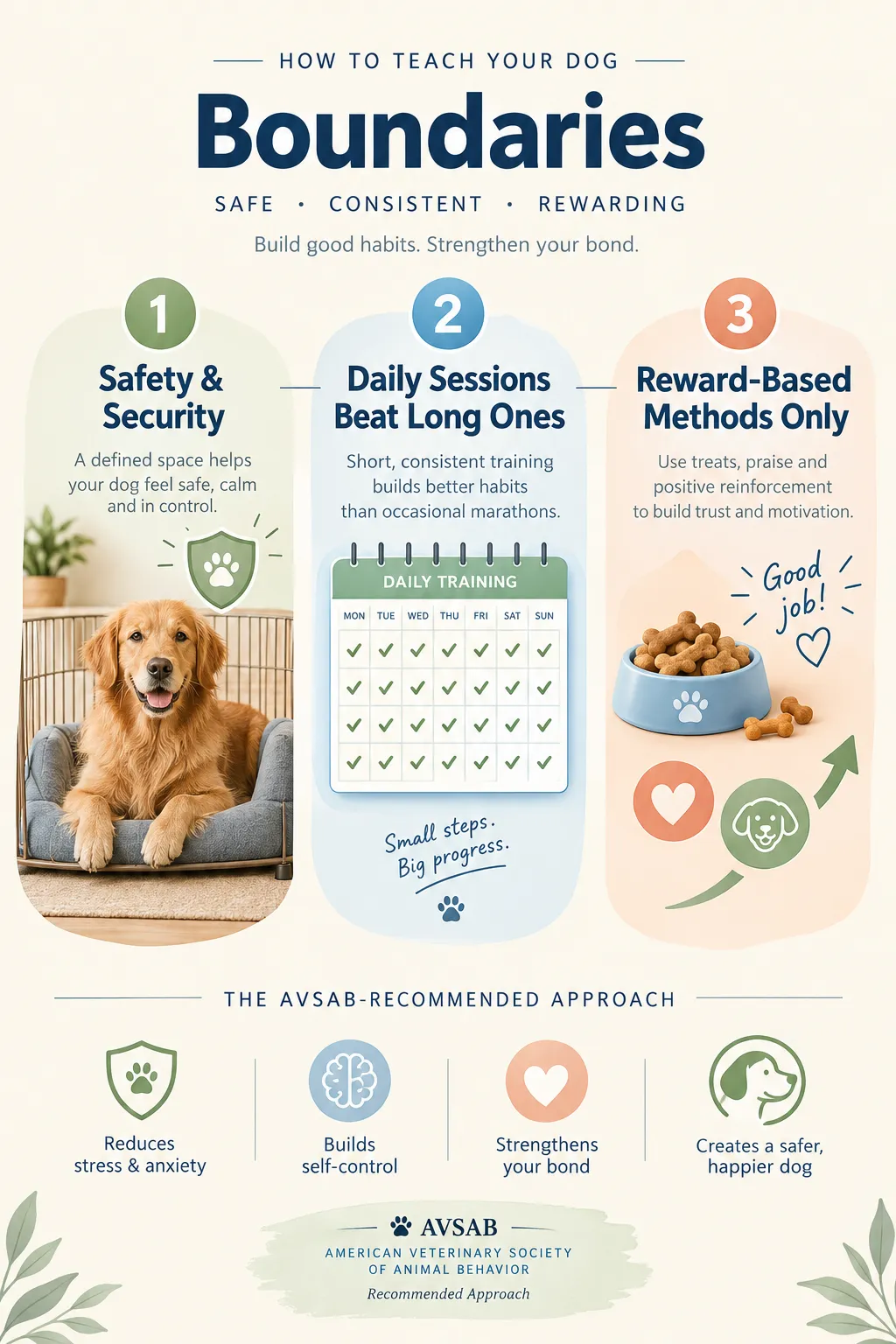
Quick Answer: Teaching your dog boundaries means using clear, consistent cues and positive reinforcement to show your dog where they can and cannot go, what behaviors are acceptable, and how to respect your personal space. According to the AVSAB humane dog training position statement, reward-based methods are the most effective and humane way to teach boundaries – no yelling, no punishment needed.
Key Takeaways
- Boundaries help dogs feel safe and secure, not restricted
- The AVSAB recommends only reward-based training for all dog training, including boundary work
- Consistency matters more than intensity – short, daily sessions beat occasional long ones
- Both puppies and older dogs can learn boundaries with the right approach
- Physical boundaries (baby gates, closed doors) support training while your dog learns
- Treats, praise, and toys are all valid rewards – use what motivates your dog most
- Testing boundaries is normal dog behavior, not defiance
- Indoor and outdoor boundary training follow the same core principles
What Does It Mean to Teach a Dog Boundaries?
Teaching dog boundaries means showing your dog which spaces, behaviors, and interactions are acceptable – and which are not. It’s not about control for its own sake. It’s about giving your dog a clear map of the world so they can make good choices and feel confident.
Boundaries for dogs fall into a few categories:
- Space boundaries – rooms, furniture, yard edges, doorways
- Behavior boundaries – no jumping, no demand barking, no counter surfing
- Social boundaries – respecting personal space of people and other dogs
- Food boundaries – staying away from human food and the dinner table
A dog that understands boundaries is easier to live with, safer around guests, and honestly – happier. Dogs are not wired to guess the rules. When you teach dog boundaries clearly, you remove the guesswork.
🐾 Want to fast-track the process? This free dog training workshop uses the same methods service dog trainers rely on to teach boundaries, stop bad behaviors, and build real obedience – and it’s available online at no cost.
Why Is It Important to Set Boundaries With Dogs?
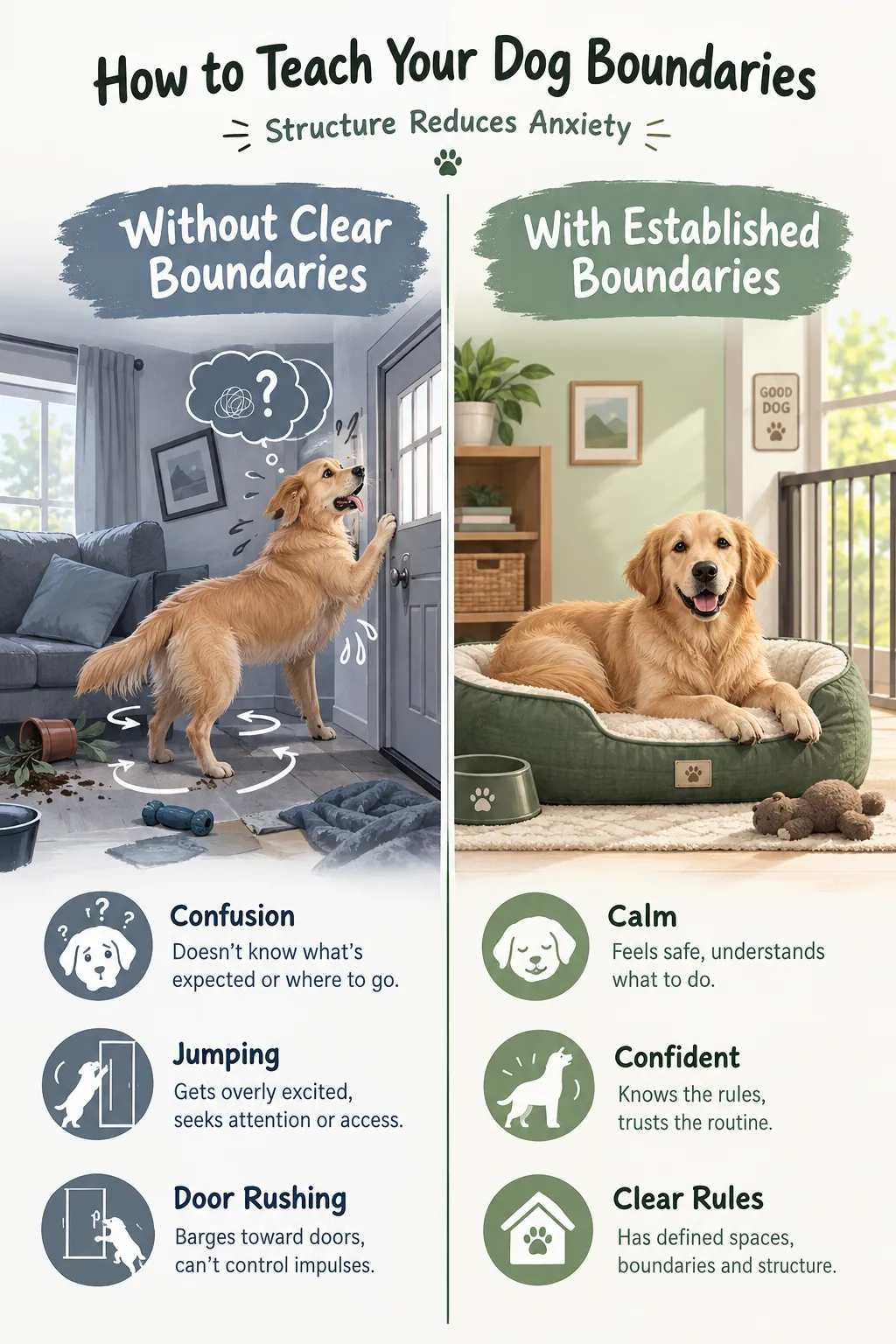
Boundaries are important because they create structure, and structure reduces anxiety in dogs. A dog that knows the rules is a calmer, more confident dog.
Without clear boundaries, dogs often develop problem behaviors out of confusion – jumping on guests, rushing through doors, or ignoring your personal space. These aren’t bad dogs. They’re dogs who never learned the rules.
Here’s what good boundaries set in place for your dog and your household:
- Fewer accidents and injuries (no door-dashing into traffic)
- Reduced stress for both dog and owner
- Easier management around guests and children
- A stronger bond built on trust, not fear
The iHeartDogs guide on teaching dogs to respect space frames boundaries as a way to reduce stress for both dog and humans, noting that calm, consistent reinforcement helps the dog feel secure rather than fearful. That’s the goal – security, not submission.
How to Teach Your Dog Boundaries Without Punishment
You can teach your dog boundaries effectively using only positive reinforcement – treats, praise, play, and affection. The AVSAB position statement is clear: aversive methods like leash corrections, yelling, or physical punishment should not be used under any circumstances.
Here’s the core method:
Step 1: Pick a clear boundary
Start simple. Choose one boundary – like not entering the kitchen or staying off the couch.
Step 2: Use a cue word
Pick a word like “back,” “off,” or “place.” Say it once, calmly.
Step 3: Reward the right choice
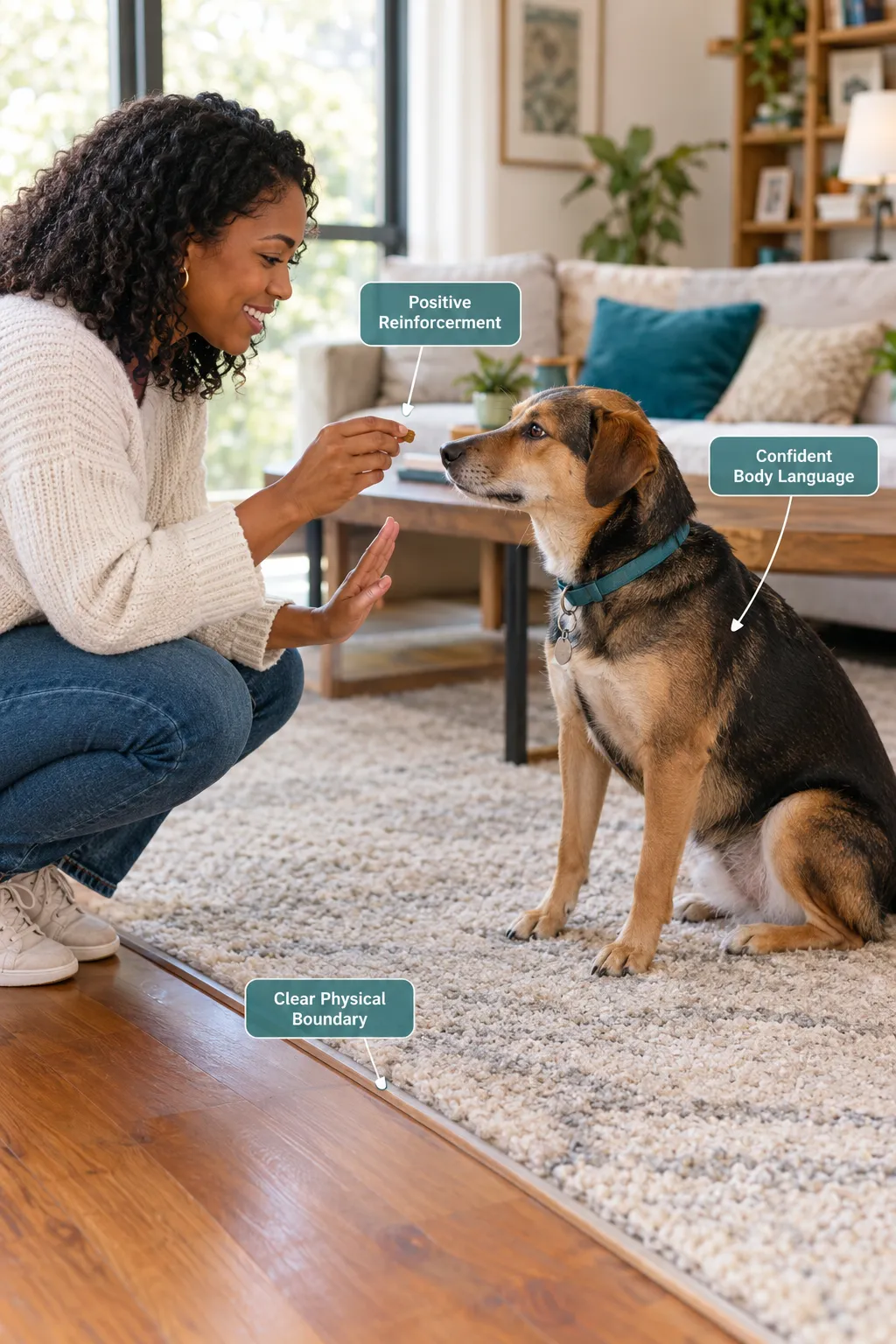
The moment your dog steps back or stays out of the space, reward immediately with a treat or praise.
Step 4: Reset without punishment
If your dog crosses the boundary, calmly redirect them back. No yelling, no scolding. Just reset and try again.
Step 5: Repeat in short sessions
According to the Dog Gone Problems protocol, 12 to 15 repetitions per session is the sweet spot for building reliable boundary habits.
The canine behaviour specialist guide to setting boundaries emphasizes using specific verbal cues consistently and rewarding desired behavior – like stopping at doorways – with praise or affection rather than scolding or physical restraint.
Boundary Training Indoors: Room by Room
Indoor boundary training focuses on teaching your dog which rooms or spaces are off-limits and how to respect your personal space inside the home.
Start with the spaces that matter most to you – the bedroom, the kitchen, or the couch. Pick one at a time. Trying to teach all indoor boundaries at once will overwhelm your dog and slow progress.
Common indoor boundaries to teach:
- Staying out of the kitchen during meals
- Not entering the bedroom without permission
- Keeping off furniture (or only getting on when invited)
- Waiting at doorways before going through
For doorway work, the TeachDog threshold training guide recommends stopping before the doorway, waiting for your dog to show calm behavior, and then rewarding with praise and high-value treats. Gradually increase the wait time and add distractions as your dog gets better.
Baby gates and closed doors are great management tools while your dog is still learning. They’re not cheating – they’re smart. Keeping your dog inside a designated space while they build the habit prevents mistakes and keeps training consistent.
You can also use your dog’s beds or a mat as a “home base.” Teaching a “place” or “go to your bed” command gives your dog a clear spot to go to instead of hovering or demanding attention. Check out how to teach your dog to settle without yelling or stress for a step-by-step method that pairs perfectly with indoor boundary work.
Boundary Training Outdoors: Keeping Your Dog Inside the Yard
Outdoor boundary training teaches your dog to stay within a yard or property line without relying on electric fences or harsh corrections.
This type of training takes more time than indoor work because there are more distractions – smells, animals, people walking by. Start indoors or in a low-distraction area, then move outside.
How to train outdoor boundaries:
- Walk your dog on a long lead near the yard edge
- When they approach the boundary, use your cue word (“back” or “boundary”)
- Reward them for turning away from the edge
- Gradually add distractions – a person walking by, a squirrel, another dog
- Always reward the dog for returning from the boundary, even if they crossed it
A clicker training protocol for yard boundaries shows how to teach dogs to stay within a yard without electric fences, using flags to mark the boundary line and click/treat rewards for correct responses.
If you’re worried about your dog escaping, also read how to teach your dog to not run away – it covers recall and boundary work together.
For dogs that bolt through doors to get outside, a door-boundary protocol works well. Introduce your dog to the door, reward calm behavior near the threshold, then add distractions while reinforcing the dog for staying behind the invisible line.
Puppy vs. Adult Dog: How to Teach Boundaries at Every Age
You can teach an older dog boundaries – this is one of the most common myths worth busting. Dogs of any age can learn new rules with consistent, positive training.
Puppies (8 weeks to 6 months):
Start simple and keep sessions to 3 to 5 minutes. Puppies have short attention spans. Use high-value treats and lots of enthusiasm. The first week with a new puppy guide covers how to start boundary habits from day one.
Adolescent dogs (6 months to 2 years):
This is the hardest stage. Dogs this age will test boundaries more often – not out of spite, but because their brains are developing. Stay consistent. Don’t get frustrated. Reward heavily when they get it right.
Adult and senior dogs:
Adult dogs often learn faster than puppies because they have better focus. Senior dogs may need shorter sessions due to energy levels, but they absolutely can learn. The key is patience and keeping training positive.
How long does it take?
Most dogs show clear improvement within 2 to 4 weeks of consistent daily training. Full reliability – meaning your dog respects the boundary even with distractions – can take 2 to 3 months. That’s normal.
What Boundaries Should Every Dog Have?
Every dog needs a core set of boundaries regardless of breed, size, or age. These are the behaviors and space rules that keep dogs safe and make them easier to live with.
Essential boundaries for all dogs:
| Boundary Type | Example | Why It Matters |
|---|---|---|
| Door manners | Wait before going outside | Prevents door-dashing into traffic |
| Personal space | Don’t jump on people | Keeps guests and children safe |
| Food rules | No begging or counter surfing | Prevents food theft and bad habits |
| Furniture rules | On/off furniture on cue | Keeps your space comfortable |
| Yard limits | Stay within the property | Prevents escaping and injury |
| Calm greetings | Sit before getting attention | Reduces jumping and chaos |
The AKC Canine Good Citizen program includes boundary-related skills like accepting a friendly stranger, sitting politely for petting, and behaving calmly around other dogs – all of which require solid boundary training as a foundation.
🐾 If you want to teach all of these faster, the free dog training workshop walks you through the exact methods used to train service dogs – the same dogs that master every one of these boundaries reliably.
How to Teach Your Dog to Respect Personal Space
Teaching a dog to respect personal space means training them not to jump, crowd, or demand attention in ways that feel intrusive. This is one of the most common dog behavior challenges owners face.
Dogs that don’t respect personal space often do it because it worked before – jumping got them attention, crowding got them pets. The fix is simple: stop rewarding the behavior you don’t want.
To teach dog respect for personal space:
- Turn your back when your dog jumps. No eye contact, no touch, no words.
- Only give attention when all four paws are on the floor.
- Reward calm, polite behavior with treats and praise immediately.
- Use a “back” or “space” cue to create distance when needed.
- Practice with guests too – ask them to follow the same rules.
To stop demand barking specifically, check out how to stop dogs from barking without yelling or punishment – it covers the exact steps to stop demand barking without reinforcing the behavior.
The AnimalKind summary of AVSAB’s humane training guidelines confirms that everyday skills like respecting space must be taught without fear or pain, using reward-based methods that support both behavioral success and emotional well-being.
What to Do When Your Dog Keeps Testing Boundaries
Testing boundaries is completely normal dog behavior – it doesn’t mean your training failed. Dogs test limits to gather information about whether the rules still apply.
The key is consistency. Every time your dog tests a boundary and you hold firm – calmly redirecting without giving in – you reinforce that the rule is real.
Common reasons dogs test boundaries:
- Inconsistent enforcement (the rule changes depending on your mood)
- Not enough reward for compliance
- Too much difficulty too fast (skipping steps in training)
- Boredom or under-stimulation
What to do:
- Go back to basics. Reward the boundary behavior more heavily for a week.
- Check your consistency – is everyone in the household following the same rules?
- Make sure your dog is getting enough exercise and mental stimulation. A tired dog tests fewer boundaries.
- Use management tools (gates, leashes, closed doors) to prevent practice of the unwanted behavior while you retrain.
If your dog keeps escaping the yard despite training, read how to stop your dog from escaping for targeted strategies.
Common Mistakes People Make When Teaching Dog Boundaries
Most boundary training problems come down to a handful of predictable mistakes. Knowing them in advance saves a lot of frustration.
Mistake 1: Inconsistency
Letting your dog on the couch on weekends but not weekdays confuses them. Dogs need the same rules every time.
Mistake 2: Yelling or punishment
Yelling might stop the behavior in the moment, but it doesn’t teach your dog what to do instead. It can also increase anxiety and damage trust. The Off Leash K9 Training guide warns that yelling or physical punishment can undermine trust, increase anxiety, and make boundary training less effective.
Mistake 3: Expecting too much too fast
Boundary training is a process. Expecting a dog to respect a new boundary after one session is unrealistic.
Mistake 4: Only correcting, never rewarding
If your dog only hears “no” but never gets rewarded for doing the right thing, they don’t learn what you want. Reward the behavior you want to see more of.
Mistake 5: Forgetting to add distractions
A dog that respects boundaries at home but not outside hasn’t fully learned the skill. Practice in different environments with increasing distractions.
Mistake 6: Giving up too soon
Some dogs take longer than others. Breed, age, history, and individual temperament all affect the timeline. Stay patient.
Treats or Praise: What Works Best for Boundary Training?
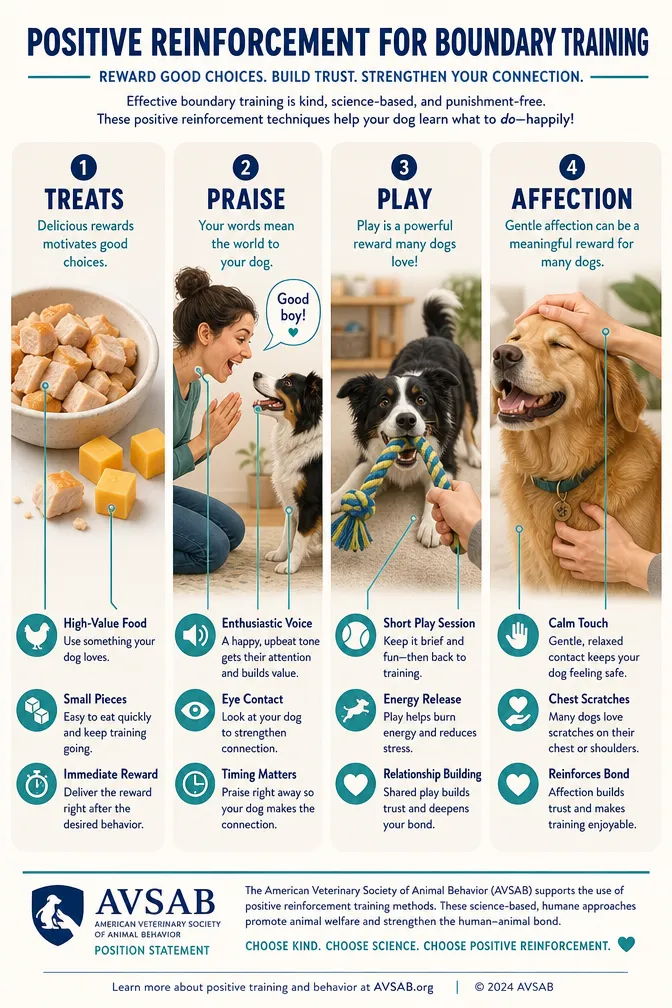
Both treats and praise work well – the best reward is whatever motivates your specific dog most. Most dogs respond best to a combination of both.
High-value treats (small pieces of chicken, cheese, or commercial training treats) are especially useful when teaching a new boundary or working in a high-distraction environment. Once the behavior is reliable, you can phase treats out gradually and rely more on praise, play, and affection.
Tips for rewarding boundary behavior:
- Reward immediately – within 1 to 2 seconds of the correct behavior
- Use a marker word (“yes!” or a clicker) to mark the exact moment
- Vary your rewards to keep your dog engaged
- Don’t forget that toys count as rewards too – some dogs are more toy-motivated than food-motivated
- Keep healthy homemade dog treats on hand for training sessions
The Acme Canine boundary training guide recommends praising and rewarding dogs with treats, pats, and verbal praise when they comply with boundary cues, framing boundaries as an opportunity to build a positive routine rather than a situation for reprimands.
🐾 Getting the reward timing right is one of the biggest factors in how fast your dog learns. The free dog training workshop covers reward timing and marker training in detail – it’s a game-changer for speeding up boundary training.
FAQ
What is the 3-3-3 rule for dogs?
The 3-3-3 rule describes the adjustment period for a newly adopted dog: the first 3 days are for decompression (the dog is overwhelmed and shut down), the first 3 weeks are for learning the routine and rules, and the first 3 months are for the dog to feel fully settled and comfortable in their new home. It’s a helpful reminder not to expect too much too soon from a newly adopted dog, including when setting boundaries.
What is the hardest command to teach a dog?
The “stay” command is widely considered one of the hardest to teach because it requires a dog to remain in place despite distractions, distance, and duration – three factors that all increase difficulty. It’s also a foundational skill for boundary training, which is why it takes consistent practice over weeks to build reliably. Starting with very short stays and gradually increasing duration is the most effective approach.
How do I say “I love you” in a dog?
Dogs don’t understand the phrase, but they do respond to the feelings behind it. You can communicate love to your dog through slow eye contact with a soft gaze (which releases oxytocin in both of you), a relaxed body posture, gentle touch, and a calm, warm tone of voice. Yawning slowly at your dog or blinking softly are also signals dogs recognize as non-threatening and affectionate.
What is the 7 7 7 rule for dogs?
The 7 7 7 rule is a socialization guideline suggesting that by 7 weeks of age, puppies should have experienced 7 different surfaces, 7 different locations, met 7 new people, encountered 7 challenges, eaten from 7 different containers, and been exposed to 7 different toys. It’s designed to build confidence and reduce fear responses later in life, which also makes boundary training easier as the dog grows.
Conclusion
Learning how to teach your dog boundaries is one of the most valuable things you can do for your relationship with your dog. It’s not about control or dominance – it’s about giving your dog a clear, consistent set of rules that help them feel safe and make good choices.
The core approach is simple: use positive reinforcement, be consistent, and be patient. Reward the behaviors you want to see. Redirect calmly when your dog tests the rules. Use management tools while your dog is still learning.
Your next steps:
- Pick one boundary to work on this week – start small
- Choose your cue word and your reward
- Practice 12 to 15 short repetitions per day
- Keep every member of your household on the same page
- Add distractions gradually as your dog improves
For more help with specific behaviors, explore how to keep your dog calm around visitors, how to use hand signals to train your dog faster, and powerful playtime games that secretly train your dog.
Every dog can learn boundaries. Every dog deserves a patient, kind teacher. You’ve got this.