

Last updated: August 14, 2026
Quick Answer: Dogs bark at night because their senses pick up sounds, smells, and movements that humans completely miss. The most common reasons include alerting to wildlife, separation anxiety, boredom, pain, and cognitive decline in older dogs. Identifying the specific trigger is the fastest path to stopping the noise for good.
Key Takeaways
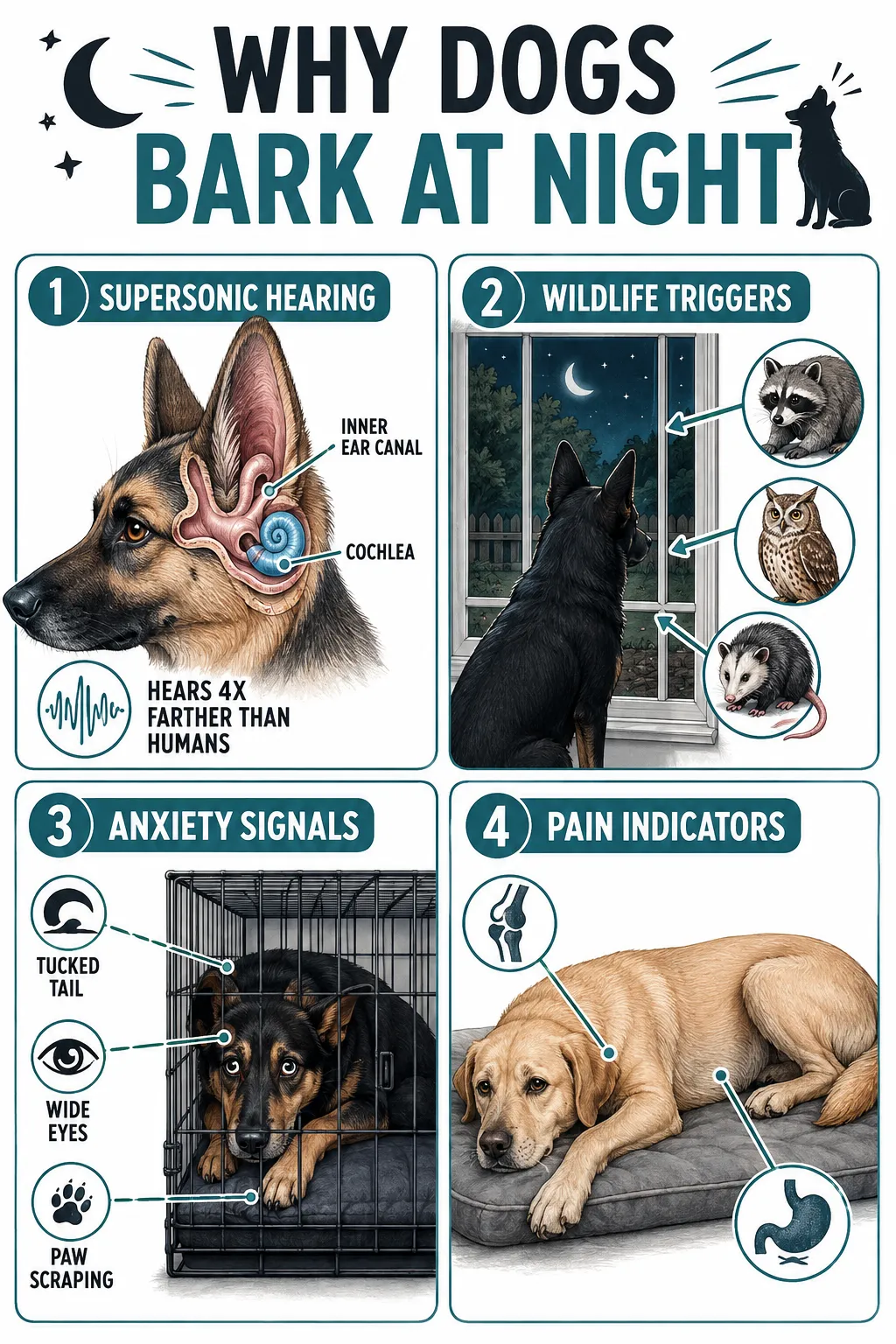
- Dogs can hear sounds at four times the distance humans can, making night barking often a response to real but invisible triggers
- Street dogs bark at night partly due to pack communication and territorial behavior
- Nighttime barking that starts suddenly in an older dog often signals a medical issue
- A consistent pre-bed routine cuts nighttime barking in most dogs within 1-2 weeks
- Never reward a barking dog with attention, food, or play – it reinforces the behavior
- Certain dog breeds like beagles, huskies, and German shepherds are naturally more vocal at night
- A dog barking at 3am is often responding to nocturnal wildlife, not ghosts or “nothing”
- If barking lasts more than 2-3 weeks despite intervention, a veterinary visit is essential
Why Do Dogs Bark at Night for No Reason?
Dogs almost never bark at truly nothing. What looks like random night barking is almost always a response to something real – just something your human senses can’t detect.
According to Borash Veterinary Clinic, dogs have hearing ranges that extend far beyond ours, picking up high-frequency sounds from distant streets, neighboring yards, and even inside walls. A dog that seems to bark at nothing is likely reacting to a sound, scent, or movement that simply falls below your detection threshold.
Common “invisible” triggers include:
- Raccoons, opossums, or deer moving through the yard
- A neighbor’s car starting up two streets over
- Pipes expanding and contracting in the walls
- A cat walking past a window
- Distant sirens or construction noise
So if your dog barks at night and you can’t figure out why, start by checking the environment rather than assuming it’s a behavior problem.
What Triggers Dogs to Bark at Night? The 7 Real Causes
Most nighttime barking falls into one of seven categories. Understanding which one applies to your dog makes the solution much clearer.
1. Alerting to Environmental Triggers Like Sounds and Movement
Dogs are natural sentinels. When they detect environmental triggers like loud noises, unfamiliar scents, or movement outside, they bark to alert the household. This is instinct, not disobedience.
Street dogs bark at night for the same reason – they’re communicating with other dogs and marking territorial boundaries. Research from Tractive’s pet behavior blog confirms that dogs react to stimuli humans simply can’t perceive, including ultrasonic sounds and barometric pressure changes before storms.
Quick fix: Use white noise machines or a fan near your dog’s sleeping area to mask environmental triggers like loud noises from outside.
2. Lack of Supervision and Separation Anxiety
Dogs are pack animals. When left alone at night – especially in a crate or a separate room – many dogs experience real distress. This isn’t just whining; it’s a stress response.
If your dog barks specifically when you leave the room or go to bed, separation anxiety is likely the cause. Check out our guide on how to stop a puppy from crying in a crate at night for step-by-step help.
Signs of separation anxiety at night:
- Barking starts within minutes of you leaving
- Dog paces, pants, or scratches at the door
- Barking stops when you return or call out
3. Boredom and Unspent Energy
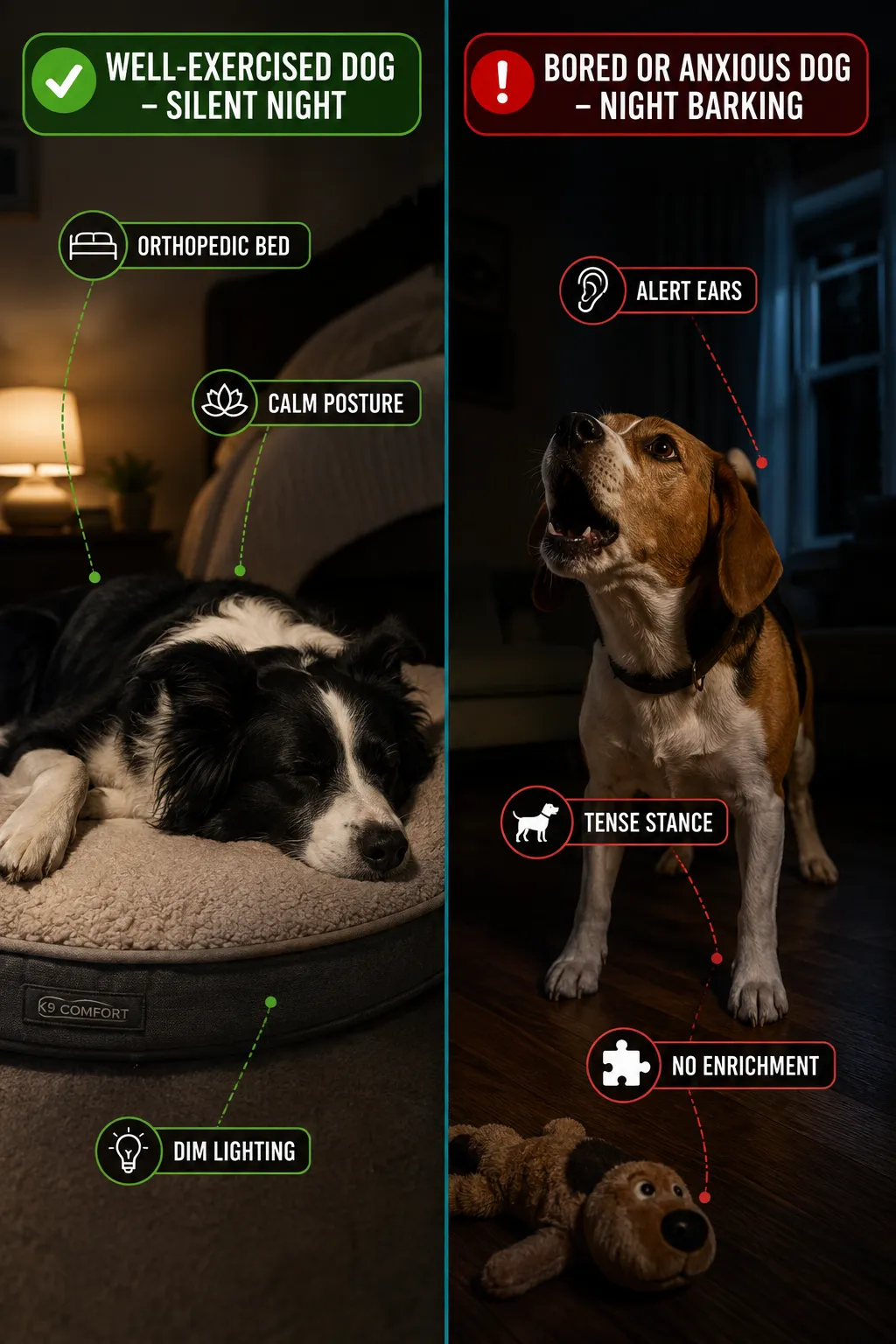
A dog that doesn’t get enough exercise during the day will often use the night to release pent-up energy. This is especially common in high-drive dog breeds like border collies, huskies, and working dogs.
Focus Pet Care notes that dogs need mental and physical stimulation to sleep soundly. Without it, nighttime becomes their activity window.
Fix: Add a 20-30 minute walk or play session 1-2 hours before bed. Check out activities for bored dogs for ideas that genuinely tire them out.
4. Loneliness and the Call for Help or Bonding
Some dogs cry at night simply because they miss social contact. This is different from separation anxiety – it’s more of a low-grade loneliness rather than panic.
Dogs cry at night to communicate, and some will bark in a rhythmic, repetitive pattern that sounds almost like a call. If you notice 10 subtle signs your dog is lonely during the day too, nighttime barking is likely part of the same pattern.
5. Expressing Anxiety or Pain
Pain is one of the most under-recognized reasons dogs bark at night. Dogs often hide discomfort during the day when they’re distracted, but at night – when it’s quiet and they’re still – pain becomes harder to ignore.
Checkpet Vet’s guide on excessive dog barking at night highlights that conditions like arthritis, urinary tract infections, and digestive pain can all cause sudden nighttime barking. If your dog is also restless, reluctant to lie down, or licking a specific body part, pain is a strong possibility.
When to call the vet: Barking that starts suddenly in an adult dog with no obvious environmental cause warrants a veterinary check within a few days.
6. Asserting Boundaries and Defense
Dogs are territorial. When they hear other dogs, street dogs, or unfamiliar animals near the home at night, they bark to assert their space and communicate with other dogs in the area.
This is especially common in multi-dog neighborhoods. One dog barks, another responds, and soon you have a chorus of barking that can last for hours. This is sometimes called “chorus barking” or pack communication.
7. Age-Related Cognitive Decline
Senior dogs sometimes develop Canine Cognitive Dysfunction Syndrome (CDS) – essentially a form of dementia. One of the most common symptoms is nighttime barking, often with no clear trigger.
Elanco’s pet behavior resource notes that older dogs with CDS may bark, pace, or seem disoriented at night because their sleep-wake cycle is disrupted. If your dog is over 8 years old and has started barking at night suddenly, a veterinary evaluation is the right first step.
Can Dogs Hear Things at Night That Humans Can’t?
Yes – dogs can hear frequencies between 40 Hz and 65,000 Hz, compared to the human range of roughly 20 Hz to 20,000 Hz. This means dogs routinely detect sounds that are completely inaudible to us.
At night, ambient noise drops significantly, which makes it even easier for a dog to pick up distant sounds. A dog barking at nothing at night is almost always reacting to something real – just something beyond your perception. Learn more about this in our deep-dive on why dogs bark at nothing.
This also explains why dogs bark at night during weather changes. Dogs can detect shifts in air pressure and static electricity before storms, which can trigger anxious or alert barking well before you see any sign of bad weather.
Is My Dog Barking at Night Because of Pain or Illness?
Sudden nighttime barking in a previously quiet dog is a red flag for pain or illness. Dogs in pain often bark, whine, or howl at night when they can’t get comfortable.
Paw Match AI’s behavior blog lists the following medical causes of nighttime barking:
- Arthritis or joint pain – especially in older dogs
- Urinary tract infections – causing urgency and discomfort
- Gastrointestinal pain – bloating, gas, or digestive issues
- Neurological conditions – including CDS in senior dogs
- Sensory loss – dogs going deaf or blind may bark from disorientation
If your dog is also showing signs like limping, changes in appetite, excessive thirst, or unusual posture, get a veterinary appointment soon. Don’t wait more than a week if the barking is new and unexplained.
How to Stop Dog Barking at Night: What Actually Works
Stopping nighttime barking starts with identifying the cause, then applying the right fix. There’s no single solution that works for every dog.
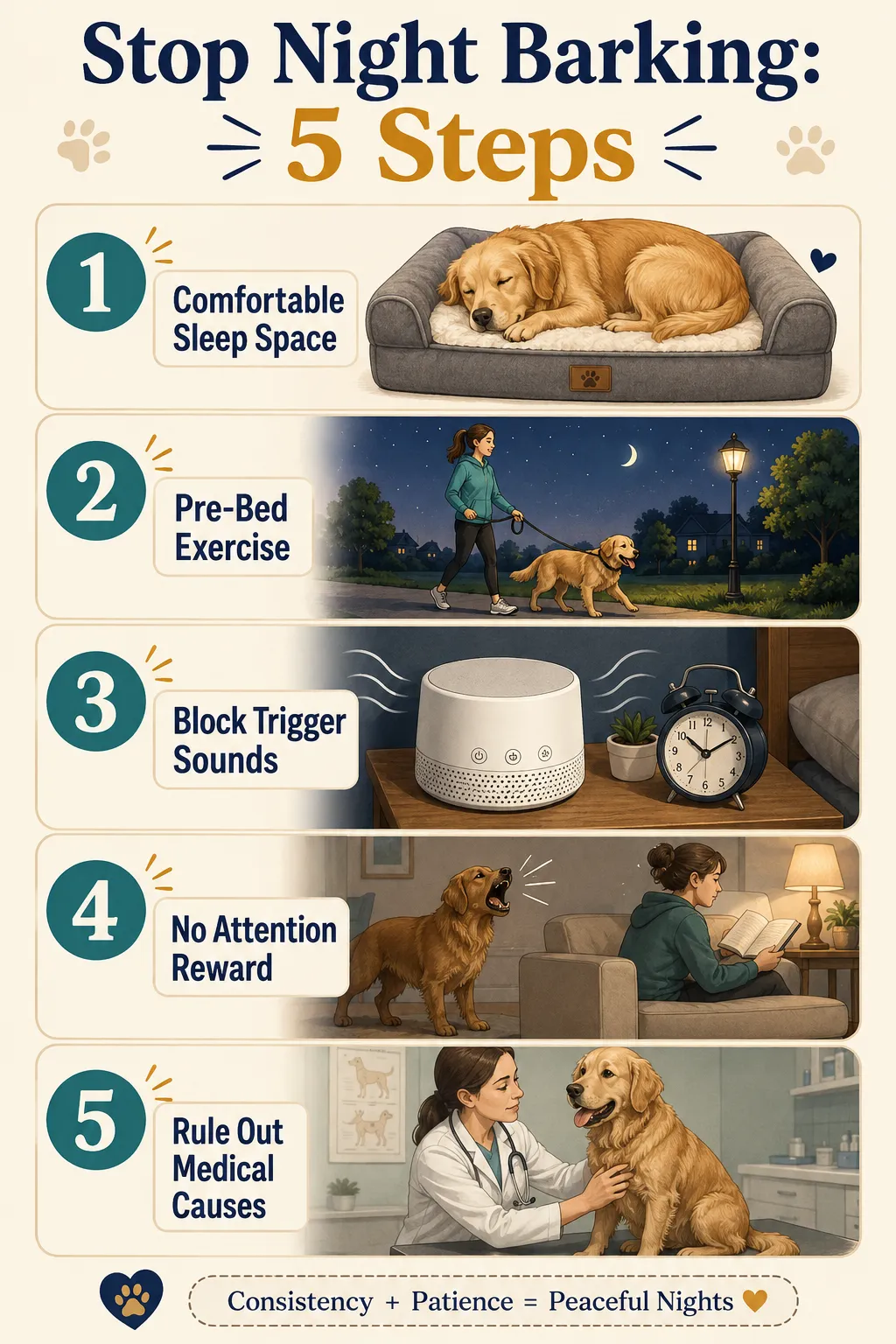
Here’s a practical approach:
Step 1 – Rule out medical causes first. If your dog is older or the barking started suddenly, see a vet before trying behavioral fixes.
Step 2 – Build a pre-bed routine. Exercise, a bathroom break, and a calm wind-down period help dogs settle. This alone reduces nighttime barking in many dogs.
Step 3 – Improve the sleep environment. Comfortable beds matter. Heated dog beds and outdoor heated cat beds (if you have a cat sharing the space) help pets feel secure. Products like heated dog beds from brands like K&H Pet Products are popular options. A crate with a familiar blanket can also help dogs feel safe.
Step 4 – Use white noise. Masking environmental triggers like loud noises from outside is one of the fastest fixes for alert barkers.
Step 5 – Don’t reward the barking. Going to your dog every time they bark teaches them that barking works. Instead, wait for a pause in the barking before offering any attention or care.
Step 6 – Teach the quiet command. Learn how to teach your dog the quiet command – it’s one of the most effective training tools for barking.
Step 7 – Consider professional help. If training and environmental changes don’t work after 2-3 weeks, a certified dog trainer or veterinary behaviorist can help.
For a broader approach to reducing barking, our guide on how to stop dogs from barking without yelling or punishment covers the full picture.
Do Certain Dog Breeds Bark More at Night?
Yes – some dog breeds are significantly more prone to nighttime barking than others. Breeds developed for guarding, herding, or hunting tend to be more vocal at night because their instincts push them to alert, communicate, or stay active.
High-bark-risk breeds at night:
| Breed | Main Reason for Night Barking |
|---|---|
| Beagle | Scent-driven, howls to communicate |
| Husky | Pack vocalization, high energy |
| German Shepherd | Territorial, alert barking |
| Chihuahua | Anxiety-prone, reactive |
| Dachshund | Hunting instinct, alert to sounds |
| Border Collie | High energy, boredom at night |
If you have one of these dog breeds, a consistent training routine and sufficient daytime exercise are especially important. Pedigree UK’s dog behavior guide recommends breed-specific approaches to managing nighttime barking.
Does Age Affect How Much Dogs Bark at Night?
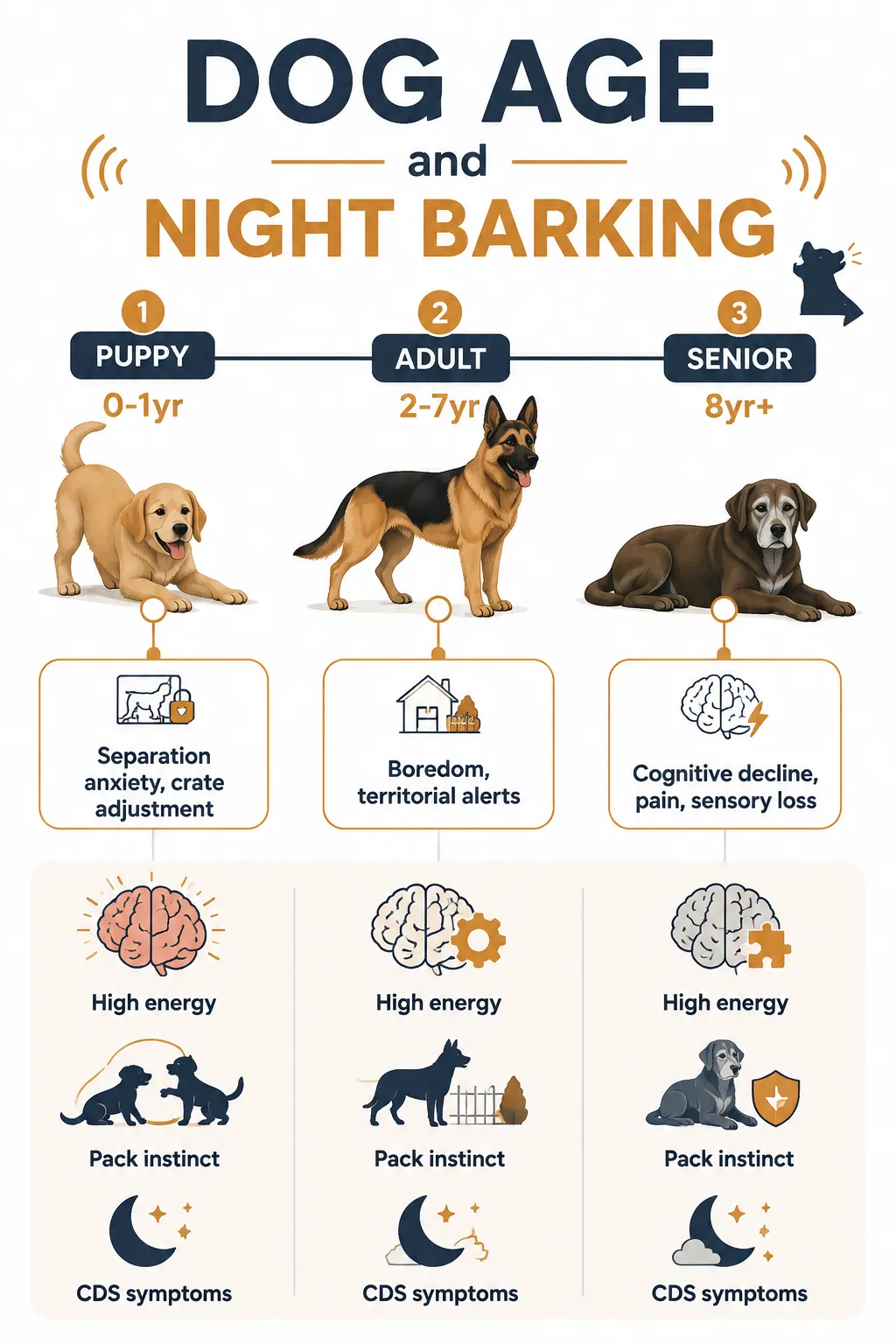
Age plays a major role in nighttime barking behavior. Puppies, adult dogs, and senior dogs all bark at night for different reasons.
- Puppies (0-12 months): Bark and cry at night due to separation from their mother, crate anxiety, and unmet needs like hunger or a full bladder
- Adult dogs (1-7 years): Bark due to boredom, territorial behavior, or learned attention-seeking habits
- Senior dogs (8+ years): Bark due to cognitive decline, pain, sensory loss, or disrupted sleep cycles
SheKnows’ pet care feature notes that senior dog barking is often mistaken for behavioral problems when it’s actually a medical issue. Always rule out health causes in older dogs before starting a training program.
Dog Suddenly Barking at Night When They Didn’t Before
A dog that suddenly starts barking at night after months or years of quiet nights is sending a signal. Something has changed – either in their environment, their health, or their emotional state.
Common causes of sudden nighttime barking include:
- A new pet or baby in the home
- A move to a new house
- A change in your schedule (working night shifts, for example)
- A new animal in the neighborhood
- The onset of pain or illness
- A traumatic event like a loud storm or fireworks
Furpathy’s causes and solutions guide recommends keeping a simple log for 3-5 nights: note the time, duration, and anything unusual that happened that day. Patterns often emerge quickly.
How Much Is Too Much Barking for a Dog at Night?
Any barking that disrupts your sleep regularly, lasts more than 10-15 minutes at a stretch, or happens multiple times per night is worth addressing. There’s no official “3 bark rule” in veterinary science, but the general standard is that occasional alert barking is normal – persistent, repetitive barking is not.
PetSafe’s nighttime barking guide notes that dogs barking more than 2-3 times per night consistently, or for more than a few minutes at a time, suggests an unmet need or underlying issue that deserves attention.
Dog Barking at Night Disturbing Neighbors – What to Do
If your dog’s nighttime barking is affecting neighbors, act quickly – both for your relationships and because noise complaints can escalate to local ordinances.
Immediate steps:
- Talk to your neighbors before they complain – it builds goodwill
- Start the pre-bed routine and white noise approach right away
- Bring outdoor dogs inside at night if possible
- Use amp pet products like anti-bark collars only as a last resort and only after consulting a vet
If you have an outdoor dog, check our guide on how to keep your outside dog warm – discomfort from cold is a common and overlooked reason dogs bark at night outdoors.
Dog Barking at Night: Anxiety or Medical Issue?
Distinguishing between anxiety and a medical cause is the most important diagnostic step. Both can look similar from the outside, but the treatment is completely different.
Signs it’s anxiety:
- Barking starts when you leave or go to bed
- Dog settles when you return or respond
- Younger dog with no other symptoms
- Barking tied to specific sounds or events
Signs it’s medical:
- Sudden onset in an older dog
- Dog seems confused or disoriented
- Restlessness, inability to get comfortable
- Other symptoms like limping, changes in appetite, or excessive thirst
When in doubt, a veterinary visit is always the right call. A good veterinary clinic – like Borash Veterinary Clinic, which covers this topic in detail – will help you rule out physical causes before you start a behavior modification program.
Conclusion
Understanding why do dogs bark at night is the first step to actually fixing it. Most nighttime barking has a real, identifiable cause – whether it’s a dog reacting to street sounds, expressing anxiety, dealing with pain, or simply not getting enough exercise during the day.
Your action plan:
- Tonight: Add white noise near your dog’s sleeping area and skip the late-night attention if they bark
- This week: Add a 20-30 minute exercise session before bed and check for signs of pain or discomfort
- If barking persists: Book a veterinary appointment to rule out medical causes
- Long term: Invest in consistent training – the calm dog method is a great place to start
Dogs bark because it works – or because something is wrong. Your job is to figure out which one it is, and then respond accordingly. With the right care, most dogs can learn to sleep quietly through the night within a few weeks.
Frequently Asked Questions
Should you ignore a dog barking at night?
It depends on the cause. If your dog is barking for attention and you’ve already ruled out medical issues, ignoring the behavior is the right approach – responding rewards the bark. But if the barking is new, sudden, or accompanied by other symptoms, ignoring it could mean missing a pain or health issue. Always rule out medical causes first before choosing to ignore nighttime barking.
Why does my dog keep barking at 3am?
3am is peak activity time for nocturnal wildlife like raccoons, foxes, and opossums. Your dog’s sensitive hearing picks up movement, scent, or sounds from these animals that you can’t detect. It’s also a time when ambient noise is lowest, making distant sounds easier for dogs to hear. If it happens consistently, check for wildlife activity near your home and use white noise to mask the triggers.
What is the 3 bark rule?
The “3 bark rule” is an informal training guideline used by some trainers: allow your dog to bark up to three times to acknowledge a trigger, then redirect with a “quiet” command and reward silence. It’s not an official veterinary or training standard, but it gives dogs an outlet for natural alert behavior while setting a clear limit. Consistency is what makes it work – the rule only helps if applied every time.
How do I get my dog to stop barking at night?
Start by identifying the trigger – anxiety, boredom, pain, or environmental sounds. Then: establish a pre-bed exercise and bathroom routine, use white noise to block outside sounds, make sure your dog has a comfortable sleep space with proper beds, and teach the quiet command through consistent training. Never reward barking with attention. If the problem persists after 2-3 weeks, consult a veterinary professional or certified dog trainer.