

Last updated: August 14, 2026
Quick Answer: You can teach your dog not to run away by building a rock-solid recall command, practicing door manners, and using long-line training to proof behavior before going off-leash. Consistent positive reinforcement, daily mental stimulation, and layered physical security work together to keep your dog safe. Most dogs show real improvement within 2-4 weeks of daily practice.
Key Takeaways
- A strong “come” command is the single most important skill for preventing a dog from bolting
- Dogs escape for specific reasons – prey drive, boredom, fear, or mating instinct – and each needs a targeted fix
- Never practice off-leash recall in an unsecured area until your dog has a near-perfect response on a long line
- Door and gate rituals (the “wait” command) stop most escape attempts before they start
- High-value treats, not corrections, build the fastest and most reliable recall
- Neutering or spaying reduces roaming behavior significantly in many dogs
- Older dogs can absolutely learn not to run away – it just takes a bit more patience
- Separation anxiety and boredom are often the hidden root causes of escape behavior
Why Do Dogs Run Away in the First Place?
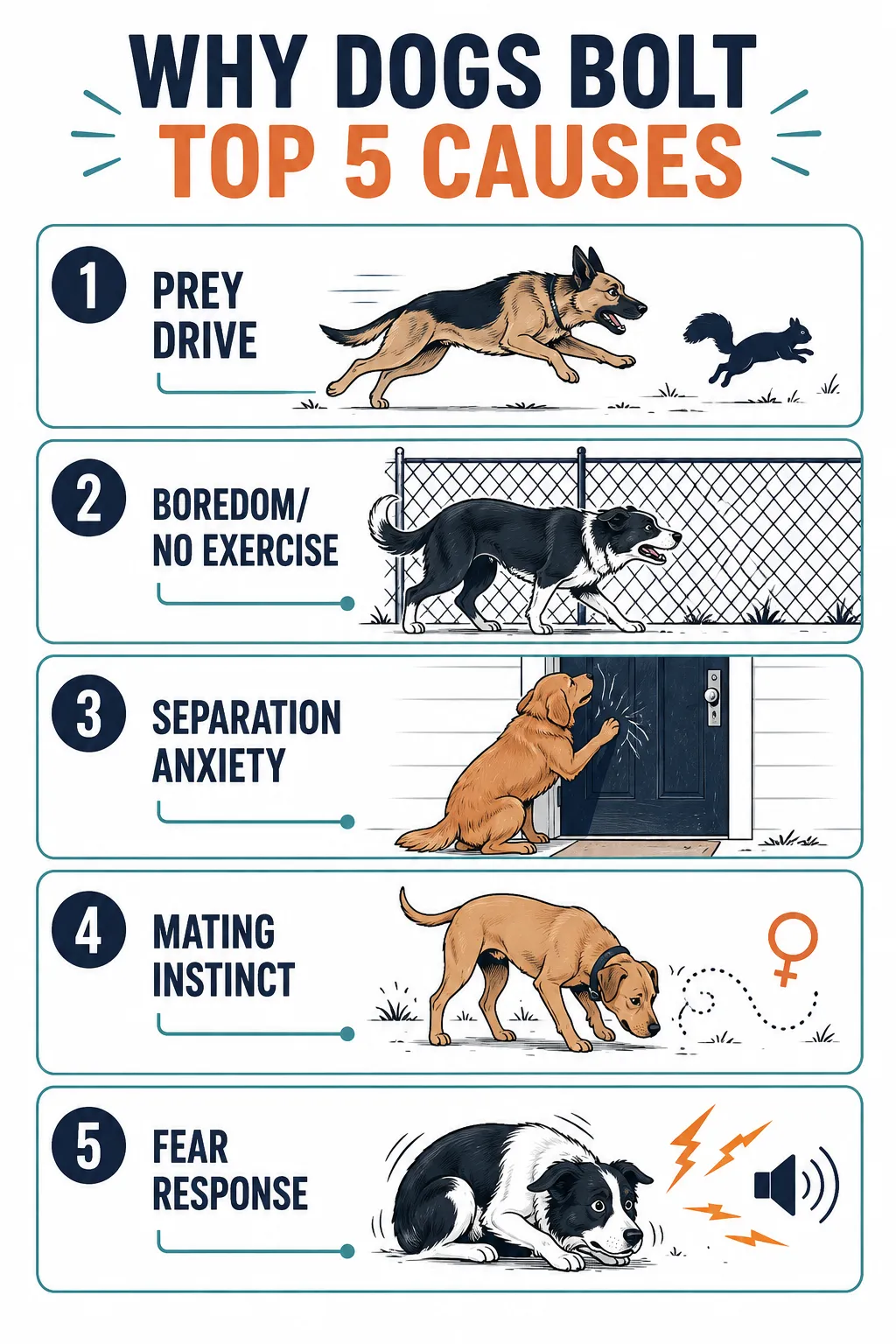
Understanding why your dog bolts is the first step in figuring out how to teach your dog to not run away. Dogs don’t escape out of spite or stubbornness – they run because something in the environment is more rewarding or more frightening than staying home.
According to research on why dogs run away, the most common triggers include:
- Prey drive – a squirrel, rabbit, or fast-moving car can trigger an instinctive chase response that overrides all training
- Boredom and under-exercise – a dog with too much energy and not enough stimulation will find his own entertainment, often through escape
- Separation anxiety – some dogs bolt the moment a door opens because being away from their owner feels unbearable (check out these 12 stressed dog signs most owners miss to see if anxiety is driving the behavior)
- Mating instinct – intact males especially will roam to find a mate, sometimes traveling miles
- Fear response – loud noises like fireworks or thunderstorms can send a dog through a fence or out an open door
“A dog that runs away isn’t being bad. He’s being a dog. Your job is to make staying with you more rewarding than anything out there.”
Once you know your dog’s escape trigger, you can target your training more precisely.
🐾 Want to fast-track the whole process? This free dog training workshop uses the same methods service dog trainers rely on – it covers recall, door manners, and stopping bad behaviors, all in one place.
How Do I Know If My Dog Has a Strong Prey Drive?
A dog with high prey drive will fixate intensely on moving animals or objects, often freezing, stalking, and then lunging or chasing with zero hesitation. According to off-leash training experts, dogs with strong prey drive are among the hardest to recall once they’ve locked onto a target.
Signs your dog has strong prey drive:
- Stiffens and stares at birds, squirrels, or fast-moving objects
- Pulls hard on the leash toward animals
- Ignores treats, his name, and all commands once a target is spotted
- Has escaped before specifically to chase something
- Shows intense interest in small animals like cats or rabbits
Breeds with naturally high prey drive include Siberian Huskies, Greyhounds, Jack Russell Terriers, Beagles, and many terrier and hound breeds. If you have one of these, leash training a dog that pulls is a great companion skill to work on alongside recall.
The 7 “Invisible Leash” Secrets: How to Teach Your Dog to Not Run Away
These seven strategies work together as a system. Skip one and the others become less effective. Use all seven and you’ll have a dog that stays close not because he has to, but because he wants to.
Secret 1 – Build a Recall That Actually Works
The recall – teaching your dog to come when called – is the foundation of everything. Dog training guides consistently show that a reliable “come” command is the single most effective tool to stop a dog from running away.
Step-by-step recall training:
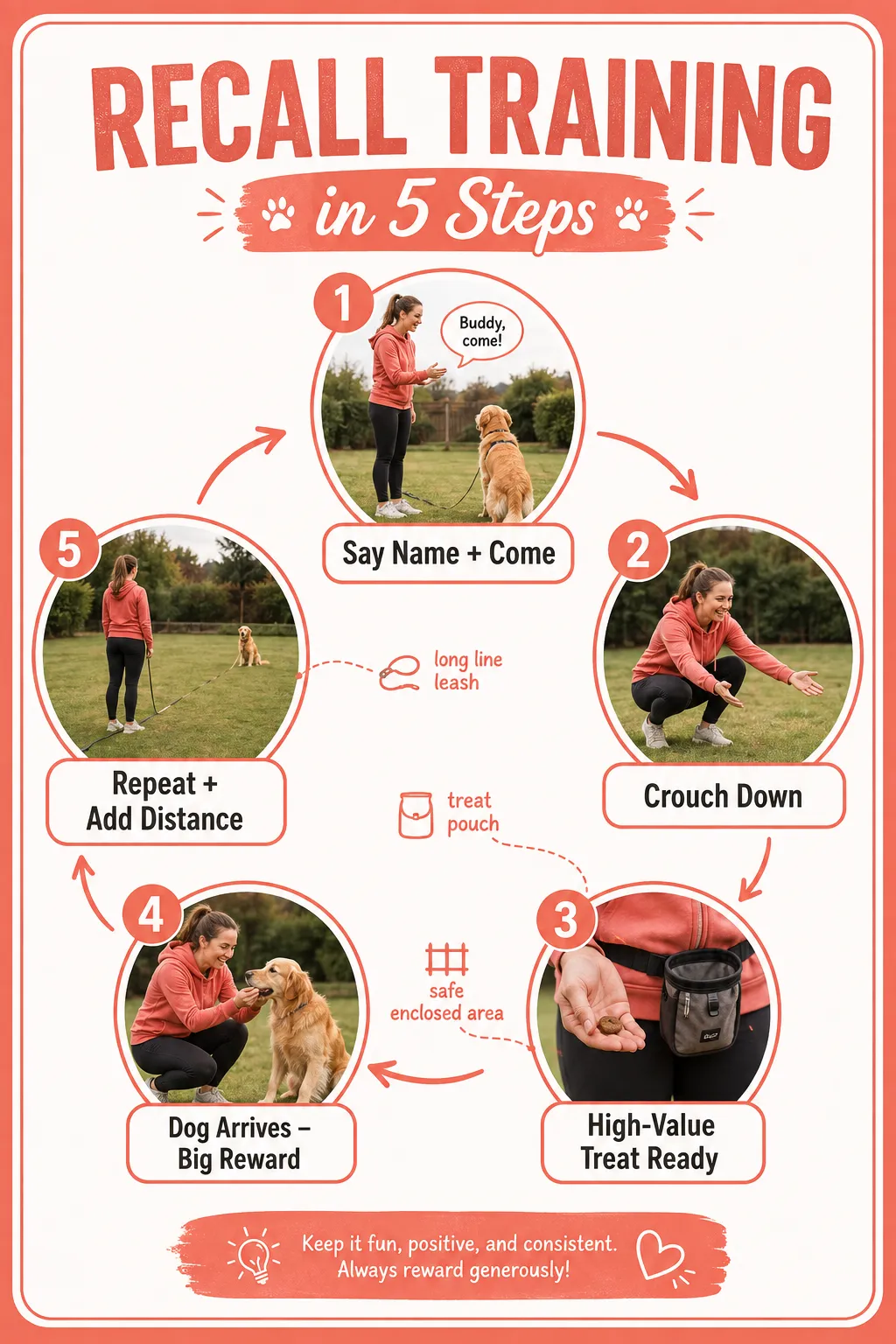
- Start indoors with zero distractions. Say your dog’s name followed by “come” in a happy, upbeat tone.
- The moment he moves toward you, crouch down and give him the highest-value treat you have – think real chicken, cheese, or hot dog.
- Make it a party every single time he arrives. Clap, praise, give multiple treats. Make him feel like coming to you is the best thing that ever happened.
- Repeat 10-15 times per session, keep sessions short (5-10 minutes), and do this 2-3 times a day.
- After 3-5 days of near-perfect indoor recall, move to the backyard or a low-distraction outdoor space.
- Attach a long line (15-30 feet) and practice the same way, using the leash as a safety net – not as a tool to drag him to you.
Common mistake: Calling your dog to you and then doing something he doesn’t like (bathing, nail clipping, ending playtime). This poisons the recall. If you need to do something unpleasant, go get him instead of calling him.
Secret 2 – Master Door and Gate Rituals
Most dog escape attempts happen through a door or gate. Teaching your dog to wait at every door before going through is one of the fastest ways to prevent bolting. Humane World for Animals recommends making the “wait” command a non-negotiable part of every exit routine.
How to teach door manners:
- Ask your dog to sit before you open any door
- Use the “wait” command as you slowly open the door
- If he moves toward the door, calmly close it and ask him to sit again
- Only give the release cue (“okay” or “free”) after he has held the wait for 3-5 seconds
- Practice this every single time, with every door – front door, car door, back gate
The goal is that your dog waits automatically, without being asked, because waiting has always been rewarded and bolting has always meant the door closes.
Secret 3 – Use a Long Line Before Going Off-Leash
A long line (a lightweight leash of 15-30 feet) is the bridge between on-leash and off-leash freedom. Experts in off-leash training consistently recommend that dogs should have a near-perfect recall on a long line in multiple environments before being given true off-leash freedom.
The long line lets your dog feel the freedom of running and exploring while giving you a safety net. You can step on it if needed, but the goal is never to use it – just to have it there.
Secret 4 – Teach Voluntary Check-Ins
A dog that regularly chooses to check in with you on his own – without being called – is a dog that’s unlikely to run off. You can teach this by rewarding every time your dog makes eye contact or comes back to you during off-leash time, even when you didn’t ask.
Carry high-value treats on every walk and every outdoor session. Any time your dog glances back at you or trots over voluntarily, give him a treat and enthusiastic praise. Over time, checking in with you becomes a habit he does naturally.
Secret 5 – Proof Recall Against Distractions Gradually
A dog that comes when called in the living room but ignores you at the park hasn’t really learned recall – he’s just learned to come when nothing interesting is happening. According to comprehensive dog training guides, proofing recall against distractions is what separates a reliable recall from a fragile one.
Distraction proofing steps:
- Start with low distractions (quiet yard) and build to moderate (neighborhood walk) and high (dog park, near animals)
- Never skip levels – if your dog fails at a distraction level, go back one step
- Use your highest-value treats only for high-distraction environments
- Keep sessions short and end on a success
Secret 6 – Address the Root Cause of Escape
If your dog keeps trying to escape, there’s a reason. Fixing the behavior without fixing the cause is like putting a bandage on a broken leg.
- Bored dog? Increase exercise, add puzzle feeders, try activities for bored dogs to burn mental energy
- Separation anxiety? Work on gradual desensitization to being alone – check out the calm dog method for a structured approach
- Intact male roaming? Talk to your vet about neutering – studies show that intact males are significantly more likely to roam than neutered ones
- Fear-based bolting? Work with a certified trainer on desensitization to the specific trigger
Secret 7 – Layer Your Physical Security
Training is essential, but physical barriers are your backup system. No dog’s training is 100% reliable in every situation, and a dog that escapes even once is at serious risk. Dog safety experts recommend a layered approach: good fencing plus training plus ID tags plus microchipping.
- Check your fence regularly for gaps, loose boards, or digging spots
- Use a double-gate system (two gates between your dog and the street)
- Keep your dog’s ID tag and microchip information up to date
- Consider a GPS tracker for dogs with a strong history of escape
Can You Train a Puppy Not to Run Away?
Yes, and starting early gives you a huge advantage. Puppies are naturally inclined to follow their owners and haven’t yet developed strong independent habits. Training guides for young dogs recommend starting recall training as early as 8 weeks old, using tiny treats and very short sessions.
Key tips for puppies:
- Keep sessions to 3-5 minutes maximum
- Use tiny, soft treats (puppy-sized portions)
- Never chase a puppy that runs away – crouch down and call him happily instead
- Make every recall a celebration
The top 10 dog commands guide covers the essential commands to teach alongside recall for a well-rounded training foundation.
Can You Train an Older Dog Not to Run Away?
Absolutely. Older dogs can learn not to run away – the process is the same as with younger dogs, just sometimes slower. The idea that you “can’t teach an old dog new tricks” is simply not true when it comes to recall and door manners.
Older dogs may have more deeply ingrained habits, so expect the process to take a bit longer – sometimes 4-8 weeks instead of 2-3. Be patient, keep sessions positive, and use extra-high-value rewards.
One thing to check: older dogs that suddenly start escaping when they didn’t before may be experiencing cognitive changes or a new anxiety. A vet visit is worth it to rule out medical causes.
What Breeds Are Most Likely to Bolt?
Some breeds were literally bred to run, chase, or roam, which makes recall training more challenging – but not impossible. The AKC notes that scent hounds, sight hounds, and working breeds have the strongest instinct to follow their nose or eyes regardless of commands.
Highest-risk breeds for bolting:
| Breed Type | Examples | Main Escape Trigger |
|---|---|---|
| Scent hounds | Beagle, Bloodhound | Following a scent trail |
| Sight hounds | Greyhound, Whippet | Chasing fast-moving animals |
| Nordic/working | Husky, Malamute | High energy, wanderlust |
| Terriers | Jack Russell, Airedale | Prey drive, digging |
| Herding breeds | Border Collie | Stimulation-seeking |
If you have one of these breeds, you’ll need to work harder on recall proofing and be extra careful about physical security. Off-leash freedom in unfenced areas may never be fully safe for some sight hounds regardless of training.
Why Does My Dog Ignore Me When He Sees a Squirrel?
This is prey drive in action, and it’s one of the most frustrating parts of dog training. When a dog locks onto a prey animal, his brain essentially floods with arousal hormones that make him temporarily unable to process commands. Off-leash training specialists explain that at high arousal levels, a dog literally cannot hear or process your voice the same way he does when calm.
The fix is not to yell louder or punish him. The fix is to:
- Practice recall at low arousal levels until it’s automatic
- Gradually introduce mild distractions and reward heavily for responding
- Work up to higher-distraction environments very slowly
- Use a long line in any environment where squirrels, rabbits, or other animals might appear
You can also work on a “watch me” or “leave it” command to interrupt the fixation before it escalates. This pairs well with 8 genius hand signals to train your dog faster.
How Long Does It Take to Train a Dog Recall?
Most dogs can learn a basic recall in 1-2 weeks of daily practice. A truly reliable recall – one that works in high-distraction environments – typically takes 2-4 months of consistent training. Dog training experts emphasize that recall is never really “done” – it needs ongoing maintenance and practice throughout your dog’s life.
Realistic timeline:
- Week 1-2: Reliable recall indoors and in the backyard
- Week 3-4: Reliable recall in low-distraction outdoor environments
- Month 2-3: Reliable recall with moderate distractions (other dogs, people)
- Month 3-4+: Reliable recall in high-distraction environments (parks, near animals)
🐾 If you’re serious about building a reliable recall fast, this free dog training workshop teaches the same proven methods used by professional service dog trainers – covering everything from basic commands to off-leash reliability.
Before and After: Door Dashing vs. Door Waiting
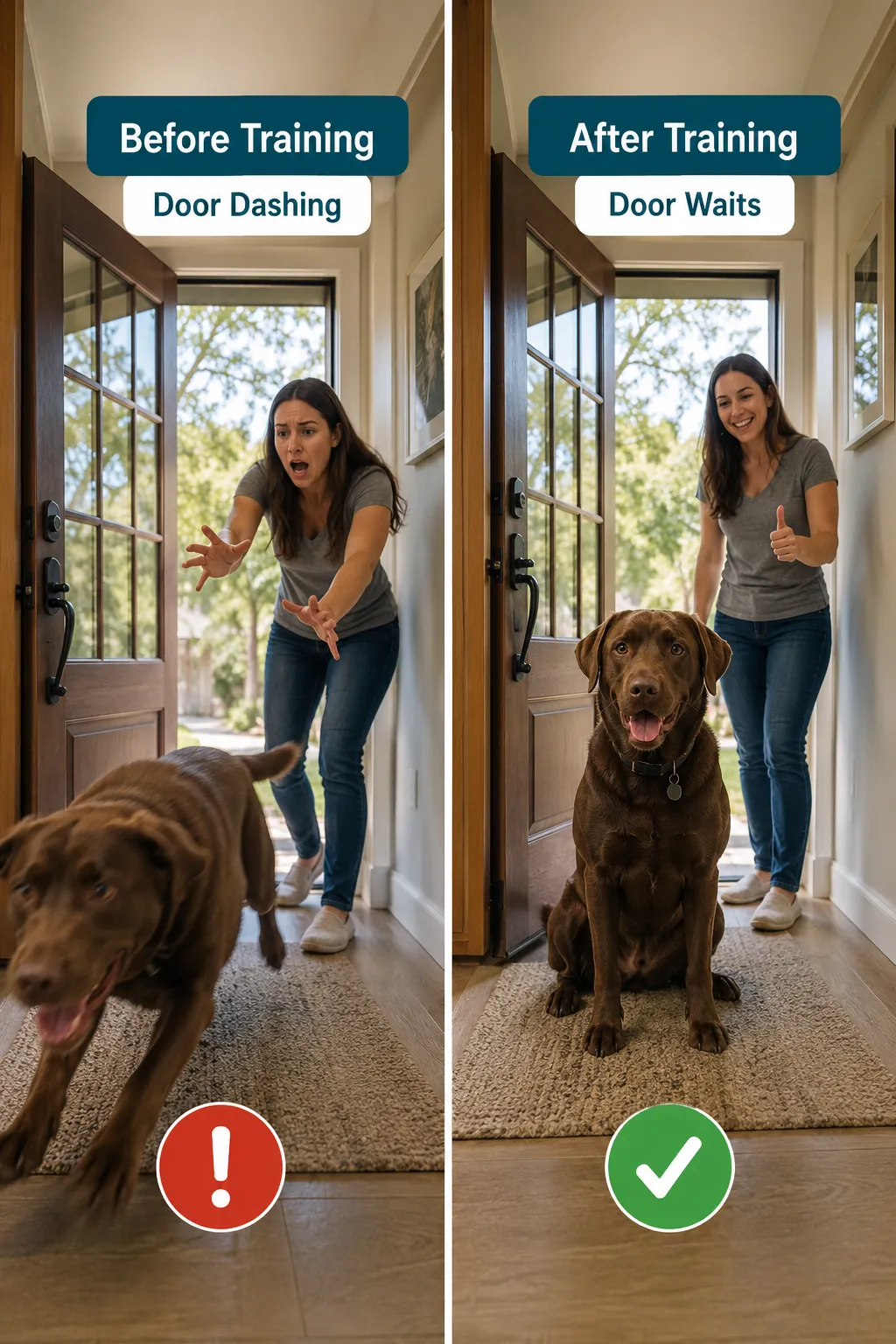
Teaching your dog to wait at an open door is one of the most practical safety skills you can give him. A dog that waits at the door without bolting is safer at home, safer getting in and out of the car, and safer at any gate or entrance.
How to practice door manners step by step:
- Ask your dog to sit near the door
- Say “wait” and slowly open the door just a few inches
- If he stays, give a treat and slowly open it more
- If he moves toward the door, calmly close it and start again – no scolding
- Build up to opening the door fully while he holds the wait
- Add a release cue so he knows when it’s okay to go through
- Practice with the front door, back door, car door, and any gate
Repeat this process daily until the wait at the door becomes automatic. This single step prevents a huge percentage of escape attempts.
Best Collar or Harness to Prevent Dogs From Escaping
The right equipment can make a real difference, especially while you’re still working on training. Dog welfare organizations recommend choosing equipment based on your dog’s escape style.
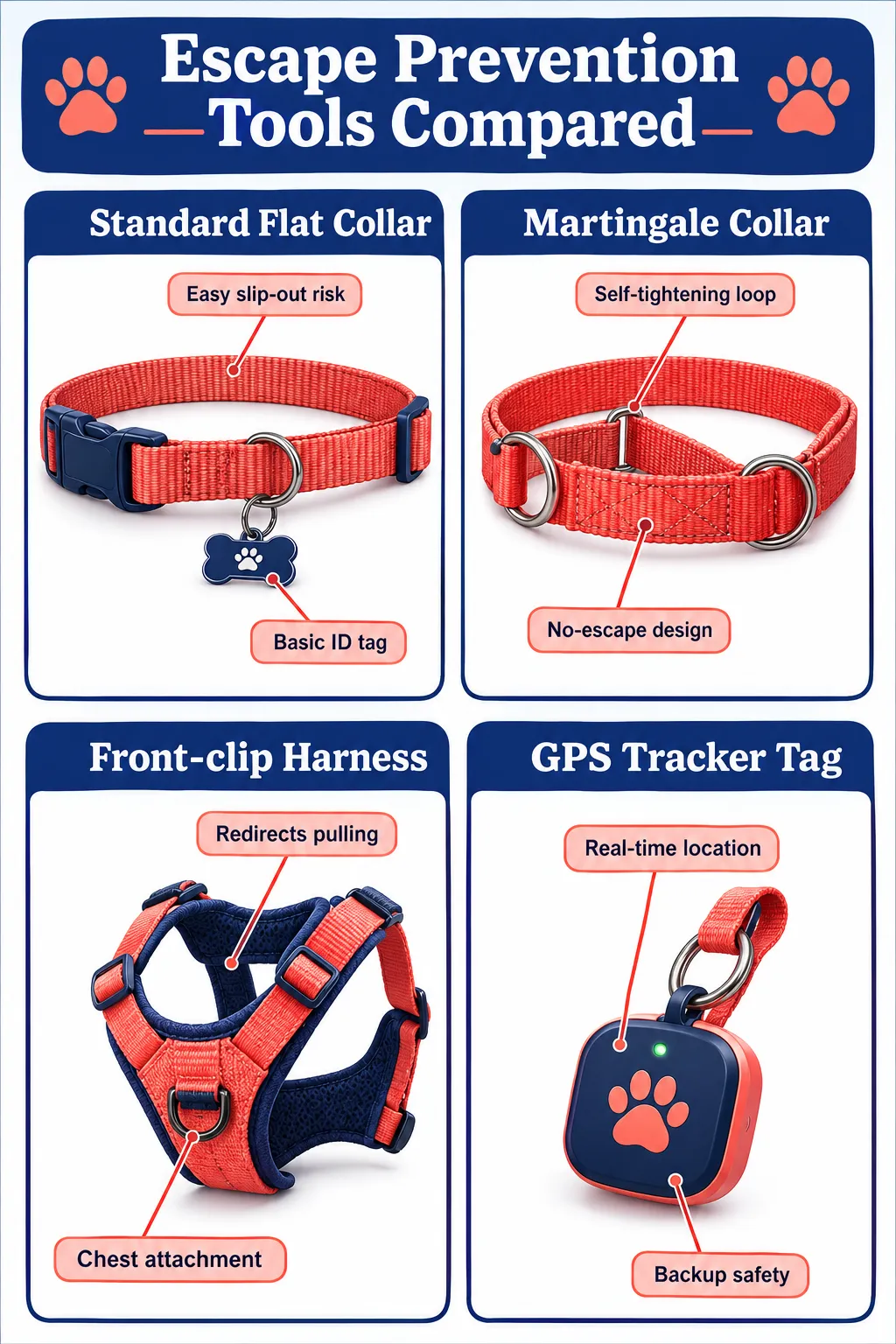
- Martingale collar – tightens slightly when the dog pulls, making it much harder to slip out of. Great for dogs with narrow heads (Greyhounds, Whippets)
- Front-clip harness – redirects pulling to the side, reducing the force of a bolt and giving you more control
- GPS tracker tag – not a prevention tool, but an essential backup for dogs that do escape
- Double-clip leash – clips to both collar and harness for extra security during high-risk situations
Avoid retractable leashes in high-traffic or high-distraction areas. They give too much distance and too little control when a dog decides to run.
What’s the Difference Between an Invisible Fence and Training?
An invisible fence uses a buried wire and a receiver collar to give your dog a static correction when he approaches the boundary. Training builds an internal “stay close” instinct through positive reinforcement. Both can help keep a dog in the yard, but they work very differently.
Key differences:
- An invisible fence doesn’t stop other animals from coming in, and a highly motivated dog may run through it anyway
- Training builds a genuine bond and reliable response that works in all environments, not just your yard
- Invisible fences can cause anxiety in some dogs, especially those already prone to fear
- Training takes more time upfront but creates a more reliable and humane long-term result
The Humane World for Animals and most animal welfare organizations recommend training and physical fencing over electronic containment systems as the primary safety strategy.
What Should I Do If My Dog Runs Away?
Act quickly and stay calm. Dog escape experts recommend the following immediate steps when your dog gets out:
- Don’t chase him – running after a dog usually makes him run faster. Instead, run away from him or crouch down to appear less threatening
- Open the car door – many dogs will jump in a familiar car voluntarily
- Bring high-value treats and shake the bag or container
- Alert neighbors and post on local lost pet groups immediately
- Contact local shelters and animal control within the first hour
- Check the area at dawn and dusk – lost dogs often move more at these times
- Leave a worn piece of clothing near where he was last seen – the scent can help him find his way back
Having a current microchip and ID tag dramatically increases the chances of getting your dog back safely.
Do Shock Collars Help With Dogs Running Away?
Shock collars (also called e-collars) are sometimes marketed as a solution for dogs that run away, but the evidence and expert consensus lean strongly against them for this purpose. Animal welfare organizations note that punishment-based tools can increase anxiety and fear, which are often the root causes of escape behavior in the first place.
More practically: a shock collar may stop a dog momentarily, but it doesn’t teach him what to do instead. Positive reinforcement recall training – where coming back to you is the best thing that ever happened – creates a far more reliable and lasting response.
If you’re having trouble affording professional training or pet health and safety resources, the partnership with animal welfare groups and free online resources can be a great starting point before investing in equipment.
How to Practice Recall Training Safely
Safe recall practice means controlling the environment so your dog can succeed and you can reward him, without the risk of him actually running away. Off-leash training guides consistently recommend using only secure areas and private hire fields for off-leash practice until recall is fully reliable.
Safe practice environments:
- Fully fenced backyard
- Rented private dog fields (available through apps like Sniffspot)
- Empty tennis courts with the gate closed
- Any securely fenced area with no gaps
Safety checklist before removing the leash:
- Dog has near-perfect recall on a 30-foot long line in this environment
- You have high-value treats ready
- No visible distractions (other dogs, squirrels) in the immediate area
- You have a backup plan (long line still attached) if needed
Never practice off-leash recall near roads, open fields, or anywhere your dog could run into traffic.
Is My Dog Too Stubborn to Learn to Stay?
No dog is too stubborn to learn – but some dogs need a different approach. “Stubborn” usually means the reward isn’t high enough, the sessions are too long, or the dog has learned that ignoring you has no real consequence.
Try these fixes:
- Upgrade your treats – use real meat (chicken, beef, hot dog) instead of dry kibble
- Shorten sessions – 3-5 minutes is enough for most dogs, especially at first
- Make it fun – use a happy voice, crouch down, run away from him to make him chase you
- Check for medical issues – hearing problems or pain can make a dog appear “stubborn”
For dogs that seem to have a harder time with impulse control, teaching your dog to lay down first can help build the foundation for a reliable stay.
FAQ
Can you train a dog to not run away?
Yes, you can absolutely train a dog not to run away. The most effective approach combines a strong recall command, door and gate manners, long-line proofing, and addressing the root cause of escape behavior (boredom, prey drive, anxiety). Most dogs show significant improvement within 2-4 weeks of consistent daily training using positive reinforcement.
What is the 7 7 7 rule for dogs?
The 7-7-7 rule is a socialization guideline for puppies: expose them to 7 different surfaces, 7 different locations, and 7 different people within their first few weeks of life. It’s designed to build confidence and reduce fear-based behaviors – including the kind of fear that can cause a dog to bolt. While it’s primarily a puppy tool, the principle of gradual, positive exposure applies to training dogs of any age.
What is the hardest command to teach a dog?
Most trainers agree that a reliable recall in high-distraction environments is the hardest command to fully proof. The “stay” command under distraction is a close second. Both require hundreds of repetitions across many environments before they become truly reliable. The difficulty isn’t in teaching the concept – it’s in building the habit so strong that it overrides competing instincts like prey drive or the urge to escape.
Do dogs that run away usually come back?
Many dogs do find their way home, but it’s not guaranteed and the risk of injury is significant. Research and shelter data suggest that microchipped dogs are returned to their owners at a much higher rate than those without identification. Dogs are more likely to return if they know their home area well, if the owner searches actively, and if the dog is posted on local lost pet networks quickly. Don’t rely on your dog coming back – act immediately if he escapes.
Conclusion
Learning how to teach your dog to not run away is one of the most valuable things you can do as a dog owner. It’s not about control for its own sake – it’s about keeping your dog safe in a world full of cars, predators, and dangers he doesn’t understand.
The 7 “invisible leash” secrets work because they address the problem from every angle: building a recall your dog actually wants to respond to, teaching door manners that prevent escape attempts, using long-line training to proof behavior safely, and fixing the root causes that make a dog want to bolt in the first place.
Your action steps starting today:
- Pick one high-value treat and start recall practice indoors for 5 minutes
- Begin asking your dog to sit and wait before every door opening
- Identify your dog’s main escape trigger and address it directly
- Get a long line if you don’t have one – it’s the safest bridge to off-leash freedom
- Check your fence and gates for any gaps or weak points
🐾 Ready to take your training further? This free dog training workshop covers housebreaking, stopping bad behaviors, and building the kind of obedience you see in service dogs – using the exact same methods the pros use. It’s a great next step after you’ve started the basics.
The goal isn’t a dog that can’t run – it’s a dog that doesn’t want to, because being with you is the best place he knows.