

Last updated: August 23, 2026
Quick Answer: Dogs can detect things humans cannot – from early-stage cancer and seizures to incoming storms and emotional distress – using a sense of smell estimated to be up to 100,000 times more powerful than ours. These aren’t myths. Peer-reviewed research now backs many of the things dogs know before humans do, and learning to read your dog’s signals could genuinely matter for your health and safety.
Key Takeaways
- 🐾 Dogs can smell volatile organic compounds (VOCs) linked to cancer, Parkinson’s disease, and COVID-19 – often before symptoms appear
- 🐾 Trained dogs predicted epileptic seizures 10-45 minutes in advance in controlled studies
- 🐾 Dogs sense barometric pressure drops and seismic changes that precede storms and earthquakes
- 🐾 A dog that won’t leave your side may be responding to real physiological changes in your body
- 🐾 Dogs read micro-expressions, body language, and scent cues to detect your emotional state
- 🐾 “Staring at nothing” often means your dog is hearing or smelling something you can’t detect
- 🐾 Dog intuition is real, but not every behavior is a warning – context and patterns matter
- 🐾 You can learn to recognize your dog’s specific alert signals with consistent observation
- 🐾 Some dog breeds are more naturally attuned to medical or environmental detection than others
- 🐾 Trusting your dog’s reactions to people or situations is often well-founded, but should be paired with your own judgment
What Can Dogs Sense That Humans Can’t?
Dogs experience the world through an entirely different sensory lens. Their noses contain roughly 300 million olfactory receptors, compared to about 6 million in humans. That’s not a small gap – it’s a completely different level of biological capability.
Beyond smell, dogs hear frequencies up to 65,000 Hz (humans top out around 20,000 Hz). They also pick up on infrasound – very low-frequency vibrations – and can detect subtle changes in the Earth’s electromagnetic field, according to research into animal behavior before natural disasters.
Here’s a quick breakdown of what dogs can sense that we simply can’t:
- Chemical changes in sweat, breath, urine, and skin caused by illness or stress
- Infrasound and ultrasound outside the human hearing range
- Barometric pressure drops that signal incoming weather
- Micro-vibrations in the ground before seismic events
- Emotional hormones like cortisol and adrenaline released during fear or anxiety
Can Dogs Predict Earthquakes or Storms? Things Dogs Know Before Humans Do
Yes – there’s real scientific evidence that dogs and other animals change their behavior before earthquakes and storms, though the exact mechanism is still being studied.
Research from the Max Planck Institute of Animal Behavior tracked farm animals with accelerometers and found they showed increased restlessness up to 20 hours before earthquakes. Dogs showed the most pronounced changes closest to the epicenter.
The leading theories for how dogs sense these events:
- Barometric pressure drops – Dogs feel pressure changes in their ears and sinuses well before humans notice the sky darkening
- Infrasound – Earthquakes produce low-frequency sound waves that travel far ahead of the actual tremor
- Ground vibrations – Subtle P-waves (primary seismic waves) arrive before the destructive S-waves, and dogs may feel them through their paws
- Static electricity – Changes in the Earth’s electromagnetic field before seismic activity may be perceptible to dogs
The CDC has also noted that pet behavior changes before disasters are worth paying attention to, even if they can’t be used as a reliable prediction system.
What to watch for: Sudden restlessness, pacing, whining, hiding, or refusing to go outside – especially when the weather looks fine to you.
Can Dogs Smell Cancer or Medical Conditions Before Symptoms Show?
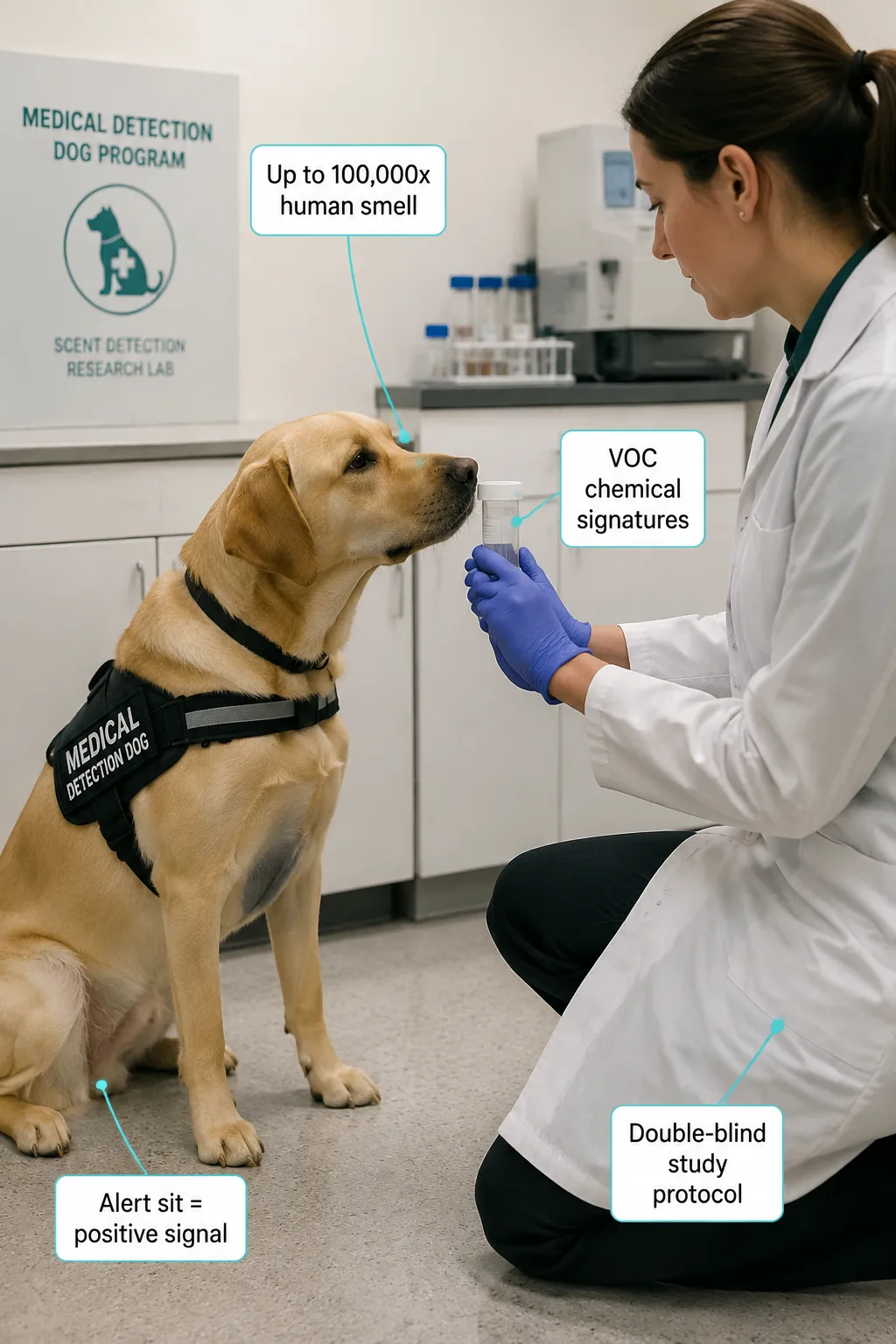
This is one of the most well-documented things dogs know before humans do. Trained dogs can detect cancer, Parkinson’s disease, COVID-19, and other conditions by identifying unique chemical signatures in body fluids and breath.
A 2025 double-blind study published in the Journal of Parkinson’s Disease found that trained dogs could distinguish sebum samples from people with and without Parkinson’s disease with up to 80% sensitivity and 98% specificity – even in patients who had other health conditions. That level of specificity is remarkable for any diagnostic tool.
For COVID-19, a review published in PMC found dogs achieved 65-100% sensitivity and 76-99% specificity across multiple studies – often identifying infected individuals before they felt sick or tested positive by conventional methods.
A 2025 review in Frontiers in Medicine confirmed that trained dogs can detect cancers, Parkinson’s, and COVID-19 by sensing VOC signatures in breath, urine, and sweat – often matching or exceeding standard diagnostic tests.
Conditions dogs have been trained to detect:
| Condition | Detection Method | Accuracy Range |
|---|---|---|
| Various cancers | Breath/urine VOCs | High (varies by study) |
| Parkinson’s disease | Skin sebum VOCs | 80% sensitivity, 98% specificity |
| COVID-19 | Sweat/breath | 65-100% sensitivity |
| Hypoglycemia (diabetes) | Breath/sweat | Clinically validated |
| Epileptic seizures | Sweat changes | 10-45 min advance warning |
If your dog keeps sniffing a specific spot on your body repeatedly, that’s worth noting. It doesn’t mean you have cancer – but it’s a signal worth mentioning to your doctor.
Signs Your Dog Knows You’re Sick Before You Do
Dogs don’t need formal training to react to illness in their owners. Even untrained pet dogs pick up on physiological changes through scent, behavior, and routine disruption.
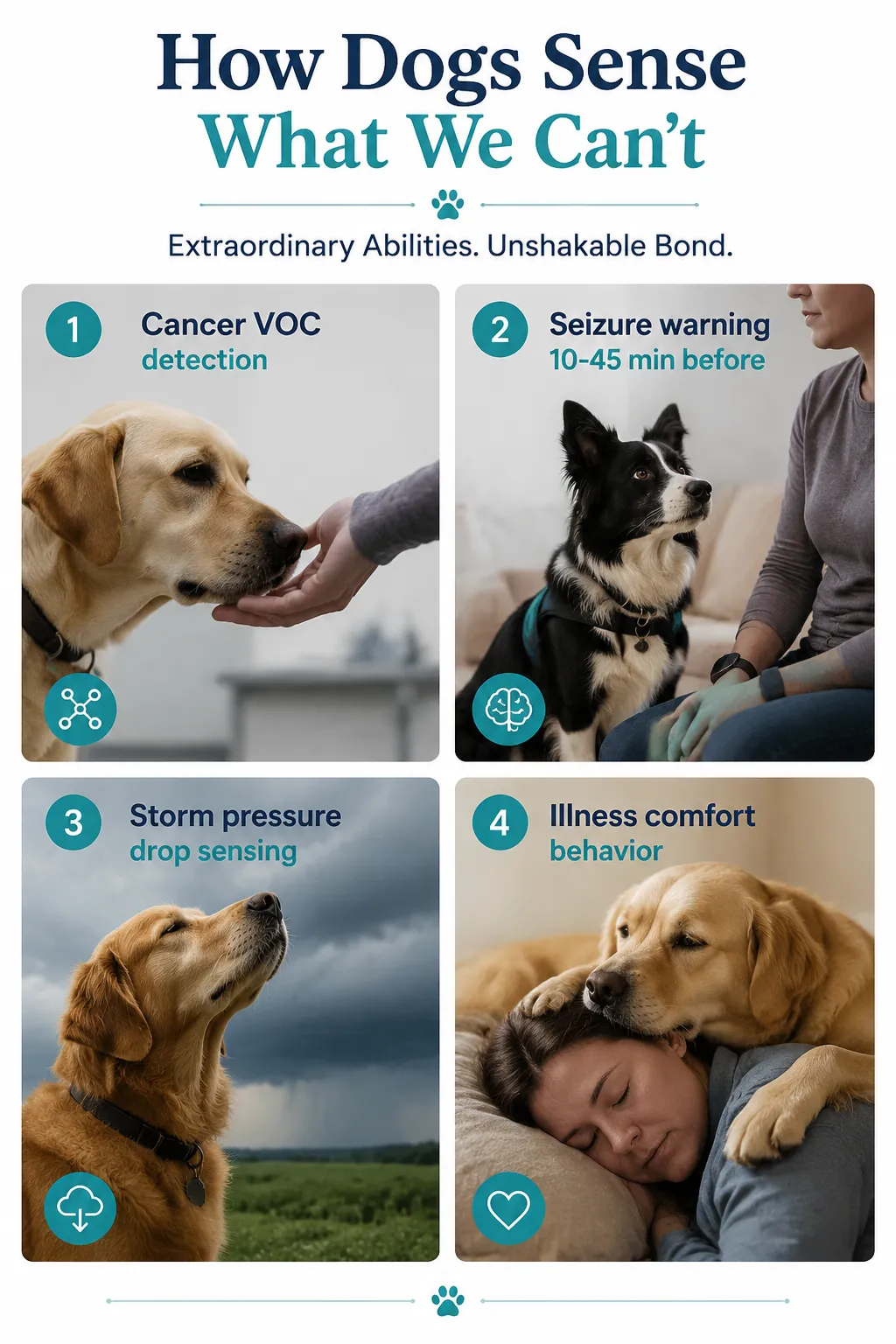
Here are the most common signs your dog may know something is off before you do:
- Excessive sniffing of a specific body part or area
- Refusing to leave your side – more than usual
- Whining or nudging you repeatedly without an obvious cause
- Laying on or near the affected area of your body
- Acting anxious or unsettled when you feel “fine” but something’s slightly off
- Staring at you with intense, sustained focus
If you notice a sudden change in your dog’s behavior toward you – especially if it’s consistent and focused – pay attention. It’s not always something serious, but dogs have flagged real health issues in their owners long before any test confirmed it.
For more on how dogs communicate discomfort and concern, check out these 10 early signs of pain in dogs every owner should recognize – understanding your dog’s signals goes both ways.
Can Dogs Predict Anxiety or Panic Attacks – and Do They Sense Death?
Yes to both, and the mechanism is the same: scent. Dogs detect the hormonal and chemical shifts that happen in the human body during emotional and physiological crises.
During a panic attack, your body releases adrenaline and cortisol, your heart rate spikes, and your breathing changes. Dogs smell these changes. Many owners report their dogs becoming alert, pressing close, or pawing at them minutes before a full panic attack hits – before the person themselves feels it coming.
For epilepsy, the evidence is even more specific. Research published in Epilepsy & Behavior found that trained dogs could predict seizures from sweat cues, providing accurate warnings 10-45 minutes before events.
On sensing death: Dogs appear to detect the physiological changes that occur as the body shuts down – changes in smell, temperature, and body chemistry. Hospice workers and palliative care staff frequently report that dogs and cats become unusually attentive to patients in their final hours. This isn’t mystical – it’s likely olfactory.
What to watch for before a panic attack:
- Dog suddenly moves very close to you
- Pawing at your leg or arm
- Whining softly with focused eye contact
- Refusing to move away even when asked
Why Does My Dog Stare at Nothing Sometimes?
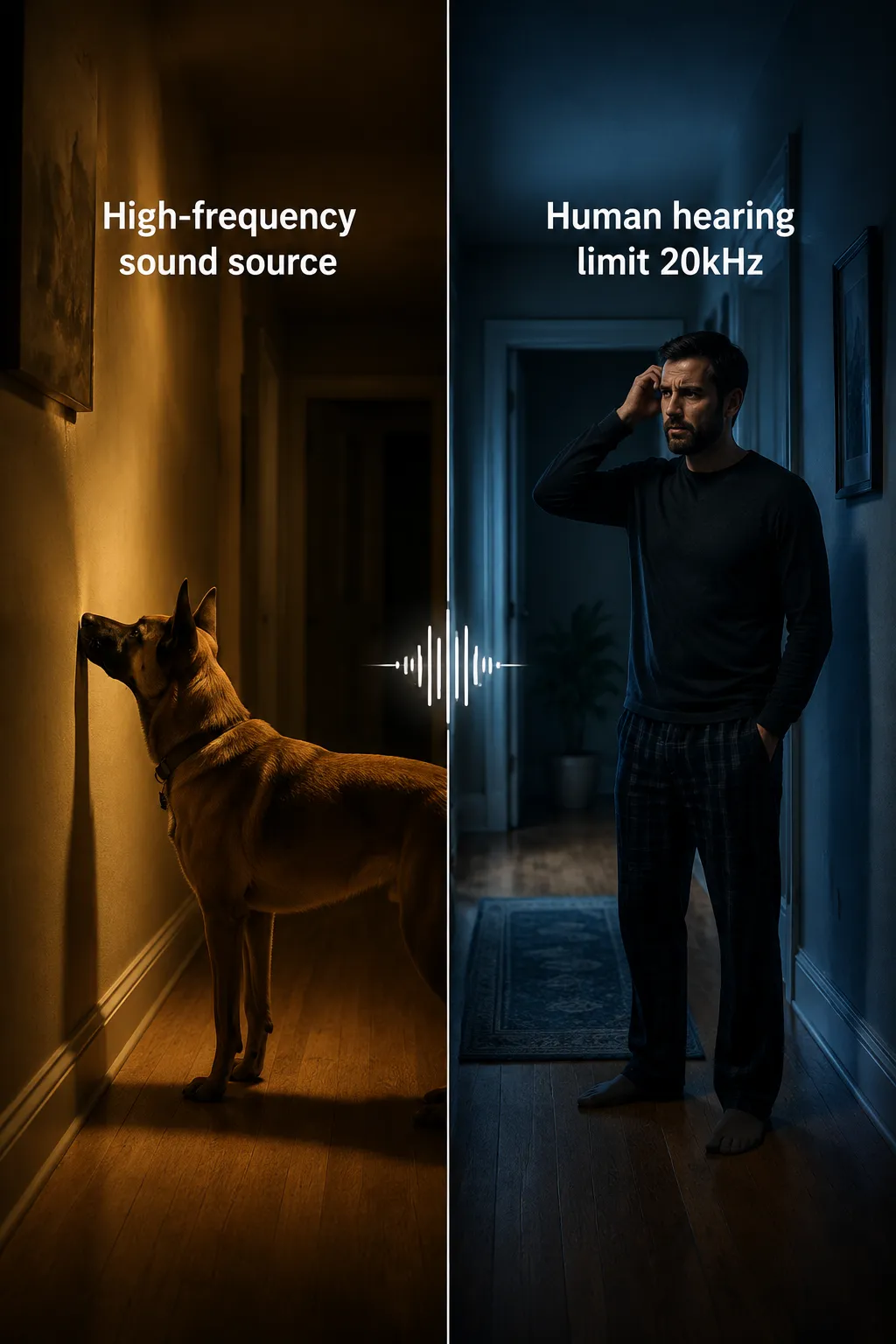
Your dog isn’t seeing ghosts. When a dog stares at a blank wall or empty corner, they’re almost certainly hearing or smelling something you can’t detect.
Dogs hear sounds at frequencies and distances far beyond human capability. A mouse inside a wall, a high-pitched electronic hum from a device, a sound from outside the house – these are all completely inaudible to you but crystal clear to your dog.
They may also be smelling something through the wall – another animal, a gas leak, or even mold. If your dog stares at the same spot repeatedly, it’s worth investigating.
Curious about this behavior? Our detailed guide on why dogs bark at nothing covers the sensory science behind these reactions in more depth.
When to investigate:
- Staring at the same spot repeatedly over days
- Combined with whining, pawing, or scratching at the area
- Near gas lines, plumbing, or exterior walls
How Do Dogs Know When Their Owner Is Coming Home?
This is one of the most fascinating things dogs know before humans do, and it’s been studied seriously. The most credible explanation is scent – specifically, the fading of your scent at home throughout the day.
Your smell lingers on furniture, clothing, and in the air. As hours pass, that scent concentration decreases. Dogs may track this as a kind of clock – when your scent drops to a certain level, they anticipate your return. This would explain why dogs seem to “know” even when owners vary their return time.
Some researchers also point to routine and circadian rhythm – dogs are highly attuned to daily patterns. A combination of scent, routine, and possibly low-frequency sounds from your car or footsteps at a distance likely all play a role.
Why Do Dogs Bark at Things We Can’t See or Hear?
Dogs bark at things we can’t perceive because their sensory range is genuinely wider than ours. This isn’t anxiety or bad behavior in most cases – it’s your dog responding to real stimuli.
Common triggers for “unexplained” barking:
- Ultrasonic sounds from electronics, pest repellers, or distant machinery
- Animals in walls, attics, or underground
- People or animals approaching from a distance before you can see them
- Infrasound from weather systems, traffic, or geological activity
- Scent trails left by animals that passed through hours ago
If your dog barks at night specifically, our guide on why dogs bark at night and the 7 bizarre triggers breaks down the most common causes.
What Does It Mean When a Dog Won’t Leave Your Side?
A dog that suddenly becomes your shadow – more than usual – is often responding to something real. Dogs don’t become clingy without reason.
Possible explanations:
- They smell a health change in you (illness, hormonal shift, pregnancy)
- They sense your emotional distress even if you’re masking it
- They’re picking up on environmental stress cues (tension in the home, a storm coming)
- They themselves are unwell or anxious – it’s not always about you
The key word is “suddenly.” If your dog has always been velcro-like, that’s just their personality. But a notable shift in clinginess, especially combined with other alert behaviors, is worth paying attention to.
If your dog seems anxious alongside the clinginess, check out these 12 stressed dog signs most owners miss to rule out anxiety as the driver.
What’s the Difference Between Dog Intuition and Coincidence?
This is a fair and important question. Not every strange dog behavior is a warning sign, and it’s easy to find patterns that aren’t there after the fact.
Signs it’s likely real detection:
- The behavior is consistent and repeatable in similar situations
- It’s focused (sniffing one specific spot, not general restlessness)
- It precedes the event, not just accompanies it
- Multiple people observe the same behavior
Signs it might be coincidence:
- It happened once and was never repeated
- The behavior is vague (general anxiety, not targeted)
- Your dog is already anxious or has a history of stress-related behaviors
- You’re pattern-matching after the fact
A PBS Nature report on animal prediction notes that while animal behavior changes before disasters are documented, distinguishing true prediction from coincidence requires careful, repeated observation.
The honest answer: dog intuition is real, but confirmation bias is also real. Track your dog’s behaviors in a journal if you want to know if there’s a genuine pattern.
Should I Trust My Dog’s Reactions to People or Situations?
Your dog’s reaction to a new person or situation is worth taking seriously – but it shouldn’t be the only factor in your decision.
Dogs read micro-expressions, body language, scent, and tone of voice simultaneously. They often pick up on subtle social cues that humans consciously overlook. If your dog consistently reacts negatively to a specific person, that’s data.
However, dogs can also react to fear, unfamiliar smells (like another animal on someone’s clothes), or past trauma. A negative reaction isn’t always about that person’s character.
A practical approach:
- Take note of consistent reactions, not one-off events
- Consider context (is your dog generally anxious around strangers?)
- Use your dog’s reaction as one input, not a verdict
- If your dog is fearful in general, work with a trainer before relying on their social signals
How to Respond When Your Dog Seems to Know Something You Don’t
The best thing you can do is pay attention and act on patterns, not single events.
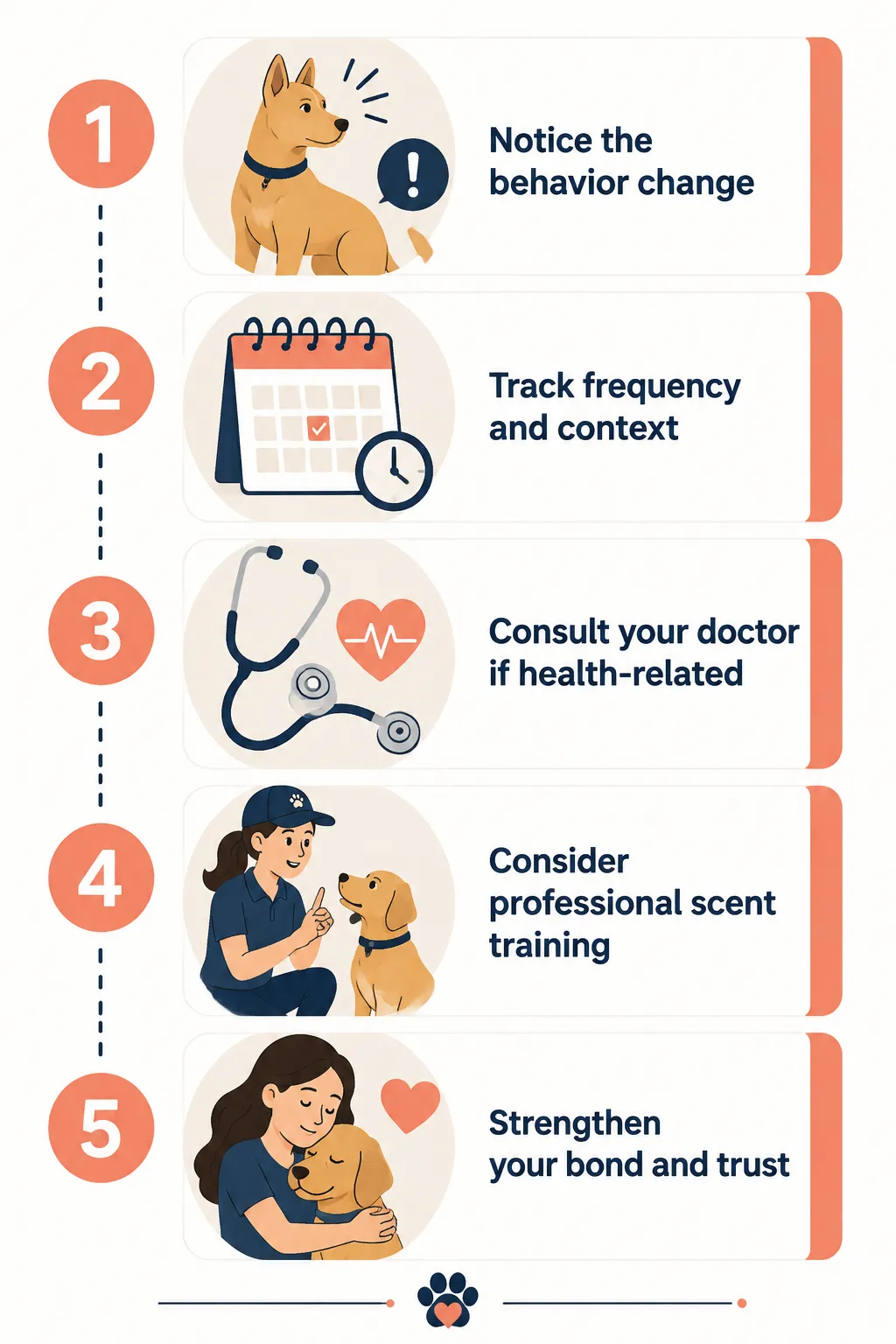
Here’s a practical approach:
- Observe without dismissing. When your dog behaves unusually, note it instead of brushing it off.
- Track the behavior. Write down what happened, when, and what followed. Patterns become clear over time.
- Check the environment first. Unusual barking or staring? Look for pests, gas smells, or sounds before assuming something medical.
- Talk to your doctor if it’s health-related. If your dog keeps sniffing a specific body part or won’t leave your side during an illness, mention it at your next appointment.
- Consider professional training. If you want your dog to reliably alert you to medical conditions, formal scent training with a certified trainer is the right path.
Understanding your dog’s stress signals is a big part of this. Our guide on stress signals in dogs and 9 warning signs can help you tell the difference between a dog that’s alerting you and one that’s just anxious.
FAQ
Can any dog detect medical conditions, or only trained ones?
Any dog may react to physiological changes in their owner through scent, but trained medical detection dogs are far more reliable and consistent. Untrained dogs can alert, but you shouldn’t depend on it as a diagnostic tool.
What breeds are best at medical or environmental detection?
Breeds with the strongest scent drives – Bloodhounds, German Shepherds, Labrador Retrievers, and Belgian Malinois – are most commonly used in detection work. But any dog with a healthy nose can pick up on changes.
How far in advance can dogs detect an incoming storm?
Dogs often show behavioral changes 30 minutes to several hours before a storm, depending on how sensitive they are to barometric pressure and how severe the incoming weather is.
My dog sniffs my arm every morning. Should I be worried?
Not necessarily. Dogs sniff as a greeting and habit. What matters is a change – if your dog suddenly starts sniffing a specific spot obsessively and repeatedly, that’s more notable than a general morning sniff.
Can dogs really smell cancer?
Yes, in controlled studies with trained dogs. Untrained pet dogs may also react to cancer-related odor changes, but this is anecdotal. Don’t use your dog’s behavior as a substitute for medical screening.
Why does my dog act weird when I’m stressed, even if I’m hiding it?
Because you can’t fully hide it from a dog. Your cortisol levels, heart rate, and even the chemical composition of your sweat change when you’re stressed – and your dog smells all of it.
Is it normal for a dog to predict seizures without training?
Some dogs do this naturally. It’s called “spontaneous seizure alerting” and it’s been documented. If your dog consistently alerts before your seizures, a certified trainer can formalize and reinforce that behavior.
What should I do if my dog keeps staring at the same spot on the wall?
Check for pests, plumbing leaks, or unusual sounds first. If the behavior persists and you can’t find a cause, have the area inspected professionally – dogs have flagged gas leaks and pest infestations this way.
Can dogs sense pregnancy before a test shows positive?
Many women report their dogs becoming more attentive or protective before they knew they were pregnant. This is plausible – hormonal changes in early pregnancy alter body chemistry and scent.
Do dogs sense their own death coming?
Dogs likely sense significant physiological decline in themselves, though whether they “understand” death the way humans do is unknown. Many dogs do become quieter and seek closeness with their owners near the end of life.
Conclusion
The things dogs know before humans do aren’t folklore – they’re increasingly backed by solid science. From detecting Parkinson’s disease in a skin sample to sensing a seizure 45 minutes before it happens, dogs are operating with sensory tools we simply don’t have.
The signs are often subtle: a dog that won’t stop sniffing one spot, a sudden shift to clinginess, restless pacing before a storm, or intense staring at a blank wall. These behaviors have real explanations rooted in biology.
Your next steps:
- Start a simple behavior journal – note unusual behaviors and what followed
- Learn your dog’s baseline so you recognize genuine changes
- If your dog repeatedly alerts to a specific body area, mention it to your doctor
- If you have a medical condition that could benefit from alert training (epilepsy, diabetes, PTSD), consult a certified medical alert dog trainer
- Keep reading about your dog’s communication – the more you understand them, the better you can respond
Dogs have been our companions for thousands of years. Part of that bond is learning to listen when they’re trying to tell us something.