

Last updated: October 7, 2026
Quick Answer: Start potty training a golden retriever puppy at 8 weeks old using a consistent outdoor schedule every 45-60 minutes during waking hours. Pair every successful outdoor trip with an immediate treat and verbal praise. Most golden retrievers show real progress within 7 days and reach reliable house training within 4-8 weeks with consistent effort.
Key Takeaways
- Start at 8 weeks old – the earlier you build the routine, the faster it sticks
- Take your puppy outside every 45-60 minutes during waking hours for the first two days
- Always go out after waking, eating, playing, and before bed
- Reward with a treat within 2 seconds of elimination outdoors – not when you get back inside
- Use a single consistent potty cue like “go potty” every time
- Crate training speeds up the process because puppies avoid soiling their sleeping space
- Accidents indoors mean less freedom, not punishment – roll back access for 3 days
- Use enzymatic cleaner on every indoor accident to remove scent completely
- Most golden retrievers are reliably house trained within 4-8 weeks
- Nighttime training requires a planned middle-of-the-night outing for puppies under 12 weeks
What’s the Best Age to Start Potty Training a Golden Retriever Puppy
The best age to start is the day your puppy comes home, typically around 8 weeks old. At this age, puppies can begin learning the association between going outside and getting rewarded, even though their bladder control is still developing.
Waiting until 12 or 16 weeks to start is one of the most common mistakes new owners make. Every week without structure is a week of reinforcing indoor elimination habits that are hard to undo.
According to golden retriever potty training guidance from Devoted to Dog, the most effective schedule starts from the very first day home, pairing every outdoor trip with consistent rewards and a fixed routine.
How Often Should a Golden Retriever Puppy Go Outside to Pee
A general rule: one scheduled outdoor trip per hour, per month of age. So an 8-week-old puppy needs to go out roughly every hour while awake, and a 4-month-old every 2 hours.
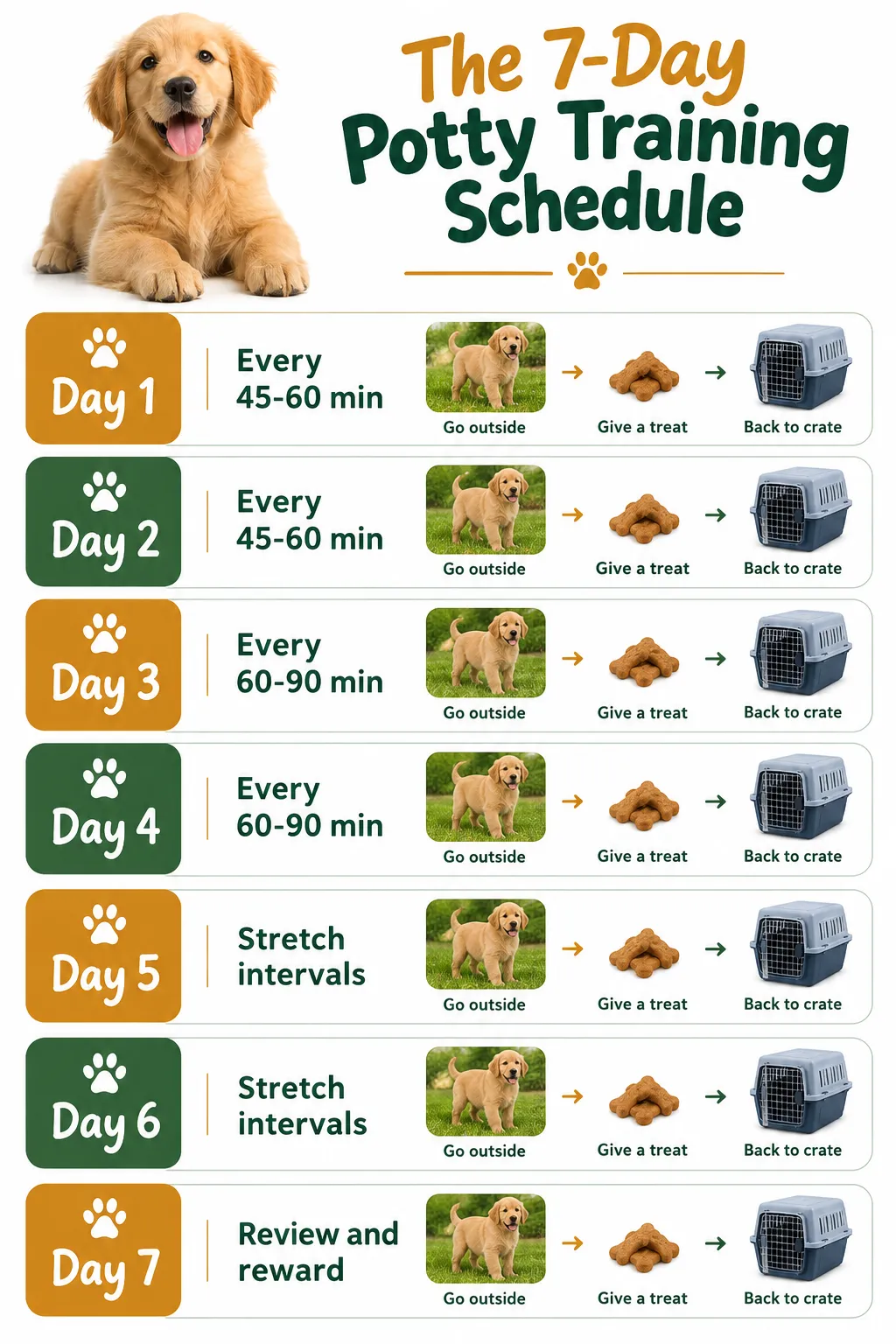
For the first two days specifically, aim for every 45-60 minutes during waking hours. After a few accident-free days, you can slowly stretch the interval.
Always take your puppy out:
- Immediately after waking (even from a short nap)
- Within 15-30 minutes of every meal
- After any play session
- Right before going into the crate
- Last thing before bed
This loop – potty, eat, play, potty, sleep – repeated throughout the day is the backbone of a successful golden retriever puppy training plan.
What’s the Difference Between Crate Training and Pad Training for Puppies
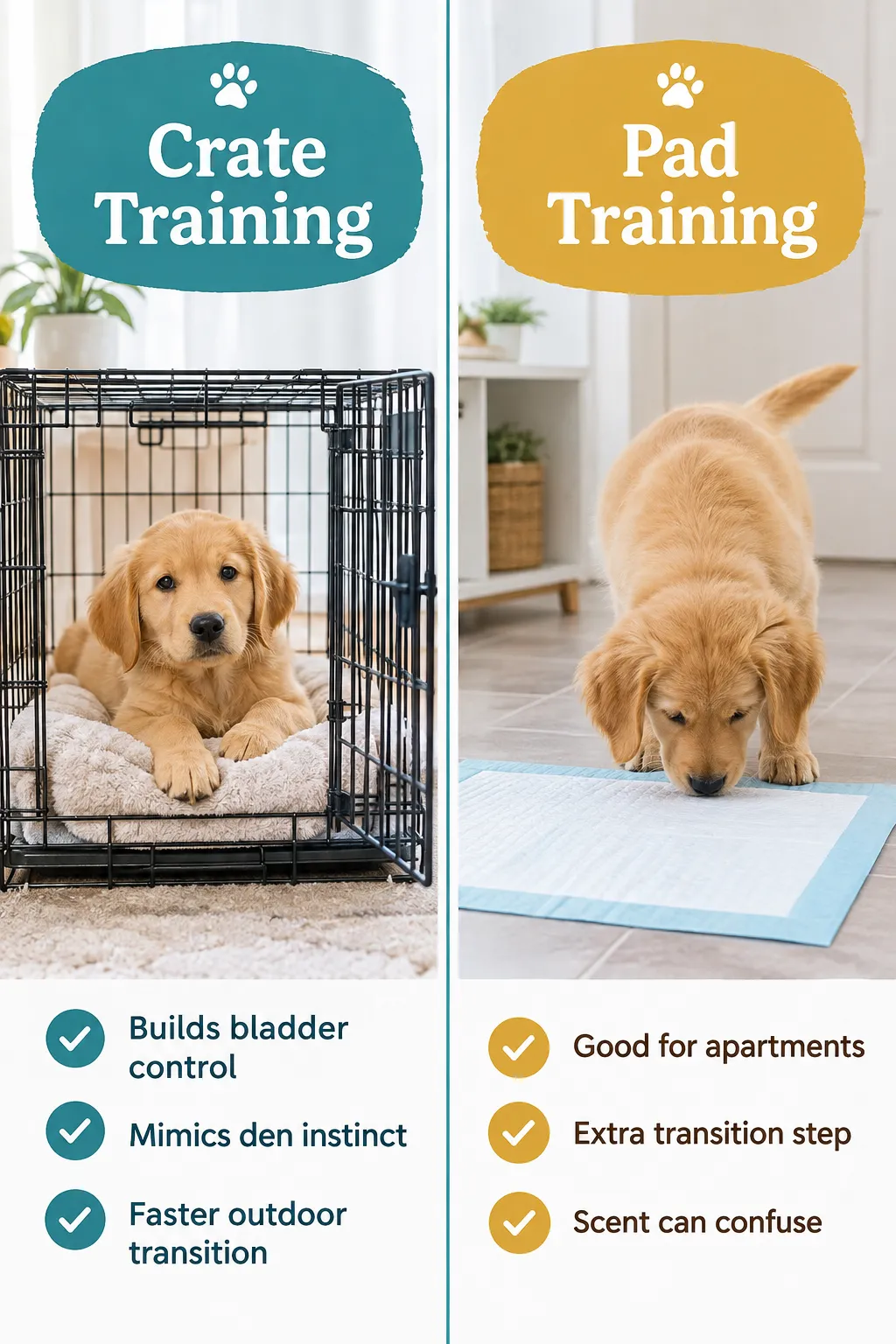
Crate training teaches a puppy to hold their bladder by using their natural instinct to keep their sleeping space clean. Pad training gives the puppy an indoor elimination option, which can be useful in apartments but adds an extra transition step later.
For most golden retriever owners with outdoor access, crate training is the faster route to full house training. Pads can create confusion because the puppy learns that going indoors is sometimes acceptable.
If you live in an apartment or have no immediate outdoor access, check out this apartment potty training method for a practical alternative.
Crate training vs. pad training – quick comparison:
| Factor | Crate Training | Pad Training |
|---|---|---|
| Speed to full house training | Faster (4-8 weeks) | Slower (requires second transition) |
| Best for | Homes with yard access | Apartments, high-rise living |
| Main benefit | Builds bladder control naturally | Flexible for busy schedules |
| Main downside | Requires strict supervision | Puppy may generalize “inside is okay” |
A 7-day crate training plan for golden retriever puppies emphasizes that every single crate release must lead directly outside before any play or interaction.
How Do I Know When My Golden Retriever Puppy Needs to Go Out
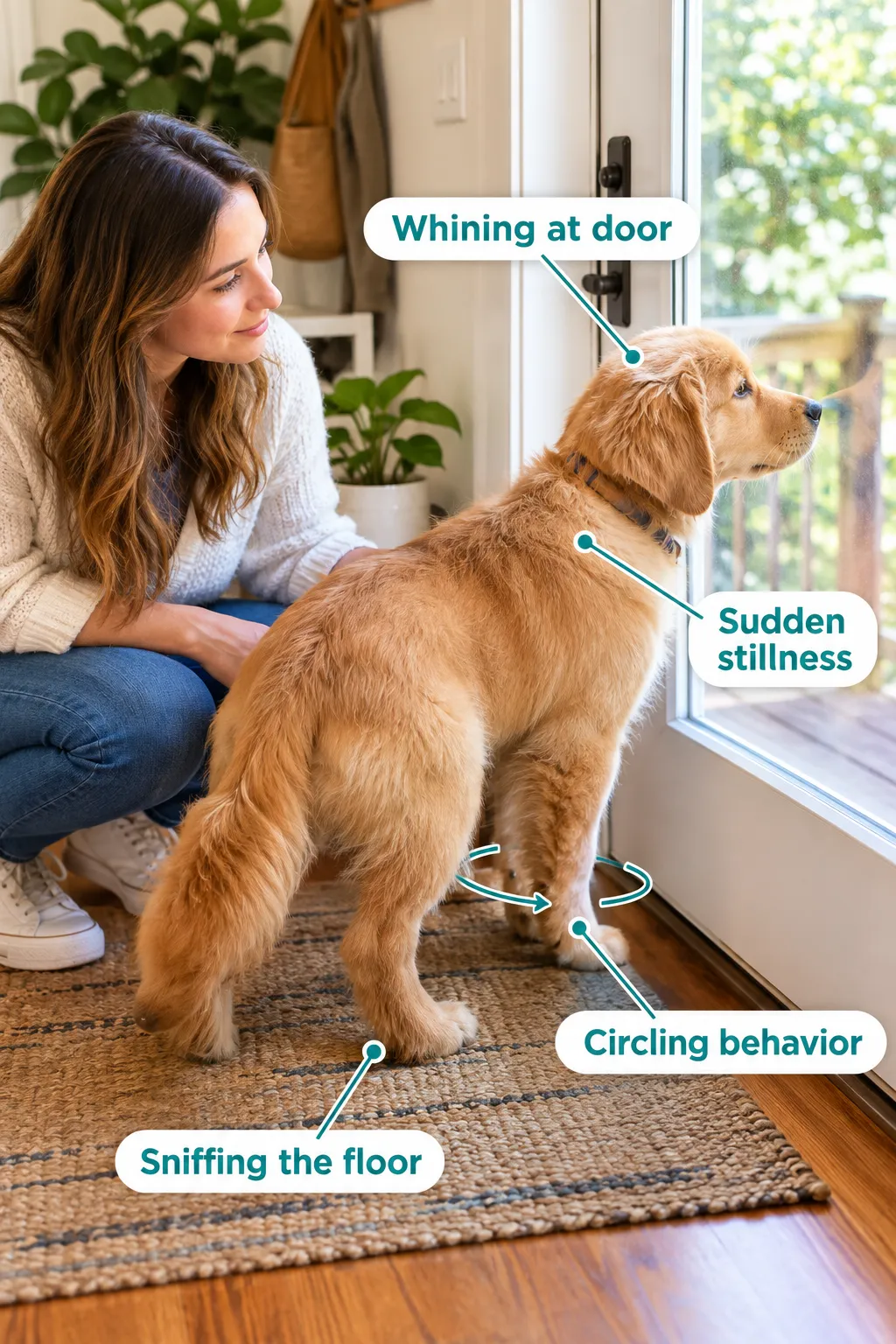
Watch for these signals and move quickly – puppies give about 30-60 seconds of warning before they go.
Signs your puppy needs to go out:
- Sniffing the floor in circles
- Suddenly stopping play and wandering off
- Whining or pawing at the door
- Squatting or starting to crouch
- Restlessness after a nap or meal
The more you watch your puppy in the first week, the faster you’ll learn their personal signals. Tethering your puppy to your waist with a short leash indoors is one of the most effective ways to catch these cues before an accident happens.
Should I Use Puppy Pads or Go Straight to Outdoor Training
For golden retrievers with yard access, go straight to outdoor training. Puppy pads work as a bridge but create an extra step – you’ll eventually have to teach the puppy that the pad is gone and outside is the only option.
If you do use pads temporarily, place them near the exit door and move them progressively closer to outside over 1-2 weeks. Never place them in multiple rooms, as this signals that any floor is acceptable.
For more ideas on setting up a dedicated outdoor spot, see these dog outside potty area ideas that make training more consistent.
What Supplies Do I Need to Potty Train a Puppy
You don’t need much, but the right supplies make a real difference.
Essential supplies:
- Crate – sized so the puppy can stand, turn, and lie down but not much more. Too large and they’ll use one corner as a bathroom.
- Enzymatic cleaner – critical for removing indoor accident odors. Regular cleaners leave scent traces that draw puppies back to the same spot.
- High-value treats – small, soft, and easy to deliver fast. Think pea-sized pieces of chicken or commercial training treats.
- Leash – for controlled outdoor trips so your puppy doesn’t get distracted before going
- Accident log – a simple notebook or phone note tracking when accidents happen helps you tighten the schedule
For a full list of what to have ready before your puppy comes home, the new puppy checklist of must-have supplies covers everything in one place.
What’s the Best Reward for Potty Training a Puppy
The best reward is a small, high-value treat delivered within 2 seconds of your puppy finishing elimination outdoors – not when you walk back inside.
Timing is everything. If you wait until you’re back in the kitchen to give the treat, your puppy connects the reward to being inside, not to going outside. This is one of the most common mistakes that slows training down significantly, as noted in golden retriever potty training guides from Puppry.
Pair the treat with calm verbal praise and a consistent cue word like “go potty” or “hurry up.” Say the cue only as elimination starts – not before, not after.
“The treat must happen outside, the moment the puppy finishes. Waiting until you’re back indoors breaks the connection your puppy needs to make.”
Can You Potty Train a Golden Retriever in 7 Days
You can build a strong foundation in 7 days, but full reliability takes 4-8 weeks. The 7-day routine is about creating habits and dramatically reducing accidents – not about achieving perfection.
Here’s what a realistic 7-day structure looks like:
- Days 1-2: Go outside every 45-60 minutes. Zero unsupervised indoor time. Log every trip and every accident.
- Days 3-4: Extend to every 60-90 minutes if you had clean days. Keep the crate-to-outside sequence tight.
- Days 5-6: If you’ve had 2-3 clean days, you can begin giving slightly more supervised indoor freedom.
- Day 7: Review your accident log. If there were accidents, roll back freedom for 3 more days.
According to house training guidance from Totally Goldens, expanding indoor freedom should only happen after several consecutive accident-free days – not based on the calendar.
Why Is My Golden Retriever Puppy Having Accidents in the House
The most common reasons are: the schedule isn’t frequent enough, the puppy has too much unsupervised freedom, or indoor accident odors haven’t been fully removed.
Golden retrievers are intelligent but slow to mature physically. Their bladder control develops gradually, so even a well-trained puppy will have accidents if the schedule gaps are too long.
Troubleshoot with these questions:
- Did you clean the accident spot with an enzymatic cleaner?
- Is your puppy unsupervised for more than 60 minutes at a time?
- Are you rewarding outdoors immediately, or waiting until you’re inside?
- Has your puppy’s feeding schedule changed recently?
If accidents keep happening in one specific spot, that area likely still has scent. Clean it again with enzymatic cleaner and temporarily block access to that room. For more troubleshooting ideas, the ultimate puppy potty training guide covers stubborn cases in detail.
What Mistakes Do People Make When Potty Training Puppies
Most setbacks come from a handful of predictable errors.
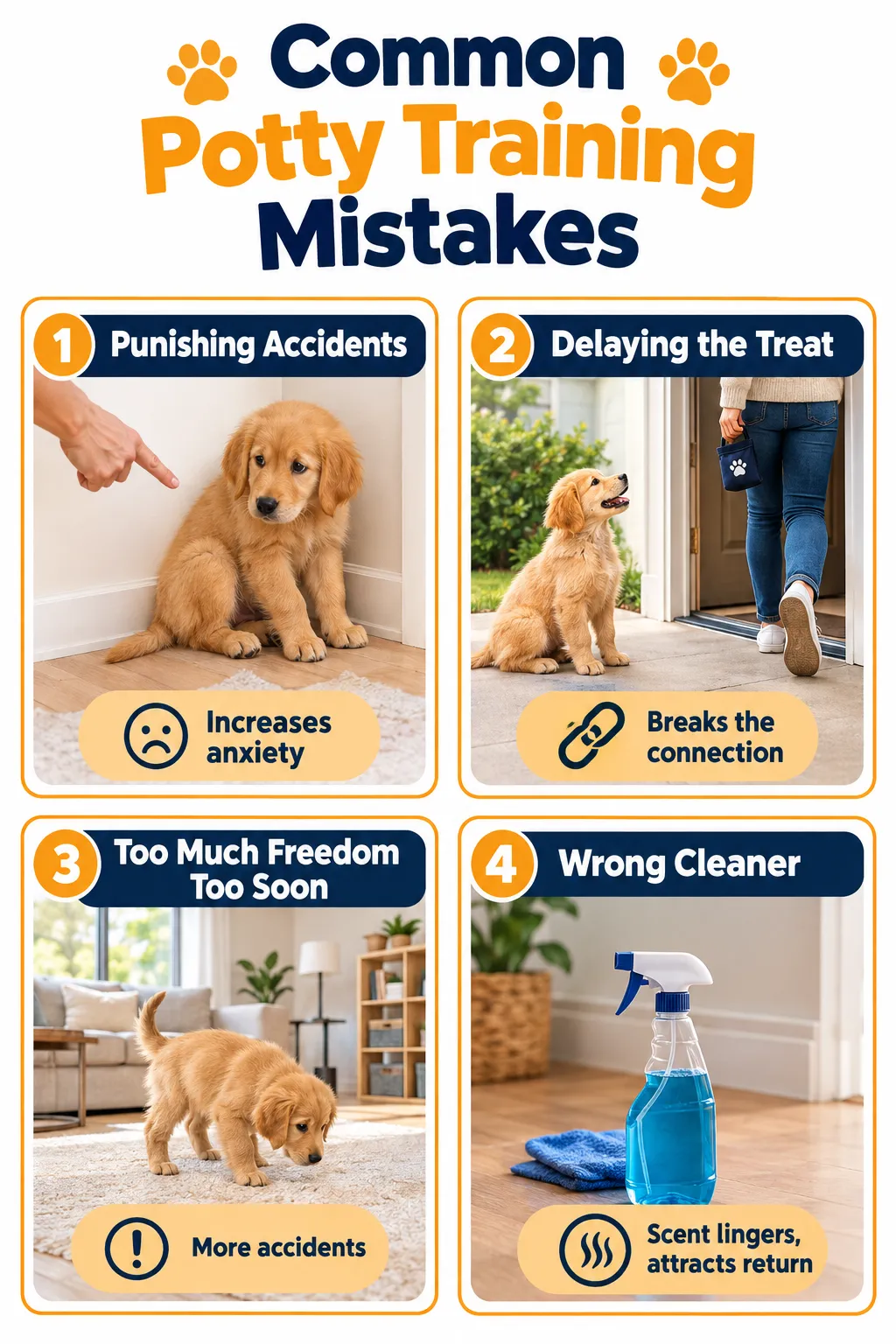
Top mistakes to avoid:
- Punishing accidents – Scolding or rubbing a puppy’s nose in an accident creates anxiety and teaches them to hide when they need to go, not to go outside. Clean it up and move on.
- Giving too much freedom too soon – One accident-free day doesn’t mean the puppy is trained. Expand freedom gradually over weeks.
- Delaying the reward – Treating indoors instead of outdoors breaks the learning connection.
- Using the wrong cleaner – Regular household cleaners don’t remove the scent compounds that attract puppies back to the same spot.
- Inconsistent exit door – Using multiple doors confuses the puppy. Pick one door and use it every time for the first few weeks.
For a broader look at what not to do, this list of 15 terrible dog training mistakes is worth a read before you start.
Is Potty Training Harder With Golden Retrievers Than Other Breeds
Golden retrievers are actually one of the easier breeds to potty train. They’re eager to please, food-motivated, and respond well to positive reinforcement.
The main challenge is their slow physical maturity. Golden retrievers take longer to develop full bladder control compared to some smaller breeds, so owners need to stay patient and keep the schedule consistent longer than they might expect.
Compared to breeds like French bulldogs or dachshunds, golden retrievers typically pick up the routine faster once the schedule is in place. See how French bulldog potty training compares if you’re curious about breed differences.
How Do I Handle Nighttime Potty Training With a Puppy
For puppies under 12 weeks, plan one middle-of-the-night outing about 4 hours after bedtime. Puppies this age physically cannot hold their bladder through a full 8-hour night.
Nighttime routine that works:
- Pick up water 1-2 hours before bed
- Take your puppy out immediately before putting them in the crate for the night
- Set an alarm for roughly 4 hours after bedtime
- Keep the nighttime trip calm and boring – no play, no big greetings
- Put the puppy straight back in the crate after they go
First-year golden retriever puppy care from Raising a Golden stresses keeping nighttime outings low-key so the puppy learns that nighttime is for sleeping, not playing.
If your puppy is struggling to settle in the crate at night, see how to stop a puppy from crying in the crate at night for specific strategies.
What Do I Do If My Puppy Won’t Go to the Bathroom Outside
Stay outside longer and stay boring. Some puppies get distracted by sights, sounds, and smells and forget why they’re out there.
What to do:
- Give your puppy 5-10 minutes in the designated spot before giving up
- Walk a small, consistent loop rather than standing still – movement stimulates elimination
- Say your cue word once, then wait quietly
- If nothing happens after 10 minutes, go back inside and watch your puppy closely for the next 15 minutes, then try again
Don’t let your puppy roam freely indoors after a failed outdoor trip. Keep them on leash or in the crate until the next attempt. Puppies often go within minutes of coming back inside if they weren’t ready outside – and that’s how accidents happen.
How Long Does It Usually Take to Potty Train a Golden Retriever
Most golden retrievers show clear progress within the first 7 days and reach reliable house training within 4-8 weeks. Some puppies take up to 6 months to be fully accident-free, especially if training was inconsistent early on.
Factors that speed things up:
- Starting at 8 weeks with a consistent schedule
- Using a correctly sized crate
- Rewarding immediately and consistently outdoors
- Keeping a log and adjusting the schedule after any accident
Factors that slow things down:
- Inconsistent schedules or multiple caregivers using different rules
- Too much indoor freedom too early
- Incomplete odor removal after accidents
FAQ
At what age can a golden retriever puppy sleep through the night without a bathroom break?
Most golden retriever puppies can sleep through the night without a trip outside by around 12-16 weeks, once their bladder control has developed enough to hold for 6-8 hours.
How many times a day should I feed my puppy to help with potty training?
Three meals a day at consistent times makes elimination more predictable. Feeding at the same times each day means you’ll know roughly when your puppy will need to go out.
Should I use a bell for potty training?
Bell training (hanging a bell on the door for the puppy to ring) works well for some dogs and can be added after the basic outdoor routine is established – usually around weeks 3-4.
What if I work full time – can I still potty train my puppy?
Yes, but you’ll need help. A dog walker, neighbor, or puppy daycare can cover midday trips. Puppies under 12 weeks need a break every 1-2 hours, so solo full-time work without coverage will lead to setbacks.
Is it okay to scold my puppy for accidents?
No. Punishment after the fact doesn’t work because puppies can’t connect the scolding to something that happened even 30 seconds ago. Clean the spot, adjust your schedule, and move on.
What’s the best crate size for a golden retriever puppy?
For an 8-week-old golden retriever, a crate around 24-30 inches is appropriate. If you buy a larger crate for the adult dog, use a divider to keep the puppy’s space small enough that they won’t use one corner as a bathroom.
Can I use the same potty spot every time?
Yes, and it actually helps. Residual scent from previous trips signals to your puppy that this is the right place to go, which speeds up elimination on each outing.
My puppy goes outside and then has an accident 10 minutes later indoors. Why?
This usually means the puppy didn’t fully empty their bladder outside. Stay out longer and wait for a complete elimination before coming inside.
Do golden retrievers regress after being trained?
Temporary regression is common during major changes – a new home, a new family member, illness, or a change in schedule. Go back to basics with the original schedule and it typically resolves within a week.
Is positive reinforcement the only method that works?
For golden retrievers, yes – it’s by far the most effective approach. This breed responds extremely well to reward-based training and poorly to correction-based methods.
Conclusion
Potty training a golden retriever puppy comes down to three things: a tight schedule, immediate rewards, and zero unsupervised indoor time in the first week.
Start the day your puppy comes home. Take them out every 45-60 minutes, reward the moment they finish outside, and use an enzymatic cleaner on every accident. Keep a simple log so you can spot patterns and adjust.
Your action steps for this week:
- Set phone alarms for every 60 minutes during waking hours
- Pick one exit door and one outdoor spot – use them every time
- Buy enzymatic cleaner before your puppy comes home
- Prepare small, high-value treats and keep them by the door
- Start a simple accident log in your phone
If you want to build on this foundation, the 15 puppy potty training tips that actually work is a great next read. And if you’re working on other behaviors at the same time, the first week with a new puppy survival guide will help you manage everything without burning out.
Consistency beats perfection every time. Stick with the routine, stay patient, and your golden retriever will get there.