Last updated: November 13, 2026
Quick Answer
Dogs aren’t drawn to Christmas lights because they find them pretty. They’re reacting to motion, flicker, and the sudden appearance of new objects hanging at nose and paw height. Most dogs see blinking lights as moving targets worth investigating, not as a sparkly holiday display, and that curiosity is exactly what can lead to chewed cords, tangled leashes, or worse.
Key Takeaways
- Dogs see Christmas lights mostly as movement and flicker, not as the colorful scene humans enjoy.
- Dog color vision is limited to blues, yellows, and grays, so reds and greens look muted or brownish to them.
- Curiosity about new, dangling, moving objects, not a love of light itself, explains most of the obsession.
- Chewed cords carry a real risk of electric shock and burns, so damaged wires need immediate attention.
- LED lights run cooler and at lower voltage, making them a safer pick than old-style incandescent strings.
- Not every dog reacts the same way; puppies, herding breeds, and high-prey-drive dogs tend to fixate more.
- Keeping cords hidden, lights mounted high, and dogs supervised near the tree prevents most holiday mishaps.
- Staring at blinking lights for long stretches isn’t typically harmful, but anxious or obsessive fixation is worth watching.
What do dogs actually see when they look at Christmas lights?
Dogs see Christmas lights as patches of brightness and movement rather than a detailed, colorful picture. Their eyes are built for detecting motion and low light, not for picking apart fine color or sharp detail the way human eyes do.
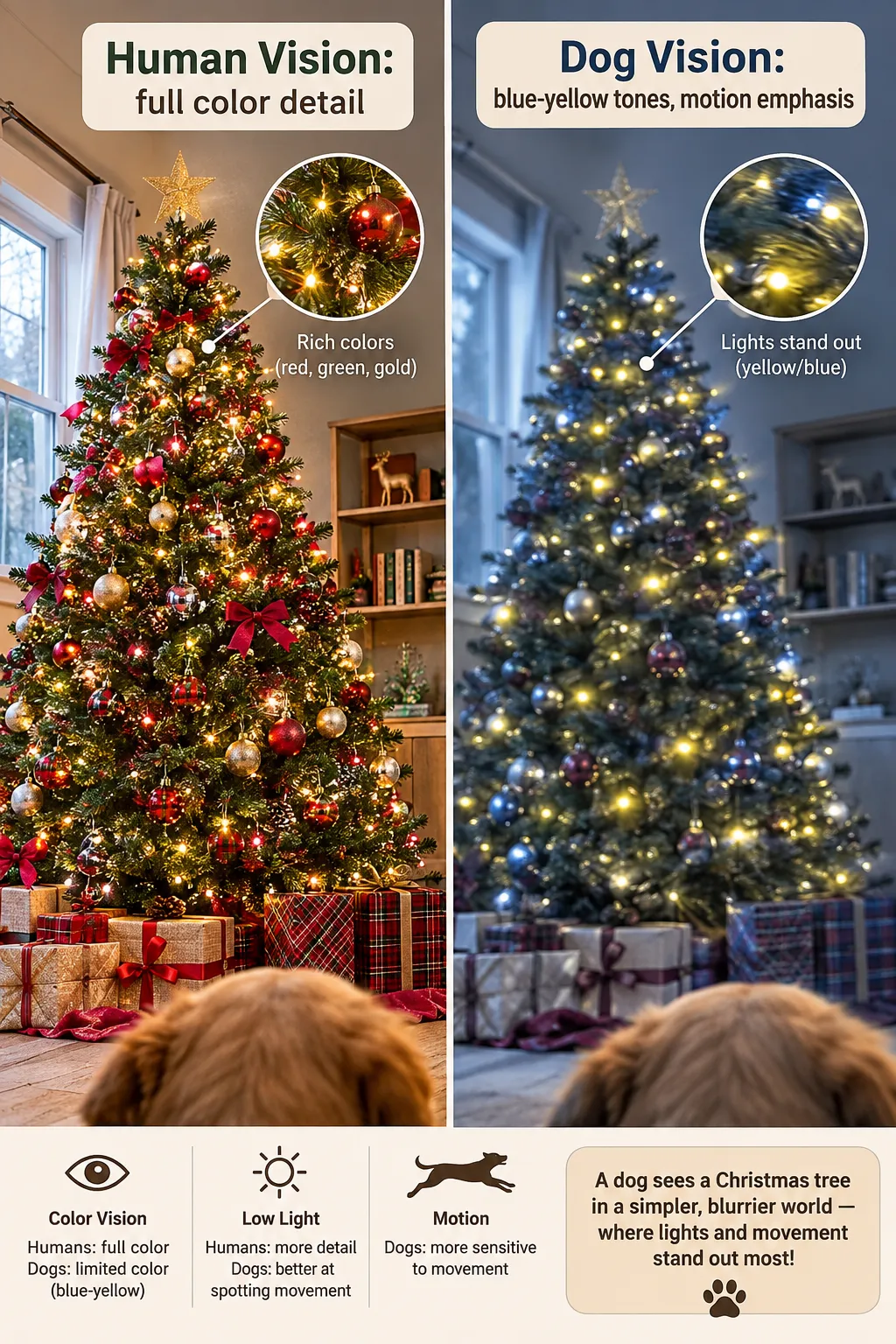
A dog’s retina has fewer cone cells than ours, which means less color sharpness and less fine detail overall. What a dog notices first is the flicker pattern, not the string of red and gold bulbs you just hung.
That’s part of why a twinkling light display can grab a dog’s attention faster than a steady porch light. The on-off rhythm reads as something alive or moving, which is worth a sniff or a bark in dog logic.
Why are dogs attracted to moving and blinking lights?
Dogs are wired to notice motion because their ancestors relied on spotting movement to find prey or sense danger. A blinking light taps into that same instinct, even though there’s nothing to chase.
This is the same reflex that makes dogs chase laser pointers or snap at shadows. The brain registers movement first and asks questions later.
- Flicker mimics prey movement: quick on-off patterns resemble the darting motion of small animals.
- Novelty matters: a newly decorated tree or porch is full of objects that weren’t there yesterday.
- Reflections and shadows: lights bouncing off tinsel or windows add extra visual noise dogs want to investigate.
Choose to expect more fixation if you have a herding breed, terrier, or any dog with a strong prey drive. Those breeds are built to react to motion, and blinking lights are an easy trigger.
Can Christmas lights hurt my dog’s eyes or vision?
Standard Christmas lights don’t damage a dog’s eyes under normal viewing conditions. There’s no vet-backed evidence that watching blinking lights causes vision problems in healthy dogs.
The real risks around lights aren’t visual, they’re physical: chewed cords, burns, and swallowed glass or plastic from broken bulbs. If your dog has sensitive eyes already, from allergies or an existing eye condition, intense strobing displays might cause mild irritation or stress, but this is more about behavior than injury to the eye itself.
What colors can dogs see in Christmas decorations?
Dogs see a narrower color range than people do, limited mostly to blues, yellows, and shades of gray. Classic holiday reds and greens often look dull, brownish, or gray to a dog’s eyes.
This happens because dogs have two types of color-detecting cone cells instead of the three humans have. It’s similar to red-green color blindness in people.
| Color in the display | What you see | What your dog likely sees |
|---|---|---|
| Red string lights | Bright red | Dull brownish-gray |
| Green tree | Rich green | Grayish or yellowish |
| Gold ornaments | Warm gold | Pale yellow |
| Blue lights | Vivid blue | Vivid blue, closest match |
So if you want a display your dog actually notices as colorful, blue and white lights stand out more to canine eyes than a red and green combo.
How do I keep my dog safe around Christmas lights and wires?
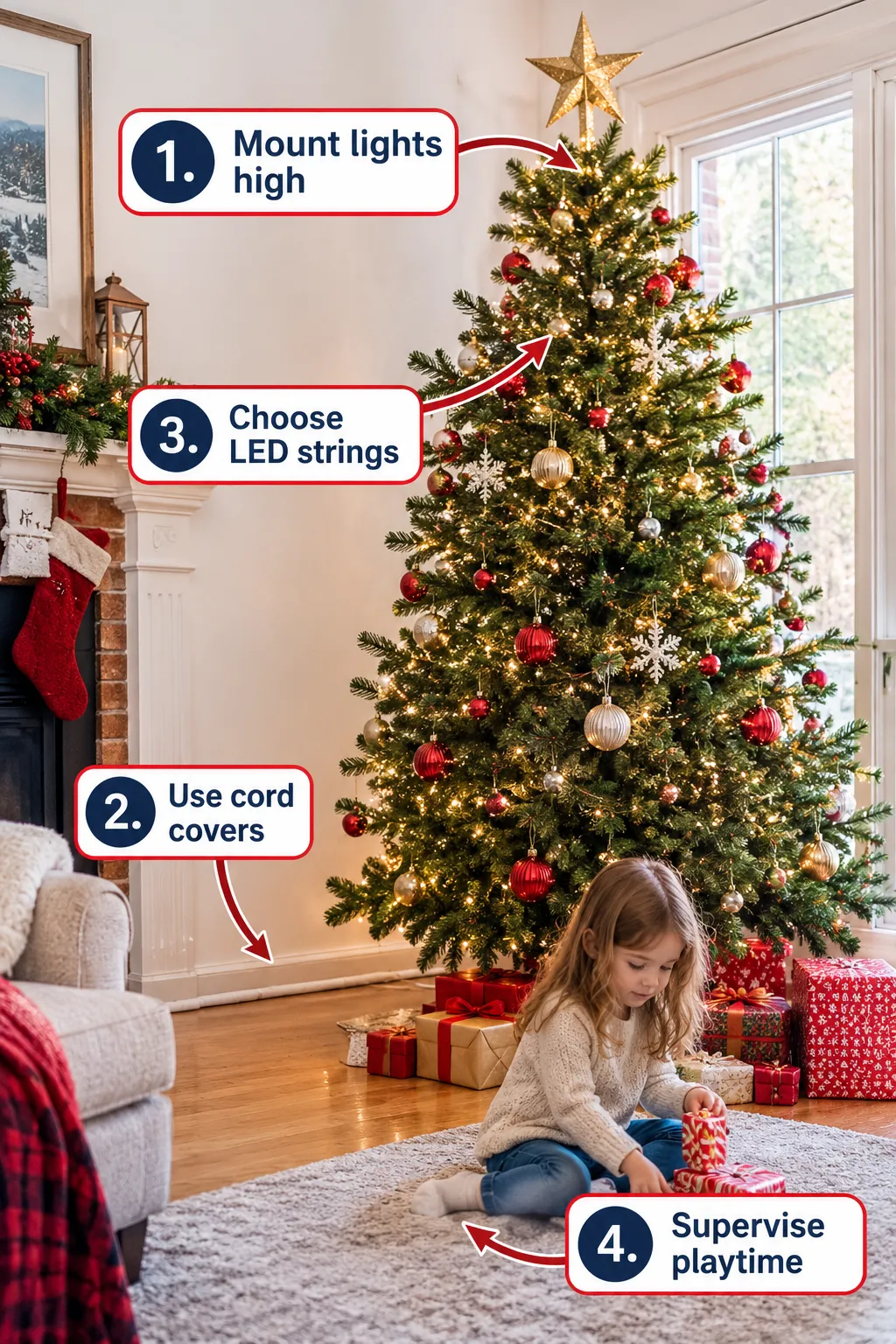
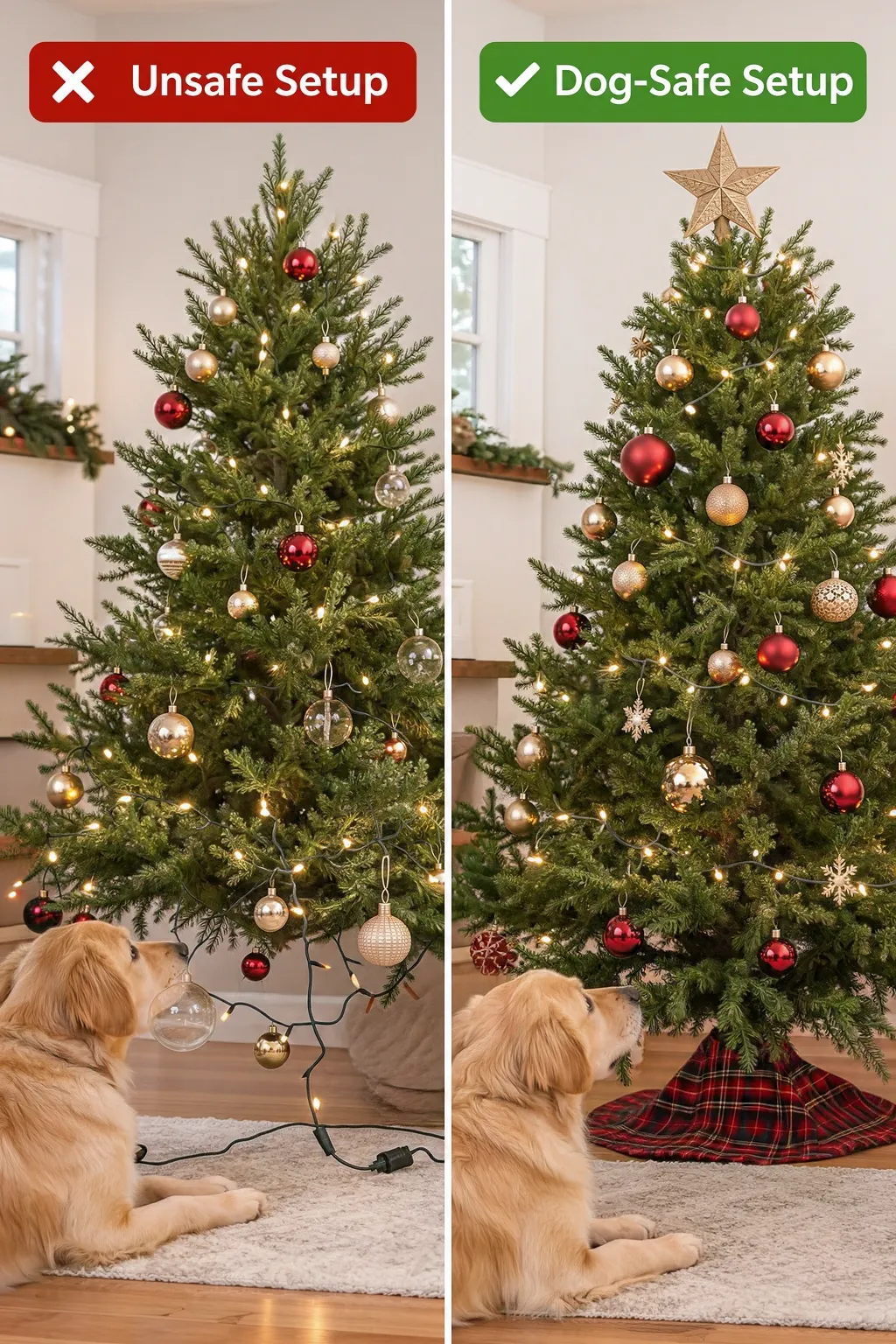
Keep cords out of paw and mouth reach, use cord protectors, and never leave a dog unsupervised near a lit tree for long stretches. These are the same baseline precautions pet safety groups have repeated for years, and they still hold up.
Practical steps that work:
- Run cords along walls, not across open floor space where a dog can trip or chew.
- Use cord covers or PVC sleeves to add a physical barrier between teeth and wire.
- Mount lower branches’ lights higher on the tree, out of casual nose range.
- Unplug lights when you leave the room, especially overnight.
- Check for frayed or chewed sections daily during the season.
The Purina guide to Christmas safety and ASPCA’s holiday safety tips both flag cords and lights as top-tier hazards worth planning around before decorating starts. If you’re setting up a tree for the first time with a dog in the house, our dog-safe Christmas tree setup guide walks through placement and anchoring in more detail.
Is it bad for dogs to stare at blinking lights for a long time?
Occasional staring at blinking lights isn’t harmful for most dogs. It becomes a concern only if the fixation turns into repetitive, anxious behavior that your dog can’t be redirected from.
Short bursts of curiosity are normal. Watch for a different pattern though: pacing, whining, or an inability to settle unless they’re near the lights. That kind of obsessive behavior is less about the lights and more about underlying anxiety, and it’s worth mentioning to your vet.
Edge case: dogs with a history of compulsive behaviors, like excessive tail chasing or shadow chasing, may be more prone to fixating on strobing lights specifically. If you already know your dog has this tendency, skip the blinking setting and use steady-glow lights instead.
Do all dogs like Christmas lights, or just some breeds?
Not all dogs care about Christmas lights, and reaction depends heavily on individual temperament and breed background. Herding breeds, terriers, and dogs with high prey drive tend to notice and react to blinking lights more than laid-back breeds.
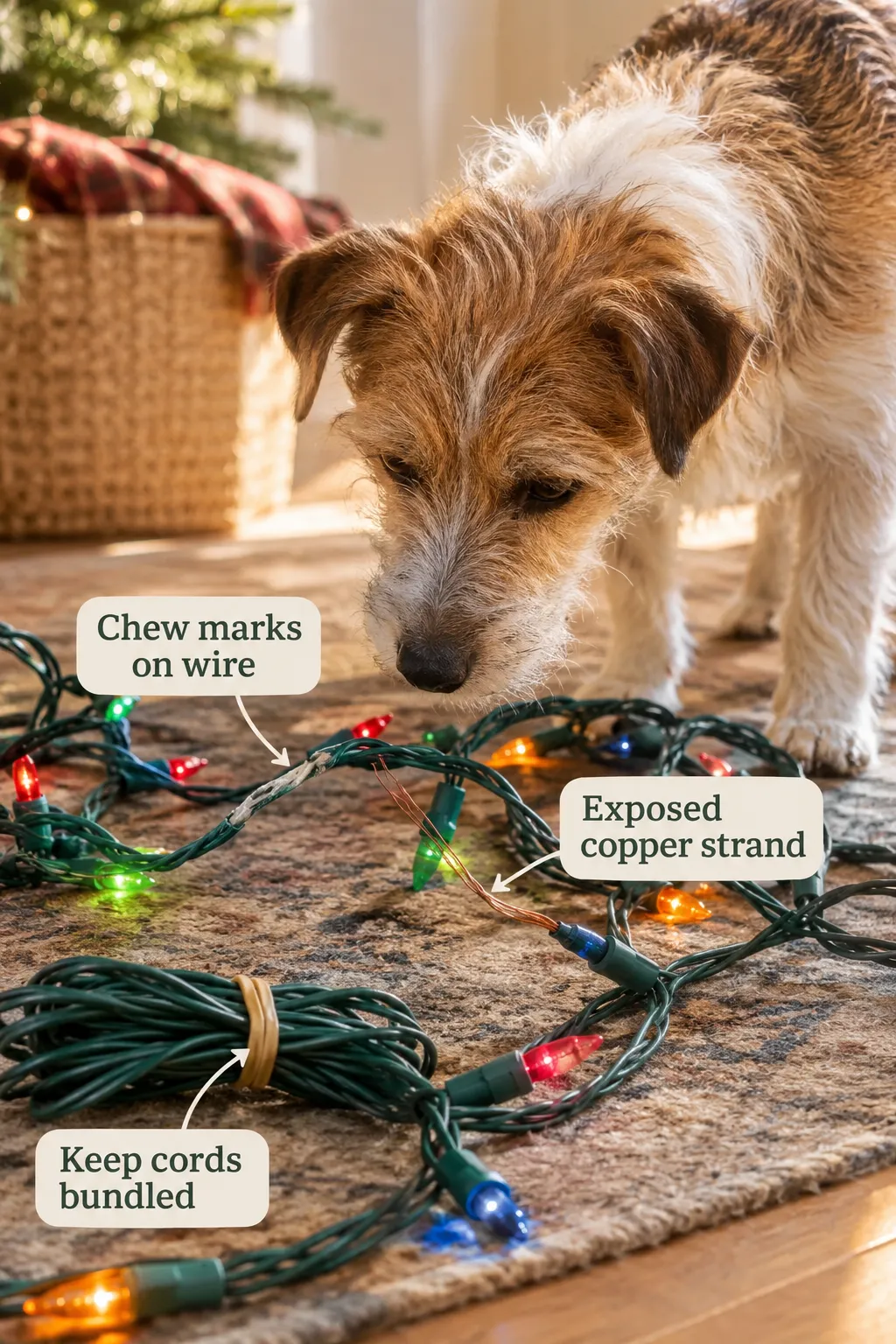
- More likely to fixate: Border Collies, Australian Shepherds, Jack Russell Terriers, and other motion-driven breeds.
- Usually indifferent: many senior dogs, calmer large breeds, and dogs with lower visual acuity due to age.
- Puppies: almost universally curious about anything new, lights included, simply because everything is new to them.
Choose extra supervision if you own a young, high-energy, or prey-driven dog this season. That combination is the most common one behind tangled cords and chewed wires.
What should I do if my dog tries to chew on Christmas light strings?
Stop the behavior immediately, redirect your dog with a toy or command, and inspect the light strand for damage. Chewed Christmas lights are never safe to leave as-is, since even a small puncture in the wire casing creates a shock risk.
Steps to take right away:
- Say “leave it” or gently remove your dog from the area.
- Check your dog’s mouth for cuts, burns, or loose wire fragments.
- Inspect the chewed section of cord before replugging anything.
- Replace damaged strands rather than trying to repair them.
- Offer an appropriate chew toy as a substitute; our guide on keeping your dog occupied with toys has ideas that hold attention longer than a light cord does.
Vet-reviewed holiday guidance is consistent on this point: chewing on lights is never considered safe, and PetMD’s rundown of holiday hazards lists it alongside tinsel and ornament hooks as a recurring emergency-room visitor during December.
Can my dog get electrocuted by playing with light cords?
Yes, a dog biting through a live Christmas light cord can suffer an electrical shock, and in serious cases this can be life-threatening. This is one of the most consistently repeated warnings in current pet safety guidance.
Signs of possible shock injury include:
- Burns or blistering around the mouth or tongue
- Drooling that starts suddenly after chewing
- Difficulty breathing or coughing
- Collapse or disorientation
If you suspect your dog has been shocked, unplug the device first (never touch your dog while the cord is still live), then get to a vet immediately. WSU’s veterinary hospital holiday hazards page and the HSNT holiday entertaining safety post both treat cord-related shock as a top-tier emergency, not a minor scare.
Are LED Christmas lights safer for dogs than regular lights?
Yes, LED lights are generally the safer choice because they run cooler and typically operate at lower voltage than older incandescent strings. Less heat means less risk of burns if a dog mouths a bulb, and lower voltage reduces shock severity if a cord is damaged.
| Feature | LED lights | Incandescent lights |
|---|---|---|
| Heat generated | Low | Higher |
| Typical voltage | Lower | Higher |
| Burn risk if chewed | Lower | Higher |
| Shock risk if cord damaged | Lower, still present | Higher |
LED doesn’t mean risk-free though. A dog can still get shocked by a damaged LED cord, and broken LED bulbs can still have small sharp pieces. Chewy’s dog-friendly Christmas lights guide recommends LED as the default pick specifically for this reason, paired with the same cord-management basics regardless of bulb type.
Why does my dog bark or go crazy around the Christmas tree?
Dogs often react strongly to a Christmas tree because it’s an unfamiliar object suddenly placed in their territory, covered in new smells, textures, and moving parts. Barking, circling, or jumping at the tree is usually excitement or alertness, not aggression.
Common triggers:
- New scents from pine needles, packaging, or store display areas
- Hanging ornaments that sway and catch light
- Unfamiliar shapes in a space the dog knows well
- Other people’s excitement rubbing off on the dog
If this bothers your household, give your dog a few calm, supervised minutes near the tree before decorating it fully. That slow introduction tends to reduce the “what is that thing” reaction. For general calming strategies during busy holiday weeks, our guide to keeping your dog calm around visitors covers techniques that also help around a newly decorated tree.
How can I decorate my house safely if my dog loves chasing lights?
Decorate with placement and containment in mind first, and accept that a highly motion-driven dog may need a modified setup rather than a standard one. The goal is to keep the fun of lights without the risk.
Practical approach:
- Hang lights starting higher up the tree or wall, out of jumping range.
- Use battery-powered or low-voltage outdoor lights where possible.
- Keep a baby gate or pen around the tree if your dog is a known chaser.
- Give your dog an approved activity during decorating time so lights aren’t the only stimulation on offer; our list of activities for bored dogs has options that double as distraction during setup.
- Consider steady-glow rather than rapid-flash settings for dogs that fixate hard on motion.
Example: a friend of mine has a Border Collie mix who treats every blinking light like a squirrel. She switched her porch lights to a steady setting and moved the tree lights up two feet. The chasing basically stopped within a week.
What are signs my dog has eaten part of a light string?
Watch for vomiting, drooling, pawing at the mouth, or visible plastic or wire fragments in stool as signs your dog may have swallowed part of a light string. Any of these warrants a call to your vet, especially if you know a piece is missing from a strand.
Other signs to watch for:
- Lethargy or sudden loss of appetite
- Gagging or repeated swallowing
- Visible cuts inside the mouth
- Choking sounds or distress
If your dog seems to be choking rather than just having swallowed something, knowing the basics of the Heimlich maneuver for dogs can buy you critical time on the way to the vet. Glass ornaments and certain decorative items can also contain chemicals like ethylene glycol in some products, which Admiral’s pet Christmas safety guide flags as a serious internal risk if ingested, separate from the choking hazard itself.
Is it normal for puppies to be obsessed with Christmas decorations?
Yes, it’s completely normal for puppies to be fascinated by Christmas decorations. Everything in a puppy’s world is new, and a tree covered in dangling, shiny, moving objects is basically a giant toy from their point of view.
This is a developmental stage, not a behavior problem. Puppies explore with their mouths, so expect more chewing attempts than you’d see from an adult dog.
- Keep the lowest third of the tree bare or covered.
- Supervise closely during the first week after decorating.
- Redirect constantly rather than expecting the puppy to self-regulate.
- Reassess safety measures as the puppy grows and can reach higher.
Local animal control advisories, including guidance echoed by AVMA’s holiday pet safety page, consistently note that puppies and young dogs account for a disproportionate share of holiday decoration incidents, simply because curiosity and mouthing peak in that age group.
Conclusion
Dogs don’t like Christmas lights because they find them beautiful. They like them because lights move, flicker, and show up in places they weren’t before, and that’s enough to trigger a dog’s natural curiosity and prey instinct.
The fun part is harmless. The risk comes from cords, chewed wires, and small swallowed pieces, not from the glow itself.
Here’s what I’d actually do this season: switch to LED lights if you haven’t already, run cords along walls instead of the floor, mount the lower third of your tree bare, and keep a close eye on your dog for the first week after decorating. That one week of extra supervision prevents most of the incidents vets see every December.
If you’re planning other dog-friendly holiday touches this year, our dog-safe Christmas cookie recipes and 17 dog-friendly Christmas activities are good next stops for making the season fun without the stress.