

Last updated: August 22, 2026
Quick Answer: IVDD in French Bulldogs is a spinal condition where the cushioning discs between vertebrae break down and press on the spinal cord. French bulldogs are genetically predisposed to it, and the earliest signs are often subtle – things like hesitating before jumping or yelping when touched. Catching these signs early gives your dog a much better chance of a full recovery.
Key Takeaways
- French bulldogs have a significantly higher IVDD risk than most other dog breeds due to their chondrodystrophic (short-legged, dwarf) genetics
- The 7 early signs most owners miss include reluctance to jump, yelping when touched, hunched posture, wobbly walking, reduced playfulness, guarded resting, and back sensitivity
- IVDD in French bulldogs is graded on a scale of 1-5; early grades respond well to conservative treatment
- Surgery is most effective when performed within 48 hours of severe symptom onset
- Crate rest, medications, and rehabilitation are the core non-surgical treatment options
- Dogs treated at early stages have a much higher chance of getting better than those treated late
- Preventing IVDD involves weight management, avoiding high-impact jumps, and using ramps or steps
- Southeast veterinary neurology specialists can provide MRI-guided diagnosis and surgical care
What Is IVDD in Dogs?
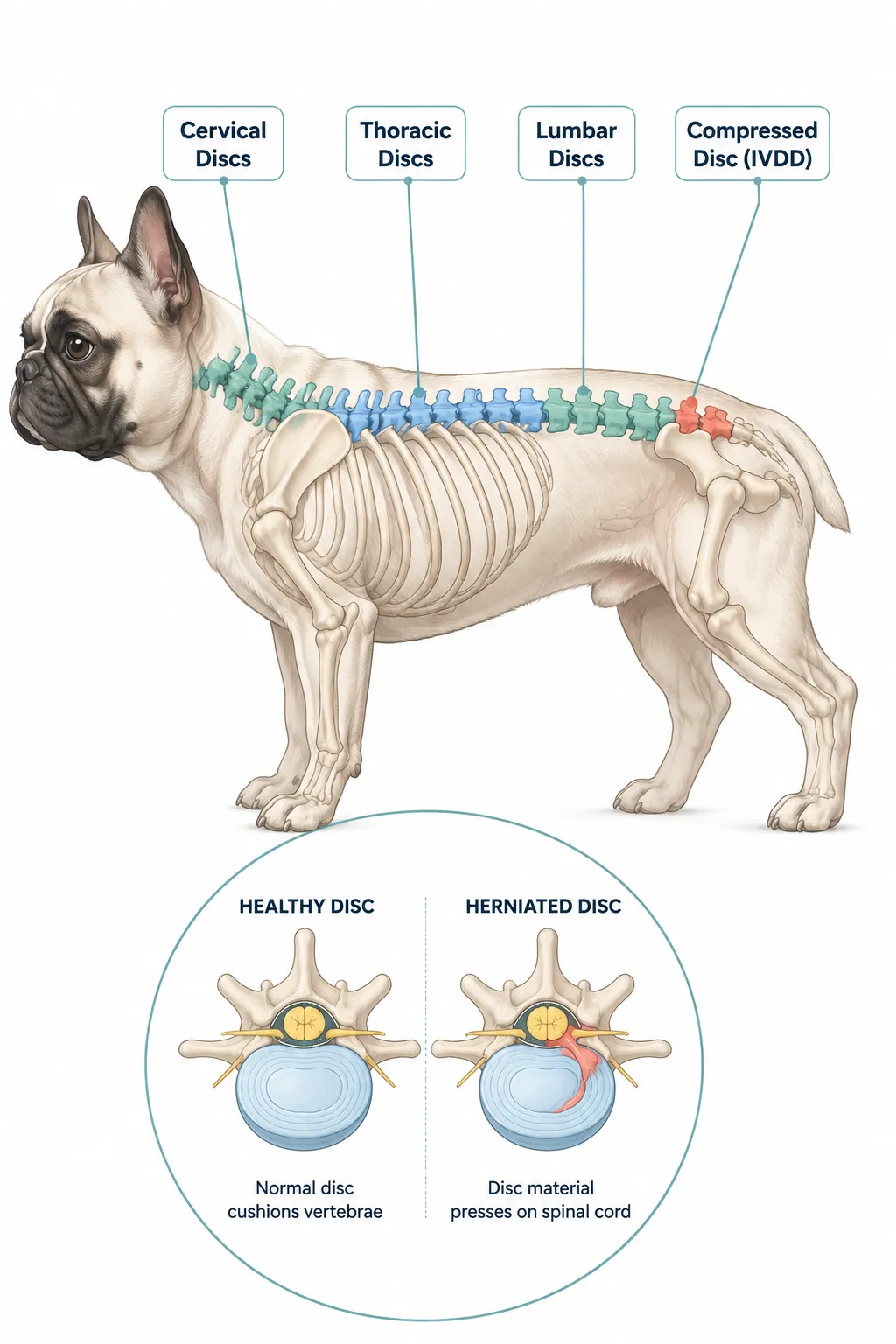
Intervertebral disc disease (IVDD) is a condition where the soft, jelly-like discs between the spinal vertebrae degenerate, bulge, or rupture, pressing against the spinal cord or nerve roots. This compression causes pain, weakness, and in severe cases, paralysis.
There are two main types. Type I IVDD involves sudden disc rupture – common in French bulldogs. Type II involves slower, gradual disc bulging. According to breed health research on French Bulldog IVDD, IVDD is one of the most frequently reported health conditions in the breed.
The spinal cord damage can range from mild discomfort to complete loss of function in the limbs, depending on how much pressure builds up and how quickly it’s treated.
Why Are French Bulldogs Prone to IVDD?
French bulldogs are a chondrodystrophic breed, meaning they carry a gene mutation that causes abnormal cartilage development. This same gene that gives them their compact, adorable build also causes their spinal discs to age and calcify far earlier than in other dogs.
According to research published in Frontiers in Veterinary Science, chondrodystrophic breeds like French bulldogs experience disc degeneration starting as early as 1-2 years of age. By the time a Frenchie is middle-aged, multiple discs may already be compromised.
Other at-risk breeds include Dachshunds, Beagles, Corgis, and Basset Hounds – but French bulldogs also have a compressed spinal canal, which leaves even less room for a bulging disc before symptoms appear.
Key risk factors for IVDD in French bulldogs:
- Chondrodystrophic genetics
- Compact spinal structure with narrow canal
- Overweight body condition
- Repetitive high-impact activity (jumping on/off furniture)
- Age (most cases occur between 3-7 years)
7 Early Signs of IVDD in French Bulldogs Most Owners Miss
The earliest symptoms of IVDD in French bulldogs are easy to dismiss as “just being tired” or “having an off day.” But these 7 signs, spotted early, can be the difference between a simple recovery and a life-altering outcome.
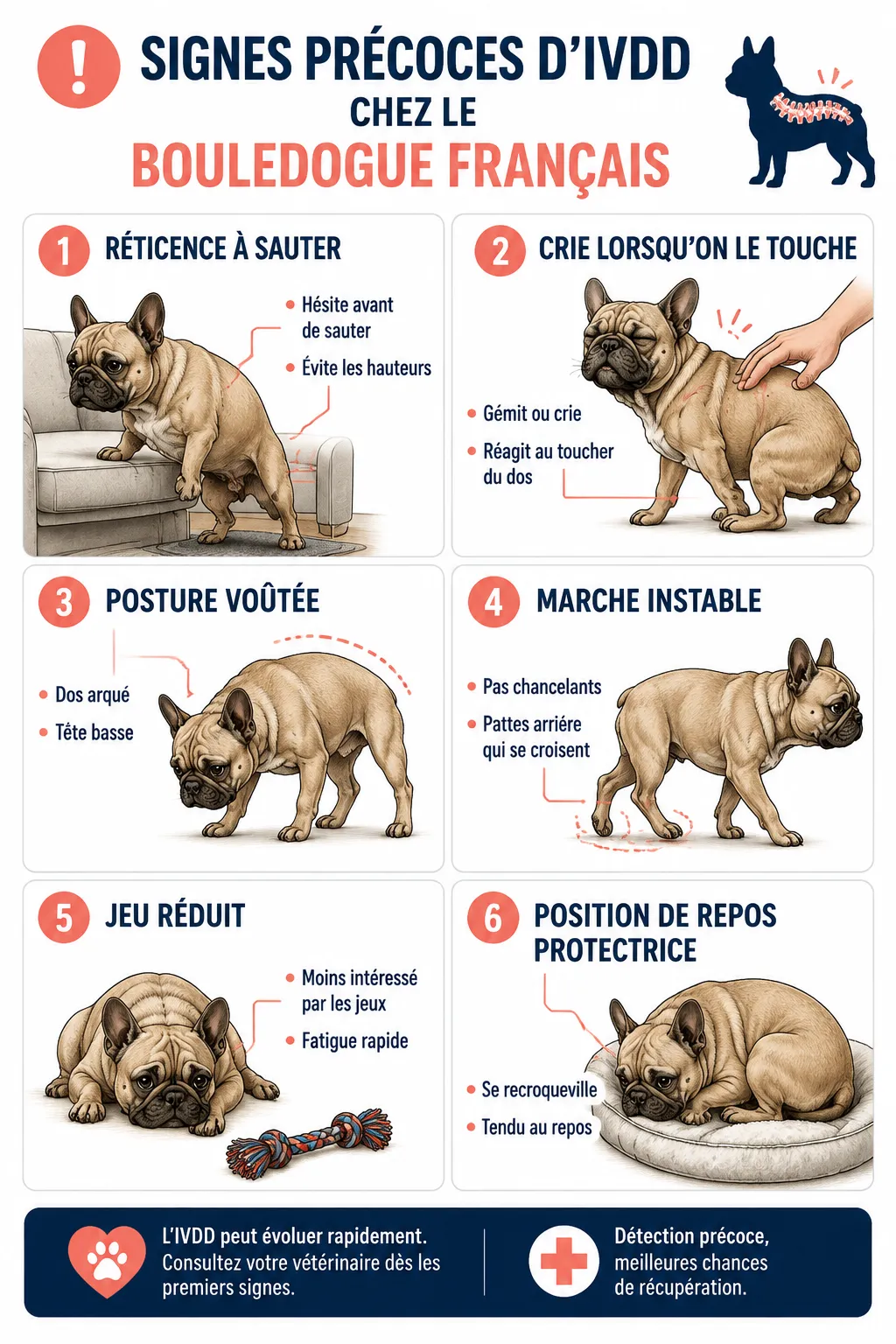
According to detailed IVDD sign guides for French Bulldog owners, the subtle behavioral changes below are the ones most owners overlook:
1. Reluctance to Jump
Your French bulldog suddenly hesitates before jumping onto the sofa or into the car. This isn’t laziness – it’s a sign the dog feels pain when loading the back or neck.
2. Yelping or Flinching When Touched
A dog with early IVDD may yelp, flinch, or snap when you touch along the spine, even lightly. This is one of the clearest early pain signals, per IVDD symptom research on French bulldogs.
3. Hunched or Stiff Posture
Watch for a dog that holds its head lower than normal, arches its back, or moves with unusual stiffness. This guarded posture is the dog’s way of protecting a painful spinal area.
4. Walking Wobbly or “Bunny Hopping”
Instead of a normal stride, some French bulldogs with early IVDD begin crossing their hind legs, walking wobbly, or hopping with both back legs together. This signals spinal cord compression affecting the limbs.
5. Reduced Enthusiasm for Play
A previously energetic Frenchie that suddenly seems uninterested in walks or play isn’t just moody. Pain along the back or neck can make movement feel threatening. Check our guide on 10 early signs of pain in dogs for more context.
6. Guarded or Tense Resting Position
Dogs with early disc disease often rest in unusual positions – lying very still, avoiding certain postures, or seeming unable to get comfortable.
7. Irritability When Picked Up
If your French bulldog growls or snaps when you pick them up along the torso, that’s a red flag. Spinal pain makes handling uncomfortable, and dogs communicate that the only way they can.
💡 If your Frenchie shows 2 or more of these signs, don’t wait. Contact your vet the same day.
You might also want to read about 12 stressed dog signs most owners miss – some IVDD symptoms overlap with stress signals.
How Is IVDD Diagnosed in Dogs?
A vet diagnoses IVDD through a combination of neurological examination, imaging, and symptom history. The most accurate tool is an MRI scan, which shows exactly which disc is affected and how severely.
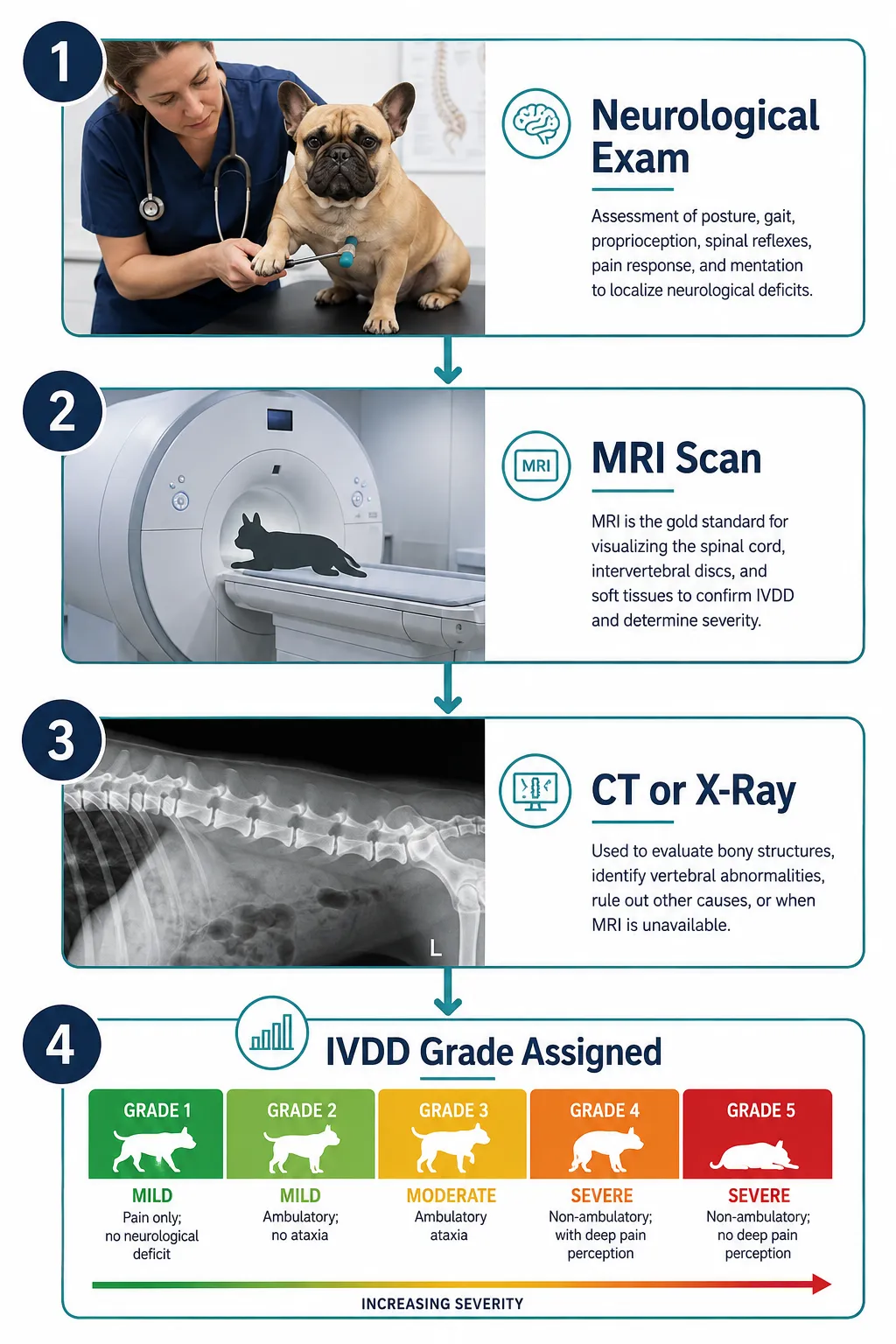
According to Southeast Veterinary Neurology’s French Bulldog IVDD guide, the diagnostic process typically follows these steps:
- Neurological exam – Testing reflexes, pain response, and limb coordination
- X-ray or CT scan – Can show calcified discs but misses soft tissue detail
- MRI scan – Gold standard; shows disc herniation, cord compression, and severity
- IVDD grade assignment – Graded 1 to 5 based on symptom severity
Grades 1-3 often respond to conservative treatment. Grades 4-5 typically require surgery. The grade also determines the dog’s chance of getting better.
To diagnose IVDD accurately, your vet may refer you to a veterinary neurology specialist, particularly if MRI is needed.
IVDD Treatment Options for French Bulldogs
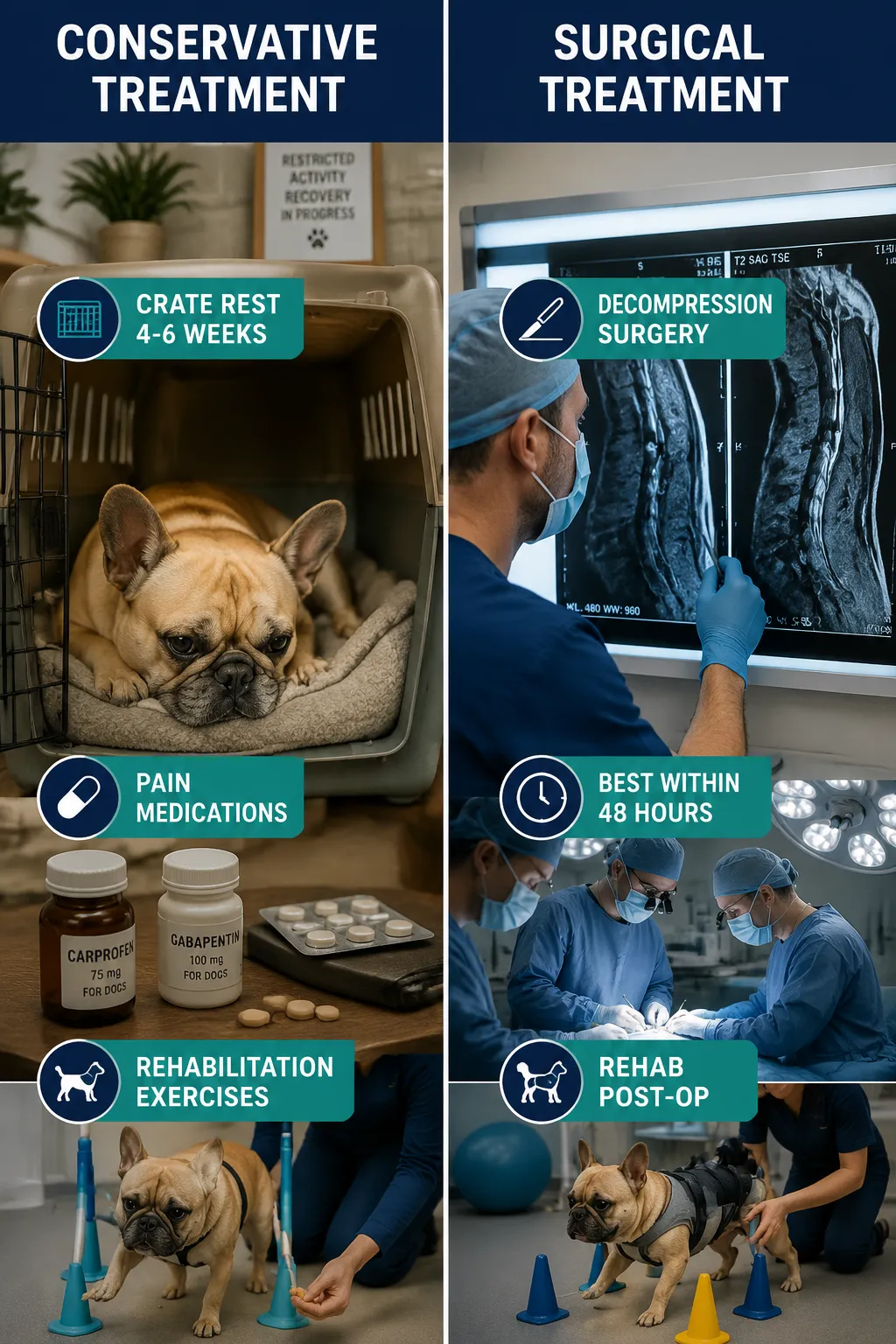
Treatment for IVDD in French bulldogs depends on the grade of the disease. There are two main paths: conservative management and surgery.
Crate Rest and Medications
For mild to moderate cases (Grades 1-3), the treatment option is strict crate rest combined with medications. This means 4-6 weeks of very limited movement – no stairs, no jumping, no running.
Medications typically include anti-inflammatory drugs, pain relievers, and sometimes muscle relaxants. According to brachydog care’s French Bulldog IVDD overview, crate rest is non-negotiable – even a dog that “seems fine” can worsen dramatically without it.
Surgery
Surgery is recommended for Grades 3-5, or when conservative treatment fails. The most common procedure is a hemilaminectomy, where a surgeon removes the disc material pressing on the spinal cord.
Vet4Bulldog’s IVDD guide notes that surgery is most effective when performed within 48 hours of severe symptom onset. Dogs that are unable to walk but still feel deep pain have a roughly 80-95% chance of recovery with prompt surgery.
Advantages of surgery:
- Faster recovery for severe cases
- Removes the source of compression directly
- Reduces risk of permanent cord damage
Disadvantages of surgery:
- Higher cost (often $3,000-$8,000 depending on location and specialist)
- Anesthesia risk, especially in brachycephalic dogs like French bulldogs
- Requires post-op rehabilitation
Rehabilitation
Rehabilitation is a key part of recovery for both surgical and non-surgical cases. Canine rehabilitation – sometimes called dogs in motion canine rehabilitation – includes hydrotherapy, massage, laser therapy, and targeted exercises to rebuild strength in the limbs.
Facilities like those offering southeast veterinary neurology services often partner with rehabilitation centers for comprehensive post-treatment care. You can also read about 9 signs of arthritis in dogs since rehab overlaps for both conditions.
What Is the Likelihood of Successful Treatment for IVDD in French Bulldogs?
The chance of getting better depends heavily on the IVDD grade at the time of treatment and how quickly care begins. Dogs treated at Grade 1 or 2 have an excellent prognosis with conservative management alone.
According to PetsWellness’s French Bulldog IVDD resource, recovery rates by grade look roughly like this:
| IVDD Grade | Main Symptoms | Recovery Chance (with treatment) |
|---|---|---|
| Grade 1 | Pain only | ~95% with rest and medications |
| Grade 2 | Wobbly walking | ~85-90% |
| Grade 3 | Unable to walk, feels pain | ~80% with surgery |
| Grade 4 | Unable to walk, reduced sensation | ~50-70% with prompt surgery |
| Grade 5 | Paralysis, no deep pain | ~5-10% even with surgery |
The key takeaway: every French bulldog owner should act fast. Waiting even 24-48 hours at Grade 4 can drop the chance of recovery significantly.
What Do We Mean by “Get Better”?
“Getting better” means the dog regains the ability to walk, control bladder and bowel function, and live a comfortable life. It doesn’t always mean 100% return to pre-IVDD activity levels. Some dogs recover fully; others need ongoing management and lifestyle adjustments.
What Are the Chances of IVDD Happening Again?
IVDD can recur in French bulldogs, especially if the underlying disc degeneration continues. Studies suggest that dogs who have had one IVDD episode have a meaningful risk of a second episode, particularly if lifestyle changes aren’t made.
Preventing IVDD recurrence means keeping your dog at a healthy weight, using ramps instead of letting them jump, avoiding high-impact play, and scheduling regular veterinary check-ins. Understanding and preventing IVDD long-term is about consistent daily habits, not just one-time treatment.
What Is Myelomalacia?
Myelomalacia is a rare but devastating complication of severe IVDD. It occurs when the spinal cord tissue begins to die following a major disc rupture, and it can progress rapidly upward through the cord.
Dogs with Grade 5 IVDD – those that are unable to walk and have lost all deep pain sensation – are at risk. Ello Pet’s comprehensive French Bulldog IVDD guide notes that myelomalacia is unfortunately irreversible and carries a grave prognosis. This is why early diagnosis and treatment are so critical.
Can IVDD in French Bulldogs Be Prevented?
You can’t fully prevent IVDD in French bulldogs because genetics play a major role, but you can significantly reduce the risk and delay onset. Understanding and preventing IVDD starts with managing the factors you can control.
Practical prevention steps:
- Keep your French bulldog at a healthy weight (excess weight stresses the back)
- Install ramps or steps for the sofa and car
- Avoid games that involve high jumping or rough play
- Use a harness instead of a neck collar to reduce spinal stress
- Schedule regular vet check-ups to catch early disc changes
For broader health management tips, see our guide on being a responsible dog owner and daily dog routines for busy owners.
When Should I Take My French Bulldog to the Vet for Back Problems?
Take your French bulldog to the vet the same day if you notice any of the 7 early signs above, especially yelping, wobbling, or reluctance to move. Don’t wait to “see if it improves.”
Go to an emergency veterinary neurology clinic immediately if your dog:
- Suddenly cannot walk or stand
- Is unable to control bladder or bowel
- Shows rapid worsening of symptoms over hours
- Has lost sensation in the back limbs
Time is the single biggest factor in whether a dog with severe IVDD gets better.
FAQ
Can a French bulldog recover from IVDD?
Yes, many French bulldogs recover from IVDD, especially when treatment starts early. Dogs with mild to moderate IVDD (Grades 1-3) have an 85-95% recovery rate with crate rest and medications. Severe cases (Grades 4-5) require surgery, and outcomes depend on how quickly treatment begins and whether deep pain sensation is still present.
What are the first signs of IVDD in French Bulldogs?
The first signs of IVDD in French bulldogs are often subtle: reluctance to jump, yelping or flinching when the back is touched, a hunched or stiff posture, and reduced enthusiasm for play. Some dogs begin walking wobbly or crossing their hind legs. These signs can appear gradually or come on suddenly after a jump or physical activity.
At what age do most Frenchies get IVDD?
Most French bulldogs develop IVDD symptoms between 3 and 7 years of age, though disc degeneration can begin as early as 1-2 years due to their chondrodystrophic genetics. Some Frenchies show signs earlier or later, but middle age is the highest-risk window. Regular vet check-ups from age 2 onward are recommended for early detection.
How long will a dog live with IVDD?
A dog diagnosed with IVDD can live a full, normal lifespan with proper treatment and management. Most dogs with Grades 1-3 recover well and go on to live comfortably for many years. Even dogs that have had surgery typically return to a good quality of life. The key is managing lifestyle factors – weight, activity level, and avoiding re-injury – to reduce the chance of recurrence.
Conclusion
IVDD in French bulldogs is one of the most common and serious health challenges the breed faces – but it’s also one of the most manageable when caught early. The 7 signs covered in this article are the ones most owners overlook until the situation becomes urgent.
Your action plan:
- Learn the 7 early signs and check your dog regularly
- Install ramps or steps to reduce jumping
- Keep your French bulldog at a healthy weight
- Contact your vet the same day if you notice any symptoms
- Ask about a veterinary neurology referral if symptoms are progressing
Early action gives your dog the best chance of getting better and living a long, comfortable life. Don’t wait for the obvious signs – the subtle ones are the ones that matter most.